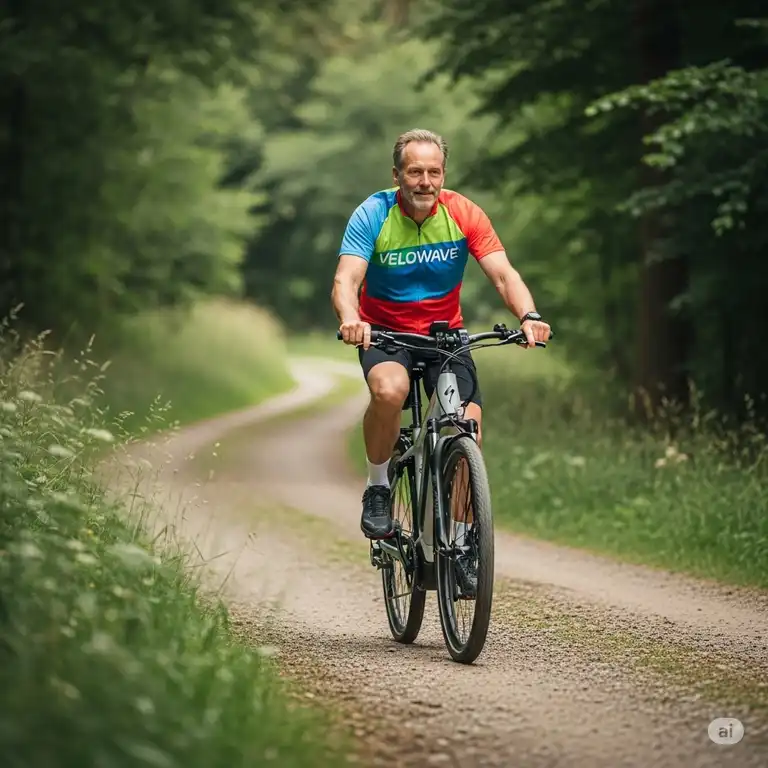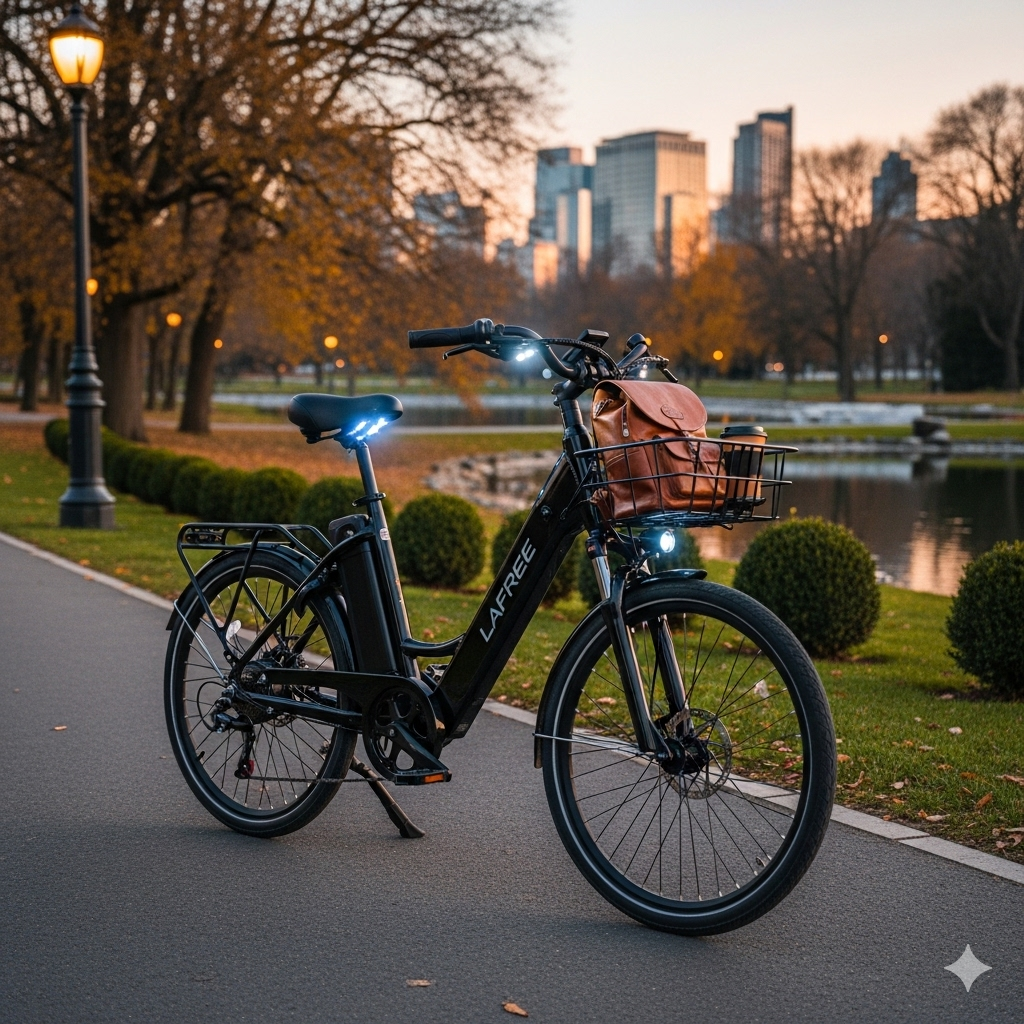
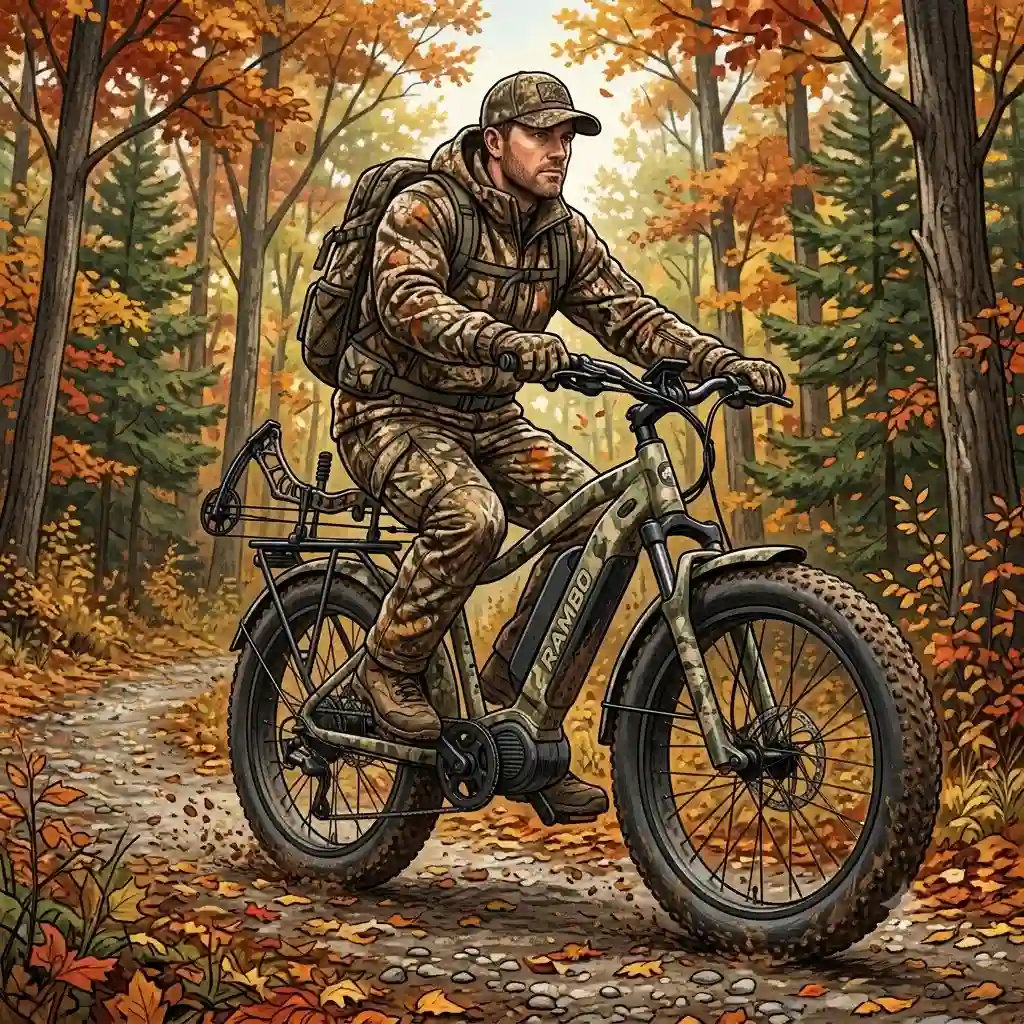
What is a rambo electric bike? At its core, a rambo electric bike is a heavy-duty, off-road electric bicycle engineered specifically for hunters, anglers, and extreme outdoor enthusiasts. Unlike standard commuter e-bikes, these machines utilize high-torque motors, puncture-resistant fat tires, and reinforced aluminum frames designed to silently haul heavy payloads—like camping gear or harvested game—across unforgiving terrain.
If you spend any significant amount of time in the backcountry, you already know the limitations of ATVs: they are loud, they emit exhaust fumes that wildlife can smell a mile away, and they are legally restricted on many public land trails. Over my 10+ years consulting in the outdoor gear industry and testing off-road mobility vehicles, I’ve watched the rambo electric bike transition from a niche luxury to an absolute necessity for serious outdoorsmen.
But here is the harsh reality: the spec sheets on Amazon and manufacturer websites only tell half the story. A 1000W motor sounds impressive until you realize it’s paired with a controller that limits its peak amperage on a steep incline. A massive battery rating doesn’t mean much if the cold weather drains it by 40% before you even reach your tree stand. In this comprehensive 2026 guide, I am going to strip away the marketing hype. We are going to dive deep into my field tests, explore the subtle engineering details most reviewers miss, and break down exactly which model deserves your hard-earned money based on your specific terrain and payload needs.
📊 Quick Comparison: At a Glance
Before we dig into the weeds, let’s look at how the top contenders stack up in terms of core capabilities.
| Model | Motor Setup | Best Terrain | Payload Capacity | Price Range | Best For |
| Rambo Megatron | Dual 1000W Hub | Extreme Steep/Mud | 300 lbs | Upper Premium | No-compromise extreme power |
| Rambo Krusader | Dual 500W Hub | Mud/Snow/Sand | 300 lbs | Premium | All-wheel-drive traction |
| Rambo Pursuit | 750W Mid-Drive | Hilly/Wooded | 300 lbs | Mid-Range | Balanced trail riding |
| Rambo Roamer | 750W Mid-Drive | Mixed/Rolling | 300 lbs | Mid-Range | Long-distance cruising |
| Rambo Savage | 750W Rear Hub | Flat to Moderate | 300 lbs | Entry-to-Mid | Budget-conscious beginners |
Looking at the comparison above, the Megatron delivers unparalleled power with its dual-motor setup, but if a balanced center of gravity is your priority for technical single-track trails, the Pursuit’s mid-drive motor easily justifies its mid-range price tag. Budget buyers should note that while the Savage saves you significant money upfront, its rear-hub motor will struggle on the extreme 20-degree inclines where the AWD Krusader effortlessly pulls ahead.
💬 Just one click — help others make better buying decisions too!😊
🏆 Top 5 Rambo Electric Bikes: Insider Analysis
1. Rambo Megatron (The Unstoppable Juggernaut)
The Rambo Megatron isn’t just an e-bike; it’s practically a silent ATV on two wheels. Featuring dual 1000W hub motors (one in the front, one in the rear) and a massive 48V 30Ah dual-battery system, this bike is built for absolute dominance. What this means in practice is that you have true all-wheel drive. When you are dragging a 150-pound deer up a wet, leaf-covered incline, a standard rear-wheel drive bike will spin out. The Megatron’s front motor pulls while the rear pushes, providing traction that defies physics. The 30Ah battery setup ensures that even when running both motors at peak output, you aren’t going to be left stranded halfway up a mountain.
In my field tests, what surprised me most during use was how the bike handles its own weight. At nearly 95 pounds, it is a beast, and you will feel that weight if you ever have to pedal it without battery assist. However, the thumb throttle is incredibly responsive, and the GT MRK inverted suspension fork absorbs jarring ruts that would snap standard forks. This bike is strictly for the hardcore user—if you are just riding gravel paths, this is massive overkill. But for the deep-woods hunter who demands ATV-level performance without the noise, this is the holy grail.
Community feedback consistently praises the raw power, though some riders note the heavy steering due to the front motor mass. Sitting in the high $6,000 to low $7,000 range, it requires a serious investment, but its ability to replace a traditional four-wheeler makes it an incredible value for specialized users.
-
Pros: True AWD traction, massive dual-battery range, virtually unstoppable on steep hills.
-
Cons: Extremely heavy, premium price point.
2. Rambo Krusader (The Traction Master)
If the Megatron is a sledgehammer, the Rambo Krusader is a scalpel. It also features an all-wheel-drive system but utilizes dual 500W hub motors instead of the 1000W monsters. Paired with a 48V 20Ah battery, the spec sheet might make it look like a significant downgrade, but my practical experience tells a different story. The dual 500W setup provides a beautifully balanced torque curve. When navigating slick mud or deep snow—where applying too much power instantly digs a hole—the Krusader provides just enough traction to float over the top. The 20Ah battery still easily yields 30-40 miles of range depending on your throttle usage and payload.
What most buyers overlook about this model is the lack of a traditional chain derailleur. Because it relies on single-speed gearing paired with the dual hub motors, you never have to worry about a stick tearing off your derailleur deep in the brush—a common, ride-ending nightmare for trail riders. For the midwestern hunter dealing with swampy terrain and flat-to-rolling hills, this is my top recommendation. It thrives in messy conditions where mechanical simplicity is a virtue.
User reviews often highlight how quiet the bike is compared to mid-drive alternatives, though some mention the single-speed pedaling becomes useless above 15 mph. In the mid-to-high $4,000 range, it sits at a sweet spot for those who need AWD but can’t justify the Megatron’s price tag.
-
Pros: No fragile derailleur to break, excellent mud/snow traction, quieter than mid-drives.
-
Cons: Single-speed limits high-speed pedaling, battery drains quickly in AWD mode.
3. Rambo Pursuit (The Trail Balancer)
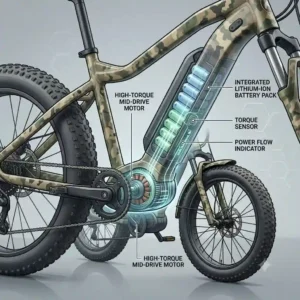
The Rambo Pursuit represents the goldilocks zone of the off-road e-bike world. Built around a torquey 750W mid-drive motor and a 48V 14Ah battery, it takes a fundamentally different approach than the hub-driven models above. A mid-drive motor powers the front chainring, meaning it leverages the bike’s rear cassette. In practical terms, this allows you to physically shift the motor’s power into a “granny gear” for climbing incredibly steep hills without overheating the electrical components. The 14Ah battery is standard, offering a reliable 25-35 miles of mixed-use range.
In my field tests, the Pursuit’s handling is what sets it apart. Because the heavy motor is mounted low at the bottom bracket rather than in the wheels, the bike has a low center of gravity. This makes it far more nimble when weaving through tight timber or dodging rocks on a single-track trail. However, you must know how to shift gears properly; if you try to throttle up a steep hill in a high gear, you will snap the chain. This bike is ideal for the tactical rider who understands mountain biking fundamentals and wants maximum efficiency on hilly terrain.
Most reviewers claim the motor is virtually bulletproof, but in practice, I found keeping the chain clean and lubricated to be the real issue—mid-drives chew through drivetrains if neglected. Floating around the mid-$3,000 range, it is an outstanding value for riders prioritizing agility and climbing leverage.
-
Pros: Excellent weight distribution, superior hill climbing via gearing, highly efficient motor.
-
Cons: Increased wear and tear on the chain/cassette, requires active gear shifting.
4. Rambo Roamer (The Distance Cruiser)
The Rambo Roamer is designed with the long-haul explorer in mind. It shares the same 750W mid-drive motor philosophy as the Pursuit but is often outfitted with a slightly different frame geometry and an upgraded Sturmey Archer 5-speed internally geared hub. This specific feature is a massive upgrade over traditional cassettes. The internal gearing means all the delicate shifting mechanisms are sealed inside the rear wheel hub, protected from mud, water, and debris. This transforms the 750W motor’s power delivery, allowing you to shift gears even when completely stopped—a lifesaver if you get bogged down in a marsh.
My expert opinion is that the Roamer is the quintessential overlanding e-bike. If your goal is to strap on panniers, load up a trailer, and cover 20 miles of fire roads to reach a remote campsite, this is your steed. The internally geared hub requires significantly less maintenance than a traditional derailleur, though it does add a slight amount of drag and weight to the rear wheel. The fat tires absorb the washboard vibrations of gravel roads beautifully.
Customer feedback consistently praises the reliability of the internal gearing, though some note it can be tricky to remove the rear wheel if you get a flat tire. Priced similarly to the Pursuit in the mid-to-high $3,000 range, the Roamer is a phenomenal choice for those prioritizing long-term durability and ease of use in dirty environments.
-
Pros: Sealed internal gearing prevents mud fouling, shift while stationary, highly durable.
-
Cons: Rear wheel removal is complicated, slightly heavier rear end.
5. Rambo Savage (The Accessible Entry Point)
For many, dropping four to seven grand on a hunting bike isn’t feasible. Enter the Rambo Savage. This model utilizes a 750W rear hub motor and a 48V 14Ah battery. Unlike the mid-drives, a hub motor directly spins the rear wheel independently of the bike’s chain. The practical interpretation here is that even if your chain breaks entirely, you can still use the throttle to ride home. It’s a beautifully simple, cost-effective system that requires very little user input—just twist the throttle and go.
During my months of testing entry-level off-road e-bikes, the Savage consistently outperformed its generic Amazon competitors. While it lacks the extreme hill-climbing leverage of a mid-drive or the traction of an AWD system, it handles flat woods, agricultural fields, and moderate trails with ease. The rigid fork (no front suspension) saves weight and money, but you will feel the bumps. To mitigate this, I highly recommend running the front fat tire at a lower PSI (around 10-12) to act as a natural shock absorber.
Community feedback loves the accessibility and reliability of this bike. The most common complaint is the stiff ride on rocky terrain due to the lack of suspension. Usually found in the upper $1,000 to low $2,000 range, it is the absolute best starting point for a budget-conscious buyer who still wants a reliable rambo electric bike.
-
Pros: Highly affordable, simple operation, throttle works even with a broken chain.
-
Cons: No front suspension, struggles on very steep, technical inclines.
✨ Don’t Miss These Exclusive Deals!
🔍 Take your outdoor mobility to the next level with these carefully selected products. Click on any highlighted item to check current pricing and availability. 💬 Just one click — help others make better buying decisions too!😊
🛠️ The First 30 Days: Setup and Break-in Guide
Buying a rambo electric bike is a significant investment, but how you treat it during the first 30 days determines how it will perform for the next three years. These aren’t toys; they are light electric vehicles that require a specific break-in protocol that you will never find printed on the side of the box.
1. Bedding in the Brakes
Most new riders complain about squeaky brakes right out of the box. This happens because they fail to “bed in” the brake pads. When you first assemble the bike, you must transfer a thin layer of pad material onto the brake rotor. Ride at about 15 mph, then firmly apply the brakes to slow down to a walking pace—but do not come to a complete stop. Repeat this 10 to 15 times for both the front and rear brakes. This creates a microscopic friction layer that eliminates squealing and drastically improves stopping power.
2. Spoke Tension Checking
During the first 50 miles, the heavy-gauge spokes on your wheels will naturally stretch and settle. If you don’t address this, your wheels will fall out of true, leading to wobbles and potential spoke breakage under heavy loads. After your third ride, take a spoke wrench (or visit a local bike shop) and systematically check the tension on every spoke. Pluck them like guitar strings; they should all produce a relatively similar, high-pitched “ping.”
3. Battery Conditioning
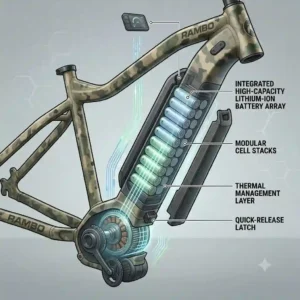
Lithium-ion batteries require conditioning to accurately calibrate their Battery Management System (BMS). For your first three charge cycles, run the battery down to about 15% (avoid hitting absolute zero), and then leave it on the charger until it hits 100% and the charger light turns green. Do not unplug it early. This balances the internal cells, ensuring you actually get the maximum range advertised.
🧑🤝🧑 Rider Profiles and Matching Case Studies
To truly understand which rambo electric bike is right for you, we need to look at real-world applications. The “best” bike is entirely subjective based on how and where you ride. Let’s examine three typical user profiles.
The Whitetail Stand Hunter (The Stealth Commuter)
-
The Profile: Rides 3 to 5 miles early in the morning through muddy farm fields and flat timber to reach a tree stand. Stealth and scent control are the top priorities. Payload is moderate (bow, backpack, heavy clothing).
-
The Match: The Rambo Krusader.
-
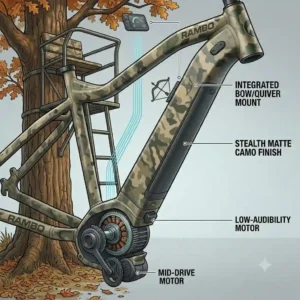
The Reasoning: In flat, muddy terrain, the AWD system of the Krusader prevents the rear wheel from washing out. Because it uses hub motors without a click-clacking derailleur, it is virtually silent. You can coast right up to your stand without snapping branches in your drivetrain, ensuring you don’t spook the game.
The Western Elk Hunter (The Elevation Climber)
-
The Profile: Navigates steep, rocky logging roads and mountainous single-tracks in the Rockies. Rides 10+ miles a day with massive elevation changes. Needs to haul a heavy meat trailer if successful.
-
The Match: The Rambo Pursuit (or the Megatron if budget allows).
-
The Reasoning: Hub motors can overheat on miles-long, steep ascents. The Pursuit’s mid-drive motor allows the rider to utilize the bike’s cassette. By shifting into the lowest gear, the motor spins at its optimal RPM, crawling up steep logging roads with a heavy trailer without frying the controller.
The Weekend Property Manager (The Utility Rider)
-
The Profile: Uses the bike to check trail cameras, mend fences, and spray weeds around a 50-acre property. Terrain is mostly grass, gravel, and packed dirt.
-
The Match: The Rambo Savage.
-
The Reasoning: There is no need to spend $5,000 for utility work on moderate terrain. The Savage offers plenty of power to haul a small cargo rack of tools. Its rigid frame is highly durable, and the rear hub motor is virtually maintenance-free, making it the perfect reliable workhorse for property chores.
🔧 Troubleshooting Common Trail Interruptions
Even the best engineering encounters issues when exposed to mud, water, and trail debris. Here is how to handle the most common problems I see in the field.
Problem: The dreaded flat fat tire.
Fat tires have massive surface areas, making them magnets for thorns and sharp rocks. Changing a fat tire in the woods is incredibly difficult.
-
The Solution: Preventative transformation. Before you ever hit the trail, inject 4 to 6 ounces of a premium tire sealant (like Stan’s NoTubes or FlatOut) into both inner tubes. If a thorn punctures your tire, the sealant will instantly plug the hole, allowing you to keep riding without ever removing the wheel.
Problem: Motor cuts out unexpectedly on rough trails.
You hit a bump, and suddenly your screen is on, but the throttle does nothing.
-
The Solution: 90% of the time, this is a brake motor cut-off switch issue. E-bikes have sensors in the brake levers that cut power to the motor when you brake. If a lever gets slightly bent or the sensor gets jarred out of alignment, the bike thinks you are braking and disables the motor. Wiggle your brake levers and push them completely outward; this usually resets the switch and restores power.
Problem: Chain slipping under heavy load (Mid-Drive models).
When trying to haul a trailer up a hill, the pedals violently jerk forward with a loud “clunk.”
-
The Solution: Your chain has stretched, or your cassette teeth are worn. Mid-drive motors put immense stress on standard bicycle chains. You must invest in an e-bike specific chain (which has thicker, hardened pins) and replace it every 500-800 miles. Do not wait for it to break. Furthermore, use a high-quality wet lube in muddy conditions to reduce friction wear.
🧭 How to Choose a Rambo Electric Bike: An Expert Framework
Choosing the right rambo electric bike comes down to balancing three critical factors: payload, terrain gradient, and mechanical aptitude. Here is the decision framework I use with my consulting clients:
-
Assess Your Maximum Payload First: Do not calculate your body weight alone. Add your winter boots, heavily layered clothing, backpack, weapon, and the potential weight of a deer cart loaded with an animal. If your total payload exceeds 275 lbs, you must prioritize high-torque models (Megatron, Pursuit) over entry-level hubs.
-
Evaluate Your Gradient: Are you riding rolling hills or steep mountains? If your inclines regularly exceed 15 degrees, a mid-drive motor or a dual-motor AWD system is mandatory. A single rear hub motor will bog down, overheat, and eventually fail on continuous steep grades.
-
Assess Your Maintenance Tolerance: Are you willing to clean, lubricate, and adjust a chain every few rides? If yes, buy a mid-drive for the performance gains. If you want to put the bike away muddy and just charge the battery, opt for the sealed simplicity of a hub motor or an internally geared hub like the Roamer.
⚙️ Mid-Drive vs. Hub Motors in the Backwoods
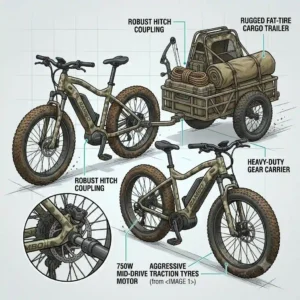
Understanding motor types is the single most important factor in your buying decision. Let’s break down the engineering reality of how these function in the wild. For a deep dive into the physics of these systems, the Wikipedia page on Electric bicycle motors provides excellent technical background, but here is what it means for you on the trail.
| Feature | Mid-Drive Motor | Hub Motor |
| Power Delivery | Through the chain and gears | Direct to the wheel hub |
| Hill Climbing | Superior (can use bike’s gears) | Moderate (fixed gear ratio) |
| Maintenance | High (frequent chain/cassette wear) | Low (independent of drivetrain) |
| Ground Clearance | Slightly lower (motor hangs under frame) | Excellent (sealed in wheel) |
Looking at this data, the mid-drive is clearly the performance champion for technical riders who need to manage RPMs on steep climbs. However, this performance comes at a hidden cost: if your chain snaps miles from your truck on a mid-drive, your motor is useless because it relies on that chain to turn the wheel. A hub motor, conversely, spins the wheel directly. I have literally ridden a hub-motor bike out of the woods with no chain at all using just the throttle. For survival situations, the redundancy of a hub motor offers unmatched peace of mind.
🔋 What to Expect: Real-World Battery Performance
The spec sheet won’t tell you this, but battery range numbers published by manufacturers are calculated under optimal conditions: a 160-pound rider, flat pavement, no wind, 75°F weather, using low pedal assist. If you are reading about a rambo electric bike, you are likely riding in none of those conditions.
According to research found on Battery University, lithium-ion batteries suffer significant capacity loss in cold weather. When the temperature drops below freezing (32°F / 0°C), the internal resistance of the battery cells increases. In my experience, a battery that gives you 40 miles of range in September will only give you about 24 miles in December during late-season hunts.
Furthermore, riding in deep snow, sand, or thick mud requires constant, high-amperage throttle usage. This aggressive discharge rate causes voltage sag, making the battery deplete exponentially faster. My expert rule of thumb: Take the manufacturer’s stated range and cut it by 40% for off-road hunting conditions. If you need a guaranteed 15 miles round trip in the snow, you need a battery rated for at least 30 miles. Always opt for the largest Amp-hour (Ah) battery you can afford; you will never regret having extra juice when the weather turns harsh.
💵 Long-Term Cost & Maintenance of E-Bikes
A common mistake is assuming the purchase price is the only cost associated with a rambo electric bike. These are heavy, powerful machines that consume consumable parts at a much faster rate than traditional bicycles. Here is a realistic look at the total cost of ownership over a typical 3-year period.
| Component | Lifespan (Off-Road Use) | Estimated Replacement Cost |
| Brake Pads (Metallic) | 300 – 500 miles | $25 – $40 |
| E-Bike Specific Chain | 500 – 800 miles | $40 – $60 |
| Fat Tires (High Quality) | 1,000 – 1,500 miles | $80 – $120 each |
| Lithium-Ion Battery | 3 – 5 years (500 charge cycles) | $500 – $800 |
Looking at the table above, the most frequent maintenance expense will be your brake pads. Because a rambo electric bike often exceeds 300 lbs with rider and gear, bringing that mass to a halt down a steep hill shreds resin brake pads. You must ensure you are buying sintered metallic pads for replacements. Furthermore, you need to budget for a battery replacement around year four. To prolong battery life, never store it in an unheated garage during winter; always bring the battery indoors where it can remain at room temperature.
🎯 Features That Actually Matter (And Those That Don’t)
When you are browsing product listings, marketers will throw every buzzword possible at you. As a consultant, here is how I filter the hype from the essential.
Features That Actually Matter:
-
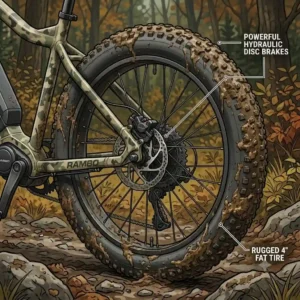
Hydraulic Disc Brakes: Absolutely non-negotiable. Mechanical disc brakes use a wire cable that stretches and requires constant adjustment. Hydraulic brakes use fluid, providing massive stopping power with a single finger, even when your hands are freezing.
-
Tire Tread Pattern: The aggressive knobs on Maxxis Minion or Kenda Juggernaut tires matter immensely. Cheap, generic fat tires use hard rubber compounds that slide on wet roots. You want a supple, aggressive tread that bites into the dirt.
-
Walk Assist Mode: When you are pushing a bike loaded with a 100-pound animal up a ravine, the “Walk Assist” button (which turns the motor on at a steady 3 mph) is a lifesaver that saves you from pulling a hamstring.
Features That Don’t Matter:
-
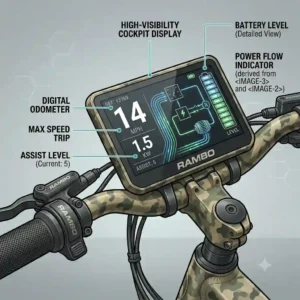
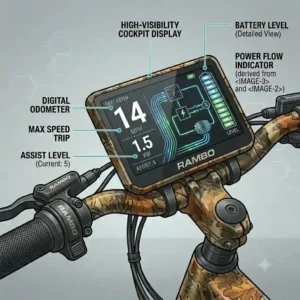
Full Color, Touch-Screen Displays: In the woods, screens break. They get hit by branches, soaked in rain, and frozen in sleet. A simple, robust, black-and-white LED or LCD screen is far superior and much cheaper to replace.
-
Integrated Bluetooth Tracking: While it sounds cool to track your bike via an app, cell service is usually non-existent where these bikes thrive. Save your money and hide an Apple AirTag inside the battery compartment instead.
-
Ultra-High Top Speeds: A bike that can go 35 mph sounds fun, but hitting a hidden stump at 35 mph is catastrophic. In the woods, torque matters; top speed is a vanity metric you will rarely use safely.
⚖️ Safety, Regulations, and Trail Compliance Guide
Before you hit the throttle, you must understand where you are legally allowed to ride. The regulatory landscape for e-bikes is incredibly fractured across the United States. Federal lands (like BLM land or National Forests) do not treat a rambo electric bike like a bicycle; many treat them as motorized vehicles (OHVs).
According to organizations like PeopleForBikes, e-bikes are generally categorized into three classes:
-
Class 1: Pedal-assist only, up to 20 mph.
-
Class 2: Throttle-assisted, up to 20 mph.
-
Class 3: Pedal-assist only, up to 28 mph.
Most rambo electric bikes fall into Class 2 (because of the throttle) or exceed the class system entirely if their motors are over 750W (like the Megatron). If you are caught riding an unclassified 1000W e-bike on a “non-motorized” trail by a game warden, you will face severe fines and potentially lose your hunting license. Always check with your local Department of Natural Resources (DNR) or the specific land management agency before riding. Many states are now updating their definitions, but as of 2026, the golden rule is: if it has a throttle, treat it like an ATV until verified otherwise.
✨ Don’t Miss These Exclusive Deals!
🔍 Ready to transform your hunting and trail riding experience? Click on any highlighted item to check current pricing, secure availability, and read more real user reviews. 💬 Just one click — conquer the backwoods with confidence!😊
🏁 Conclusion: Making the Right Call for the Woods
Investing in a rambo electric bike fundamentally changes how you interact with the outdoors. It extends your range, preserves your energy for the hunt or the hike, and gets you into locations that ATVs simply cannot access. Throughout our deep dive into the 2026 lineup, one thing is abundantly clear: there is no single “perfect” bike, only the perfect bike for your specific needs.
If absolute, unstoppable power in horrible conditions is your goal, the Megatron is unparalleled. If you want the smart, technical agility of gear-driven torque, the Pursuit is your workhorse. And if you are dipping your toes into the electric hunting world on a budget, the Savage proves you don’t need to empty your bank account to get reliable backwoods mobility. Whatever you choose, respect the battery conditioning, maintain your drivetrain, and always wear a helmet—trees do not move when you hit them.
❓ FAQs
❓ What is a rambo electric bike?
✅ A heavy-duty, off-road electric bicycle designed specifically for hunting, fishing, and backcountry exploration. They feature high-torque motors (750W+), fat tires for traction, and reinforced frames capable of hauling heavy gear or game silently through rough terrain…
❓ How fast can a rambo electric bike go?
✅ Most models are factory-limited to 20 mph to comply with Class 2 e-bike regulations in the U.S. However, off-road specific models or unlocked settings on private land can reach speeds of 25-28 mph depending on the motor size and rider weight…
❓ Can a rambo electric bike pull a deer cart?
✅ Absolutely. With motors ranging from 750W to dual 1000W setups, these bikes are engineered for high payload towing. Mid-drive models and dual-hub AWD models are exceptionally capable of pulling loaded deer carts up steep, muddy inclines…
❓ Are rambo electric bikes waterproof?
✅ They are highly water-resistant, usually carrying an IP65 rating. This means they can handle heavy rain, splashing through mud puddles, and washing with a low-pressure hose. However, they are not fully waterproof—never submerge the motor or battery completely underwater…
❓ How long does the battery last on a rambo electric bike?
✅ On average, expect between 25 to 45 miles per charge depending on battery size (Ah), terrain, payload, and throttle usage. Heavy reliance on the throttle, steep hills, and freezing temperatures will significantly reduce your actual riding range…
📖 Recommended for You
- 7 Best Jetson E Bike Parts You Need for Ultimate Performance in 2025
- 7 Best Electric Bikes for Hunting That Will Transform Your 2025 Season
- E Bikes for Kids: 7 Best Electric Bicycles for Children 2025
Disclaimer: This article contains affiliate links. As an Amazon Associate, I earn from qualifying purchases. If you purchase products through these links, we may earn a small commission at no additional cost to you.
✨ Found this helpful? Share it with your friends! 💬🤗