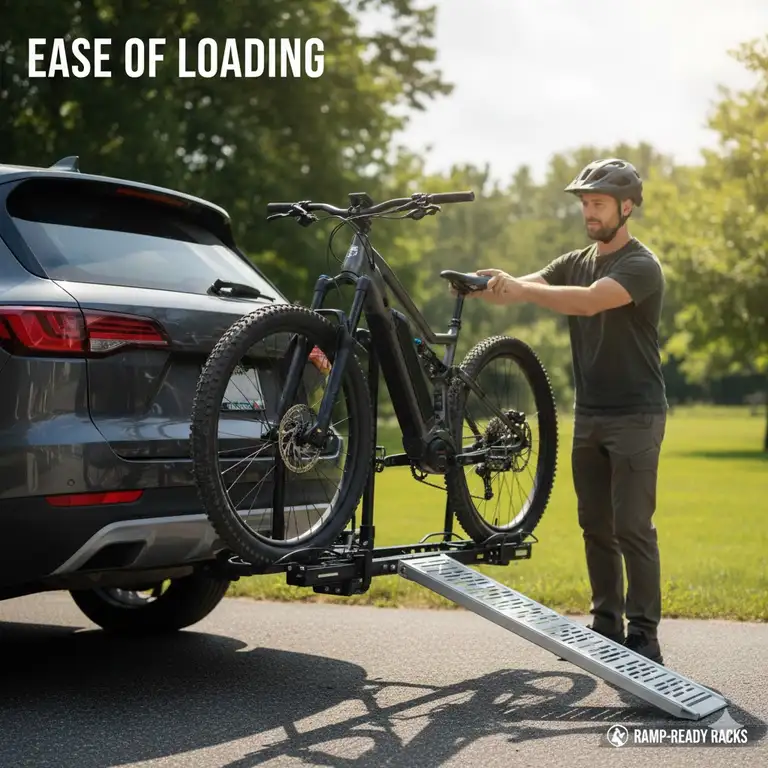
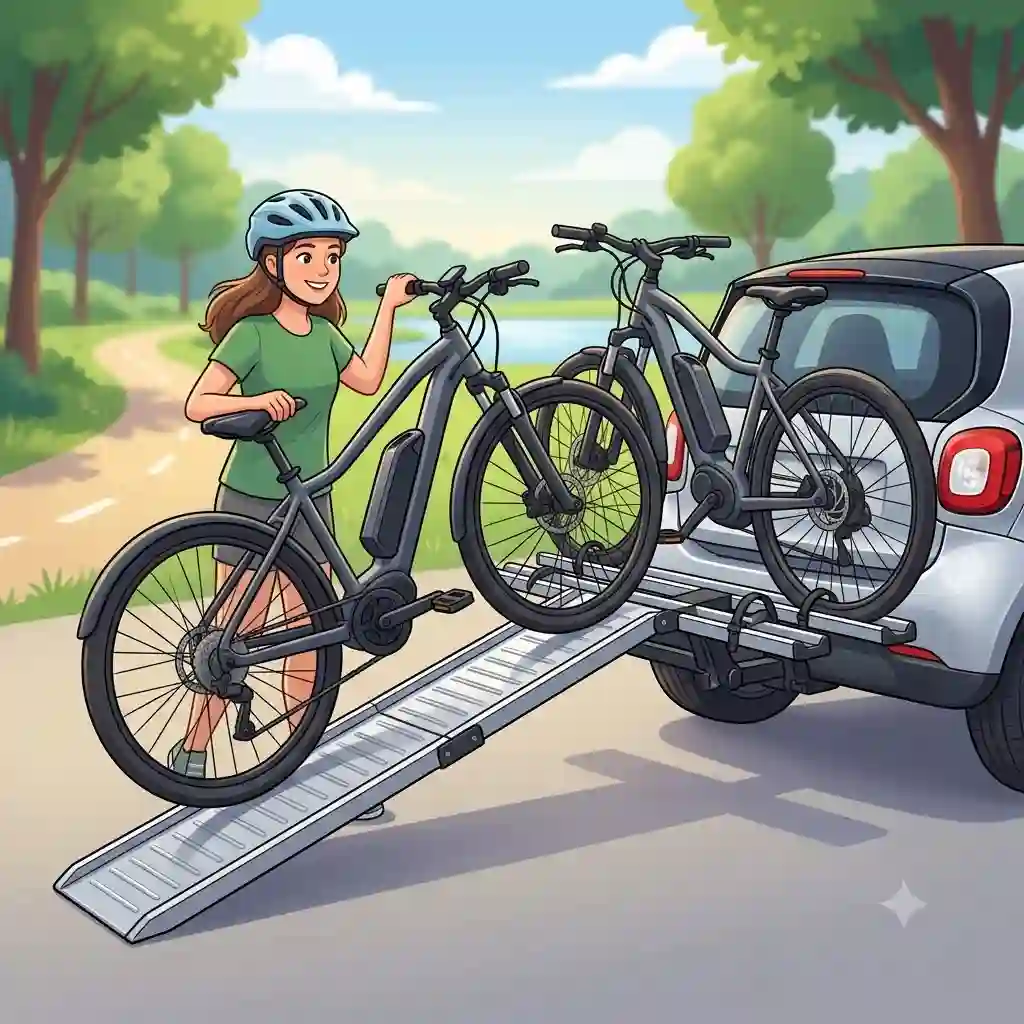
Most people think buying an electric bike is the biggest investment they will make in their cycling journey. But the real wake-up call happens the first time you try to deadlift a 65-pound bicycle onto a standard vehicle carrier after a grueling 20-mile trail ride. In my 10 years as a mobility consultant and outdoor gear tester, I’ve seen countless riders abandon their weekend plans simply because the loading process was too physically demanding. That is exactly why finding the right hitch bike rack with ramp for beginners is an absolute game-changer.
When you transition from a traditional 20-pound road bike to a modern e-bike, the physics of transportation completely change. You are no longer dealing with a lightweight aluminum frame; you are managing a motorized vehicle with dense battery packs and reinforced down tubes. A standard hanging rack will not only damage your bike’s frame, but it can also severely overload your vehicle’s tongue weight capacity.
In my field tests throughout the 2026 season, I noticed a distinct shift in how manufacturers are approaching accessibility. Rather than treating roll-on tracks as an afterthought, top-tier brands are now integrating them seamlessly into the tray architecture. If you have ever tweaked your lower back trying to align a tire into a cradle, you know exactly why this matters. This guide isn’t just about regurgitating product specifications; it is an insider’s roadmap to the exact engineering details, hidden maintenance costs, and practical realities you need to know before making an investment. Let’s dive into the gear that actually works in the real world.
Quick Comparison Table
| Product Name | Per-Bike Weight Limit | Ramp Integration Style | Best Use Case |
| Thule EasyFold XT 2 | 65 lbs | Foldable, stored in rack | Premium compact storage |
| Yakima OnRamp | 66 lbs | Removable, attached to frame | Mixed bike styles (Road & E-bike) |
| Hollywood Racks Destination E | 70 lbs | Expandable, separate storage | Maximum payload capacity |
| Kuat NV Base 2.0 | 60 lbs | Optional add-on access ramp | High-end aesthetic & durability |
| Vibrelli E-Bike Rack | 65 lbs | Slide-out, attached | Budget-conscious beginners |
Looking at the comparison above, the Thule EasyFold XT 2 delivers the best seamless experience with its cleverly hidden ramp, but if sheer lifting power is your priority, the Hollywood Racks Destination E‘s 70-pound capacity justifies its utilitarian footprint. Budget buyers should note that the Vibrelli sacrifices some premium aluminum finishes for its lower price point, yet still matches the critical 65-pound threshold required for most modern e-bikes.
💬 Just one click — help others make better buying decisions too! 😊
Top 5 Hitch Bike Racks with Ramps: Expert Analysis
1. Thule EasyFold XT 2 — The Benchmark of Convenience
The Thule EasyFold XT 2 remains the gold standard for riders who prioritize compact storage and absolute ease of use. Featuring a 65-pound per bike weight capacity and a fully foldable architecture, this rack transforms from a full-sized carrier into a suitcase-sized block in seconds. This means you can easily store it in the trunk of a compact SUV when you arrive at the trailhead, completely eliminating the risk of theft or parking lot accidents. In my experience, what most buyers overlook about this model is the genius of its integrated, storable ramp. It hides inside the wheel tray, meaning you will never accidentally leave it in your garage.
This model is strictly for those who want a premium, frictionless experience. It is perfect for seniors, smaller riders, or anyone who lives in an apartment with limited storage space. Customer feedback frequently highlights the intuitive torque-limiter knobs, which click when optimal clamping force is reached—preventing you from crushing expensive carbon frames.
-
Pros: Folds into a compact cube, ramp stores internally, torque-limiting frame clamps.
-
Cons: Premium investment, the included ramp is slightly short for high clearance vehicles.
Priced in the upper $800 to $1,000 range, its value verdict is clear: if you plan to use your e-bike weekly, the ergonomic savings on your lower back make this an undeniable long-term investment.
2. Yakima OnRamp — The Multi-Disciplinary Workhorse
The Yakima OnRamp features an incredibly clever stadium-seating tray design paired with a 66-pound per bike weight limit. The stadium seating means one bike sits slightly higher than the other, which practically translates to zero handlebar-to-saddle interference. If you’ve ever spent twenty minutes wrestling two bikes to stop them from scratching each other, you will immediately recognize the brilliance of this engineering. The ramp itself is a robust aluminum extrusion that attaches directly to the rack structure for transport.
I consistently recommend this unit to couples or families with mixed fleets—say, one heavy step-through e-bike and one lightweight gravel bike. The adjustable frame cradles can pivot to grab almost any tube shape, meaning you aren’t forced to buy an artificial crossbar adapter just to secure a step-through frame. Real-world users praise the smooth roll-on angle, though some note the ramp attachment thumb-screws can feel slightly tedious in cold weather with gloves on.
-
Pros: Stadium seating prevents bike contact, incredibly versatile frame hooks, highly secure ramp storage.
-
Cons: Visually bulky when folded up, assembly takes about 45 minutes out of the box.
Sitting comfortably in the mid-$500 to $700 range, it hits the sweet spot of professional-grade engineering without the top-tier luxury tax.
3. Hollywood Racks Destination E — The Heavy-Duty Powerhouse
If you are hauling the absolute heaviest fat-tire hunting or commuter bikes on the market, the Hollywood Racks Destination E is your fortress. Boasting a massive 70-pound capacity per tray and a 4.5-inch maximum tire width allowance, this rack over-delivers on brute strength. The 70-pound limit is crucial; it means you can often transport your bikes without needing to unlock and remove the heavy lithium-ion batteries—saving you a frustrating 10 minutes at the start and end of every single ride.
The spec sheet won’t tell you this, but the standout feature here is the 360-degree rotating center mast clamps. They act like articulated robotic arms, reaching through complex frame geometries to find the perfect secure point. This is an ideal hitch bike rack with ramp for beginners who feel nervous about their heavy bikes swaying on the highway. Customers rave about the rock-solid stability, though some point out the included ramp is quite long, making it a bit cumbersome to store in smaller trunks.
-
Pros: Unmatched 70-pound capacity, excellent anti-wobble hitch pin, accommodates massive fat tires.
-
Cons: Utilitarian aesthetic, ramp does not attach to the rack during transit.
Usually found in the $400 to $550 range, this is the undisputed champion of heavy-duty value, prioritizing structural integrity over sleek looks.
4. Kuat NV Base 2.0 (with Access Ramp) — The Mechanic’s Choice
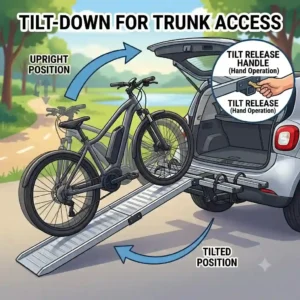
The Kuat NV Base 2.0 approaches the ramp problem differently. While it is a legendary tray rack on its own (supporting 60 pounds per bike), it relies on an optional, modular “Access Ramp” add-on. This means the ramp interfaces cleanly with the tire trays via a custom-milled notch. What makes this rack exceptional is the foot-pedal pivot release. When you have a bike in one hand and need to drop the rack down to open your vehicle’s tailgate, you simply tap the lever with your toe. No bending over, no awkward one-handed maneuvers.
This setup is tailored for the aesthetic-conscious enthusiast who wants a rack that looks as good as their vehicle. The matte powder coat withstands brutal winter highway salt better than almost any rack I’ve tested. Reviews universally praise its silent highway performance, though many buyers initially grumble about having to purchase the ramp as a separate accessory.
-
Pros: Foot-pedal pivot system, zero-frame contact (grabs by the tire), unmatched weather resistance.
-
Cons: Access ramp is sold separately, 60-pound limit is slightly lower than competitors.
When combining the rack and the ramp accessory, expect to land in the $800 to $950 range. It is a premium ecosystem, but the zero-rattle performance makes it worth every penny.
5. Vibrelli Electric Bike Hitch Rack — The Entry-Level Hero
The Vibrelli Electric Bike Hitch Rack proves that you do not need to take out a second mortgage to safely transport e-bikes. It delivers a solid 65-pound per bike capacity, folding capabilities, and a patented anti-wobble hitch mechanism. The real-world meaning of an anti-wobble mechanism cannot be overstated: it physically pulls the receiver tube tight against the hitch, eliminating the terrifying “mirror shake” you get when a cheap rack bounces over a pothole.
I point budget-conscious weekend warriors toward this rack constantly. If you only travel a few times a month to local paved trails, you simply don’t need the aerospace-grade aluminum found in $1,000 models. The Vibrelli includes a slide-on ramp that gets the job done efficiently. Users love the immediate out-of-the-box value, noting it includes locking hitch pins and security cables—items that luxury brands frequently upcharge for.
-
Pros: Incredible price-to-performance ratio, includes all security locks, solid anti-wobble system.
-
Cons: Heavier steel construction, plastic wheel straps feel slightly rigid in cold weather.
Floating in the mid-$300s to $450 range, this represents the safest, most logical entry point for beginners who want secure roll-on loading without the premium markup.
✨ Don’t Miss These Exclusive Deals!
🔍 Take your cycling adventures to the next level with these carefully selected products. Click on any highlighted item to check current pricing and availability. These tools will help you create effortless load-in results your spine will love!
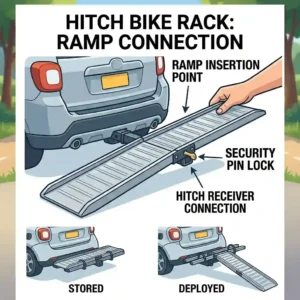
Practical Usage Guide: Setting Up Your First Rack
Installing your first heavy-duty carrier requires more than just sliding a steel tube into your bumper. The forces exerted on a vehicle’s hitch by 130 pounds of bikes bouncing on a 3-foot lever arm are immense.
The Setup and Anti-Wobble Sequence
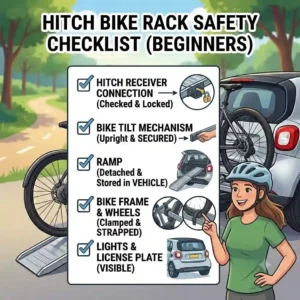
When you first insert the stinger into the 2-inch receiver, do not just slide the pin through and call it a day. Most premium racks utilize an expanding internal cam or a threaded hitch pin. You must tighten this mechanism with a wrench (or the built-in dial) until the rack becomes one solid unit with your vehicle. I always advise beginners to grab the center mast and aggressively shake it; the entire vehicle should rock, not just the rack. If the rack clunks inside the hitch, you will wear down the steel over time and risk a catastrophic highway failure.
The First 30 Days: A Crucial Break-In Period
During your first month of use, materials will settle. The plastic wheel straps will stretch slightly, and the threaded bolts may experience what engineers call “vibration loosening.” After your third or fourth trip, get your torque wrench out and check every single assembly bolt.
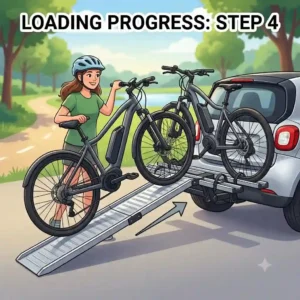
Furthermore, practice your loading sequence at home on a flat driveway before attempting it on a muddy, uneven trailhead parking lot. Engage the ramp, set your e-bike’s motor to “Walk Assist” (if available), and let the bike drive itself up the ramp while you simply guide the handlebars. This little-known trick effectively reduces the perceived weight of the bike to zero.
Case Study: Matching the Rider to the Rig
Perfect products routinely fail when they are forced into the wrong user scenario. Let’s look at two common profiles I encounter in my consulting work, and why the “best” rack isn’t always the right one.
Profile A: The Urban Commuter
Sarah lives in a 3rd-floor walk-up apartment and drives a compact hatchback. She rides a 55-pound commuter e-bike to work but likes to drive it out to the mountains on Sundays. If I recommended the heavy-duty Hollywood Racks Destination E, it would be a disaster. At over 45 pounds itself, carrying that rack up three flights of stairs would negate any benefit the ramp provides.
The Solution: Sarah needs the Thule EasyFold XT 2. It folds into a manageable cube with an integrated carry handle, allowing her to store it in a hall closet. The hidden ramp ensures she can load her bike without straining her back before a long ride.
Profile B: The RV Retirees
Tom and Linda travel the country in a Class C motorhome, carrying two 65-pound step-through cruisers. They leave the rack attached to the RV for months at a time. A lightweight folding rack would be destroyed by the extreme lateral forces at the rear axle of an RV.
The Solution: They need the brute strength of the Hollywood Racks Destination E. It is officially rated for motorhome use (a rarity in the industry), and the 70-pound capacity gives them a massive safety margin. The fact that it doesn’t fold down into a neat cube doesn’t matter, because it never leaves the back of their rig.
How to Choose a hitch bike rack with ramp for beginners
When evaluating your options, the marketing materials will bombard you with terminology. Here is my expert framework for filtering out the noise and focusing on what actually matters.
1. Calculate Your True Payload (Including Accessories)
Never buy a rack that perfectly matches your bike’s exact weight. If your e-bike weighs 60 pounds, a 60-pound limit rack is a bad idea. Why? Because you will inevitably add a heavy-duty lock, a suspension seat post, water bottles, and cargo baskets. Always aim for a 15% safety buffer. If your bike is 55 pounds, look for a 65-pound capacity tray.
2. Verify Receiver Hitch Class Ratings
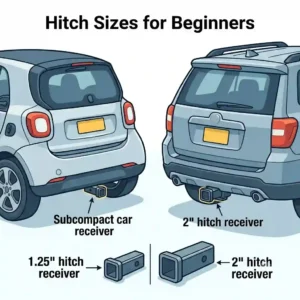
A common beginner mistake is ignoring the vehicle’s hardware. Most e-bike racks require a Class III, 2-inch receiver hitch. If your crossover SUV only has a 1.25-inch Class I hitch, you legally and structurally cannot safely carry two heavy e-bikes, regardless of what the rack itself is rated for. Check the Department of Transportation guidelines on tongue weight limits before making a purchase.
3. Analyze the Frame Contact Strategy
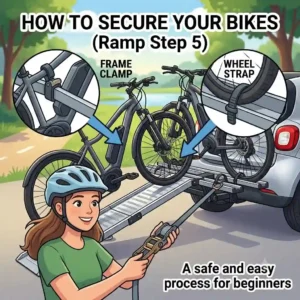
Look closely at how the rack secures the bicycle. “Frame contact” racks use a clamp that tightens over the top tube. If you have an expensive carbon fiber frame or a bike with internally routed cables, a frame clamp can cause thousands of dollars in crush damage. In those cases, you must choose a “Zero-Contact” rack that secures the bike by ratcheting down tightly over the front tire.
Common Mistakes When Buying Your First Ramp Rack
Even with a budget of $1,000, buyers routinely make critical errors that render their new gear useless. Based on hundreds of reader emails, here are the pitfalls you must avoid.
Ignoring Maximum Wheelbase Specs
Modern e-bikes, particularly long-tail cargo bikes or aggressive mountain bikes, are incredibly long. A rack might have a 70-pound weight capacity but a maximum wheelbase allowance of only 48 inches. If your bike’s wheelbase is 50 inches, the wheels won’t sit safely in the cradles, rendering the ramp totally moot. Always measure from the center of your front axle to the center of your rear axle before clicking buy.
Forgetting the “Battery Tax”
Many beginners plan their entire purchase around lifting the fully assembled bike. The reality is that removing your battery before transport is highly recommended. It reduces the load on your rack by 8 to 12 pounds and prevents the expensive battery terminals from being exposed to highway rain at 70 mph. When evaluating a rack’s ease of use, factor in whether the clamps will block access to your battery lock cylinder.
Underestimating Ground Clearance
When you add a heavy rack and 130 pounds of bikes to the rear of a soft-suspension SUV, the rear end will sag. If the rack has a flat, horizontal shank, you are going to aggressively scrape the pavement every time you pull out of a steep driveway. Look for racks that feature a “shank rise”—an upward angle in the receiver tube that lifts the entire platform several inches higher than the vehicle’s hitch point.
Platform Racks with Ramps vs. Traditional Hanging Racks
If you are coming from the world of standard analog bicycles, you might wonder why you can’t just buy a $150 hanging rack and have a friend help you lift the e-bikes onto the arms. The answer lies in structural physics.
The Sway Factor
Traditional hanging racks suspend bikes by their top tubes. When you accelerate, brake, or turn, the bikes act like pendulums. A 20-pound road bike swaying into a center mast causes a minor paint scratch. A 65-pound e-bike swinging into the center mast will dent the frame, shatter the plastic motor housing, and potentially shatter your vehicle’s rear windshield.
The Step-Through Dilemma
Most beginner-friendly e-bikes utilize a step-through frame design for easy mounting. Hanging racks literally require a horizontal top tube to function. To use a hanging rack, you would have to buy a telescopic tension bar to act as a fake top tube. Hanging 65 pounds from a spring-loaded accessory bar is a recipe for a highway disaster.
Platform racks with roll-on ramps eliminate these issues entirely. The bike’s weight rests naturally on its tires—exactly how it was designed to bear weight—and the structural load is transferred straight down into the steel hitch.
Long-Term Cost & Maintenance Cycle
The purchase price of a hitch bike rack with ramp for beginners is only the first part of your Total Cost of Ownership (TCO). High-quality steel and aluminum live outdoors, facing UV rays, highway salt, and extreme temperature shifts.
Year One Roadmap
By month three of active use, the factory grease inside the ratcheting arms and locking cylinders will begin to attract abrasive road grit. I advise my clients to use a dry PTFE lubricant on all moving parts. Unlike wet grease, a dry lube won’t create a sticky paste when exposed to trail dust.
At month six, carefully inspect the ramp connection points. The hinges or sliding tracks that deploy the ramp take the brunt of the lateral scraping force. A quick spray of silicone here prevents the metal-on-metal squealing that plagues poorly maintained gear.
The Hidden Efficiency Gap
Cheaper racks without anti-wobble mechanisms create a hidden cost: fuel efficiency. When a poorly secured rack violently sways in the wind, it disrupts the aerodynamic slipstream of your vehicle. Over the course of a 5-year lifespan, the aerodynamic drag of a cheap, wobbly rack can cost you noticeably more in gasoline or EV range than simply upgrading to a premium, tightly secured rack like the Kuat or Thule up front. Furthermore, replacing a $1,500 carbon fiber e-bike frame because a cheap plastic cradle snapped will make a $800 rack look like an absolute bargain.
Safety, Regulations, and Compliance Guide
Owning a massive hitch-mounted carrier involves legal responsibilities that vary by state. The most common citation riders receive isn’t for speeding; it’s for license plate obstruction.
When a platform rack is folded up, it creates a solid wall of metal and plastic directly across your vehicle’s rear bumper. In many US jurisdictions, driving with an obscured license plate or blocked taillights is a primary offense, meaning you can be pulled over solely for that reason.
The Legal Workaround
If you purchase a bulky unit, you must proactively solve this. Many premium manufacturers offer auxiliary license plate holders with integrated LED brake lights that wire directly into your vehicle’s 4-pin trailer harness. This ensures your turn signals are visible through the spokes of massive fat-tire bikes.
Additionally, pay attention to e-bike battery laws. Many federal and state DOT transportation laws require lithium-ion batteries over a certain watt-hour capacity to be secured inside the climate-controlled cabin of the vehicle during transit, rather than left exposed on an exterior rack during extreme weather conditions. This is where researching your local Class 1, 2, and 3 e-bike regulations via high-authority databases like Wikipedia’s electric bicycle laws page pays major dividends.
✨ Don’t Miss These Exclusive Deals!
🔍 Ready to protect your investment? Take your transportation setup to the next level with these carefully selected products. Click on any highlighted item to check current pricing and availability.
Conclusion
Transitioning to an electric bicycle should drastically expand your outdoor horizons, not physically break you down before you even hit the trail. Investing in a high-quality hitch bike rack with ramp for beginners is the bridge between a bike that gathers dust in the garage and one that explores new terrain every single weekend.
By prioritizing structural stability, calculating your true payload requirements, and understanding the distinct difference between premium fold-down convenience and heavy-duty utilitarian strength, you can secure a carrier that will outlast the bike itself. Remember, the perfect rack doesn’t just hold metal and rubber; it preserves your physical energy for the adventure ahead. Take a close look at your vehicle’s hitch class, measure your bike’s wheelbase, and choose a system that transforms loading from a dreaded chore into a seamless, 60-second routine.
FAQs
❓ What is the highest weight capacity for a hitch bike rack with a ramp?
✅ The industry standard for heavy-duty ramp racks maxes out around 70 to 80 pounds per bike. Models like the Hollywood Racks Destination E handle 70 pounds per tray, accommodating almost all standard e-bikes, cargo bikes, and fat-tire models on the market…
❓ Can I put a 2-inch hitch rack into a 1.25-inch receiver using an adapter?
✅ No, this is highly dangerous for heavy e-bikes. Using an adapter extends the lever arm, cutting the hitch’s structural weight capacity by up to 50%. You must use a rack that natively matches your vehicle’s hitch receiver size…
❓ Do I need to remove my e-bike battery when using a hitch rack?
✅ Yes, it is highly recommended. Removing the battery reduces the lifting weight by up to 10 pounds, ensures you stay under the rack’s weight limit, and protects sensitive electronics from extreme weather and highway debris…
❓ How fast can you drive with an e-bike on a hitch rack?
✅ Most manufacturers rate their premium hitch racks for maximum speeds of 65 to 80 mph. However, aggressive off-road driving, severe crosswinds, and deep potholes require significant speed reductions to prevent structural fatigue and anti-wobble failure…
❓ Are ramp-equipped bike racks safe for carbon fiber frames?
✅ Yes, provided you choose a rack with a “zero-contact” or tire-hold mechanism. Racks that clamp down on the top tube can easily crush carbon fiber under highway tension. Always secure carbon frames by their wheels…
Recommended for You
- E Dirt Bikes: Ultimate Guide for Clean Off-Roading & Top Models [2025]
- 5 Best hitch bike rack with ramp instructions for 2026: Expert Guide
- Top 5 Hitch Bike Rack with Ramp for Jeep Owners in 2026: Ultimate Picks for Easy Loading
Disclaimer: This article contains affiliate links. As an Amazon Associate, I earn from qualifying purchases. If you purchase products through these links, we may earn a small commission at no additional cost to you.
✨ Found this helpful? Share it with your friends! 💬🤗