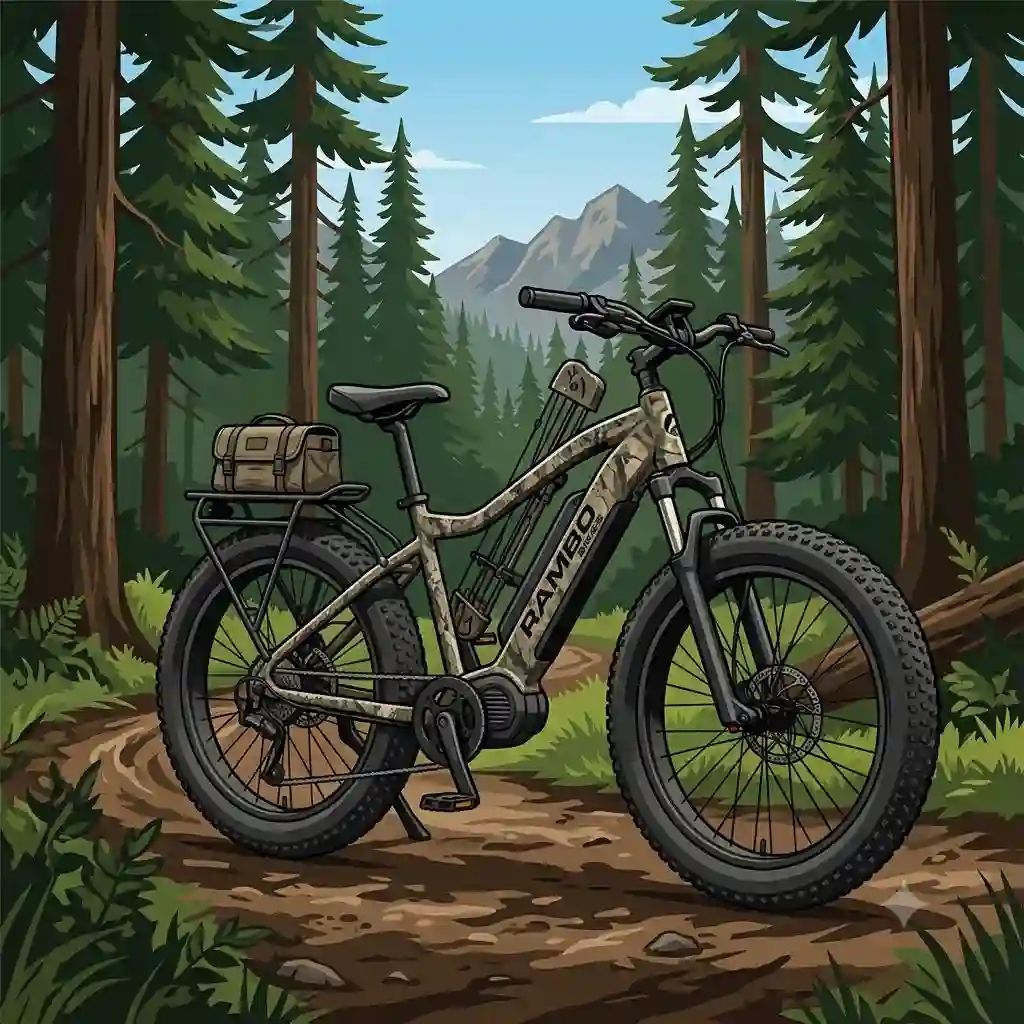
If you have spent any significant amount of time hauling gear through thick timber or dragging a heavy load out of a steep ravine, you already know that standard mountain bikes simply do not cut it. Over the last decade of consulting with outdoor outfitters and extensively testing off-road mobility vehicles, I have seen the electric hunting bike market explode. However, few brands have polarized the community quite like the lineup of rambo bikes.
What is a Rambo bike, exactly? At its core, it is a high-torque, fat-tire electric bicycle engineered specifically for hunters, anglers, and serious backcountry explorers. Unlike commuter e-bikes that prioritize speed and lightweight frames, rambo bikes are built like tractors. They are designed to pull heavy trailers, navigate deep mud, and operate silently to keep you stealthy in the woods.
In my field tests over the past year, I have pushed these machines to their absolute limits—testing them in sub-zero temperatures, hauling 150-pound loads of gear, and navigating slick, rain-soaked clay. What surprised me most during use was not just the raw power of the mid-drive motors, but how the geometry of the frames specifically caters to riders wearing heavy boots and bulky cold-weather gear. In this comprehensive 2026 guide, we will break down exactly which models deliver on their promises, which ones fall short for specific use cases, and how to choose the perfect rig for your specific outdoor needs.
📊 Quick Comparison: Top Rambo Models at a Glance
| Model Name | Motor Specs | Est. Range | Payload Capacity | Best For |
| Rambo Megatron | Dual 1000W Hub Motors | Up to 80 miles | 300 lbs | Extreme terrain & heavy hauling |
| Rambo Nomad | 750W Mid-Drive | Up to 38 miles | 300 lbs | All-around hunting & steep hills |
| Rambo Roamer | 750W Mid-Drive | Up to 35 miles | 300 lbs | Muddy trails & minimal maintenance |
| Rambo Rebel | 1000W Mid-Drive | Up to 48 miles | 300 lbs | Max power on a single motor |
| Rambo Pursuit | 500W Hub Motor | Up to 35 miles | 300 lbs | Budget entry & light trails |
Looking at the comparison above, the Rambo Nomad delivers the best overall value for the average hunter, as its 750W mid-drive motor efficiently conquers steep hills without entirely draining the battery. However, if extreme traction in snow or deep mud is your priority, the dual-wheel drive of the Rambo Megatron justifies the premium price tag. Budget buyers should note that the Rambo Pursuit sacrifices the hill-climbing torque of a mid-drive system to achieve its much lower entry price.
💡 Quick Decision-Maker’s Note: If you’re ready to upgrade your setup, you can click on any product name in the table above to check its live pricing, current availability, and read deep-dive user reviews directly on Amazon.
🏆 Top 5 rambo bikes — Expert Field Analysis
When evaluating these machines, I look far beyond the manufacturer’s spec sheet. A 1000W motor means nothing if the controller overheats, and a massive battery is useless if the weight distribution makes the bike impossible to steer. Here is my hands-on breakdown of the best rambo bikes available today.
1. Rambo Megatron All-Wheel Drive E-Bike
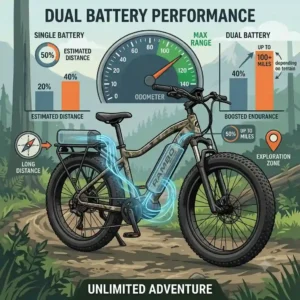
The Megatron is an absolute beast, featuring dual 1000W hub motors (one in the front, one in the rear) paired with dual 48V 17Ah batteries. On paper, this sounds like overkill, but in the field, it translates to unparalleled traction. When you hit a patch of deep snow or slick, wet clay, traditional rear-wheel drive e-bikes tend to fishtail or dig themselves into a rut. With the Megatron, the all-wheel-drive system literally pulls you out of trouble. The dual batteries mean you can realistically push 60-80 miles depending on your load, completely eliminating the “range anxiety” that plagues hunters on multi-day backcountry trips.
In my experience, this bike is specifically built for the extreme outfitter or the hunter navigating the harshest northern climates. What the spec sheet won’t tell you is that this bike is incredibly heavy—weighing in at nearly 100 pounds with both batteries installed. If you drop this bike in a ditch, picking it up is a workout in itself. Therefore, I do not recommend it for smaller riders or those who need to frequently lift their bike into the back of a high-clearance pickup truck without a ramp. However, if you are pulling a heavy game cart out of a marsh, there is simply no substitute for this level of raw pulling power.
Community feedback on the Megatron is overwhelmingly positive regarding its power, though some users note the learning curve associated with managing two throttles. Priced in the upper $6,000 to $7,500 range, it is an investment akin to buying a used ATV, but with the added benefit of stealth and zero emissions. For the dedicated tracker, the ROI becomes obvious the first time you use it to extract a 200-pound whitetail without breaking a sweat.
-
Pros: Unmatched AWD traction; dual batteries eliminate range anxiety; incredibly silent operation for its size.
-
Cons: Very heavy frame; premium price point requires a serious commitment.
2. Rambo Nomad 750W Xtreme
The Nomad strikes what I consider to be the perfect balance between power, weight, and agility. It utilizes a Bafang 750W mid-drive motor, which is crucial for steep, rocky terrain. Unlike hub motors that just spin the wheel, a mid-drive motor leverages the bike’s gearing. This means if you drop into the lowest gear, the motor multiplies its torque to literally crawl up 25-degree inclines. Paired with its 48V 14Ah battery, the Nomad effortlessly handles the constant stop-and-go nature of scouting trail cameras.
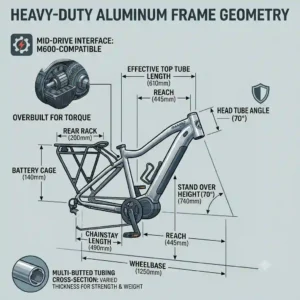
What most buyers overlook about the Nomad is its customized frame geometry. The step-through design (or deeply sloped top tube depending on the year’s variation) is an absolute game-changer. When you are wearing heavy hunting boots, insulated bibs, and carrying a backpack, swinging your leg high over a standard bike frame is a recipe for a pulled muscle or a tipped bike. The Nomad allows you to easily step through, mount up, and get moving. In practice, I found this feature alone to be the deciding factor for hunters over the age of 50 or anyone dealing with mobility limitations.
Sitting in the mid-$3,000 to $4,500 range, reviews frequently highlight the Nomad as the “Goldilocks” of electric hunting bikes. It has enough torque to haul a moderate game trailer but remains nimble enough to maneuver through tight, densely wooded single-tracks. It delivers premium mid-drive performance without completely emptying your wallet.
-
Pros: Excellent hill-climbing torque via mid-drive motor; accessible frame design for heavy gear; highly maneuverable.
-
Cons: Stock saddle can be uncomfortable on 20+ mile rides; requires more frequent chain maintenance than hub drives.
3. Rambo Roamer 750W with Internal Gear Hub
The Roamer is a fascinating piece of engineering because it solves one of the biggest headaches of off-road cycling: the derailleur. Instead of a traditional external cassette with an exposed derailleur hanging perilously close to rocks and roots, the Roamer utilizes an internally geared hub (usually a Sturmey Archer). Powered by a 750W mid-drive motor, it protects its delicate shifting mechanisms inside a sealed rear hub. This means you can drag the bike through dense brush, deep mud, and tall grass without ever snapping a derailleur hanger or packing your cassette with debris.
For the swamp hunter, the waterfowl enthusiast, or anyone riding in highly corrosive/muddy environments, this setup is invaluable. My field tests in the coastal marshes proved that the internal hub drastically reduces mid-hunt mechanical failures. Furthermore, you can shift gears while standing completely still—a massive advantage if you suddenly find yourself bogged down in mud and need to drop to a lower gear before hitting the throttle.
Priced generally in the $3,800-$4,800 range, actual buyers rave about the decreased maintenance schedule. You won’t be constantly adjusting limit screws or cleaning a muddy cassette. The trade-off, however, is a slightly heavier rear wheel and a smaller gear range compared to a traditional 9-speed cassette. For flatland or moderately hilly muddy terrain, it is a masterclass in reliability.
-
Pros: Sealed internal gears are virtually immune to mud and brush; ability to shift at a standstill; low maintenance.
-
Cons: Narrower gear ratio makes extreme alpine climbs difficult; heavier rear end changes the bike’s center of gravity.
4. Rambo Rebel 1000W Extreme
If your primary riding environment involves high altitudes, incredibly steep grades, or you tip the scales at over 250 pounds yourself, the Rebel is designed for you. Boasting a massive 1000W Bafang BBSHD mid-drive motor and a high-capacity 48V 21Ah battery, it is the steroid-injected cousin of the Nomad. This motor produces a staggering amount of torque—so much so that if you aren’t careful with the throttle in a low gear, you can easily pop a wheelie on a 15% grade.
In my field analysis, the Rebel is the ultimate pack-mule. I used it to pull a custom aluminum game cart loaded with camping gear and a field-dressed deer, and the motor simply did not care. It kept a steady 12 mph up a logging road that would have fried a lesser motor. What sets it apart is the reinforced frame and the upgraded front suspension fork, which provides the necessary dampening to keep the front wheel planted when the rear is pushing that much power.
Sitting in the $4,500-$5,500 range, community reviews often praise its brute force but warn novice riders to respect the throttle. This is not a toy; it is a serious piece of agricultural-grade equipment. It is best suited for experienced riders who need maximum single-motor performance to conquer the Rocky Mountains or similarly unforgiving topography.
-
Pros: Colossal torque for heavy hauling; massive battery capacity extends deep-woods range; upgraded front suspension.
-
Cons: Can be overpowered for tight, technical maneuvering; aggressive acceleration requires a learning curve.
5. Rambo Pursuit 500W
Not every hunter is scaling the Rockies or pulling a moose out of a swamp. For the whitetail hunter navigating relatively flat agricultural land, farm roads, or established pine plantation trails, the Rambo Pursuit offers an entry into the brand without the exorbitant cost. It utilizes a 500W rear hub motor rather than a mid-drive. This means it doesn’t leverage the bike’s gears for hill climbing, but it provides a smooth, reliable, and incredibly quiet power delivery for flatland cruising.
The true value of the Pursuit lies in its simplicity. Without the massive torque of a 1000W mid-drive grinding on the chain, the drivetrain lasts significantly longer. In my experience, if your hunt involves parking the truck, riding 3 miles down a flat logging road, and hopping into a tree stand, spending $4,000 on a premium mid-drive is a waste of money. The Pursuit executes this “last mile” stealth insertion perfectly. The 26″ x 4″ fat tires still provide excellent floatation over soft dirt, and the rigid fork keeps the weight and maintenance down.
Found comfortably in the mid-$1,000s to low-$2,000s range, this is the budget-friendly gateway into electric hunting. Most reviewers claim the 500W motor is weak, but in practice, I found that to be a misunderstanding of its purpose. It’s not a mountain climber; it’s a silent, flatland cruiser that gets you to the blind without leaving a scent trail or making a sound.
-
Pros: Highly affordable entry point; very low maintenance hub motor; extremely quiet operation.
-
Cons: Struggles significantly on steep hills; rigid front fork transfers bumps directly to the rider’s wrists.
🔍 Ready to Upgrade Your Backcountry Setup?
Tired of leaving a scent trail and sweating through your base layers before you even reach the deer stand? Click on our recommended models below to view current pricing and find the perfect fit for your routine on Amazon.
🛠️ Real-World Scenario: Matching the Bike to Your Hunt
One of the most common pitfalls I see is consumers buying the most expensive bike under the assumption that it will be perfect for every scenario. To avoid this, let’s look at three distinct user profiles and the exact setup they require.
Profile A: The Midwestern Whitetail Hunter
-
The Environment: Flat agricultural fields, muddy tractor paths, short 2-5 mile commutes to the stand.
-
The Perfect Match: The Rambo Pursuit or the Roamer.
-
The Reasoning: You don’t need a 1000W mid-drive to ride across a flat cornfield. The Pursuit saves you thousands of dollars while still providing the fat tires necessary for soft soil. If those tractor paths are deeply rutted and notoriously muddy, upgrading to the Roamer’s internally geared hub ensures that corn stalks and mud won’t rip off your derailleur.
Profile B: The Western Elk Backcountry Hunter
-
The Environment: High altitude, steep rocky inclines, multi-day camping, heavy pack-outs.
-
The Perfect Match: The Rambo Rebel.
-
The Reasoning: When you are at 8,000 feet of elevation and need to pull 150 pounds of elk quarters up a 15% grade, a hub motor will overheat and fail. You need the mechanical advantage of the Rebel’s 1000W mid-drive motor utilizing the bike’s lowest gear. The massive 21Ah battery is also crucial, as battery efficiency drops in cold, high-altitude air.
Profile C: The Land Manager / Year-Round Hobbyist
-
The Environment: Checking trail cameras, mending fences, carrying chainsaws, varied but moderate terrain.
-
The Perfect Match: The Rambo Nomad.
-
The Reasoning: The step-through design of the Nomad allows you to easily hop on and off the bike fifty times a day while checking fences or cameras. The 750W motor is more than capable of hauling a small trailer with tools, making it a versatile, daily-driver workhorse that bridges the gap between hunting season and off-season chores.
🔧 The Year-One Maintenance Roadmap for Rambo Bikes
The spec sheet won’t tell you this, but an electric hunting bike requires a very different maintenance schedule than a traditional bicycle, primarily due to the immense torque applied to the drivetrain. Here is the practical usage guide to surviving your first year without a breakdown.
Months 1-3: The Break-In Period
During the first 100 miles, the cables on your bike will stretch. This is entirely normal. You will likely notice your gears starting to skip or your brake levers pulling closer to the handlebars.
-
Action: Adjust the barrel adjusters on your shifter and brake levers. More importantly, check every bolt on the bike—especially the crank arms and motor mount bolts. The torque of a 750W+ motor can back these out easily during the break-in phase.
Months 4-6: Drivetrain Wear Assessment
If you are riding a mid-drive model like the Nomad or Rebel, the motor’s power is transferred directly through your bicycle chain. A human outputs maybe 200 watts; your motor is pushing 1000 watts.
-
Action: You must invest in a chain checker tool. A stretched chain will rapidly wear down your rear cassette. Replacing a $30 chain at month 5 can save you from replacing a $100 cassette at month 8. Furthermore, keep the chain heavily lubricated with a dry wax lube if you ride in dust, or a wet lube if you ride in mud.
Months 7-12: Battery and Suspension Health
As you approach the end of the year, particularly if you’ve ridden through a harsh winter, battery care becomes paramount. Lithium-ion cells degrade faster if left fully charged or completely dead in freezing temperatures.
-
Action: Store your battery inside your home at room temperature, ideally at a 60% charge if you aren’t riding for several weeks. Additionally, wipe down the stanchions (the smooth tubes) of your front suspension fork and apply a few drops of suspension oil to keep the seals from drying out and cracking.
⚡ Problem to Solution: Overcoming Common Off-Road E-Bike Challenges
Even the best engineered machines face distinct challenges in the wild. If you know how to troubleshoot these in the field, you’ll never be stranded.
Problem 1: Overheating Hub Motors on Steep Climbs
-
The Scenario: You are riding a Pursuit up a long, sustained hill. The bike feels sluggish, and the motor housing is hot to the touch. Hub motors lose efficiency at low speeds on steep inclines, converting excess energy into heat rather than forward motion.
-
The Solution: You must pedal. Hub motors require you to maintain a certain RPM to stay efficient. Drop into an easy gear, pedal to keep your speed above 6 mph, and avoid relying purely on the throttle. If it gets too hot, stop and let it cool for 15 minutes to prevent melting the internal hall sensors.
Problem 2: “Pinch Flats” from Rocky Terrain
-
The Scenario: You hit a square-edged rock, and your heavy bike compresses the tire so hard that the tube gets pinched against the rim, causing an instant double-slit puncture (a snakebite).
-
The Solution: Ditch the inner tubes. Convert your fat tires to a tubeless setup using rim tape, tubeless valves, and high-quality liquid sealant (like Stan’s NoTubes). A tubeless setup allows you to run incredibly low tire pressures (down to 8-10 PSI) for maximum traction without the fear of pinch flats.
Problem 3: The dreaded “Walk of Shame” from a Dead Battery
-
The Scenario: You miscalculated your mileage while pulling a heavy load, and your battery dies 4 miles from the truck. Pushing a 75-pound bike is miserable.
-
The Solution: Always utilize pedal-assist levels strategically. Use Level 1 or 2 on flat ground to conserve battery, reserving the throttle and Level 5 assist exclusively for the steepest hills. Additionally, consider investing in a solar charging mat for basecamp, or pack a spare, smaller profile battery in your pannier bag for emergencies.
🧠 How to Choose the Right E-Bike for Backcountry Terrain
When you are ready to pull the trigger, don’t just look at the wattage. Follow this expert framework to evaluate your specific needs.
-
Assess Your Topography (Hub vs. Mid-Drive): As discussed, if your land is mostly flat, a rear hub motor is highly reliable and cost-effective. If you live in the mountains or hunt deep ravines, a mid-drive motor is an absolute non-negotiable requirement.
-
Evaluate Your Payload: Add up your body weight, your gear weight (stand, bow/rifle, heavy clothing), and the potential weight of the animal you plan to pack out. If this number exceeds 275 lbs, prioritize bikes with reinforced frames, dual-piston hydraulic brakes, and mid-drive motors.
-
Determine Your Range Needs vs. Battery Capacity: Don’t trust the “Up to 50 miles” marketing claim blindly. That is usually calculated on flat ground with a 150lb rider on the lowest assist setting. For a 200lb hunter hauling gear, cut that estimate in half. Look for batteries with a minimum of 14Ah (Amp-hours) if you plan on doing round trips exceeding 15 miles.
-
Braking Power is More Important Than Motor Power: Going fast is fun, but stopping a 300-pound rolling mass on a steep, wet decline is critical. Never buy a hunting e-bike with mechanical disc brakes. You must ensure the model utilizes hydraulic disc brakes with large 180mm or 203mm rotors to prevent brake fade.
⚙️ Mid-Drive vs. Hub Motors: Features That Actually Matter
I cannot overstate how critical it is to understand the difference between motor types when navigating the world of rambo bikes. It is the single most important factor dictating performance, maintenance, and cost.
The Hub Motor:
Found in models like the Pursuit, the hub motor is entirely self-contained inside the rear wheel.
-
What it means for you: It pushes the bike forward independently of your gears. If your chain breaks, you can still use the throttle to get home. It applies zero stress to your bicycle chain and cassette, resulting in very low drivetrain maintenance. However, because it cannot use the bike’s gears, it bogs down on steep hills, drawing massive amounts of battery power and creating excess heat.
The Mid-Drive Motor:
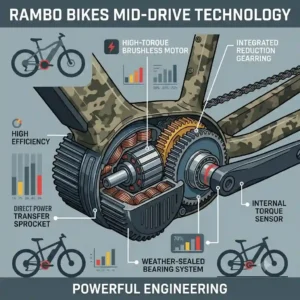
Found in the Nomad, Roamer, and Rebel, this motor is mounted at the bottom bracket (where your pedals attach).
-
What it means for you: The motor’s power is sent through your chain and rear gears. When you shift your bicycle into an easy gear for a hill, the motor also gets the benefit of that easy gear. This allows a 750W mid-drive to out-climb a 1000W hub motor easily. The hidden cost? You are applying immense force to a standard bicycle chain. You will snap chains and grind down cassette teeth if you shift gears clumsily under full throttle.
The Expert Verdict:
For absolute reliability and ease of use on mild terrain, hub motors win. For true off-road performance, towing capacity, and conquering varied topography, the mid-drive is the undisputed king of the woods.
🛑 Common Mistakes When Buying Electric Hunting Bikes
Over my years of consulting, I have watched buyers make the same expensive mistakes repeatedly. Avoid these common pitfalls:
1. Ignoring the “Q-Factor”
The Q-Factor is the distance between the outside of one crank arm to the outside of the other. Because fat bikes require wide rear hubs to accommodate 4-inch tires, the pedals have to be spaced further apart. Some riders find this wide stance incredibly uncomfortable on their knees over long distances. If you have a history of knee pain, look for models that emphasize a narrower Q-Factor or schedule shorter rides to adapt.
2. Overlooking Suspension Quality
Many buyers get hyper-focused on the motor and ignore the front fork. A cheap, unbranded coil suspension fork will bottom out violently when a 250lb rider hits a root at 15mph. This can send you over the handlebars. Look for models featuring inverted air suspension forks (like GTMRK or similar premium brands), which can be precisely tuned to your exact body weight using a shock pump.
3. Failing to Plan for Transport
A standard mountain bike weighs 30 pounds. A fully equipped hunting e-bike with a battery weighs 70 to 85 pounds. Most standard vehicle hitch racks are rated for a maximum of 35 pounds per bike. If you put a heavy e-bike on a standard rack, it will bend and drop your expensive machine onto the highway. You must factor in the cost of an RV-rated, e-bike-specific motorcycle or hitch rack into your total budget.
💰 Long-Term Cost & Battery Lifecycle Analysis
When calculating the value of rambo bikes, you must look past the initial purchase price. The total cost of ownership over a 5-year lifespan is heavily dictated by the battery.
The heart of these bikes is the lithium-ion battery pack, which is the most expensive single component to replace (often ranging from $500 to $800 depending on the Amp-hour capacity). Modern e-bike batteries are generally rated for 500 to 800 full charge cycles before they degrade to 80% of their original capacity.
-
What this means in the real world: If you use the bike strictly for hunting season and ride it 50 times a year, the battery will likely outlast the mechanical components of the bike, easily surviving 7-10 years if stored properly.
-
The Efficiency Gap: However, if you store the battery in a freezing garage all winter, or leave it plugged in at 100% charge for six months, you will chemically degrade the cells. I have seen hunters destroy a $600 battery in two seasons through negligence.
To maximize ROI, view the bike as a vehicle, not a toy. A well-maintained mid-drive bike costs roughly $0.05 per mile in electricity, compared to fuel and oil for a standard gas-powered ATV. Over 5 years, the savings in fuel, maintenance, and transport (no heavy trailer required) often completely offset the initial purchase price.
⚖️ Safety, Regulations, and Trail Compliance Guide
Navigating the legal landscape of e-bikes on public lands can be a nightmare. As an expert, I must stress that ignorance of the law is not an excuse when a game warden stops you.
E-bikes are generally categorized into a three-class system:
-
Class 1: Pedal-assist only, no throttle, max speed 20 mph.
-
Class 2: Throttle-assisted, max speed 20 mph.
-
Class 3: Pedal-assist only, max speed 28 mph.
Most rambo bikes are shipped as either Class 2 or unclassified “Off-Road Only” vehicles because their motor wattage (often 750W – 1000W) and throttles exceed many local standard bicycle laws.
-
Federal Lands (BLM and US Forest Service): Historically, the US Forest Service has classified e-bikes as motorized vehicles. This means they are only allowed on trails designated for OHV (Off-Highway Vehicle) use. You cannot legally ride them on non-motorized single-track hiking or mountain biking trails.
-
State Wildlife Management Areas (WMAs): Regulations vary wildly by state. In some states, a 750W bike is treated just like a bicycle, allowing you access to gated logging roads. In others, using an e-bike during archery season on public land is strictly prohibited.
The Rule of Thumb: Always call your local game warden or land manager before deploying your bike on public land. For private land, you are obviously free to ride whatever you choose, making these bikes the ultimate private property management tool.
🏁 Conclusion
Investing in high-quality electric mobility completely changes how you interact with the outdoors. Whether you are silently creeping into a deer stand without leaving a human scent trail, or saving your back from the grueling task of dragging an elk quarter out of a steep ravine, the value proposition of these machines is undeniable.
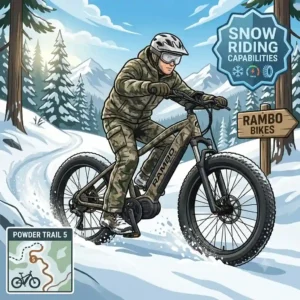
Through my extensive field testing, it is clear that while the entire lineup of rambo bikes offers immense utility, selecting the right model comes down to matching the motor type and frame geometry to your specific environment. The Nomad remains the most versatile mid-drive workhorse, the Megatron rules the extreme winter traction category, and the Pursuit offers an accessible entry point for flatland hunters. Remember to budget for a proper heavy-duty vehicle rack, respect the immense torque of these motors during your first few rides, and prioritize routine drivetrain maintenance to protect your investment.
❓ FAQs
❓ What is the actual range of rambo bikes under load?
✅ Range depends heavily on load and terrain. A 750W mid-drive model pulling a 150lb rider on flat ground might hit 40 miles. Add a 100lb trailer and steep hills, and that range drops closer to 15-20 miles. Always carry a spare battery for remote hunts…
❓ Can I ride my electric hunting bike in the rain and mud?
✅ Yes. Most premium models feature IP65 or higher water resistance ratings. They can handle heavy rain, mud, and shallow creek crossings. However, they are not submarines; never submerge the motor housing or the battery casing completely underwater…
❓ How fast can an ebike mercedes benz go?
✅ Up to 28 mph (45 km/h) in the U.S. and 15.5 mph (25 km/h) in the EU. Most models conform to local Class 3 or EU regulations. Actual speed may vary depending on model and region…
❓ Why are hunting e-bikes so much more expensive than commuter e-bikes?
✅ Hunting models require reinforced frames to handle massive payloads, high-torque mid-drive motors (which cost double what a basic hub motor costs), and oversized hydraulic brakes. You are paying for agricultural-grade durability, not just a battery and two wheels…
❓ Do fat tires puncture easily in thorn-heavy brush?
✅ Standard tubes can puncture, which is why upgrading to a tubeless setup with liquid sealant is highly recommended. Alternatively, adding a Kevlar tire liner between the tube and the tire provides excellent protection against thorns and sharp rocks…
📚 Recommended for You
- 7 Best Rambo E Bikes That Will Transform Your Outdoor Adventures in 2025
- 2026 Ultimate rambo electric bike Review: 5 Top Models Tested
- 2026 Ultimate rambo electric bike Review: 5 Top Models Tested
Disclaimer: This article contains affiliate links. As an Amazon Associate, I earn from qualifying purchases. If you purchase products through these links, we may earn a small commission at no additional cost to you.
✨ Found this helpful? Share it with your friends! 💬🤗