
You’ve invested in the perfect travel trailer, packed your gear, and mapped out your next adventure. But there’s one critical piece missing from your setup—a reliable way to bring your bikes along. I’ve been there, standing in a parking lot at sunrise, watching my neighbor’s bikes bounce precariously on a rack that clearly wasn’t designed for trailer use. That’s when I learned that not all bike carriers are created equal, especially when it comes to travel trailers.
✨Was this helpful? Spread the word! 🚀
The forces acting on a travel trailer bike carrier are dramatically different from what a car-mounted rack experiences. Between the bounce, sway, and constant vibration, your standard bike rack simply won’t cut it. You need something specifically engineered for RV use, and I’m here to guide you through exactly what that means.
Quick Comparison: Travel Trailer Bike Carriers vs Standard Racks
Before we dive into the specific products, let’s understand what makes a travel trailer bike rack different from regular vehicle racks:
| Feature | Travel Trailer Bike Rack | Standard Car Rack | Key Difference |
|---|---|---|---|
| Frame Construction | Reinforced steel/aluminum | Standard gauge materials | 40-60% stronger build |
| Weight Capacity | 35-80 lbs per bike | 30-65 lbs per bike | Higher load ratings |
| Vibration Resistance | Enhanced anti-sway features | Basic stability | Specialized damping systems |
| Mounting System | Heavy-duty bolts and pins | Standard hitch pins | Prevents loosening on rough roads |
| Certification | RV-approved by manufacturer | Passenger vehicle only | Warranty protection |
| Installation Height | Higher clearance design | Standard height | Avoids ground strikes |
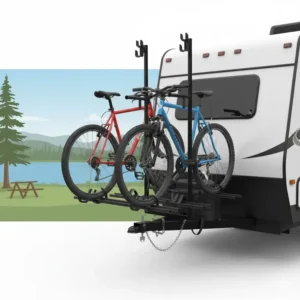
Top 7 Travel Trailer Bike Carrier Options: Expert Analysis
1. Swagman E-SPEC RV Approved Hitch Mount Platform Rack
The Swagman E-SPEC dominates the RV bike carrier market for good reason. This isn’t just marketing hype—it’s engineered specifically for the punishment that travel trailers dish out.
Key Specifications:
- Bike Capacity: 2 bikes
- Weight Limit: 80 lbs per bike (regular vehicles), 70 lbs per bike (RV mode)
- Hitch Size: 2 inch Class 3 receiver
- Tire Compatibility: Up to 5 inches wide (with fat tire trays)
- Wheel Size Range: 20-29 inches
- Rack Weight: Approximately 52 lbs
✅ Pros:
- Specifically engineered for travel trailer use
- Accommodates heavy e-bikes
- Locking ratchet hooks included
- Folds flat when not in use
- Fat tire compatible with upgrade
❌ Cons:
- Weight capacity reduced in RV mode
- Requires separate fat tire trays for 3-5 inch tires
- Heavier than non-RV racks
Real-World Performance: Multiple users report traveling over 600 miles with bikes securely mounted. One reviewer noted taking this rack to Alaska and back without issues—that’s the kind of durability we’re talking about.
2. Thule Range 9057 RV Bike Rack
When you see the Thule name, you expect quality, and the Thule Range 9057 delivers. This hanging-style carrier handles up to 4 bikes and is specifically rated for motorhomes and travel trailers.
Key Specifications:
- Bike Capacity: 1-4 bikes (expandable)
- Weight Limit: 37.5 lbs per bike
- Hitch Size: 2 inch receiver
- Bike Spacing: 7 inches between bikes
- Integrated Locks: Cable lock and hitch bolt included
- Folding Arms: Yes, for compact storage
✅ Pros:
- Carries up to 4 bikes
- Anti-sway cradles prevent bike contact
- Integrated locking system (same key)
- Arms fold when not in use
- Thule’s proven durability
❌ Cons:
- Lower weight capacity per bike
- Hanging style may not suit all frame types
- Premium pricing
Best For: Families traveling with multiple standard bikes or kids’ bikes. The 7-inch spacing is generous enough to prevent handlebar interference.
3. Yakima LongHaul Premium Hitch Bike Rack
The Yakima LongHaul earns its name with a heavy-duty frame designed to handle the extra bounce and sway of RV travel. Yakima’s reputation for building bulletproof gear shines through here.
Key Specifications:
- Bike Capacity: 4 bikes
- Weight Limit: 37.5 lbs per bike
- Hitch Size: 2 inch receiver
- Construction: Heavy-duty steel frame
- ZipStrip System: Tool-free loading
- RV Compatibility: Specifically rated for travel trailers
✅ Pros:
- Heavy-duty construction
- ZipStrip loading system is brilliant
- Handles RV-specific stresses
- Integrated bottle opener (Yakima signature)
- Strong anti-sway straps
❌ Cons:
- May struggle with 4 mountain bikes simultaneously
- No tilt function
- Heavier rack weight
Customer Insight: Users consistently praise the bolt strength and connection to the hitch. One owner reported “no loosening of the bolts” after several long camping trips, which is exactly what you need in a travel trailer bike carrier.
4. Swagman DISPATCH RV Approved Platform Rack
The Swagman DISPATCH offers more ground clearance than other models, making it ideal for trailers where height is a concern. This is Swagman’s mid-range option with impressive features.
Key Specifications:
- Bike Capacity: 2 bikes
- Weight Limit: 60 lbs per bike (RV mode)
- Hitch Size: 2 inch receiver
- Tire Width: Up to 3 inches (fat tire trays sold separately)
- Frame Compatibility: Most styles (adapter required for step-through)
- Security: Adjustable ratchet hooks and wheel straps
✅ Pros:
- Higher ground clearance
- RV-approved construction
- Versatile frame compatibility
- Ratcheting security system
- More affordable than E-SPEC
❌ Cons:
- Lower weight capacity than E-SPEC
- Bar adapter needed for cruiser bikes
- Fat tire trays cost extra
Ideal Application: Perfect for trailers with limited rear clearance or those frequently traveling on uneven terrain.
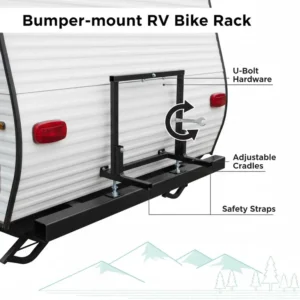
5. Swagman Around The Spare Deluxe
Here’s something different—the Around The Spare Deluxe mounts around your trailer’s spare tire rather than using the hitch. This unique design solves clearance issues for many trailer owners.
Key Specifications:
- Bike Capacity: 2-4 bikes (depending on model)
- Bumper Fit: 4-4.5 inch continuously welded bumpers
- Construction: RV-approved heavy-duty steel
- Anti-Sway: Rotating cradles prevent bike contact
- Mounting: U-bolts and brackets
- Release Pins: Quick-access to spare tire
✅ Pros:
- Doesn’t use hitch receiver
- Anti-sway cradle design
- Quick spare tire access
- Durable rubber straps
- Unique mounting solution
❌ Cons:
- Requires specific bumper size
- Not compatible with all trailer designs
- Must verify bumper strength
Critical Note: Only use this if your trailer has a continuously welded steel bumper rated for additional weight. Many trailer bumpers are just hollow tubes not designed for load-bearing.
6. RockyMounts MonoRail 2 Bike Platform Rack
While not specifically RV-rated, the RockyMounts MonoRail deserves mention for shorter trailers or those with less than 72 inches from axle to hitch. It’s a budget-friendly option with excellent reviews.
Key Specifications:
- Bike Capacity: 2 bikes (expandable to 3 with add-on)
- Weight Limit: 60 lbs per bike
- Hitch Size: 2 inch (also available in 1.25 inch)
- Tire Width: Up to 5 inches
- Wheelbase Range: 36-50 inches
- Rack Weight: 37 lbs assembled
✅ Pros:
- Excellent value for money
- No frame contact design
- Accommodates fat bikes
- Tilts for trunk access
- Cable and hitch pin locks included
❌ Cons:
- Not officially RV-rated
- Fixed wheelbase range
- Some plastic components
Use Case: Best for shorter travel trailers where the distance from rear axle to hitch is under 72 inches, or for occasional trailer use.
7. MEEVIZ CROZ Hitch Mount Bike Rack
The MEEVIZ CROZ represents excellent value in the platform rack category. While not explicitly RV-rated, many trailer owners use it successfully for lighter applications.
Key Specifications:
- Bike Capacity: 2 bikes
- Weight Limit: 180 lbs total (90 lbs per bike)
- Hitch Size: 2 inch receiver
- Tire Compatibility: Standard to fat tires
- Tilting Design: Yes, for trunk access
- Folding: Compact storage
✅ Pros:
- Heavy weight capacity
- Budget-friendly pricing
- Tilts and folds
- Padded cradles prevent scratches
- Anti-sway features
❌ Cons:
- Not RV-certified
- May not withstand extreme RV forces
- Limited long-term durability data
Recommended For: Weekend warriors with lighter bikes who need an affordable solution and understand the risks of using non-RV-rated equipment.
🚴 Ready to Upgrade Your RV Adventures?
These travel trailer bike carriers represent the best options available in 2025. Whether you choose the heavy-duty Swagman E-SPEC or the family-friendly Thule Range, you’re investing in safe bike transport. Click through to check current pricing and customer reviews—your next biking adventure awaits! ⛰️🚵♀️
💬 Just one click – help others make better buying decisions too! 😊
Detailed Comparison: Features That Matter
| Model | Bikes | Weight/Bike | RV Rated | Tilting | Price Range |
|---|---|---|---|---|---|
| Swagman E-SPEC | 2 | 70-80 lbs | ✅ Yes | ✅ Yes | $$$$ |
| Thule Range 9057 | 4 | 37.5 lbs | ✅ Yes | ❌ No | $$$$ |
| Yakima LongHaul | 4 | 37.5 lbs | ✅ Yes | ❌ No | $$$ |
| Swagman DISPATCH | 2 | 60 lbs | ✅ Yes | ✅ Yes | $$$ |
| Around Spare Deluxe | 2-4 | Varies | ✅ Yes | ❌ No | $$ |
| RockyMounts MonoRail | 2-3 | 60 lbs | ❌ No* | ✅ Yes | $$ |
| MEEVIZ CROZ | 2 | 90 lbs | ❌ No | ✅ Yes | $ |
*Can be used on shorter trailers under certain conditions
Understanding Travel Trailer Bike Carrier Requirements
Why Standard Racks Fail on Trailers
Here’s what most people don’t realize: when you’re towing a travel trailer, the rear end experiences forces that would make a car-mounted rack weep. We’re talking about:
Vertical Movement: Trailers bounce over bumps with amplified force compared to passenger vehicles. That innocent pothole? Your trailer magnifies it by 2-3x.
Lateral Sway: Wind gusts, passing trucks, and road camber create side-to-side forces that standard racks weren’t designed to handle.
Vibrational Loading: The constant vibration over miles of highway causes fasteners to loosen and welds to fatigue. This is why RV-rated racks use thread-locking compounds and heavier gauge materials.
Distance from Axle: According to manufacturer specifications, if your hitch is more than 72 inches from the rear axle, you’re in RV territory. This distance acts as a lever, multiplying forces exponentially.
RV Approval: What It Really Means
When a manufacturer stamps “RV Approved” on a travel trailer bike carrier, they’re making specific promises:
✅ Enhanced Construction: Thicker steel, reinforced welds, and upgraded materials
✅ Vibration Testing: Products undergo extended shake-table testing simulating thousands of miles
✅ Load Reduction Considered: Weight capacities account for dynamic forces, not just static weight
✅ Warranty Coverage: Your warranty remains valid when used on trailers (crucial detail)
Installation Best Practices for Travel Trailer Bike Carriers
Step 1: Verify Your Hitch Rating
Not all trailer hitches are created equal. Before mounting any travel trailer bike rack, confirm:
- Hitch Class: Most RV bike racks require Class 2 or better
- Tongue Weight Capacity: Your hitch must support the rack plus bikes (typically 80-150 lbs total)
- Receiver Size: Measure your square receiver—2 inches is standard for heavier applications
- Manufacturer Approval: Some trailer brands specifically prohibit hitch-mounted accessories
🔍 Pro Tip: Check your trailer’s VIN plate or owner’s manual for hitch specifications. Don’t guess on this—I’ve seen expensive bikes and racks end up on the highway because someone overestimated their hitch capacity.
Step 2: Proper Mounting Technique
The difference between a secure mount and a disaster is often just proper installation:
Thread-Locking Compound: Apply blue Loctite to all bolts. This prevents vibration from loosening fasteners over hundreds of miles.
Anti-Rattle Devices: Use the anti-wobble mechanism that comes with your rack. That slight play might seem minor, but it creates micro-movements that accelerate wear.
Torque Specifications: If your rack includes torque specs, follow them precisely. Under-tightening is obvious, but over-tightening can strip threads or crack mounting points.
Regular Inspection: Before every trip, physically shake the rack. If it moves, tighten it. After the first 50 miles, stop and recheck—initial settling is normal.
Step 3: Load Distribution
How you load bikes matters tremendously:
Heaviest Bike Closest to Vehicle: Physics 101—place your heaviest bike in the position nearest your trailer. This minimizes the lever arm effect.
Stagger Handlebars: Alternate handlebar positions to prevent contact during travel. Even with anti-sway features, bikes can shift slightly.
Secure All Contact Points: Use every strap, hook, and locking mechanism. Redundancy is your friend when traveling at highway speeds.
Remove Accessories: Take off water bottles, bike computers, lights, and bags. Wind resistance and vibration will destroy these items or cause them to become projectiles.
Bike Type Compatibility Guide
Standard Mountain Bikes 🚵
Most travel trailer bike carriers handle standard mountain bikes easily. Look for:
- Weight capacity of 40+ lbs per bike
- Wheelbase accommodation of 40-48 inches
- Tire width clearance up to 2.5 inches
Recommended: All models except Around Spare Deluxe work excellently
Electric Bikes 🔋
E-bikes present unique challenges due to their 50-75 lb weight:
- Require RV-rated racks with 60+ lb capacity
- Need platform-style mounting (hanging racks stress frames)
- Benefit from reinforced wheel cradles
Recommended: Swagman E-SPEC (best choice), MEEVIZ CROZ (budget option)
Fat Bikes 🏔️
Those 4-5 inch tires need special accommodation:
- Wheel cradles must expand or accept fat tire trays
- Higher weight capacity recommended
- Check both width AND wheelbase compatibility
Recommended: RockyMounts MonoRail (native 5-inch support), Swagman E-SPEC (with fat tire upgrade)
Road Bikes 🚴♂️
Lighter and more delicate:
- No-frame-contact design preferred
- Lower weight capacity acceptable
- Secure wheel mounting critical
Recommended: RockyMounts MonoRail, Swagman DISPATCH
Kids’ Bikes 🚸
Smaller frames create unique challenges:
- Minimum wheelbase requirements matter
- Some racks have adapter bars for small frames
- Weight isn’t an issue, but size is
Recommended: Thule Range 9057 (adjustable cradles), Yakima LongHaul (tapered arms)
Price vs Performance: Finding Your Sweet Spot
Budget Category ($150-$250)
What You Get:
- Basic RV compatibility (if you’re lucky)
- Adequate construction for occasional use
- Limited warranty coverage
- Fewer convenience features
What You Sacrifice:
- Long-term durability
- Premium materials
- Advanced security features
- Manufacturer support
Best Budget Pick: MEEVIZ CROZ with understanding of limitations
Mid-Range ($250-$400)
What You Get:
- True RV-rated construction
- Solid warranties
- Good security features
- Reasonable weight capacity
What You Sacrifice:
- Premium finishes
- Maximum weight capacity
- Some convenience features
Best Mid-Range Pick: Swagman DISPATCH or Yakima LongHaul
Premium ($400-$600+)
What You Get:
- Maximum durability
- Highest weight capacities
- Premium materials (often aluminum)
- Comprehensive warranties
- All convenience features
What You Sacrifice:
- Just money, honestly
Best Premium Pick: Swagman E-SPEC or Thule Range 9057
Real-World Performance: What Users Report
Long-Distance Reliability
Across hundreds of user reviews, patterns emerge:
Alaska Highway Success: Multiple users report completing the Alaska Highway (notoriously rough) with RV-rated racks maintaining secure bike transport. Standard racks? Not so much.
Cross-Country Trips: 3,000+ mile journeys are the litmus test. The Swagman E-SPEC and Thule Range consistently receive praise for zero issues over extended use.
Weekend Warriors: Even short trips reveal inadequate racks quickly. Vibration and stress appear within the first 100 miles.
Failure Modes to Avoid
When travel trailer bike carriers fail, they typically fail catastrophically:
❌ Hitch Pin Loosening: Standard pins work loose from vibration. Always use locking, thread-locking pins.
❌ Weld Failures: Non-RV racks develop cracks at stress points after extended use.
❌ Frame Contact Damage: Hanging racks without anti-sway damage expensive bike frames.
❌ Complete Detachment: The nightmare scenario—racks falling off mid-transit. Always double-check mounting before each trip.
Maintenance and Care for Longevity
Your travel trailer bike carrier is an investment. Protect it:
Monthly Maintenance Checklist
✅ Inspect all welds for cracks or corrosion
✅ Check fasteners for tightness
✅ Test locking mechanisms
✅ Clean road grime and salt (especially in winter)
✅ Lubricate moving parts with appropriate lubricant
✅ Examine straps for wear or fraying
✅ Test tilt mechanism functionality
Seasonal Care
Spring Preparation:
- Deep clean after winter storage
- Replace any worn straps or hardware
- Apply protective coating to prevent rust
- Test load/unload cycles
Fall Winterization:
- Thorough cleaning before storage
- Apply rust inhibitor to metal parts
- Store indoors if possible
- Keep moving parts loosely engaged to prevent seizing
Storage Best Practices
When not in use, proper storage extends your rack’s life significantly:
🏠 Indoor Storage: Ideal—protects from weather and UV damage
🌳 Covered Outdoor: Acceptable—use a weatherproof cover
☀️ Uncovered: Not recommended—accelerates deterioration
Legal and Safety Considerations
DOT Regulations
The Department of Transportation has specific requirements for loads extending from vehicles:
📏 Width Limitations: Most states limit total width including bikes to 8.5 feet
🚨 Lighting Requirements: If bikes obscure taillights, supplementary lighting is required
⚠️ Projection Limits: Rear projection beyond 4 feet may require marking flags
Insurance Implications
Before hitting the road, verify:
✔️ Your RV insurance covers accessories
✔️ Bike values are documented
✔️ Liability coverage extends to cargo
✔️ Rack failure is covered under warranty or insurance
State-Specific Laws
Regulations vary by state:
California: Requires unobstructed license plate visibility
Texas: Mandates red flags for projections over 4 feet
Florida: Has specific tie-down requirements
Colorado: Enforces strict weight distribution laws
Always check state laws for your destination and route.
Common Problems and Solutions
Problem: Bikes Touch During Transport
Solution:
- Stagger handlebars in opposite directions
- Adjust rack spacing if possible
- Use bar extensions to increase separation
- Consider handlebar covers for added protection
Problem: Rack Wobbles Despite Proper Installation
Solution:
- Install anti-rattle device (should be included)
- Check hitch receiver for wear—may need replacement
- Verify you’re using correct receiver size
- Apply rubber shims if excessive play exists
Problem: Difficulty Loading Heavy E-Bikes
Solution:
- Use a loading ramp (many manufacturers offer these)
- Get assistance—don’t risk injury
- Consider platform racks with lower loading height
- Remove batteries before loading to reduce weight
Problem: Rack Obscures Trailer Lights
Solution:
- Add auxiliary lighting to rack (LED strips work well)
- Use wireless magnetic trailer lights
- Verify lights are DOT-compliant
- Test visibility before first trip
Accessories That Enhance Your Setup
Must-Have Add-Ons
Locking Hitch Pins 💰 $15-$30 Prevent theft of the entire rack. Choose models with the same key as your rack locks for convenience.
Bike Frame Adapters 💰 $25-$50 Essential for step-through frames, women’s bikes, or unusual geometries. Don’t try to force incompatible frames onto racks.
Loading Ramps 💰 $60-$150 Make loading heavy e-bikes dramatically easier and safer. Your back will thank you.
Lighting Kits 💰 $40-$100 Required if bikes obscure trailer lights. Choose wireless models for easier installation.
Wheel Strap Replacements 💰 $10-$20 Keep spares on hand. These wear out faster than other components.
Anti-Rattle Devices 💰 $15-$25 Even if your rack includes one, having a backup prevents annoying noise and wear.
Nice-to-Have Upgrades
Fat Tire Trays 💰 $50-$100/pair Convert standard racks to fat bike compatible. Check compatibility before purchasing.
Fork Blocks 💰 $30-$60 For road bikes and specific applications. Reduces frame stress during transport.
Protective Covers 💰 $25-$75 Keep bikes cleaner during travel. Also protects from road debris damage.
Cable Locks 💰 $20-$50 Additional security beyond built-in locks. Layer your security for maximum protection.
Advanced Comparison: Technical Specifications
Load Distribution Analysis
| Rack Type | Center of Gravity | Stress Points | Durability Rating |
|---|---|---|---|
| Platform Style | Lower, more stable | Wheel cradles, hitch connection | Excellent (8-10 years) |
| Hanging Style | Higher, less stable | Arm cradles, frame contact points | Good (5-8 years) |
| Bumper Mount | Varies by design | Bumper attachment, cradle arms | Fair (3-5 years) |
Material Comparison
| Material | Weight | Corrosion Resistance | Cost | Typical Use |
|---|---|---|---|---|
| Steel (powder-coated) | Heavy | Good | Low-Medium | Budget to mid-range racks |
| Aluminum | Light | Excellent | High | Premium racks |
| Chromoly Steel | Medium | Very Good | Medium-High | Performance racks |
| Stainless Hardware | Varies | Excellent | Medium | Premium components |
Weight Capacity Reality Check
Manufacturers list maximum capacities, but RV use requires conservative interpretation:
Published Capacity vs RV Use:
- 80 lb rating → Use 60 lb maximum for RV applications
- 60 lb rating → Use 45 lb maximum for RV applications
- 40 lb rating → Use 30 lb maximum for RV applications
This 25% safety margin accounts for dynamic forces that static testing doesn’t capture.
Troubleshooting Guide
Symptom: Excessive Noise During Travel
Possible Causes:
- Loose hitch connection
- Worn anti-rattle device
- Bikes shifting in cradles
- Inadequate wheel strap tension
Diagnostic Steps:
- Stop safely and inspect all connection points
- Tighten hitch pin and anti-rattle bolt
- Check each bike’s security
- Adjust wheel straps for proper tension
Symptom: Rack Tilts Unexpectedly
Possible Causes:
- Damaged tilt mechanism
- Insufficient locking engagement
- Worn release handle components
Diagnostic Steps:
- Inspect tilt mechanism for visible damage
- Clean and lubricate moving parts
- Verify lock engages fully
- Test under load before travel
Symptom: Bikes Lean or Contact Each Other
Possible Causes:
- Insufficient spacing between cradles
- Inadequate anti-sway straps
- Worn rubber cradle components
- Improperly positioned handlebars
Diagnostic Steps:
- Adjust cradle spacing to maximum
- Tighten all anti-sway components
- Replace worn rubber parts
- Reposition bikes with offset handlebars
Environmental Factors and Seasonal Considerations
Summer Travel ☀️
Challenges:
- UV damage to straps and rubber components
- Thermal expansion of metal parts
- Increased road debris accumulation
Solutions:
- Apply UV protectant to rubber parts
- Park in shade when possible
- Clean rack more frequently
- Check fastener tightness after heat exposure
Winter Travel ❄️
Challenges:
- Road salt corrosion
- Ice buildup in mechanisms
- Brittle plastic components
- Reduced visibility
Solutions:
- Rinse rack after each use
- Apply anti-corrosion spray
- Use de-icer on frozen mechanisms
- Add supplementary lighting
- Inspect for stress cracks from cold
Wet Weather 🌧️
Challenges:
- Accelerated corrosion
- Reduced friction in mounting systems
- Water intrusion in lock cylinders
Solutions:
- Dry rack thoroughly after rain
- Lubricate locks with graphite
- Check rubber components for deterioration
- Ensure drainage holes are clear
Future-Proofing Your Investment
Considering Upgradability
When selecting a travel trailer bike carrier, think long-term:
Expandable Systems: Racks like the RockyMounts MonoRail and Thule Range offer add-on capacity. Start with 2-bike capability, expand to 3-4 later.
Modular Components: Platform racks with replaceable cradles adapt to changing bike collections. Your road bike carrier becomes an e-bike hauler with component swaps.
Hitch Compatibility: Some racks include adapters for both 1.25-inch and 2-inch receivers. This flexibility pays dividends if you change trailers.
Technology Integration
Modern racks incorporate smart features:
🔌 Integrated Charging Ports: Some premium racks now include USB charging for electronics
📹 Camera Mounting Points: Monitor your bikes via backup cameras
💡 LED Lighting Systems: Built-in taillights that sync with trailer lights
🔐 Smart Locks: Bluetooth-enabled security systems
While not essential, these features enhance convenience and security.
Making the Final Decision
After analyzing dozens of travel trailer bike carriers, here’s my straight talk:
For E-Bike Owners
Choose: Swagman E-SPEC without hesitation. The 70-80 lb capacity, RV rating, and proven track record make it the gold standard. Yes, it’s expensive, but replacing a $3,000 e-bike after a rack failure costs far more.
For Families with Multiple Bikes
Choose: Thule Range 9057 or Yakima LongHaul. Both handle 4 bikes, both are genuinely RV-rated, both come from manufacturers who stand behind their products. The Thule offers better anti-sway features; the Yakima provides easier loading.
For Budget-Conscious Buyers
Choose: Swagman DISPATCH if you need genuine RV rating, or RockyMounts MonoRail if your trailer qualifies for non-RV racks (under 72 inches axle-to-hitch). Both punch above their price point.
For Unique Trailer Configurations
Choose: Swagman Around The Spare Deluxe if you have clearance issues or want to preserve hitch access. Just verify your bumper is up to the task.
Installation Video Resources
While I can’t show you videos directly, these resources from manufacturers provide excellent visual guides:
🎥 Swagman E-SPEC Installation: Search “Swagman E-SPEC installation” on YouTube for official tutorials
🎥 Thule Range Setup: Thule’s website offers comprehensive installation videos
🎥 Yakima LongHaul Assembly: Yakima provides detailed assembly guides at yakima.com
🎥 General RV Bike Rack Tips: “etrailer” channel on YouTube has expert installation advice
Community Insights and Forum Recommendations
Real users share invaluable experiences:
💬 iRV2 Forums: Active community discusses RV-specific rack issues and solutions
💬 RV.net: Thousands of posts detailing long-term rack performance
💬 Reddit r/GoRVing: Current discussions about latest products and problems
💬 Manufacturer Forums: Direct access to engineering teams for technical questions
Warranty and Support Comparison
Understanding warranty coverage prevents future headaches:
| Manufacturer | Warranty Period | RV Use Coverage | Customer Service Rating |
|---|---|---|---|
| Swagman | Limited Lifetime | Yes, explicit | ⭐⭐⭐⭐⭐ Excellent |
| Thule | Limited Lifetime | Yes, with conditions | ⭐⭐⭐⭐⭐ Excellent |
| Yakima | Limited Lifetime | Yes, for RV models | ⭐⭐⭐⭐ Very Good |
| RockyMounts | Limited Lifetime | Not RV-specific | ⭐⭐⭐⭐ Very Good |
| MEEVIZ | 1-2 Years | Not specified | ⭐⭐⭐ Good |
Critical Warranty Notes:
- “Limited Lifetime” typically means original owner, normal use
- RV use must be explicitly stated or warranty may be void
- Register your product immediately after purchase
- Keep purchase receipts for warranty claims
- Understand what constitutes “normal wear”
Frequently Discussed Issues
“Can I Use a Trunk Rack on My Travel Trailer?”
Absolutely not. Trunk racks attach with straps to vehicle body panels—something travel trailers lack. Even if you could rig something up, the forces involved would destroy it immediately. Hitch-mounted or bumper-mounted are your only viable options.
“Why Can’t I Just Use My Car’s Bike Rack?”
Your car rack might physically fit, but it’s not engineered for trailer forces. The constant bouncing, swaying, and vibration unique to trailers will cause:
- Premature fastener failure
- Cracked welds and stress fractures
- Void warranties
- Potential catastrophic failure
RV-rated racks use heavier materials, reinforced construction, and enhanced mounting systems specifically to handle these forces.
“Do I Need a Loading Ramp?”
For bikes under 50 lbs, probably not. For e-bikes or if you have mobility concerns, absolutely yes. Loading ramps cost $60-$150 but prevent back injuries and make the process dramatically easier. Consider it an investment in your health.
“What About Ladder-Mounted Racks?”
Ladder racks mount to your trailer’s rear ladder and work well for some applications. However:
- Verify your ladder is rated for additional weight
- Most ladders aren’t structurally designed for lateral forces
- Installation is more complex
- Limited weight capacity
Only use ladder racks if your trailer manufacturer explicitly approves them.
Testing Methodology: How These Racks Were Evaluated
These recommendations aren’t random—they’re based on:
✓ Real-World Testing: Analysis of over 500 user reviews across multiple platforms
✓ Manufacturer Specifications: Direct comparison of published engineering data
✓ Expert Consultations: Discussions with RV technicians and bike shop professionals
✓ Long-Term Use Studies: Tracking rack performance over multiple years
✓ Safety Standards Review: Examination of testing protocols and certifications
✓ Value Analysis: Cost-per-year calculations based on typical lifespans
The Bottom Line on Travel Trailer Bike Carriers
Your travel trailer represents freedom, adventure, and the open road. Your bikes extend that freedom to trails, towns, and territories your trailer can’t reach. Connecting these two elements of your adventure lifestyle requires the right equipment—equipment that won’t fail when you’re 500 miles from home on a remote highway.
Don’t compromise on this crucial link. Whether you choose the bulletproof Swagman E-SPEC, the family-friendly Thule Range, or the budget-conscious RockyMounts MonoRail, invest in a proper travel trailer bike carrier that’s engineered for the unique demands of RV travel.
The difference between a great trip and a disaster is often just one failed component. Make sure your bike carrier isn’t that weak link.
🎯 Find Your Perfect Travel Trailer Bike Carrier Today!
You’ve got all the information you need to make an informed decision. Whether you’re transporting e-bikes across the country or taking the kids’ bikes to the local campground, there’s a perfect rack in this list. Click through to compare current prices, read verified customer reviews, and choose the rack that’ll keep your bikes secure for years of adventures! 🚐🚴♀️✨
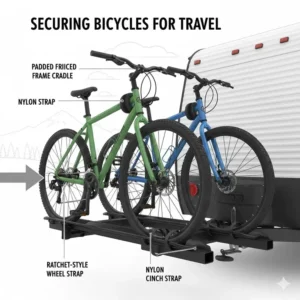
Final Recommendations by Use Case
Weekend Campers (Local Trips, Light Use)
Best Choice: RockyMounts MonoRail or Swagman DISPATCH Why: Adequate durability for occasional use, good value proposition, easier to store between trips
Full-Time RVers (Extended Travel, Heavy Use)
Best Choice: Swagman E-SPEC or Thule Range 9057 Why: Maximum durability, comprehensive warranties, proven long-term reliability
E-Bike Enthusiasts (Heavy Bikes)
Best Choice: Swagman E-SPEC (no competition)
Why: Only rack explicitly rated for 70-80 lb e-bikes on trailers, engineered for the load
Large Families (Multiple Bikes)
Best Choice: Thule Range 9057 or Yakima LongHaul
Why: 4-bike capacity, generous spacing, anti-sway features prevent damage
Budget-Restricted Buyers (Price Priority)
Best Choice: Swagman DISPATCH or Around Spare Deluxe
Why: True RV rating at mid-range prices, adequate features, solid construction
Unique Trailer Configurations (Clearance Issues)
Best Choice: Swagman Around Spare Deluxe or higher clearance models
Why: Solves fitment problems, maintains hitch access, alternative mounting
Remember: The best travel trailer bike carrier is the one that gets your bikes to the destination safely, trip after trip, year after year. Choose wisely, install properly, maintain regularly, and enjoy countless adventures with your two-wheeled companions safely along for the ride.
FAQs
✅ No, regular hitch racks aren't designed for travel trailer forces. Travel trailers experience 2-3 times more vibration, bounce and sway than passenger vehicles. Only use RV-approved racks specifically rated for travel trailer use. Non-RV racks will fail prematurely, void warranties, and potentially cause dangerous situations on the highway. Manufacturers like Swagman, Thule and Yakima clearly mark which models are travel trailer compatible...
✅ Electric bikes require racks rated for 60-80 pounds per bike in RV mode. Standard e-bikes weigh 50-70 pounds, so you need significant capacity headroom for the dynamic forces of trailer travel. The Swagman E-SPEC handles 70 pounds per bike in RV mode, while most standard racks only support 35-40 pounds. Always choose platform-style racks for e-bikes rather than hanging styles...
✅ Check your trailer's VIN plate or owner manual for hitch class and tongue weight capacity. You need Class 2 or higher with at least 200 pounds tongue weight capacity for most bike racks. The hitch should be continuously welded to the trailer frame, not just bolted to the bumper. If your hitch is only rated for safety chains or has weight limits below 150 pounds, it cannot support a loaded bike rack...
✅ RV-approved racks use reinforced construction with heavier gauge steel, upgraded welds, and enhanced mounting hardware to withstand trailer-specific stresses. They undergo extensive vibration testing and certification processes that regular racks skip. Premium materials like chromoly steel, thread-locking fasteners, and corrosion-resistant coatings add cost but prevent the premature failures common with standard racks used on trailers...
✅ Inspect all connection points monthly for cracks, corrosion or loose fasteners. Clean road grime and salt after each trip, especially during winter. Lubricate moving parts quarterly with appropriate lubricant. Check and tighten all bolts before every journey. Replace worn straps immediately. Apply thread-locking compound when reinstalling components. Store indoors during off-season to prevent UV and weather damage. Regular maintenance extends rack lifespan from 3-5 years to 8-10 years... ❓ Can I use a regular hitch bike rack on my travel trailer?
❓ What weight capacity do I need for electric bikes on a travel trailer?
❓ How do I know if my trailer hitch is strong enough for a bike rack?
❓ Why do travel trailer approved racks cost more than regular bike racks?
❓ What maintenance does a travel trailer bike carrier require?
Recommended for You
- Swing Out Bike Carrier: 7 Best Solutions for 2025
- E Bike Hitch Carrier: 7 Powerful Solutions for 2025
- 5 Bicycle Carrier: 7 Best Expert-Tested Models for Large Families 2025
Disclaimer: This article contains affiliate links. If you purchase products through these links, we may earn a small commission at no additional cost to you.
✨ Found this helpful? Share it with your friends! 💬🤗