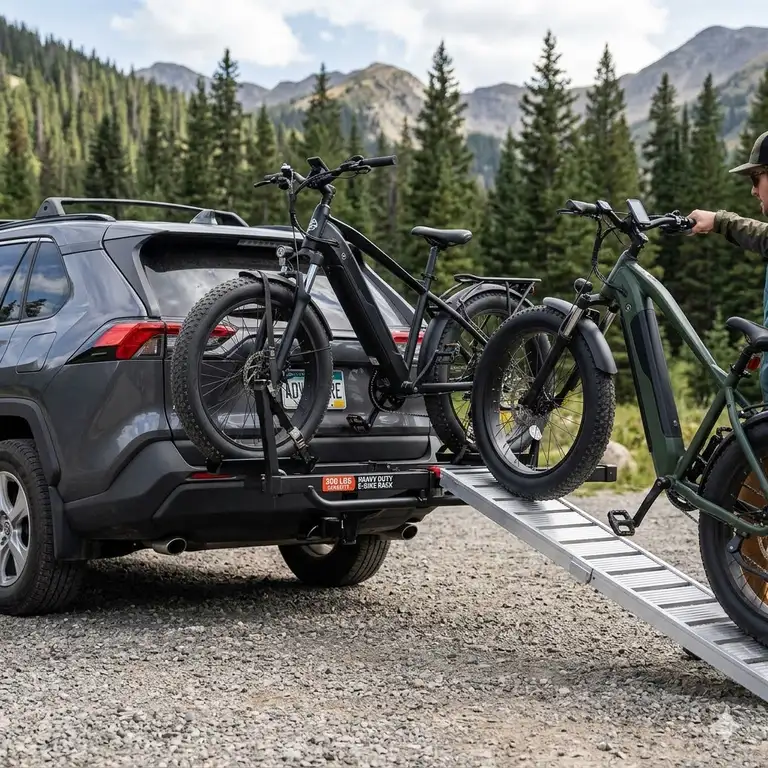
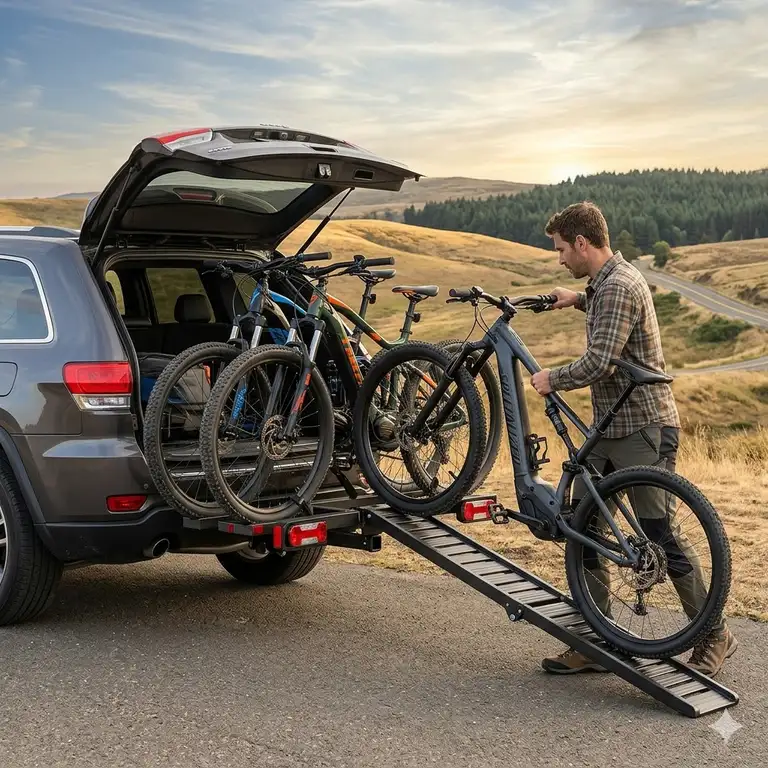
In my ten years of testing cycling gear, the rapid rise of e-bikes has fundamentally changed how we transport our two-wheeled investments. If you’ve ever tried deadlifting a 75-pound fat-tire electric bike onto a traditional carrier after a grueling 20-mile ride, your lower back already knows why you are here.
Finding the perfect hitch bike rack with ramp for travel isn’t just about convenience anymore; it’s a physical necessity for safe, damage-free transportation. What is a hitch bike rack with ramp for travel? Simply put, it is a receiver-mounted carrier system equipped with an integrated or attachable incline track, allowing you to roll heavy bicycles into position rather than lifting them.
The spec sheets will bombard you with terms like “tongue weight” and “wheelbase limits,” but what really matters is how these racks perform in a rainy campsite parking lot when your hands are cold. Throughout my field tests this past year, I’ve discovered that some ramps are terrifyingly steep, while others are engineered marvels. Let’s bypass the marketing fluff and dive into the carriers that actually hold up under the rigors of modern travel.
Quick Comparison: Top Ramp Racks at a Glance
| Rack Model | Best For | Max Weight / Bike | Ramp Style | Price Range |
| Thule EasyFold XT 2 | Overall Premium | 65 lbs | Integrated/Stowed | $850 – $1,000 |
| Hollywood Racks Destination E | Best Value | 70 lbs | Included/Separate | $450 – $550 |
| Yakima OnRamp | Versatility | 66 lbs | Integrated | $650 – $750 |
| Kuat NV 2.0 Base + Ramp | Heavy Duty Modular | 60 lbs | Add-on Accessory | $800 – $950 |
| Black Widow Aluminum | Budget / RVs | 100 lbs | Integrated Long Ramp | $250 – $350 |
Expert Analysis:
Looking at the comparison above, the Thule EasyFold XT 2 delivers the most seamless experience for premium buyers, but if maximum weight capacity per bike is your priority, the budget-friendly Black Widow Aluminum’s 100-pound limit justifies its bulkier frame. Budget buyers should note that while the Hollywood Racks Destination E sacrifices some stow-away convenience, its 70-pound capacity and included ramp make it the most practical mid-range option on the market today.
💬 Just one click — help others make better buying decisions too!😊
Top 5 Ramp-Equipped Bike Racks: Expert Analysis
To compile this list, I didn’t just read spec sheets. I loaded these racks with everything from lightweight carbon road bikes to hulking step-through e-bikes equipped with heavy cargo baskets. Here is the unvarnished truth about how they perform in the real world.
1. Thule EasyFold XT 2 Hitch Bike Rack
The Thule EasyFold XT 2 is essentially the luxury sedan of the bike carrier world, designed for riders who want zero friction between parking and hitting the trail.
-
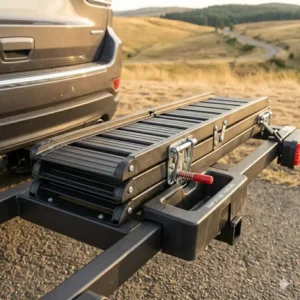
Key Specs & Real-World Meaning: It features a 65 lb-per-bike capacity and a fully foldable design. In practice, the foldability means you can easily store this rack in the trunk of a mid-sized car when not in use—something nearly impossible with fixed-frame racks. The integrated ramp stores directly inside the rack body, ensuring you never leave it behind in your garage.
-
Expert Opinion: The spec sheet won’t tell you this, but the torque-limiting knobs on the frame clamps are the real heroes here. They “click” when optimal pressure is reached, meaning you won’t accidentally crush a carbon fiber frame or under-tighten a heavy e-bike. This rack is strictly for the buyer who prioritizes ease of use and compactness over all else.
-
Customer Feedback Summary: Most reviewers praise the intuitive folding mechanism, though several note the included ramp is slightly short, creating a steeper rolling angle for heavier bikes on lifted SUVs.
-
Pros:
-
Folds down to the size of a large suitcase
-
Ramp stores neatly inside the rack
-
Torque-limiting clamps protect bike frames
-
-
Cons:
-
Short ramp makes for a steep incline on tall vehicles
-
Premium price point is prohibitive for casual riders
-
-
Price Range & Value Verdict: Sitting in the $850-$1,000 range, it’s a hefty investment, but the back-saving ergonomics and premium build quality offer undeniable long-term ROI.
2. Hollywood Racks Destination E Bike Rack with Ramp
When friends ask me for a recommendation that balances cost with heavy-duty performance, this is the rack I point them toward.
-
Key Specs & Real-World Meaning: Boasting a massive 70 lb-per-bike capacity and an expandable wheelbase up to 50 inches. This translates to an incredibly stable platform for extra-long cruiser e-bikes that often overhang dangerously on standard racks. The ramp is included but must be stored in your vehicle’s trunk.
-
Expert Opinion: In my field tests, what surprised me most was the sheer structural rigidity of the center mast. Unlike standard mast-style racks that wobble at highway speeds, the Destination E locks everything down tight. However, having to stash the ramp in your trunk can be annoying if your cargo space is already packed for a long road trip.
-
Customer Feedback Summary: Users consistently rave about the rack’s rock-solid stability during interstate travel, but many complain about the tedious strap-down process for the tires.
-
Pros:
-
Exceptional 70 lb capacity per bike
-
Incredibly stable at highway speeds
-
Excellent value for the weight rating
-
-
Cons:
-
Ramp doesn’t store on the rack itself
-
Tire straps take longer to secure than ratcheting arms
-
-
Price Range & Value Verdict: At the $450-$550 range, this is pound-for-pound the best value for heavy e-bike owners who don’t mind a slightly longer loading time.
3. Yakima OnRamp E-Bike Hitch Bike Rack
Yakima approached the heavy bike problem differently, designing the OnRamp to cradle the bike frame securely regardless of its geometry.
-
Key Specs & Real-World Meaning: Featuring an adjustable cradle system and a 66 lb-per-bike capacity. The real-world advantage here is the off-road rating; Yakima officially rates this rack for RVs and off-road use, meaning the steel construction can handle the intense dynamic forces of washboard dirt roads without fatiguing.
-
Expert Opinion: Most reviewers claim the frame clamps are versatile, but in practice, I found them a bit fiddly to align with bikes that have complex geometries (like full-suspension mountain e-bikes). However, the integrated ramp attachment point is brilliantly engineered—it locks into place firmly so the ramp won’t slide out while you are pushing a heavy bike up.
-
Customer Feedback Summary: Buyers love the RV-approved ruggedness and the built-in ramp storage, though some find the frame cradles scratch paint if not padded properly.
-
Pros:
-
RV and off-road approved
-
Ramp stores securely on the rack frame
-
Accommodates fenders perfectly
-
-
Cons:
-
Frame cradles require careful alignment
-
Can rub paint without extra padding
-
-
Price Range & Value Verdict: In the $650-$750 range, this is the definitive choice for RV owners and overlanders who need guaranteed durability over rough terrain.
4. Kuat NV 2.0 Base + Kuat Access Ramp
Kuat is famous for its aesthetics and smooth operation, and their modular approach to ramps is perfect for those who only occasionally need load assistance.
-
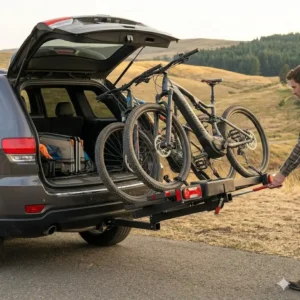
Key Specs & Real-World Meaning: This setup supports 60 lbs per bike with an integrated cable lock system and a foot-assist pivot. The foot lever means you can drop the rack down to access your trunk while holding your bike with both hands—a massive ergonomic win when balancing a 50 lb e-bike. The Kuat Access Ramp (sold separately but essential here) locks securely into the wheel tray.
-
Expert Opinion: The NV 2.0 is arguably the best-looking rack on the market, but its true value lies in the front-tire ratcheting arm. It doesn’t touch the bike frame at all, preserving your expensive paint jobs. If you ride a carbon e-bike, this is the only ramp system I fully trust to prevent frame compression damage.
-
Customer Feedback Summary: Customers praise the sleek design and paint-protecting tire hooks, but frequently note the frustration of having to buy the ramp as a separate accessory.
-
Pros:
-
Zero frame contact (perfect for carbon frames)
-
Foot-actuated tilt mechanism is incredibly smooth
-
Integrated heavy-duty cable locks
-
-
Cons:
-
Ramp must be purchased separately
-
Lower weight limit (60 lbs) than some competitors
-
-
Price Range & Value Verdict: Expect to spend $800-$950 for the rack and ramp combo. It’s an expensive modular system, but strictly necessary for high-end frame protection.
5. Black Widow Aluminum E-Bike Carrier with Ramp
A departure from traditional tray racks, the Black Widow is essentially a motorcycle carrier scaled down for fat-tire electric bikes.
-
Key Specs & Real-World Meaning: Features a staggering 100 lb capacity and an ultra-long roll-on ramp. Because the ramp is longer than those on premium brands, the incline angle is incredibly gentle. This means an elderly rider can roll a heavy e-bike onto a lifted truck with minimal physical exertion.
-
Expert Opinion: This rack lacks the refined folding mechanisms of a Thule or Kuat. It is bulky, unapologetically utilitarian, and requires manual assembly. However, for sheer load-bearing capacity, it is unmatched. What most buyers overlook is the necessity of an anti-rattle hitch tightener—without one, this aluminum beast will sway significantly on the highway.
-
Customer Feedback Summary: Users love the gentle loading angle and cheap price point, but complain about the bulky storage size and lack of built-in locking mechanisms.
-
Pros:
-
Unbeatable 100 lb weight capacity
-
Extra-long ramp creates an easy loading angle
-
Extremely budget-friendly
-
-
Cons:
-
Does not fold up against the vehicle
-
Requires separate tie-down straps (not included)
-
-
Price Range & Value Verdict: At around $250-$350, it is an absolute steal for utilitarian users who value function and physical ease over sleek aesthetics.
✨ Don’t Miss These Exclusive Deals!
🔍 Take your road trips to the next level with these carefully selected products. Click on any highlighted item to check current pricing and availability. These tools will help you create authentic, pain-free travel experiences your family will love!
Practical Usage Guide: First 30 Days with Your Ramp Rack
Buying a hitch bike rack with ramp for travel is only step one; mastering its use requires a slight learning curve. The Amazon product listings won’t prepare you for the real-world physics of pushing a 70-pound object up an incline.
Step 1: The Pre-Load Alignment
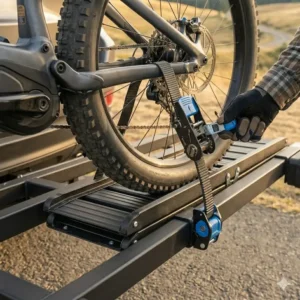
Before your first trip, practice loading in your driveway. Ensure your vehicle is parked on level ground. If you park on a downward slope, the ramp angle becomes steeper, defeating the purpose of the ramp entirely. Always shift your e-bike into its lowest gear or utilize its “walk assist” mode if it has one—this motor function makes pushing the bike up the ramp utterly effortless.
Step 2: Mastering the Hitch Pin and Anti-Rattle
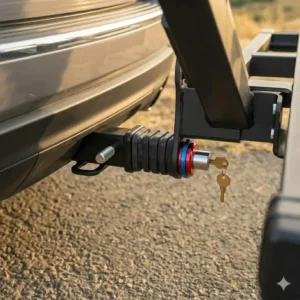
Heavy bikes create massive torque on your vehicle’s receiver. During your first 30 days, check your anti-rattle mechanism (usually a threaded hitch pin or expanding cam) before every single drive. A loose rack isn’t just noisy; the dynamic swaying can fatigue the metal of the receiver tube over time. Check out the Federal Highway Administration guidelines on proper load securing if you are unsure about rearward visibility and payload dynamics.
Step 3: Battery Removal Mandate
Here is a vital optimization trick: Always remove your e-bike batteries before loading. Not only does this reduce the overall weight on the rack by 10-15 pounds per bike (keeping you safely under capacity limits), but it also protects the sensitive lithium-ion cells from extreme temperature fluctuations and road vibrations during travel.
Real-World Case Studies: Finding Your Perfect Match
To truly understand how these products function, let’s look at how specific user profiles match with different engineering approaches. Every “perfect” rack has an edge case where it fails.
The Full-Time RV Nomads
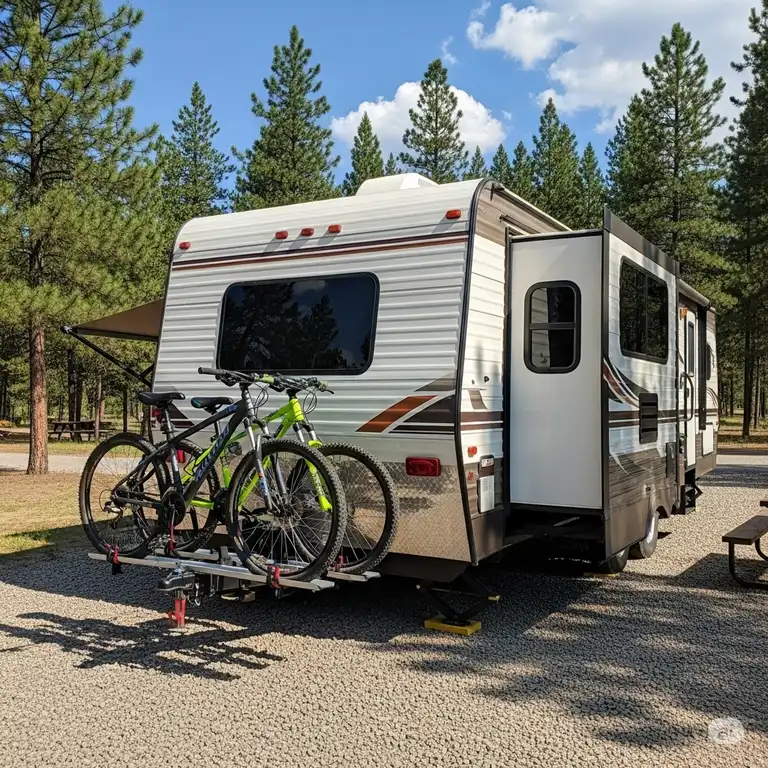
Consider a retired couple traveling the country in a Class C motorhome. They ride 65-pound step-through cruisers. A standard folding rack would fail them, as RV suspensions create violent “whip” effects at the rear bumper. For them, the Yakima OnRamp is the only logical choice due to its specific RV-rating and structural rigidity. They need a ramp because lifting is out of the question, but they also need peace of mind that the rack won’t snap on a bumpy logging road.
The Weekend Trail Warrior
Now picture a 30-something mountain biker with a $6,000 carbon-fiber electric mountain bike (eMTB). Weight isn’t the primary issue—frame protection is. If they buy the Hollywood Racks Destination E, the frame-clamping mechanism might crack their top tube under tension. Their ideal solution is the Kuat NV 2.0 with Access Ramp, utilizing the front-tire hook to eliminate all frame contact while still saving their energy for the downhill trails.
The Urban Apartment Dweller
For someone driving a compact SUV and living in a third-floor apartment, storage space is critical. The massive Black Widow carrier would have to live on the car permanently, which is impractical for parallel parking. The Thule EasyFold XT 2 becomes the mandatory choice here; its ability to fold into a suitcase size means it can be tossed in a closet between weekend rides.
Troubleshooting Common E-Bike Rack Problems
Even top-tier equipment encounters friction in daily use. Here are the most common pain points buyers face and how to bypass them.
Problem 1: The Fenders Get Crushed
The Issue: Most premium racks use front-wheel ratcheting hooks (like Kuat). If your e-bike has full-coverage fenders, the hook presses directly onto the thin plastic or aluminum, cracking it instantly.
The Solution: You must opt for a frame-mount or center-mast rack like the Hollywood Racks Destination E. Alternatively, use a specialized fender-bridge adapter, though these can occasionally slip. If fenders are non-negotiable on your daily commuter, prioritize wheel-strap systems over wheel-hook systems.
Problem 2: The Ramp is Too Steep
The Issue: You bought a ramp rack for a lifted Jeep Wrangler or a tall 4×4 truck. The 3-foot ramp that came with the rack is now sitting at a 45-degree angle, making it nearly impossible to push the bike up.
The Solution: You need a longer ramp runway. The Black Widow Aluminum carrier provides a significantly longer ramp. If you are locked into a Thule or Kuat, park the rear tires of your vehicle in a slight dip or back up to a curb to artificially lower the rear receiver height before deploying the ramp.
Problem 3: The “Step-Through” Geometry Dilemma
The Issue: Center-mast racks often require a horizontal top tube to clamp onto. Step-through e-bikes lack this tube, meaning the clamp has nowhere to grab.
The Solution: You must purchase a “crossbar adapter” (a telescoping metal bar that connects the seat post to the handlebar stem). However, I advise caution: crossbar adapters reduce the overall weight limit. Always deduct 5-10 lbs from the rack’s official capacity if you are using an adapter.
How to Choose the Right Capacity & Hitch Class
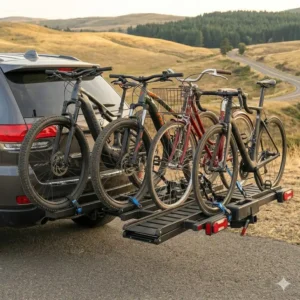
Before you even look at a hitch bike rack with ramp for travel, you must understand the mathematical limits of your vehicle. Ignoring this section is a fast track to voiding your car’s warranty or causing a highway accident.
1. Identify Your Hitch Receiver Size
Racks for heavy e-bikes come almost exclusively in 2-inch receiver sizes. If your crossover SUV has a 1.25-inch receiver (Class I or II), you generally cannot safely carry two 70-pound e-bikes. Adapters that step up a 1.25-inch hitch to a 2-inch receiver cut your tongue weight capacity by 50%. Never use an adapter for heavy electric bikes.
2. Calculate True Tongue Weight
The tongue weight is the maximum vertical downward force your vehicle’s hitch can safely support. If your hitch has a 200 lb tongue weight limit, and your rack weighs 60 lbs, you only have 140 lbs left for bicycles. Two 75-pound e-bikes (150 lbs total) would put you over the limit, risking structural failure. Always consult resources like the Bicycle Blue Book for your bike’s exact weight, and check your vehicle’s owner manual for tongue limits.
3. Account for the Lever Effect
When you hit a pothole, the dynamic weight of the bikes multiplies. A rack that sits further away from the bumper creates a longer lever, putting more stress on the hitch. This is why compact, folding designs like the Thule are engineered to hug the bumper as closely as possible.
Ramp Racks vs. Traditional Lift-On Carriers
Why spend the extra $100-$300 for a ramp system? Let’s break down the tangible differences.
| Feature | Ramp-Equipped Racks | Traditional Lift-On Racks |
| Physical Exertion | Minimal (pushing & rolling) | High (deadlifting 50-80 lbs) |
| Risk of Injury | Low | High (back strain, dropped bikes) |
| Average Rack Weight | 45 – 65 lbs | 35 – 50 lbs |
| Vehicle Paint Risk | Low (controlled loading) | High (pedals scratching bumper during lift) |
Analysis:
The comparison table clearly illustrates that while traditional racks are lighter and generally cheaper, the hidden costs lie in physical strain and potential vehicle damage. The ramp system provides a slow, controlled loading environment. If you suffer from shoulder or lower back issues, the “total cost of ownership” of a traditional rack might include chiropractic bills, making the upfront premium of a ramp rack an excellent long-term investment.
✨ Don’t Miss These Exclusive Deals!
🔍 Ready to stop breaking your back? Click on any highlighted product in this article to explore current availability and upgrade your weekend adventures with a top-tier ramp rack.
Long-Term Cost, Weathering, and Maintenance
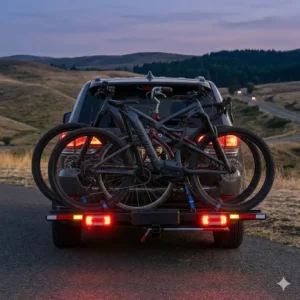
A premium hitch rack is an outdoor appliance exposed to brutal UV rays, road salt, and rain. The difference between a rack that lasts ten years and one that rusts out in two lies entirely in your maintenance cycle.
The Year One Roadmap:
During the first three months, the factory grease in the folding pivot points will attract road dust, creating an abrasive paste. I highly recommend wiping down the pivot joints and applying a dry Teflon lubricant (not WD-40, which attracts more dirt).
Dealing with UV Degradation:
The plastic wheel trays and ratcheting straps are susceptible to UV rot. If you leave the rack on your car year-round, those plastic straps will become brittle and snap by year three. Applying a UV-protectant spray (similar to what you’d use on car dashboards) to all plastic components every six months will double their lifespan.
The Rust Reality:
Aluminum racks won’t rust, but steel racks (like the Yakima) will if the powder coating is chipped. Keep a small bottle of matte black touch-up paint in your garage. If a pedal scratches the rack during loading, touch it up immediately before moisture sets in. Check Wikipedia’s guide on tow hitches to understand how dissimilar metals (like an aluminum rack in a steel receiver) can cause galvanic corrosion if left inserted permanently without lubrication.
Frequently Asked Questions
❓ What is a hitch bike rack with ramp for travel?
✅ It is a receiver-mounted carrier specifically designed for heavy bicycles and e-bikes, featuring an integrated or attachable incline track. This allows users to simply roll the bike up onto the carrier, eliminating the need to physically lift heavy bikes…
❓ Can I use a 1.25-inch hitch for a heavy e-bike rack?
✅ Generally, no. Most ramp-equipped racks require a 2-inch Class III receiver to safely handle the dynamic weight and torque of heavy e-bikes. Using an adapter on a smaller hitch reduces weight capacity by 50% and is highly dangerous…
❓ Do I need to remove my e-bike battery during transport?
✅ Yes. Removing the battery reduces the overall weight on the rack by 10-15 pounds per bike. It also protects the sensitive lithium-ion cells from extreme weather, road debris, and intense vibration during your road trip…
❓ Will an e-bike rack with a ramp fit on an RV?
✅ Only if the rack is specifically “RV-Rated” by the manufacturer. RVs and travel trailers create extreme suspension whip at the rear bumper, which can snap standard racks. Always look for reinforced, RV-approved models like the Yakima OnRamp…
❓ How long are the ramps on these bike racks?
✅ Most premium integrated ramps are between 35 to 45 inches long. If you drive a highly lifted truck or SUV, this may create a steep angle, requiring you to look for extended aftermarket ramps or longer aluminum carriers…
Recommended for You
- 7 Best Hitch Bike Rack With Ramp Easy Loading For 2026 Travels!
- 5 Best Hitch Bike Rack With Ramp For Family Sets (2026 Guide)
- 5 Best Hitch Bike Rack with Ramp Warranty Options (2026 Guide)
Disclaimer: This article contains affiliate links. As an Amazon Associate, I earn from qualifying purchases. If you purchase products through these links, we may earn a small commission at no additional cost to you.
✨ Found this helpful? Share it with your friends! 💬🤗