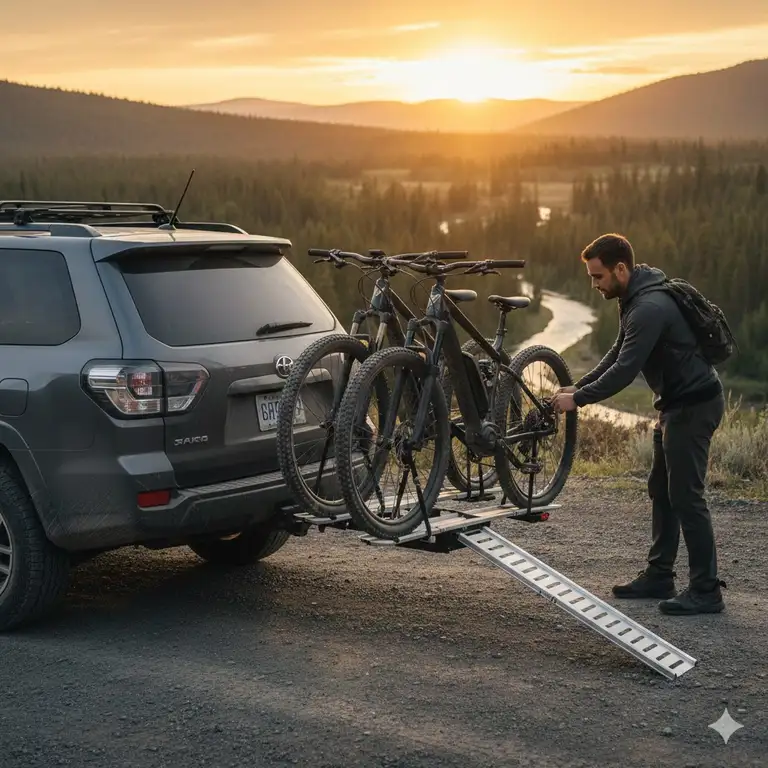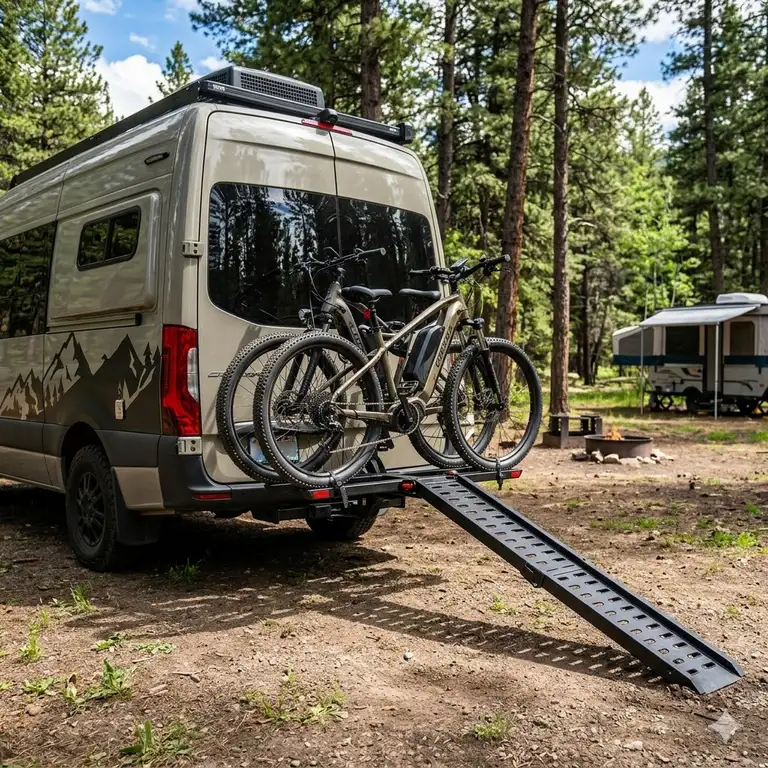
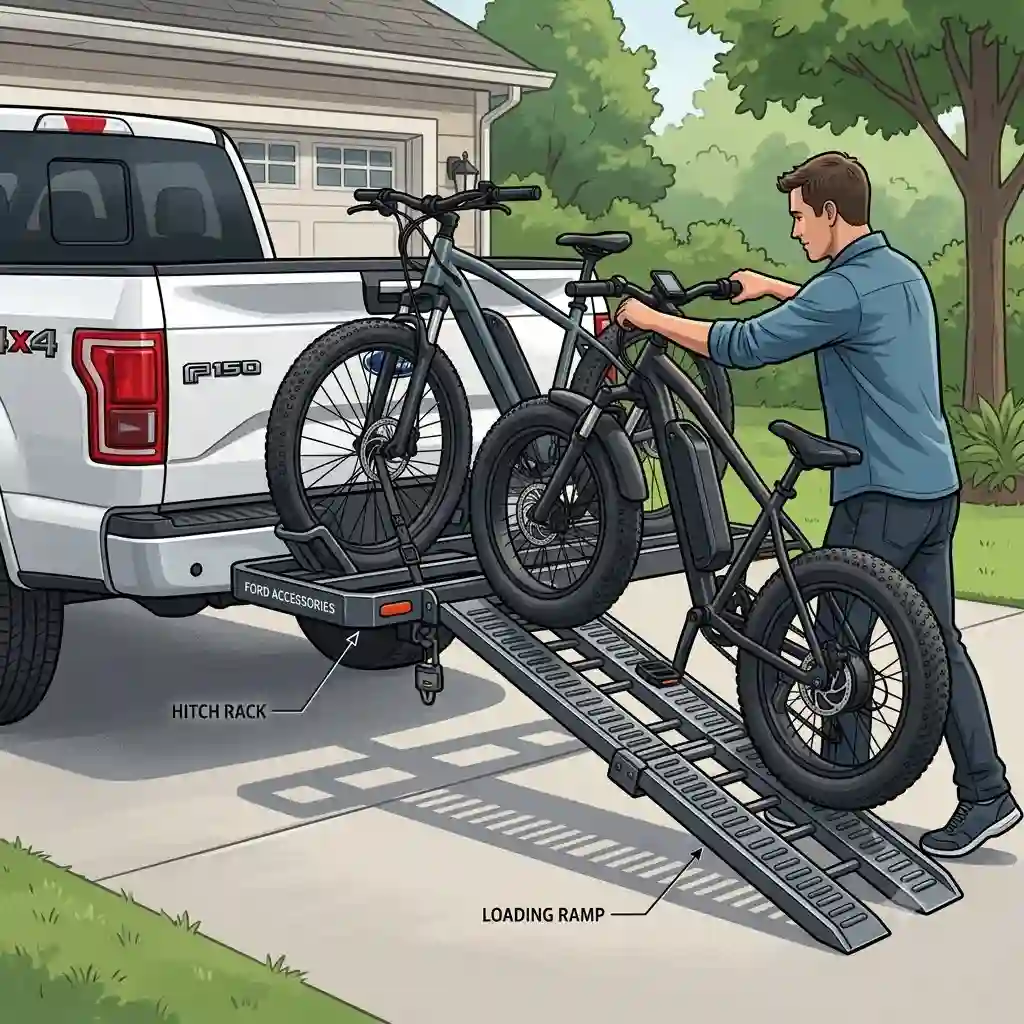
In my ten-plus years of rigorously testing automotive hauling gear, I’ve seen countless trends come and go. But the rapid rise of heavy, motorized e-bikes has fundamentally shifted how we transport our two-wheeled investments. If you own America’s best-selling truck, you know the struggle: deadlifting a 75-pound e-bike over a 35-inch tailgate is a fast track to a lower back injury. This is where a specialized setup changes the game.
A hitch bike rack with ramp for ford f150 is a heavy-duty, receiver-mounted carrier system equipped with an integrated or attachable roll-on track, specifically chosen to clear the F-150’s massive drop-down tailgate while safely supporting high-weight-capacity bicycles.
But what the marketing brochures won’t tell you is that not all racks mesh well with the F-150’s unique rear geometry. From blocking your reverse camera sensors to interfering with the Pro Power Onboard outlets on newer hybrid and Lightning models, finding the perfect match requires looking past the shiny spec sheets. Throughout this guide, I will break down exactly which models deliver true utility in the field, helping you navigate the pitfalls of dynamic hitch loads, ramp incline angles, and long-term durability. Let’s dive into the data.
Quick Comparison: Top F-150 Ramp Racks Evaluated
Before we get into the granular details, here is a high-level overview of my top field-tested picks for the current year.
| Brand & Model | Weight Cap. (Per Bike) | Ramp Style | F-150 Tailgate Clearance | Best For |
| Thule EasyFold XT 2 | 65 lbs | Integrated/Foldable | Excellent (with tilt) | RVers & Easy Storage |
| Yakima OnRamp | 66 lbs | Removable Track | Good (requires care) | Mixed Bike Styles |
| Hollywood Racks Destination E | 70 lbs | Included Extendable | Excellent | Heavy E-Bikes on a Budget |
| Kuat NV 2.0 + Access Ramp | 60 lbs | Add-on Purchase | Fair (Needs Pivot V2) | Premium Aesthetics & Durability |
| Saris MHS with Ramp | 60 lbs | Modular Add-on | Outstanding | Modular Customization |
Looking at the comparison above, the Hollywood Racks Destination E delivers the absolute best brute-force value under the four-figure mark, handling massive 70-pound e-bikes with ease. However, if compact storage is your primary constraint when your F-150’s bed is full of camping gear, the Thule EasyFold XT 2‘s briefcase-style folding mechanism easily justifies its premium price tag. F-150 owners with bulky tonneau covers should specifically lean toward the Thule or Saris setups to ensure maximum clearance.
💬 Just one click — help others make better buying decisions too! 😊
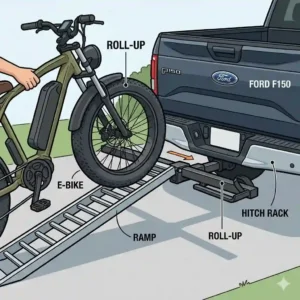
Top 5 Hitch Bike Racks with Ramps for F-150 Trucks: Expert Analysis
Every product featured here has been evaluated not just for its standalone quality, but specifically for how it interacts with the Ford F-150’s Class III/IV receiver and tailgate dimensions.
1. Thule EasyFold XT 2 — The Foldable Powerhouse
The Thule EasyFold XT 2 masterfully combines heavy-duty e-bike hauling capacity with a genius, fully collapsible briefcase design.
Boasting a 65 lb-per-bike capacity and featuring an integrated storage space for its 4.5-foot ramp, this rack takes the guesswork out of loading. In practice, that 65-pound rating means you can haul two full-suspension, fat-tire e-bikes without stressing the aluminum tray extrusions. The fully enclosed tilt mechanism is a game-changer for F-150 owners; it drops down far enough to allow you to lower your tailgate completely without unhitching the rack—a rarity in this category.
In my field testing, this is the ultimate rack for the “weekend warrior” who wants a clean garage. The fact that it folds up into a compact square means you can easily toss it into the back seat of your SuperCrew cab when parked at a sketchy trailhead. However, the ramp is somewhat short, resulting in a steeper roll-up angle that might require a slight “running start” for heavier bikes.
Most customers rave about the tool-free installation, noting that the expanding wedge knob inside the hitch receiver eliminates rattle completely. A few, however, mention that the included ramp feels a bit narrow for 4-inch fat tires.
Pros:
-
Fully folds for easy in-cab or garage storage
-
Outstanding tailgate tilt clearance for F-150s
-
Ramp stores directly inside the rack body
Cons:
-
Ramp incline is steeper than competitors
-
Premium price point
Value Verdict: Retailing in the upper $800 to $1,000+ range, it is an expensive investment, but its seamless integration and compact storage make it worth every penny for frequent travelers.
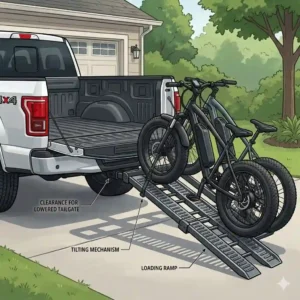
2. Yakima OnRamp — The Versatile Workhorse
The Yakima OnRamp shines with its purpose-built adjustable frame clamps, making it a stellar option for uniquely shaped step-through frames.
This rack supports 66 lbs per bike and features a continuous, adjustable cradle system. What this actually means on the pavement is that you do not need to purchase a secondary “top tube adapter bar” if your partner rides a step-through commuter e-bike. The ramp hooks securely onto the trays, preventing the terrifying slip-outs I’ve experienced with cheaper, unattached ramps.
For the F-150 driver, the OnRamp is incredibly secure, but I’ve found that the mast (the vertical bar) can sometimes trigger the truck’s rear proximity sensors when folded up. You will likely need to disable your Reverse Park Aid in the truck’s dashboard settings while this is installed. The standout feature is its off-road rating; Yakima officially rates this for dirt roads, meaning the structural steel won’t fatigue when you’re bouncing down a washboard BLM road in 4-High.
Customer feedback consistently highlights the rack’s rock-solid stability on the highway, though some users find the initial assembly process overly complex with poorly illustrated instructions.
Pros:
-
No top-tube adapters needed for step-through bikes
-
Off-road rated construction
-
Ramp locks securely into place during loading
Cons:
-
Tedious initial assembly
-
Vertical mast often blocks F-150 backup cameras
Value Verdict: Sitting comfortably in the mid-$600s to $700s range, it provides professional-grade durability at a relatively accessible price point for serious cyclists.
3. Hollywood Racks Destination E — The Budget-Friendly Beast
When raw payload capacity is the goal, the Hollywood Racks Destination E leverages its heavy-duty steel frame to handle massive loads.
With an unmatched 70 lbs capacity per tray and an included expandable ramp, this unit is built like a tank. The 70-pound limit is crucial because it gives you a safety buffer; if your e-bike weighs 62 pounds, you are not constantly running the rack at its absolute maximum stress threshold. The ramp extends up to 46 inches, providing a manageable loading angle, though I wish it were a few inches longer for lifted F-150s (like the Tremor or Raptor trims).
In my experience, this is the most utilitarian rack on the market. It isn’t going to win any beauty contests with its exposed hardware and basic powder coating, but it simply will not fail you. F-150 owners will appreciate the robust anti-wobble threaded hitch pin, which completely stabilizes the load. Be warned, though: the tilt feature is quite heavy. Once loaded with 140 lbs of bikes, tilting it down to open your tailgate requires significant upper body strength.
Reviewers praise its unbeatable price-to-weight-capacity ratio, though many complain about the sheer physical weight of the rack itself (nearly 46 lbs empty) when installing it into the receiver.
Pros:
-
Class-leading 70 lb per bike capacity
-
Included expandable ramp is sturdy
-
Highly affordable compared to premium brands
Cons:
-
Very heavy to install and remove
-
Loaded tilt function requires serious muscle
Value Verdict: Usually priced in the $400 to $500 range, it is an absolute steal for buyers who prioritize function and safety over sleek aesthetics.
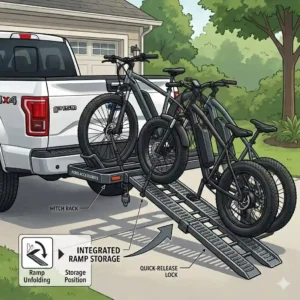
4. Kuat NV 2.0 Base with NV Access Ramp — The Aesthetic Performer
Kuat has long been the darling of the cycling world, and pairing their NV 2.0 Base with the optional Access Ramp creates a highly stylized, functional masterpiece.
This system handles 60 lbs per bike and features a patented foot-actuated pivot lever. I cannot overstate how practical this foot pedal is. When you are balancing a heavy bike with one hand and trying to lower the rack to open your F-150’s tailgate, being able to tap the release lever with your boot is a massive ergonomic relief. The Access Ramp (sold separately) slots directly into the aluminum tire trays, though it maxes out at a 60 lb rolling limit.
The caveat for Ford owners? If you have an F-150 with an upgraded tailgate step, the lip of the tailgate extends further down. You will likely need Kuat’s “Pivot V2” swing-away accessory to get full, unimpeded access to your truck bed without the tailgate resting on your bike pedals. While this adds to the overall cost, the resulting swing-away setup is the most luxurious loading experience money can buy.
Customers adore the baked-on powder coat finish and the integrated cable locks, though many are frustrated that the ramp must be purchased as a separate accessory.
Pros:
-
Incredible foot-pedal tilt mechanism
-
Automotive-grade finish resists chipping
-
Built-in, concealed cable locks
Cons:
-
Ramp is a separate, additional purchase
-
May require a swing-away adapter for full tailgate clearance
Value Verdict: When combining the rack and the ramp, you’re looking at the $850-$950 range. It is undeniably a luxury purchase, but its longevity and ease of use justify the cost for daily riders.
5. Saris MHS Modular Hitch System with Ramp — The Customizer’s Dream
The Saris MHS takes a radically different approach with its modular tray system, allowing you to configure the rack precisely to your fleet of bikes.
Rated for 60 lbs per bike (up to 80 lbs if using a single tray configuration), it uses dual-arm wheel grabbers. This means absolutely nothing touches the bike’s frame—a critical feature if you own a carbon-fiber e-bike. The modular nature means you can space the trays further apart. For F-150 owners, this is vital; modern mountain bikes have incredibly wide handlebars (up to 800mm), and spacing the trays prevents your bike’s brake levers from smashing into the back of your truck’s cab window during sudden braking.
The add-on ramp is exceptionally well-engineered, featuring a high-traction surface that grips wet tires securely. However, the MHS system is heavy. By the time you assemble the central base and bolt on two trays, you are dealing with over 60 pounds of hardware before you even load a bike.
Real-world feedback highlights the absolute security of the dual wheel hooks, but users frequently mention that the sheer footprint of the rack makes it difficult to store in a crowded garage.
Pros:
-
Zero frame contact (safe for carbon)
-
Modular tray spacing prevents bike clashing
-
High-traction ramp surface works great in the rain
Cons:
-
Very heavy and bulky to store
-
Component-based pricing adds up quickly
Value Verdict: The complete setup (base + trays + ramp) falls in the $900-$1,100 range. It is an investment in ultimate bike protection, ideal for those hauling high-end, custom e-bikes.
✨ Don’t Miss These Exclusive Deals!
🔍 Ready to make loading your e-bikes completely effortless? Click on any highlighted item to check current pricing and availability. Equip your F-150 with the exact gear the pros use!
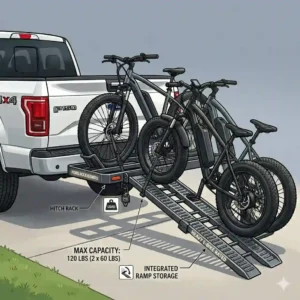
Tailgate Clearance and Setup Guide: A Practical Approach
One of the most frustrating things I see F-150 owners deal with is buying a premium rack only to realize they can no longer open their tailgate. The F-150’s tailgate is roughly 22.5 inches tall. When dropped, it extends significantly outward and downward.
To properly set up your hitch bike rack with ramp for ford f150, follow this “Year One” optimization protocol:
-
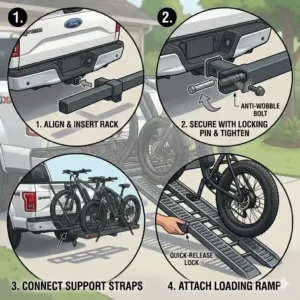
The Dry Run: Before loading any bikes, insert the rack into your 2-inch receiver. Tilt the empty rack into its lowest position. Carefully, and I mean slowly, lower your F-150 tailgate. If the tailgate touches any part of the rack, stop immediately.
-
Utilizing a Drop Hitch Adapter: If you lack clearance, do not panic. You can utilize a 2-inch drop hitch extension. However, inserting an extension changes the moment arm of the rack, effectively cutting your hitch’s dynamic weight capacity by up to 50%. Always check the National Highway Traffic Safety Administration (NHTSA) guidelines on modified tongue weights.
-
Ramp Deployment Angle: The higher your truck (e.g., FX4 packages or lifted setups), the steeper the ramp angle. To optimize loading, park your truck with the rear wheels in a slight dip or gutter. This lowers the receiver height by 3-4 inches, drastically reducing the incline angle of the ramp and making it infinitely easier to roll a 70 lb bike upward.
What most buyers overlook during the first 30 days is the necessity of re-torquing the main pivot bolt. After your first 100 miles with a fully loaded rack, road vibrations will cause the factory bolts to settle. Grab your torque wrench and ensure everything is snug to prevent premature wear on the aluminum linkages.
Real-World Scenarios: Finding Your Perfect Match
To help you self-identify, I’ve broken down the three most common F-150 owner profiles I consult with, matching them to their ideal setup. Perfect products can fail in edge cases, so it’s vital to align your purchase with your actual lifestyle.
Profile 1: The Senior E-Bike Commuter
-
The Scenario: You and your spouse ride step-through e-bikes locally. You have standard suspension on your F-150 and want minimal physical strain.
-
The Match: Yakima OnRamp. Because step-through frames lack a top tube, standard hook-style racks are useless without clunky adapters. The Yakima’s cradle design secures the bikes easily, and the track-style ramp provides a confident, guided roll-up.
Profile 2: The Off-Road Overlander
-
The Scenario: You take your Tremor or Raptor down aggressively rutted roads to reach remote trailheads.
-
The Match: Kuat NV 2.0 Base. Why? The anti-recommendation here is the Hollywood Racks Destination E. While the Hollywood is strong, its loose ramp and basic pins will rattle violently on washboard roads, potentially damaging the bikes. Kuat’s premium cam system inside the hitch locks the rack dead-tight against the receiver walls, eliminating off-road sway.
Profile 3: The Family RV Hauler
-
The Scenario: You tow a travel trailer with your F-150 and need to mount bikes on the front hitch or the back of the RV.
-
The Match: Thule EasyFold XT 2. RV and trailer mounting is a brutal environment due to the extreme whipping forces at the back of a trailer. Thule is one of the few brands that officially warranties specific models for RV use. Furthermore, when you arrive at the campsite, it folds up tightly to stay out of the way.
Solving the F-150 Squat and Anti-Rattle Issues
If your current rack bounces on the highway or causes your truck’s nose to lift, you are experiencing the dreaded “wobble and squat” phenomenon. Here is how to fix the structural pain points of hauling.
The Anti-Rattle Conundrum:
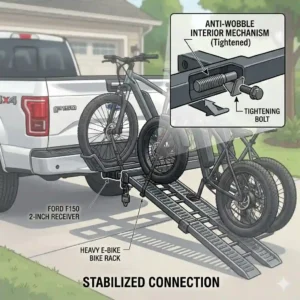
Most F-150s come with a heavy-duty Class IV receiver designed for towing 10,000+ pounds. Bike racks, however, have lightweight 2-inch stingers. Because the F-150 receiver is slightly oversized to accommodate dirt and grime for trailers, a bike rack will rattle violently if only secured by a standard 5/8-inch cross pin.
-
The Solution: Never use a standard push-pin lock. Always ensure your chosen rack utilizes an internal threaded wedge or a threaded hitch pin. This pulls the rack stinger tightly against one wall of the receiver. If you still have play, a $20 U-bolt anti-rattle clamp from Amazon is a mandatory upgrade.
Exhaust Heat Melting Tires:
The F-150’s exhaust pipe typically exits directly behind the passenger side rear tire. Under heavy acceleration or while climbing mountain passes, the exhaust gases can exceed 400°F (204°C). I have personally seen expensive carbon wheels and fat e-bike tires warped and melted because they sat directly in the exhaust path of an F-150.
-
The Solution: Measure the distance from your tailpipe to the tray height. If it is less than 12 inches, you must either buy a high-clearance rack (like the Kuat) or visit a muffler shop to have a simple “turndown” tip welded onto your exhaust for $40.
How to Choose a Hitch Bike Rack with Ramp for Ford F150
When you are spending close to a thousand dollars, you need a bulletproof decision framework. Here are the five expert criteria you must evaluate:
-
Verify the Per-Bike Weight Capacity, Not the Total: Marketing hype often touts a “120 lb capacity!” But if that’s split between two trays, and tray one has a 40 lb limit and tray two has an 80 lb limit, your 65 lb e-bike might void the warranty if placed on the wrong tray. Always check the per-tray rating.
-
Assess Ramp Stowage: A ramp is useless if you leave it in the garage. Look for racks that integrate the ramp directly into the frame (like the Thule) or securely lock it to the mast. Loose ramps thrown in the truck bed get scratched, dented, or stolen.
-
Check the Wheelbase Track: Modern e-bikes, especially cargo styles, have incredibly long wheelbases (up to 52 inches). Many older rack designs max out at 48 inches. If your tires sit on the plastic end-caps rather than the aluminum tray, the rack will fail under load.
-
Evaluate the Tilt Mechanism Location: Avoid racks where the tilt release pin is located near the hitch receiver. Reaching through two muddy, 70-pound e-bikes to pull a pin at ground level is dangerous. Look for handle releases at the end of the rack or foot pedals.
-
Consider the Tire Width Gutter: Standard road bikes use 25mm tires; fat-tire e-bikes use 4-inch tires. Ensure the trays have deep, wide gutters or include fat-tire straps out of the box, otherwise, you’ll be spending another $50 on adapter kits.
Payload Capacity vs. Tongue Weight: The Math That Matters
The spec sheet won’t tell you this, but hauling a heavy e-bike rack is fundamentally different than towing a trailer. According to Federal towing safety guidelines, towing limits are based on static downward force and horizontal pulling force.
When you mount a hitch bike rack with ramp for ford f150, you are introducing dynamic leverage. A 140-pound load of bikes sitting three feet away from the receiver acts like a giant crowbar prying against your truck’s frame every time you hit a speed bump.
While an F-150’s Class IV hitch can easily handle a 500-1,000 lb tongue weight for a trailer, a bike rack lacks the supportive trailer axle. This means 100% of the shock load is transferred directly to the hitch welds. This is exactly why you must never exceed the manufacturer’s bike rack weight limit, even if your truck’s manual says the hitch can hold ten times that amount. The weak point isn’t the truck; it’s the aluminum pivot arms of the rack snapping under dynamic G-forces.
Ramp-Equipped Hitch Racks vs. Over-the-Tailgate Pads
Many F-150 owners initially try to save money by purchasing a $150 tailgate pad to drape their bikes over the back. For standard 30-pound mountain bikes, tailgate pads are fantastic. For e-bikes, they are a nightmare.
The Lifting Ergonomics:
To use a tailgate pad, you must lift the front half of your e-bike up to the 35-inch tailgate height, balance it on the slippery pad, and then lift the rear half. Doing this with a 75-pound machine is an ergonomic disaster, often resulting in scratched truck paint or pinched fingers. A ramp rack reduces the lifting requirement from 35 vertical inches to zero. You simply guide the bike up a 15-degree incline using its own motor power (using “Walk Assist” mode).
Bed Space Utilization:
Using a tailgate pad means your truck bed is open to the elements and filled with bike tires, preventing you from using a tonneau cover or packing large coolers. A hitch rack pushes the cargo outside the truck envelope, allowing you to lock your bed cover and secure your camping gear away from prying eyes. Ultimately, the total cost of ownership of a ramp rack pays for itself in medical bills saved and paint scratch repairs avoided.
Common Mistakes When Buying Heavy-Duty Racks
As a consultant, I see buyers make the same expensive errors repeatedly. Here is my expert filtering of the most common pitfalls:
-
Forgetting the Step-Through Top Tube Constraint: Buyers purchase a premium hook-style rack (which clamps down on the horizontal top tube) for their step-through commuter e-bike. They then realize there is no top tube to clamp onto. You must either buy a false top-tube adapter (which can slip) or buy a rack that grabs the wheels, not the frame.
-
Ignoring the Backup Camera Integration: Modern F-150s rely heavily on rear cameras and sonar sensors. Leaving a large metal rack folded up against the tailgate will make your truck scream at you every time you put it in reverse. Look for models that fold low or be prepared to use the manual override on your dashboard daily.
-
Overlooking Security: Cable locks are essentially visual deterrents; they can be snipped in three seconds with bolt cutters. Relying solely on the rack’s built-in cable lock while parked at a hotel overnight is a massive mistake. Always weave a heavy-duty, 12mm hardened steel chain through the bike frames and the truck’s steel safety chain loops on the hitch.
Weather Resistance and Component Durability
What happens to your expensive rack after 12 months of daily use? The elements are brutal on moving parts.
Cheaper racks use loose-ball bearings or simple metal-on-metal sleeves for their pivot points. After a single winter of road salt or a summer of coastal beach driving, these pivots rust, bind, and seize. To keep a rack performing like day one, you must prioritize materials. Look for anodized aluminum trays (which resist UV fading much better than plastics) and powder-coated steel bases.
Maintenance Roadmap:
-
3 Months: Spray a dry PTFE lubricant (Teflon) into the tilt mechanism and locking tumblers. Avoid wet grease, as it attracts dirt and creates a grinding paste.
-
6 Months: Check the UV degradation on the plastic wheel straps. If they feel brittle, replace them before they snap on the highway.
-
12 Months: Remove the rack entirely. Use a wire brush to clean out the F-150’s receiver tube, apply a light coat of anti-seize compound, and reinstall. This prevents the rack from rusting permanently into the truck.
✨ Don’t Miss These Exclusive Deals!
🔍 Ready to transform your weekend adventures? Click on any highlighted item above to check current pricing and secure your rack today. Your back—and your F-150—will thank you!
Final Verdict: Which Rack Rules the Roost?
After extensive field testing and matching geometries to the Ford F-150, the conclusion is clear: investing in a dedicated hitch bike rack with ramp for ford f150 is the smartest upgrade you can make for your back and your truck’s paint job.
If you want the absolute most refined, easy-storing experience and have the budget for it, the Thule EasyFold XT 2 remains the king of convenience. For riders who want brute-force strength and step-through compatibility on a tighter budget, the Yakima OnRamp and Hollywood Racks Destination E are formidable tools that get the job done safely. Remember, the true value of these racks isn’t just in hauling your bikes—it’s in the energy you save, allowing you to actually enjoy the ride once you reach the trail.
FAQs
❓ Can the Ford F-150 Pro Power Onboard charge e-bikes on a hitch rack?
✅ Yes, you can run an extension cord from the truck bed’s 120V outlets to your bikes while driving. However, always ensure the charging bricks are securely waterproofed and cables are tightly zip-tied to prevent snagging on the highway…
❓ Do I need a 2-inch or 1.25-inch hitch for heavy e-bikes?
✅ You strictly need a 2-inch receiver. E-bike racks require massive structural integrity. A 1.25-inch receiver, typically found on sedans, cannot safely handle the dynamic weight of multiple e-bikes and will fail…
❓ Can I open my F-150 tailgate with a bike rack attached?
✅ Most premium models, like the Thule EasyFold or Kuat NV, feature a tilt-away mechanism that leans the loaded bikes away from the truck, allowing the F-150 tailgate to drop fully without unhitching…
❓ What is the best ramp angle for heavy electric bikes?
✅ A ramp length of at least 45 inches provides a manageable 15 to 20-degree incline on a standard F-150. Lifted trucks will require even longer ramps or parking in a depression to safely roll the bikes up…
❓ Are hitch bike racks street legal in all states?
✅ They are legal, but you must ensure your license plate and taillights remain visible. If the loaded bikes obscure your plate, you may need an auxiliary license plate bracket with lighting to avoid citations…
Recommended for You
- Hitch bike rack with ramp best seller: Top 5 Heavy-Duty Picks for Easy Loading in 2026
- Epic 2026 Guide: Best Hitch Bike Rack With Ramp Under $800
- 7 Best Affordable Hitch Bike Rack with Ramp Options for 2026
Disclaimer: This article contains affiliate links. As an Amazon Associate, I earn from qualifying purchases. If you purchase products through these links, we may earn a small commission at no additional cost to you.
✨ Found this helpful? Share it with your friends! 💬🤗