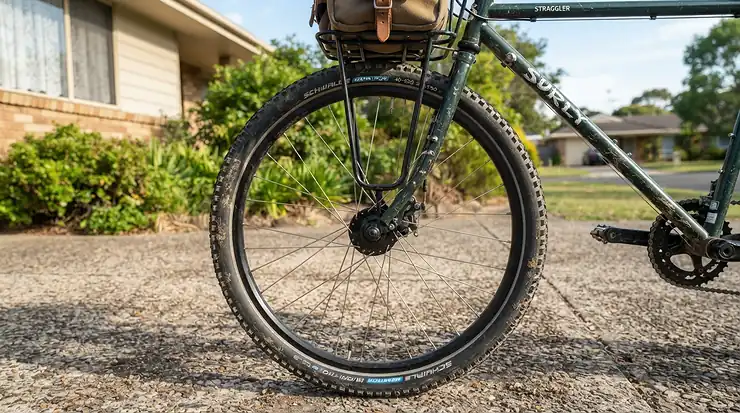
A wrong set of ebike tires costs more than the $60 to $75 a good commuter tire runs, because the mistake arrives as a flat on a wheel that has to leave the frame before anything can be fixed. On a rear hub-motor bike, Volt Bikes’ support page walks through removing a chainstay pad, cutting zip ties, unplugging the motor cable and loosening two axle nuts with an 18 mm wrench before the tube is even in reach.
The short answer for 2027: most commuters want a puncture-belted tire rated for e-bikes in the widest size the frame clears, run with a tube unless the rims are marked tubeless-ready, at a pressure set with a gauge. The sections below put the decisions in order, then match four real products to the steps.
The findings rest on maker spec tables, a lab-style rolling-resistance test, a specialist stand review, owner threads on two ebike forums and Stan’s published tubeless guide. Nobody mounted or rode these tires for this article, so every remark about feel belongs to a named source, and dollar amounts are dealer-page ranges rather than Amazon.com prices.
Choosing ebike tires in the right order
Read the sidewall: size, pressure range, and load rating
Three numbers molded into the rubber settle most of what follows. The ETRTO size (50-584, 40-622 and so on) says which rim the tire fits, the pressure range sets how it is inflated, and the load rating caps what each tire may carry. Schwalbe’s U.S. listing for the Schwalbe Marathon E-Plus Performance Line shows how fast those numbers move as the casing gets wider.
Tire and size
Pressure range
Weight
Max load per tire
Schwalbe Marathon E-Plus Performance Line 700x38C (40-622)
50–85 psi
990 g
112 kg
Schwalbe Marathon E-Plus Performance Line 28×1.75 (47-622)
45–70 psi
1,150 g
121 kg
Schwalbe Marathon E-Plus Performance Line 27.5×2.00 (50-584)
35–65 psi
1,170 g
118 kg
Schwalbe Marathon E-Plus Performance Line 28×2.15 (55-622)
30–55 psi
1,395 g
136 kg
Going from the 40 mm casing to the 55 mm one buys 24 kg of rated load and lowers the pressure ceiling by 30 psi (our arithmetic from Schwalbe’s table). That is the trade a heavier rider, or a bike with a loaded rear rack, is making. Weight and rim width differ between rows, so a wider tire only helps if the frame and rim accept it.
Speed is the other printed rating. Schwalbe labels the E-Plus E-50 with ECE-R75 approval. BikeRadar’s electric bike tyre guide explains that EU rules require ECE-R75 only for fast pedelecs, that no equivalent tire rating exists for US Class 3 bikes, which assist up to 28 mph, and that riders of those bikes should still consider an ECE-R75 tire. Upway’s wear guide adds a caution: the e-bike badge alone does not prove a tire suits the rim, the load or the terrain.
Match the protection layer to where you ride
Schwalbe’s casing page ranks its puncture belts on a 3-to-7 scale and puts Smart DualGuard, a 4 mm insert plus two nylon layers, at level 7, the top, and recommends it for e-bikes. The Schwalbe Marathon E-Plus Performance Line uses it. In the Bicycle Rolling Resistance lab test of the narrow 37-622 size, the tire scored 163 points for tread puncture resistance, measured 8.8 mm of rubber at the center and earned a 5.0 of 5 rating.
The tester accepts a rolling-resistance penalty of at most 2 watts per tire against the standard Marathon Plus and argues that a motor makes low rolling resistance matter less than flat protection. Heavier rubber does feel different, though. One owner on Electric Bike Forums, who fitted the E-Plus to a Specialized Vado, found it heavier and less lively than the stock tires but good in corners. A second poster, who had owned Continental, Kenda and Schwalbe tires, rated Schwalbe’s flat protection well above the other two and said a Kenda casing failed before 2,000 miles. Two individual reports are not a trend, but they point the same way as the lab data.
Fat tires reverse the priority list: low pressure and flotation come first, and the protection layer is whatever the casing offers. The Kenda section below covers that case.
Tube or tubeless: an ebike 750watt with tubeless tires
Searches for an “ebike 750watt with tubeless tires” usually boil down to whether motor power changes the answer. BikeRadar ties extra wear and sidewall damage to torque, weight and speed, not to a wattage figure, and none of the pages opened for this guide links 750W itself to tubeless failures.
Hardware changes the answer instead. Stan’s tubeless guide calls for tubeless-ready rims, non-porous rim tape, tubeless valves with removable cores, tires labeled for tubeless use, and sealant. Its original formula seals punctures up to ¼ inch and wants a top-up every two to seven months. BikeRadar lists the downsides as sealant that dries out and messier punctures and repairs.
Owners split along the same lines. In an Electric Bike Forums thread about converting a Specialized Turbo Vado, several riders reported few or no flats afterward, one at about 1,800 miles. Others described tires that were hard to seat in the field without a compressor or electric pump, a sidewall cut that forced a tube back in, and a conversion that failed on rims not built for tubeless. On an e-MTB forum, most riders said extra rotating weight barely matters under a motor. Their main complaint was mess; one rider’s sealant could not close a very large slash, and another had a bead ripped off and walked 5 km home.
The practical rule follows from that: if the rims carry no tubeless marking, a tube-type tire with a puncture belt is the lower-risk setup. Tubeless earns its place on tubeless-ready rims, with a tube and a plug kit still in the bag.
Set pressure with a gauge, not your thumb
Schwalbe’s Marathon Plus MTB page warns that the usual thumb check is not reliable on its belted construction and tells owners to use a pressure gauge. Upway’s wear guide treats the printed range as a boundary rather than a target and says to recheck whenever load or terrain changes, since a pressure that suits an unloaded commute can run too low with cargo aboard. The rear tire usually wears first, Upway adds, because it carries more weight and pushes the motor’s force into the ground.
On fat tires, one ebike maker’s pressure guide says the maximum molded on most Kenda fat tires falls between 20 and 30 psi and should be read as a ceiling. Stan’s notes that off-road tubeless setups typically run 7 to 10 psi lower than the same tire with a tube.
Get the wheel off safely: hub motors, motor cables, and the tool set
Volt Bikes’ rear-motor service page gives the clearest sequence found. Remove the battery or switch the bike off, photograph the order of the spacers and anti-spin washers, support the bike on a stand or with a helper, unplug the motor cable, then loosen the axle nuts with an 18 mm wrench and a 10 mm wrench on the axle flats. It warns against squeezing the rear hydraulic brake lever with the wheel off, gives 45–55 N·m as the reinstall torque for its own bikes, and says to recheck the nuts after 24 hours of riding.
Owners on Electric Bike Forums describe the same job with fewer words: disconnect one wire, expect a heavy wheel, and consider flipping the bike onto its seat with a rag underneath. A workable ebike tool set therefore includes plastic tire levers, a floor pump or compressor, an 18 mm wrench and hex keys, a zip-tie cutter and a torque wrench. Add a valve core remover and a sealant injector if the tires are tubeless, which are the items Stan’s lists.
Where tire swaps go wrong on ebikes
Fitting a fatter tire than the frame allows is the first slip. BikeRadar notes that frame clearance sets the maximum width, and that commuter, road and gravel ebikes usually have less room than e-MTBs, so the wider casing a motor makes tempting may simply not fit.
Converting rims that were never built for tubeless comes second. One participant in the Vado thread said a non-tubeless-ready rim failed during a conversion attempt, which matches Stan’s instruction to confirm the rim is marked for tubeless before anything else.
Rushing the reinstall is the most expensive mistake. Volt Bikes states that a rear hub-motor wheel that is not properly re-tightened may work loose over time and damage the frame, which is why its page ends with the 24-hour recheck.
Sidewalls take the abuse nobody plans for. The Kenda owner thread describes a trail strike that cut a sidewall and the tube together, while Upway lists sidewall cracks as a sign of low pressure, heavy loads, age or repeated impacts, and says deep cracks, exposed casing threads, bulges or bead damage mean replacement.
Best ebike tires and the gear that goes with them
The best ebike tires change with the route and the wheel, so each pick below answers one of the steps above.
Daily pavement on a 27.5×2.00 or 700x38C wheel is the job this tire was built for. Schwalbe describes it as flat-less for e-bikes: a SmartGuard layer backed by two layers of RaceGuard fabric, the Addix E compound aimed at grip at speed, sidewalls made to resist cracking at low pressure, and a reflective sidewall for visibility. It carries an E-50 rating with ECE-R75 approval and a 67 EPI casing.
The costs are weight and a firmer feel. Schwalbe’s table gives 990 g for the 700x38C and 1,170 g for the 27.5×2.00, and the Vado owner quoted earlier called it less lively than stock rubber. The lab tester’s view that motor-assisted riders will barely notice the extra two watts of rolling resistance is the argument for paying that cost. Dealer pages put it between about $60 and $75, depending on size.
Schwalbe lists it as a wired, tube-type tire, so it cannot be converted to tubeless.
Schwalbe Marathon E-Plus Performance LineSee current price, sizes and reviews on Amazon.
Around $55 on one dealer’s page puts this at the cheap end of 26×4.0 rubber for a fat-tire ebike. That dealer, Scooterworks, describes a K-Shield puncture layer, a 30 TPI wire-bead casing, a multi-purpose tread, and fitment for Aventon, Rad Power, Himiway and most 26-inch fat-tire e-bikes. The fitment line is a seller’s claim, not a manufacturer’s compatibility list.
The real-use evidence is thinner and less kind. On Electric Bike Forums, one owner reported two nail punctures in a rear Juggernaut at roughly 200 miles and a trail sidewall cut some months later, then switched to a Maxxis. Other posters suggested a tire boot, or thicker tires with taller knobs that shed nails and glass better. The thread does not say which Juggernaut version that owner had.
The name also hides different builds. Bicycle Rolling Resistance’s 2016 test of the Kenda Juggernaut Pro, an 835 g, 120 TPI tire with 1.70 mm of tread, rated it 1 of 5 and found the highest rolling resistance of any fat tire it had tested. The K1188E is a 30 TPI K-Shield tire, so that verdict does not transfer.
Shoppers who type “ebike fat tire under 500” may mean replacement tires or a whole bike. The tires sit far below that figure: two at around $55 each leave most of the budget untouched. Whole fat-tire bikes in that band exist, but their stock tires and prices change often, so read the printed size on the bike’s current tire and check the current price on Amazon.com.
Pros:
✅ A 30 TPI K-Shield build marketed for fat-tire ebikes at a low price
✅ Wire bead and tube-type design that any shop can patch
Cons:
❌ An owner thread reports nail and sidewall punctures on the rear
❌ Fitment is the seller’s claim, and forum posters favor thicker-tread rivals for shedding debris
Kenda Juggernaut K1188E 26×4.0See current price, sizes and reviews on Amazon.
Sealant is the last piece of a tubeless setup, not the first. Without tubeless-ready rims, tape, valves and tires labeled for tubeless use, the bottle does nothing useful, and Stan’s own guide states that it is the sealant that makes a tubeless system reliable once the rest is in place.
A dealer page for the 16 oz bottle says two ounces repair punctures up to ¼ inch, and that the formula stays liquid in the tire for up to seven months. Sources disagree on cold: the dealer page claims protection down to -30°F, while Stan’s FAQ gives -20°F, so the maker’s figure is the safer one. Volume scales with tire size, which is why a 29×2.5 mountain tire needs more than a 700x35c gravel tire in Stan’s volume guide. The same guide offers a Race formula with extra crystals for bigger holes, but it cannot go through an injector and needs a check every two weeks.
A bottle runs around $20 on one dealer page. Large punctures can still defeat sealant, and Stan’s recommends a plug tool such as its DART for those. The original formula’s two-to-seven-month refill interval makes a calendar reminder part of the real cost.
Stan’s NoTubes Tubeless Tire Sealant 16 ozSee current price, sizes and reviews on Amazon.
Anyone searching for a “heavy duty max weight fat tire compatible ebike repair stand kit and ebike tool set” is really asking two things: will the stand hold the bike, and what hand tools finish the job. The tool question is answered in the hub-motor section above. On the stand, Electric Bike Report’s review lists a 100 lb maximum load, an 18 lb stand weight and jaws that open to tubes up to 2.6 inches, and says an 85 lb fat bike stayed stable throughout testing.
Flaws are specific. The thick mast does not accept Feedback’s own tool tray, the reviewer wanted a more durable release button, and the travel bag costs extra. REI’s page shows 11 reviews averaging 3.8 stars with 80 percent recommending; praise centers on stability with heavy e-bikes, while complaints mention bulk, the plastic release button and, from one buyer, a used unit. Even the height range differs between the two sources, 42 to 67 inches against 46 to 71, so confirm it against the shop you buy from.
At around $500 to $525 at the retailers checked, this is a serious sum for a home garage. It makes sense for someone who pulls hub-motor wheels often, and less sense for a once-a-year flat, where a helper and a safely supported bike do the same job.
Feedback Sports Pro Mechanic HDSee current price, sizes and reviews on Amazon.
Ebike tires reviews: what tests and owners actually report
The ebike tires reviews behind these picks vary in weight, and the table shows how much each piece of evidence can carry.
Product
What the source reports
How solid it is
Schwalbe Marathon E-Plus Performance Line
Bicycle Rolling Resistance lab test, 37-622 size: 5.0 of 5
One lab, one size
Schwalbe Marathon E-Plus Performance Line
Electric Bike Forums: heavier than stock, good in corners
Individual owners
Kenda Juggernaut K1188E 26×4.0
Electric Bike Forums: nail punctures near 200 miles, later trail sidewall cut
One owner, version not stated
Kenda Juggernaut Pro
Bicycle Rolling Resistance, 2016: 1 of 5, highest rolling resistance tested
A different, ultralight build
Feedback Sports Pro Mechanic HD
REI: 3.8 stars from 11 reviews; Electric Bike Report: stable under 85 lb
Small review count, one hands-on test
Two points stand out. The strongest tire evidence is lab data on a narrow commuter size, so it says little about wide e-MTB or fat casings. And the only fat-tire real-use report is a single owner’s, which is useful as a warning about sidewalls but too thin to condemn a tire.
Thin-tire commuters, Made in USA labels, and the best price
A search like “thin tire commuter ebike for men made in usa best price” bundles four separate questions. Tire width follows the rim, the frame clearance and the load rating, none of which depends on the rider, so the useful number is total weight: rider, bike, battery and cargo. As a hypothetical, a 220 lb rider on a 65 lb ebike carrying 20 lb of cargo totals about 305 lb, or roughly 138 kg. If the rear tire carried 60 percent of that, an assumption, it would see about 83 kg, against the 112 kg that Schwalbe lists for each 700x38C Schwalbe Marathon E-Plus Performance Line (our arithmetic).
Made in USA is a regulated claim. The FTC’s guidance says an unqualified label requires that a product be “all or virtually all” made in the United States, with negligible foreign content. A bike labeled Assembled in USA falls under a separate, looser standard and can still roll on imported tires. The Decathlon listing for the E-Plus names Ralf Bohle GmbH of Reichshof, Germany, as Schwalbe’s contact, and the Scooterworks page says Kenda builds tires in Taiwan, China, Vietnam and Indonesia. Anyone shopping on the American-made angle should ask whether the claim covers the tires at all, and the FTC’s Made in USA standard explains what the label must mean.
On price, dealer pages put the Marathon E-Plus between about $60 and $75 across sizes and the Kenda near $55. Those figures come from other retailers, so check the current price on Amazon.com.
Quick answers on tire life, tubeless and fat-tire pressure
❓ Are ebike tires really different from regular bike tires?
✅ Often, yes, but the badge alone proves little. BikeRadar says they generally have sturdier construction, and EU speed pedelecs must use ECE-R75 rubber. Check load rating, rim fit and the puncture belt rather than trusting the word e-bike.
❓ How long does a set of tires last on an ebike?
✅ No single mileage applies. Upway's wear guide says durable commuter tires can last several thousand miles, while soft e-MTB rubber wears much sooner. The rear tire usually goes first, so check it for flattened centers, cracked sidewalls and exposed casing threads.
❓ Can I run tubeless tires on a powerful hub-motor ebike?
✅ Yes, if the rims are tubeless-ready and the tires are labeled for it. Sources tie wear to torque and weight, not wattage. Expect sealant top-ups every few months, and carry a tube because large cuts can still defeat sealant.
❓ What psi suits a fat-tire ebike?
✅ Stay inside the range printed on the sidewall, which is a ceiling rather than a target. One ebike maker says Kenda fat tires typically top out between 20 and 30 psi. Adjust in small steps with a gauge, and remember the rear carries more weight.
❓ Do I need a repair stand to change an ebike tire?
✅ Not strictly. Volt Bikes says to support the bike on a stand, with a helper, or carefully upside down, and forum owners flip bikes onto the seat. A stand rated above your bike's weight makes hub-motor wheel removal easier and safer.
Putting the steps together
Ebike tires reward an orderly decision: read the sidewall, choose protection for your route, decide tube or tubeless on the rims you actually own, and keep the pressure gauge handy. For a commuter, the Schwalbe Marathon E-Plus Performance Line is the strongest-evidenced pick here. For a fat-tire bike, the Kenda Juggernaut K1188E 26×4.0 is a low-cost option whose sidewalls deserve watching. Add Stan’s NoTubes Tubeless Tire Sealant 16 oz only after the rims and tires are confirmed tubeless-ready, and buy the Feedback Sports Pro Mechanic HD only if wheel work will be routine. The rule underneath all of it: the tire must fit the rim, the frame and the load, and everything else is optional. Read each listing’s load rating and rim fit before anything goes in the cart.
Disclaimer: This post contains affiliate links. As an Amazon Associate, we earn from qualifying purchases made through these links, at no additional cost to you.
Line up the size and model printed on your sidewall with the listing before you order, and the rest of the job gets simple.
NextGenEBike is an independent buying-guide site for electric bikes, motors, batteries and accessories. Our editorial team compares products using manufacturer specifications, independent tests from specialist e-bike media, owner reports and retailer listings. We do not claim to have tested the products ourselves; see How We Choose Gear for our method.