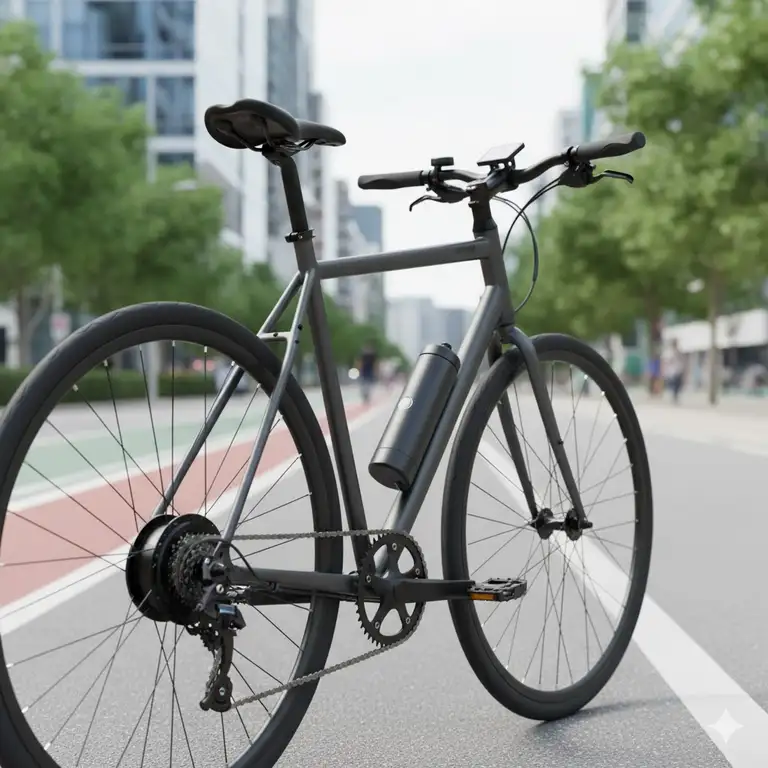
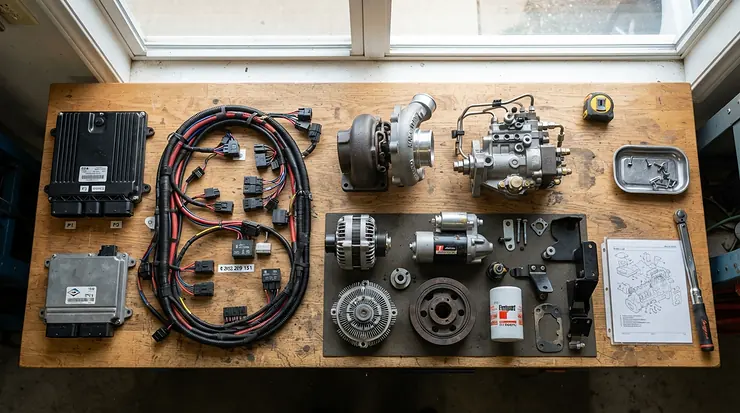
The BAFANG 48V 500W Front Hub Motor Kit lists 65 N·m of maximum torque, and Grin Technologies puts the point where an axle starts to spin out of most forks at roughly 60 to 90 N·m. That overlap is why front wheel ebike kits need a fit check before a shopping cart in 2027: the motor sits in the part of the bike with the thinnest metal. Grin’s figures come from a one-sided test, and a torque arm lifts the threshold above 150 N·m, so read the overlap as a warning rather than a verdict.
No kit was bolted to a fork for this guide. The findings rest on maker manuals and spec pages, hands-on write-ups from Cyclingnews and Cycling UK, Grin’s torque-arm notes, owner threads on Electric Bike Review and Endless Sphere, and buyer comments quoted on retailer mirrors of the Amazon listings; any point that rests on a single owner is labeled as one.
The method comes first because it eliminates kits faster than any review does: fork material, dropout width, brakes, wheel size and battery. Three kits follow, each tied to the step it solves, then what owners report, how a front wheel drive bike behaves in the wet, and a note on bearings.
Fork, dropouts, brakes, wheel and battery: the fit method that comes before any kit
Run these in order. The first failure usually ends the search for that kit.
Fork material sets the torque-arm rule
A refrigerator magnet sorts most forks in seconds: it clings to steel and slides off aluminum. That split drives the safety advice. In an Electric Bike Review thread about a 250 W front hub on an alloy suspension fork, a member asked the owner whether the dropouts had been checked with a magnet, and the replies leaned toward fitting a torque arm regardless. A dealer page for a US front kit from E-BikeKit says it plainly: steel forks are recommended, and aluminum forks need properly installed torque arms. The torque-arm section further down has the force figures.
Dropout width and the 9 mm versus 10 mm slot
Bafang’s manual says its front motors suit 100 mm dropouts, with tolerance for 97 to 103 mm, and carry a 10 mm axle. Measure between the inside faces of your dropouts with a ruler, then measure the slot the axle drops into. The slot is where kits go wrong. In Cycling UK’s tech test of the Swytch front-wheel kit, the technical editor found his road fork offered a 9 mm slot where the hub needed 10 mm. The maker’s fix was filing flats on the axle, the wheel then sat about 2 mm low, and the nut flanges fouled the mudguard stay clamps. He stopped the test when the pedal sensor would not fit his crankset.
Other reports match. The Electric Bike Review writer behind the Dillenger kit review filed dropouts that were a millimeter or two too narrow for an axle of about 9.9 mm, and a buyer of the EBIKELING 36V 700C kit on a retailer mirror filed an axle that was half a millimeter too large. Bikerumor’s reviewer of a different front kit suggested filing the flats on the axle ends rather than the dropouts.
Thru-axle forks are a separate problem. BikeRadar notes that the Swytch hub is not compatible with thru-axles, and a Road Bike Rider reader review of the Cytronex kit says the fork must be the older quick-release design.
Brakes and the levers in the box
A kit’s own brake levers can limit your brake type. Cyclingnews’ reviewer built the Bafang front kit on a 700c disc-brake wheel and reports that the supplied levers cut motor power when squeezed, which means only cable-actuated brakes are supported. He also needed a T25 Torx tool for the rotor bolts. EBIKELING’s FAQ says every hub motor it carries is disc-compatible and lists brake levers as optional. Owners of hydraulic brakes should ask the seller whether a cut-off sensor exists for their levers before ordering.
Wheel size, tire and battery
Wheel size follows the donor bike: Bafang lists 20-inch, 26-inch and 700C wheels for its front motor, EBIKELING’s FAQ gives tire widths of 1.75 to 2.125 inches for 26-inch wheels and 28C to 35C for 700C, and the Voilamart kit appears at 26 inches. Contents vary by option. One Voilamart variant lists a 26 x 1.95 inch tube and tire, while another lists only the wheel, and a retailer mirror for the EBIKELING 750 W 700C front kit says battery and tire are not included.
The battery is almost always a separate purchase. The voltage has to match the controller: EBIKELING recommends a 36V pack for its 500 W kits and allows 48V only if the LCD display can adjust the input voltage, while Bafang’s manual caps the 48V kit’s controller at 18A. Cyclingnews’ build used a 48V 17.5Ah pack, about 840 Wh, on a rear rack, and the reviewer notes it worked loose on the first ride until it was locked.
Torque arms on a front hub: what the fork has to survive
Grin’s torque-arm page supplies the clearest numbers. A hub motor with a 12 mm axle producing 40 N·m spreads each dropout with just under 1,000 lb of force, according to Grin, and most forks let the axle spin out at roughly 60 to 90 N·m. Aluminum dropouts tend to crack suddenly, whereas steel ones spread open. Grin lists the cases that call for an arm: setups above about 1,000 W, anything with regenerative braking, front installs with aluminum dropouts, and shallow vertical dropouts even at lower power. A standard 36V, 20A setup on steel front dropouts may not need one if the axle nuts are fully tightened. Rear dropouts are usually thicker and stronger than front ones, which is why front kits get the stricter advice.
The BAFANG 48V 500W Front Hub Motor Kit (65 N·m, 10 mm axle, per its manual) and the Voilamart 48V 1000W Electric Bicycle Conversion Kit (45 N·m and 1,000 W, per reseller pages) both land where Grin’s rule for aluminum front dropouts applies. An Electric Bike Review member describes the failure path: the rocking motion of a keyed axle can chew into alloy dropouts, and eventually the motor spins the axle and twists the power cable, possibly ripping it.
Placement is where forums disagree. In an Electric Bike Review thread, one member argues the arm belongs on the front side of the fork so the clamp is in tension, another says Grin’s own guidance puts it at the back, and a third says either side works as long as the arm stops the axle from turning. Treat the kit’s instructions and Grin’s page as the tiebreakers, and expect a fitting puzzle: Electric Bike Review’s Court Rye, replying to a reader, called front torque arms tricky because kickstands and disc calipers crowd the area. One Voilamart buyer on a retailer mirror reports spinning the hub once before adding an arm. A shop listing for a universal stainless torque arm kit shows about $30.
Front wheel drive on a bicycle: grip, steering and where the weight goes
A motor in the front hub pulls the bike from the wheel that carries the least rider weight. Bikerumor’s testers expected that to feel odd and reported the opposite for the 250 W Swytch kit: natural, and never out of control even at the highest assist setting. Tougher verdicts come with more power and wet roads. BikeRadar says front wheel drive takes some getting used to in wet conditions and warns of torque steer. Electric Bike Review’s Dillenger write-up notes less traction, a hub that changes steering a little, and a tester who got speed wobble riding no-hands.
Owner reports point the same way. A rider with a 500 W geared front hub on a 20-inch folding bike described traction trouble in a Bike Forums thread, and replies suggested easy throttle below 10 mph and extra weight over the front wheel, such as a loaded basket. A buyer of the EBIKELING 750 W 700C front kit on a retailer mirror says the wheel burns out often unless the front end is weighted down. Upway, an e-bike retailer, goes further and argues that a front-wheel slide is much harder to recover from than a rear one, so treat that as a seller’s opinion. It also notes that a rear-rack battery leaves the middle of the bike light, which is the arrangement Cyclingnews’ build used.
The sensible reading: front hubs are easy to fit and pleasant on dry pavement, and the risk grows with power, rain and loose surfaces. Starting in a lower assist level and keeping some load over the front wheel are the two adjustments those reports share.
Best front wheel ebike kits, matched to the step each one solves
Three kits cover the main fit situations. The comparison below shows how little they overlap on voltage, torque and what ships in the box.
Model
Motor and rated power
Voltage
Listed torque
Fork spacing
Battery in the listing
BAFANG 48V 500W Front Hub Motor Kit
Geared, 500 W
48V
65 N·m (manual)
100 mm ±1, 10 mm axle
Optional bundles
Voilamart 48V 1000W Electric Bicycle Conversion Kit
Gearless, 1,000 W (a 750 W version appears on a reseller page)
48V
45 N·m (reseller page)
100 mm per listing titles
No
EBIKELING 36V 700C Front 500 Watt Ebike Conversion Kit
Geared, 500 W
36V
Not stated
Check the product description (maker FAQ)
No
Voltage is the first split: only the EBIKELING 36V 700C Front 500 Watt Ebike Conversion Kit runs on a 36V pack by default. Power is the second, since the Voilamart 48V 1000W Electric Bicycle Conversion Kit is the only one listed above the 750 W federal line. The third is paperwork: the BAFANG 48V 500W Front Hub Motor Kit has the most complete manual and the longest stated warranty of the three.
Cable-actuated brakes, a 100 mm fork and a patient owner describe the bike this kit suits. The motor is a geared G020 unit, rated 48V and 500 W, with 65 N·m of maximum torque, an IPX5 waterproof grade, noise under 55 dB and a 7.1 kg motor weight, according to Bafang’s manual. It fits 20-inch, 26-inch and 700C wheels, and the controller tops out at 18A.
Cyclingnews built one with the 48V 17.5Ah rear-rack battery and found it fun but slow work: about six hours including rework, with cable routing the hardest part and wiring still visible after zip-tying. Because assist is cadence-based, gearing matters, and the top level, just over 25 mph, felt uncomfortable to cruise at. The verdict called it a high-quality kit with plenty of options. The same reviewer adds that in the US a 500 W build with a throttle would likely count as Class 3, so state rules on where it can be ridden apply.
Buyers on a retailer mirror of the Amazon listing mention swapping the PAS sensor for one that fits without pulling the crank, buying shorter screws, and, in two comments, slow replies from Bafang support. An Electric Bike Review member who runs the G020 front motor on two cargo bikes calls it a good motor that is quite heavy. Dealer and listing pages show about $170 to $260 for the motor kit without a battery, and bundles with a pack cost considerably more.
Bafang backs the motor and optional battery with a one-year limited warranty, according to the manual.
BAFANG 48V 500W Front Hub Motor KitSee current price, sizes and reviews on Amazon.
A low outlay and a gearless motor come with a heavier wheel and a shorter warranty. A reseller page lists the front version at 48V and 1,000 W with 45 N·m of torque, a 28 mph claim and a net weight of 10.5 kg, and retailer mirrors add a 200 kg maximum load, 100 mm front spacing and a six-month warranty. The battery is not included, and the display and twist throttle vary by option.
Power matters legally. A 1,000 W motor sits above the 750 W line in the CPSC notice, which describes a low-speed e-bike as having fully operable pedals, a motor under 750 W and a motor-only top speed under 20 mph; the notice does not regulate conversion kits or aftermarket motors. A reseller page lists a 750 W, 48V version, the one to look for if the federal line matters where you ride.
Owner evidence splits. One buyer on a retailer mirror calls a torque arm essential after spinning the hub once, a second reports bearing failure on both wheels he bought, and a third finds the screen and twist throttle cheap. A Pedelecs forum member who paid about £135 for the front kit on an old rigid mountain bike says he loves it, while another poster there says front suspension forks work poorly with these motors. All of these are single reports.
Pros:
✅ Lowest outlay of the three, with a simple wheel swap
✅ Gearless motor with no internal plastic gears
Cons:
❌ Heavy wheel, 1,000 W exceeds the federal low-speed line, and a torque arm is expected
❌ Six-month warranty on the mirrored listings
Voilamart 48V 1000W Electric Bicycle Conversion KitSee current price, sizes and reviews on Amazon.
Thirty-six volts is the voltage EBIKELING recommends for this 500 W kit. Its FAQ says a 48V pack works only if the LCD display lets you set the input voltage and the 22A controller stays the same, and it advises 36V to avoid motor and controller trouble. The controller carries an SY60 connector compatible with XT60 plugs, the rim takes 28C to 35C tires, and every hub motor the maker carries is disc-compatible.
Setup effort is the recurring theme. An Endless Sphere owner who wrote a full review of the 36V 500 W front geared kit says it took four long, frustrating days to get the throttle to spin the wheel, tracing the problem to a system parameter. In a 2019 Bike Forums thread, one member who bought a front 550 W 700C kit called the install easy and the quality surprising for the price, while another reported two LCD display problems and guessed a newer Amazon kit with waterproof connectors had fixed them. Higher-power versions exist: one Endless Sphere owner says EBIKELING warned him a 1,200 W front kit was too powerful for his chromoly fork.
Torque is not stated on the pages read, and price is best checked on Amazon.com. The maker’s FAQ lists no battery in the kit and does not say whether a tire is included.
EBIKELING 36V 700C Front 500 Watt Ebike Conversion KitSee current price, sizes and reviews on Amazon.
Front wheel ebike kits reviews: what owners report before anything else
Across the Cyclingnews build, the Electric Bike Review and Endless Sphere threads and the buyer comments, a few patterns repeat. Fitting complaints come first and come from several independent sources: dropout slots that are a millimeter off, axles that need filing, and screws or spacers that do not clear the fork. Settings and controllers come second, from the throttle parameter story to the PAS sensors buyers replaced. Support speed comes third, with two Bafang buyers describing slow replies.
Shipping can mislead too. Cyclingnews notes that its kit arrived in two boxes and that Amazon initially showed only one delivered, because the wheel shipped separately from China. Check both boxes before assuming a part is missing.
One finding runs against the cheap-kit stereotype. Cyclingnews called the Bafang front kit high quality and fun to build, and the one fault its reviewer blamed on himself was an unlocked battery, with cable routing the lone drawback. The complaints that carry real safety weight are the fork ones, and they apply to any front hub.
Front wheel bearing and spoke checks after the wheel goes in
A front hub kit replaces your old wheel, so your original bearing wear disappears and the new motor’s bearings become the open question. Reports on front wheel bearing life are mixed. One Voilamart buyer on a retailer mirror says the bearings failed on his first and second wheel, and an Endless Sphere owner reports bearing trouble in two front hub motors bought from E-BikeKit, though both are single accounts. A retailer’s cost guide from Leoguar estimates a front wheel bearing job on a hub motor at roughly $95 to $180 including labor, against $60 to $120 for a front wheel without a motor, and describes the symptom as a gritty noise that tracks wheel speed rather than pedaling and continues when coasting.
Spokes deserve a look first. A Macfox troubleshooting article lists loose spokes and a misaligned rim as the simplest causes of hub noise, and an Endless Sphere owner of a different budget front kit found none of the spokes tightened properly. Spin the wheel by hand before the first ride, check for side play, and re-check the axle nuts after the first few miles.
Front wheel walker searches lead somewhere else
Searches for “front wheel walker” return mobility aids, not bicycle parts. A University of Arizona aging-program handout describes a rolling walker as having two front wheels and two rear sliders, and a clinical reference calls it a front-wheeled walker. Nothing in a hub motor kit converts or relates to one. For choosing a mobility aid, a clinician or physical therapist is the right source.
Torque arms, thru-axles, batteries and legality: short answers
❓ Are front wheel kits better than rear wheel kits?
✅ Neither wins everywhere. Front kits install faster and leave your drivetrain alone, but the motor pulls from the wheel carrying less rider weight, which testers link to slipping on wet or loose ground. Rear kits grip better and take more fiddling to fit.
❓ Do front hub kits need a torque arm?
✅ Usually, yes. Grin Technologies says front installs with aluminum dropouts need one, as do setups above about 1,000 W. A low-power build on steel dropouts may manage without, but several forum members still advise fitting at least one.
❓ Can a front wheel kit go on a bike with a thru-axle fork?
✅ Unlikely. Bafang's manual specifies 100 mm dropouts with a 10 mm axle, and BikeRadar and a Road Bike Rider reader review both flag thru-axle forks as incompatible with the front kits they covered. Measure your dropouts before ordering.
❓ Do front wheel kits include a battery?
✅ Not as listed. Two of these kits list no battery, and the Bafang kit offers packs as optional bundles. Budget for a pack that matches the motor's voltage, plus a rack or mount, since Cyclingnews' build carried its 48V battery on a rear rack.
❓ Is a front hub conversion legal to ride?
✅ The federal low-speed definition covers fully operable pedals, a motor under 750 W and a motor-only top speed under 20 mph, according to a CPSC notice. State rules on where and how you ride still apply, and a 1,000 W kit exceeds the federal line.
The decision rule, in one fit check
Measure before you browse: fork material, dropout width and axle slot, brake type, and the wheel size you need. A bike that passes all four can take any of these front wheel ebike kits; a bike that fails one should look at a rear hub or mid-drive instead. Among the survivors, the BAFANG 48V 500W Front Hub Motor Kit suits cable-brake bikes and riders who want a manual and a one-year warranty, the Voilamart 48V 1000W Electric Bicycle Conversion Kit suits a tight budget and a fork already fitted with a torque arm, and the EBIKELING 36V 700C Front 500 Watt Ebike Conversion Kit suits a 700C commuter wheel on a 36V pack. Fit a torque arm on any aluminum fork, keep the throttle gentle on wet ground, and the best front wheel ebike kit is simply the one that passes your tape measure. Spotted one you like? Take a closer look at its listing below.
Disclaimer: This post contains affiliate links. As an Amazon Associate, we earn from qualifying purchases made through these links, at no additional cost to you.
Ready to match a wheel to your fork? Take a closer look on Amazon.com. 🚲
NextGenEBike is an independent buying-guide site for electric bikes, motors, batteries and accessories. Our editorial team compares products using manufacturer specifications, independent tests from specialist e-bike media, owner reports and retailer listings. We do not claim to have tested the products ourselves; see How We Choose Gear for our method.