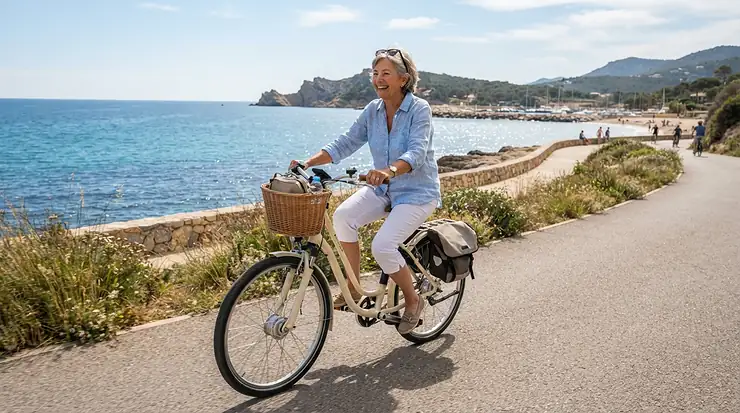
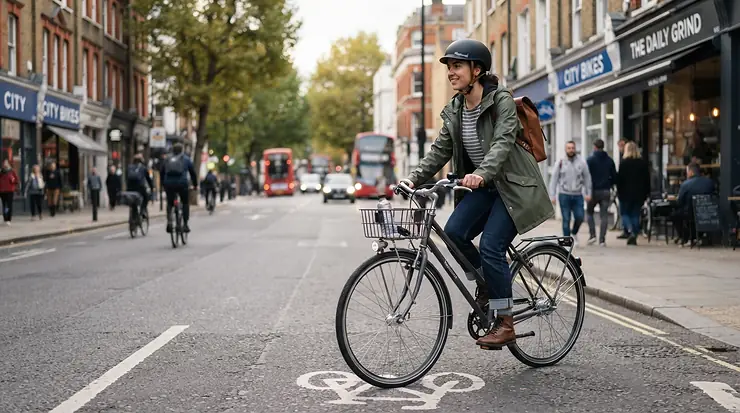
Choosing among hub motor electric bikes in 2027 depends more on weight and route than on watts: Electric Bike Report’s scale read 39 pounds for the Aventon Soltera 3 ADV and 88.3 for the Aventon Abound LR, and both drive the rear wheel. That 49-pound gap decides stairs, car racks and how a bike feels on a steep block long before the motor rating does.
Range, weight and hill figures below come from test pages at Electric Bike Report, OutdoorGearLab and Electric Bike Review, while the notes on flats, heat and throttle feel come from owner threads on the Electric Bike Review forum, each labeled as one. The tools used for this research cannot read Amazon product pages, so confirm size, color and stock on Amazon.com before ordering.
Five bikes follow, each matched to one situation: a folding bike for small spaces, an all-round commuter, a featherweight city bike, a cargo hauler and a high-payload utility bike on fat 20-inch tires. A short guide to reading an electric bike motor label comes first, because “hub” covers more than one design.
Reading an electric bike hub motor label before the price tag
Four details separate hub motors that look alike on a listing: the gearing inside, the wheel it sits in, how it senses your pedaling and how long it can climb before it runs hot.
Geared or gearless: a 4-kilogram question
Electric Bike Report’s guide to geared and direct drive hubs puts a geared hub at roughly 2 to 4 kg and a direct drive hub at 4 to 9 kg, with a diameter over 20 cm. Geared motors give better low-speed torque for hills and usually freewheel, so the bike pedals easily with the power off. Direct drive motors run virtually silent and suit higher speeds such as Class 3 at 28 mph, but they have no freewheel, which makes unpowered pedaling harder. The same guide adds that the quality of the whole bike matters more than the motor type.
Labels differ by brand. Electrek describes the Lectric XP 4.0 as using a geared rear hub, while the pages for the Aventon and Velotric bikes below list a rear hub without naming the design, so ask the maker if gearing matters to you.
Rear or front: where an electric bicycle hub motor puts the weight
BikeTips says rear hubs concentrate weight behind the rider, while front hubs can pull the steering on loose or slippery ground. All five bikes here use rear hubs. On the Aventon Abound LR, Electric Bike Review’s tester says the rear motor shifts the 88-pound bike’s weight rearward, which shows when maneuvering it unloaded.
Torque, cadence and throttle: how the electric bike motor reads you
A cadence sensor detects that the cranks are turning and ramps power up to the chosen level, and posters in an Electric Bike Review forum thread describe it as a simple on/off switch. A torque sensor scales power to how hard you push. One lighter rider in a 2020 forum thread about the Aventon Pace 500 disliked cadence assist for its lunge in stop-and-go traffic, even at the lowest level, and kept a hand on the brake lever when starting. That is one rider’s report, but it matches how the sensor works.
All five picks can read pedaling force, and the Velotric GoMad lets you switch to cadence mode as well. Throttles vary: the Aventon Soltera 3 ADV has none and is Class 1 only, while the other four add one.
Class labels follow the throttle. Bosch’s three-class explainer says Class 1 is pedal assist to 20 mph, Class 2 adds a throttle at the same 20 mph, and Class 3 is pedal assist to 28 mph and typically limited to roads and on-road bike lanes. States and cities set the actual rules, so check yours.
Hills and heat: where a hub motor runs out of room
A hub motor makes the same wheel torque in every gear, which is why BikeTips says it can overheat on sustained climbs where a mid-drive, working through your gears, keeps torque high. Test and owner pages show where that line sits for these bikes. OutdoorGearLab clocked the 500W Lectric XP 4.0 at 13.6 mph on a 9% grade, said it struggles above 8%, and points steep-hill riders to the 750W version. The 37-pound Aventon Soltera 3 ADV, with only 250W, climbed grades up to 15% for OutdoorGearLab’s testers at the highest assist level, so low weight and a rider who pedals both help.
Owner reports split. A rider of about 240 pounds in the Pace 500 thread described a 4-mile gravel climb at a 9% average with no overheating. A 2019 RadRover owner carrying heavy gear up a long, steep climb got a “motor position sensor fault” shutdown, and one poster in that thread advised a mid-drive geared low for such climbs, because a hub loses efficiency as wheel speed drops. Both are single accounts, yet they bracket the same rule: gentle to moderate rollers suit a rear hub, and long, loaded, double-digit climbs are better served by a mid-drive.
Posters in a separate assist-strategy thread add a habit worth copying. They warn against pinning the throttle or maximum assist on a long, slow climb, since the energy turns into heat, and one says dropping below roughly 10 to 15 km/h on steep grades led to overheating faults.
Tested weight, motor and battery for the five rear-hub picks
Bike
Tested weight
Rear hub motor
Battery
Tested miles, lowest / highest assist
Price tier
Lectric XP 4.0 (500W)
72 lb
500W, 55 Nm
499 Wh
55.1 / 30.2
Around $1,000
Aventon Level 3
67.5 lb
500W, 60 Nm
708 Wh
80.6 / 44.2
Around $1,900
Aventon Soltera 3 ADV
39 lb
250W, 40 Nm
About 367 Wh
55.1 / 23.7
Around $1,500
Aventon Abound LR
88.3 lb
750W, 80 Nm
708 Wh
80.3 / 36.1
Around $2,000
Velotric GoMad
77.8 lb
750W, 85 Nm
802 Wh
80.1 / 37.2
Check Amazon.com
Weights and miles are Electric Bike Report’s. Price tiers come from Electric Bike Report for the Lectric XP 4.0 and Aventon Abound LR, and from OutdoorGearLab for the Aventon Level 3 and Aventon Soltera 3 ADV.
Packs of 708 to 802 Wh turned in 36 to 44 miles at the highest assist and 80 or more at the lowest, so the three big-battery bikes behave alike on range. The Aventon Soltera 3 ADV is the only one that fell short of its own claim at the lowest assist, 55.1 miles against a claimed 70. At the highest assist every bike kept between about 43% and 55% of its low-assist miles, by arithmetic from the tested figures.
Best hub motor electric bikes, matched to five kinds of riding
The order runs from the smallest footprint to the heaviest load, and none of it is a ranking.
A closet, a hatchback or a ground-floor apartment is where this bike earns its place. Electric Bike Report measured the folded frame at 35 by 19 by 29 inches, a little wider than Lectric’s 37 by 17 by 29 claim, and weighed the bike at 72 pounds with the battery against a claimed 61 without it. OutdoorGearLab’s scale read 68.5, and Electric Bike Report calls it heavy and hard to lift alone.
The 500W geared rear hub (1,092W peak) comes with a torque sensor, UL 2849 and UL 2271 labels, and Class 1, 2 and 3 modes. Electric Bike Report recorded a 15-foot-3-inch average stop, the shortest it had logged at the time, but found the torque sensor less natural than rivals’ and the tires slippery on sand and pea gravel. Fork parts scratched the frame when folded, so the reviewers suggest rubber bumpers.
Hills are the limit. OutdoorGearLab found the throttle jumpy and the motor somewhat noisy, and it recommends the 750W version for steep hills, heavy cargo or long commutes; Electric Bike Report puts that upgrade, with its 840 Wh battery, at about $300 more. The 500W bike starts around $1,000.
Check current availability on Amazon.com for the step-over or step-through frame.
Near $1,900, per OutdoorGearLab, buys a 500W rear hub bike (864W peak, 60 Nm) with a 708 Wh pack and a torque sensor. Electric Bike Report weighed it at 67.5 pounds and logged 80.6 miles in Eco and 44.2 in Turbo against a claim of 70. OutdoorGearLab covered 38.1 miles over more than 1,900 feet of climbing, among the longest ranges it has measured. On the climb, Electric Bike Report’s pedal-assist time matched the commuter average, while OutdoorGearLab saw speed fall from 16.6 mph to 12.5 mph on the steepest pitch.
It ships as Class 2 and can be raised to 28 mph pedal assist in the app. UL 2849 and UL 2271 labels, a 5’3″ to 6’4″ fit range (5’3″ to 6’1″ on the step-through) and a 300-pound total rating with 59 on the rack complete the sheet. OutdoorGearLab’s 5’4″ tester found the step-over frame’s standover restrictive and recommends the step-through.
Pros:
✅ A 4G security module controlled through the Aventon app, per Electric Bike Report
✅ Range that Electric Bike Report calls well above average among commuters
Cons:
❌ Flexible composite brake levers and no brake-light function
❌ A dim headlight and an underside charging port that OutdoorGearLab calls awkward
One of OutdoorGearLab’s test bikes dropped its battery out of the frame mid-ride because of a retainer clip defect, which the review calls isolated, and Aventon sent a replacement. A reader comment dated July 26, 2026 under Electric Bike Report’s review says Aventon sent the wrong replacement battery; that is a single unverified account.
No throttle, no removable battery and a single gear define this bike, and each is a deliberate trade for weight. Electric Bike Report’s scale read 39 pounds (OutdoorGearLab measured 37), light enough to carry upstairs, thanks to a 250W torque-sensing rear hub (500W peak, 40 Nm) and a Gates carbon belt that Gates rates to last at least twice as long as a chain without lubrication.
Range is the weak number. Electric Bike Report logged 55.1 miles at the lowest assist and 23.7 at the highest, against a claimed 70, and OutdoorGearLab got 24.8 miles on a hilly course in Turbo with a 180-pound rider pedaling about 100 watts, calling the claim largely theoretical. Hills go better than the motor suggests: Electric Bike Report’s climb took 2:21 at 12.9 mph against a 2:39 average for similar bikes with the app sliders raised to 100%, and OutdoorGearLab’s testers had no problem with grades up to 15% at the highest assist, though they call the belt’s gearing tall.
Both reviewers note that the brakes lack motor cutoff, so the taillight cannot act as a brake light, and the bike is Class 1 with UL 2271 and UL 2849 labels. OutdoorGearLab puts the price near $1,500, and Electric Bike Report lists four frame sizes for riders from 5’1″ to 6’4″.
Hauling is the job, and testers describe a frame that stays composed under it. Electric Bike Review’s reviewer found it stiff and confident with a 180-pound rider and 40 pounds of gear, and Electric Bike Report saw a hill climb with 60 pounds of pannier cargo cost less than 10 seconds and about 2 mph. The same Electric Bike Review test says a steep 9% grade cost about 1 mph with the throttle held, while a 5 to 7% grade held the 20 mph limit.
The motor is a 750W Shengyi rear hub (1,188W peak, 80 Nm) with torque-sensor assist, fed by a 708 Wh battery and carrying UL 2271 and UL 2849 labels. Electric Bike Report weighed the bike at 88.3 pounds and measured 80.3 miles in Eco and 36.1 in Turbo against a claimed 60. Total payload is 440 pounds, it ships as Class 2, and the two-piston Tektro brakes stopped it in 20 feet 7 inches against a 19-foot-6-inch category average.
Footboards and mesh wheel guards come standard, with a seat pad, handrail and captain’s chair sold as options for child passengers; rules on carrying children differ by state, so check yours and the kit’s approved weight. Complaints are about fit and display: both reviewers say the seatpost and pedal extension run short for riders near 6 feet, and the display text is small. Optional 4G service costs $20 a year after the first free year, and the bike costs around $2,000, per Electric Bike Report.
Check current availability on Amazon.com before choosing a seat kit.
Five hundred pounds of total payload and a 176-pound rack rating are the headline figures on the Velotric GoMad, with a 750W rear hub (1,300W peak, 85 Nm) and an 801.6 Wh battery behind them. Electric Bike Report weighed it at 77.8 pounds and recorded 80.1 miles at the lowest assist and 37.2 at the highest, against a claim of up to 75. Its hill times beat the category averages on throttle (1:46 against 1:51) and on maximum assist (1:39 against 1:49), and the 15-foot-9-inch average stop beat the 18-foot-10-inch group figure.
Kenda 20 by 4.0 tires, Class 1, 2 and 3 modes and UL 2271 and UL 2849 labels fit riders from 5’0″ to 6’3″. Torque and cadence sensing are both available and switchable, with tuning through the app or display.
Pros:
✅ Torque or cadence sensing, switchable, plus Class 3 pedal assist to 28 mph
✅ Find My tracking and NFC key access as theft deterrents
Cons:
❌ The center stand comes only with the optional Young Passenger Kit
❌ Eco-mode output is not constant, and adjusting it may cost range
One reader comment under Electric Bike Report’s review, dated Sept. 28, 2026, reports that the passenger kit arrived about 42 days after ordering, that no printed manual came with it, and that one of five mounting screws on a misaligned frame barely threaded in. The same commenter calls the bike itself well made and worth the money. It is a single unverified account. Check the current price on Amazon.com.
Hub motor electric bikes reviews: what testers and owners keep reporting
Four patterns recur, and each should change what you buy or how you ride.
A rear flat takes more steps, not a workshop. In an Electric Bike Review forum thread on changing a flat on a hub-drive bike, most posters call the job more work than on a mid-drive with a quick-release wheel, and not a serious obstacle. They list an 18 mm wrench for the axle nuts, a hex key for the torque arm bolt, a split connector to separate and sometimes zip ties to cut. One rider patched a tube by breaking the bead without removing the wheel, and one says to carry spare zip ties. A minority call it time-consuming, so ask a local shop whether it will do rear-wheel work on the brand.
The box range is an Eco-mode number. Four of the five bikes beat their claimed range at the lowest assist: the Aventon Level 3 logged 80.6 miles against 70, the Aventon Abound LR 80.3 against 60, the Velotric GoMad 80.1 against 75 and the Lectric XP 4.0 55.1 against 50. At the highest assist all five lost roughly 45% to 57% of that figure. OutdoorGearLab’s throttle-only run on the Lectric XP 4.0 over hilly ground covered 19.1 miles, which shows how much the way you ride moves the result.
Weight is the complaint no spec sheet softens. Tested weights run 67.5 to 88.3 pounds for four of the five bikes. Electric Bike Report calls the Lectric XP 4.0 hard to lift alone, OutdoorGearLab calls balancing it to remove the battery awkward, and Electric Bike Review ties the Aventon Abound LR‘s rearward weight to its hub. Only the 39-pound Aventon Soltera 3 ADV escapes the pattern.
Support stories are single accounts so far. The wrong replacement battery on the Aventon Level 3 and the late passenger kit for the Velotric GoMad each come from one commenter, and neither can be verified. Aventon lists a 2-year warranty on its own frames, components and batteries, and Electric Bike Review lists two years for the Aventon Abound LR. Ask the seller who handles claims on an Amazon order before you rely on either.
Class labels, UL stickers and a proposed battery rule for 2027
The test pages list UL 2849 for the bike’s electrical system and UL 2271 for the battery on all five picks. Look for both labels on the listing and on the pack.
Federal rules are moving toward that standard. The Consumer Product Safety Commission’s proposed rule would require e-bike electrical systems to meet UL 2849 with modifications, and battery packs sold separately to meet UL 2271, adding tamper-resistant enclosures, a post-discharge charge test, a reverse polarity test and revised labeling. It is a proposal, not a final rule. Written comments closed August 24, 2026.
One more number matters for hub bikes. Bosch says all three classes cap motor power at 750 watts, and the Aventon Abound LR and Velotric GoMad both list 750W nominal, at that ceiling, with peak figures of 1,188W and 1,300W. Read the class label on the bike itself, and remember that local rules decide where each class may ride.
Where a rear hub motor is the wrong tool
Long, steep, loaded climbs come first. BikeTips, a forum poster in the RadRover thread and OutdoorGearLab’s note on the 500W Lectric XP 4.0 all point the same way: a mid-drive geared low, or a larger hub motor with a lighter load, handles that job better than a small electric bike hub motor running at low wheel speed.
Daily stairs come second. At 67.5 to 88.3 pounds, four of these five bikes need a ground-level home, and the 39-pound Aventon Soltera 3 ADV is the exception. Roadside repairs come third, since rear flats take a wrench and a connector, as the forum posters describe.
Soft surfaces and stop-and-go riding round out the list. Electric Bike Report found the Lectric XP 4.0‘s tires slippery on sand and pea gravel, OutdoorGearLab calls the Aventon Soltera 3 ADV‘s tire clearance limited, and cadence-only assist can lunge forward from a stop, as one forum rider reports.
Hub motor answers on hills, flats, sensors and commuting
❓ Are hub motors good for hills?
✅ Yes on gentle to moderate grades, with limits. OutdoorGearLab found a 500W model struggled above 8%, while a 250W, 37-pound bike climbed grades up to 15% at top assist. Long, steep, loaded climbs overheat hubs more easily, so consider a mid-drive for those.
❓ Is a geared or direct drive electric bicycle hub motor better?
✅ Geared hubs weigh roughly 2 to 4 kg, climb better at low speed and freewheel easily. Direct drive hubs run nearly silent and suit higher speeds, but they weigh 4 to 9 kg and pedal harder unpowered, per Electric Bike Report. Whole-bike quality matters more than the type.
❓ How hard is it to fix a rear flat on a hub motor bike?
✅ Forum posters call it more work than a quick-release mid-drive wheel, though not a serious obstacle. Expect an axle-nut wrench, a torque arm bolt, a connector to separate and possibly zip ties to cut. Carry spares, or ask a shop to handle rear-wheel work.
❓ Should I choose a torque sensor or a cadence sensor?
✅ Torque sensing scales power to how hard you pedal and feels more natural. Cadence sensing acts like a switch, and one forum rider found it lunged forward in stop-and-go traffic. All five bikes here offer torque sensing, and one adds a switchable cadence mode.
❓ What is the best hub motor electric bike for a daily commute?
✅ A 67.5-pound commuter with a 708 Wh battery, 80.6 tested Eco miles and UL labels suits most commutes. A 39-pound belt-drive model suits short, flatter trips and stairs. Match your weight limit and route before comparing motor watts or battery size.
Matching the rear hub to your route and your stairs
Decide by the hardest thing you will ask of the bike: lifting it, hauling with it or climbing on it. For most commuters the Aventon Level 3 is the safest start among hub motor electric bikes, with 80.6 tested Eco miles and wide sizing. The Lectric XP 4.0 is the storage-first, lowest-price route, with steep hills better left to its 750W version. The Aventon Soltera 3 ADV is the stair-friendly pick at 39 pounds, the Aventon Abound LR is built for kids and groceries, and the Velotric GoMad carries the highest rated load. Long, steep, loaded climbs belong to a mid-drive, so rule those out before you shop. Check current availability on Amazon.com for the size and frame style that fits you, and confirm the exact model on the listing before ordering.
Disclaimer: This post contains affiliate links. As an Amazon Associate, I earn from qualifying purchases made through these links, at no additional cost to you.
Count the stairs and the steepest block on your route before you count the motor’s watts.
At NextGenEBike, we are passionate about the future of mobility. Our team of experts provides in-depth reviews, comparisons, and buying guides on the latest electric bikes, ensuring you stay ahead in the world of eco-friendly transportation.
Home » Hub motor electric bikes: Matched to Budget and Routine Choosing among hub motor electric bikes in 2027 depends more on weight and route than on watts: Electric Bike
Home » Hub motor electric bikes: Matched to Budget and Routine Choosing among hub motor electric bikes in 2027 depends more on weight and route than on watts: Electric Bike
Home » Hub motor electric bikes: Matched to Budget and Routine Choosing among hub motor electric bikes in 2027 depends more on weight and route than on watts: Electric Bike