Why does one e-bike feel like a bicycle with a tailwind while another lurches away from a stoplight like a golf cart? Usually the difference is a small part near the cranks. Torque sensor electric bikes read how hard you push the pedals and scale the motor to match, while cadence-sensor bikes only ask whether the cranks are turning. Electric Bike Report notes that falling sensor costs have pushed torque sensing down to some bikes under $2,000, so a 2027 shopper can now get it without paying for a premium frame.
That makes the sensor worth checking before the wattage. The test figures below come from published road and bench tests (Electric Bike Report, Electrek, GearJunkie, Freshly Charged) plus owner forum threads, so every range number is one tester’s result on one day. The guide runs in order: five checks, the ways torque sensing disappoints, what the lower price tier gives up, then three bikes that fit the method.
What a torque sensor measures, and why the ride changes
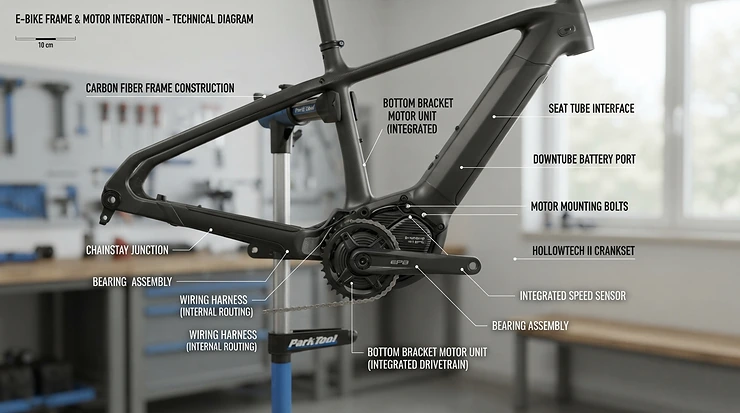
A torque sensor is usually a strain gauge, and Electric Bike Report’s explainer on torque and cadence sensors places it either in the bottom bracket or on the frame near the rear wheel mount. It reports how hard the rider presses, and the controller multiplies that effort by a ratio tied to the assist level, with the article’s examples running from 1:1 at the lowest level up to 1:4 at the turbo level. Push harder and the motor follows. Ease off and it backs away.
A cadence sensor asks something simpler. A ring of about a dozen sensors at the bottom bracket watches a magnet on a crank arm and checks whether the pedals are turning. Output then depends on the assist level, roughly 20% of nominal power at level 1 and 100% at level 5, whatever your legs are doing. The same article says the motor waits for roughly half a pedal stroke or more before it engages, which makes loaded starts harder, and that these bikes tend to use more battery than torque-sensor bikes with the same pack.
Neither design is inherently better, and the source stresses that most riders simply develop a preference. What differs is who gets rewarded. Torque sensing rewards effort and stretches range, because the motor shares the work with you. A cadence sensor suits a rider who wants the bike to do the lifting, such as someone recovering from an injury or finishing a long workday.
Five checks before you trust the words “torque sensor” on a listing
Electric bikes with torque sensor now fill several price tiers, but listings use the term loosely, so run these checks first.
Find out which sensor is really fitted, and where. A listing headed “Cadence/Torque Sensor” without saying which one drives the motor is not a specification. Amazon’s search results for the phrase also include replacement parts sold as torque sensors that are described as 12-magnet dual-hall units, the construction Electric Bike Report associates with cadence sensing. Better listings name the placement, as Aventon does with its “double sided bottom bracket torque sensor” wording on the Level.3 page.
Look for a switch between the two modes.Lectric XPress 2 lets riders toggle between torque and cadence behavior in the display menu, according to Electric Bike Report, and the Velotric Discover 2 listing advertises SensorSwap beside its torque sensor. The toggle matters because the modes ride differently. In Electric Bike Report’s Discover 2 test on a short pilot hill, cadence mode finished in 1:10 in Eco while torque mode took 1:47; in Boost the gap nearly closed, at 1:03 against about 1:00.
Match the sensor to the gearing and the hills. A torque sensor cannot fix a drivetrain with no easy gear. GearJunkie’s reviewer could not get a single-speed bike up a steep dirt road even while standing on the pedals, and Electrek’s reviewer says the single-speed Ride Scoozy Torque 1 is not a fit for very hilly cities. Owners on an Electric Bike Review forum thread describe the mirror-image problem on geared bikes: weak help when pulling away in a low gear or climbing steeply.
Rehearse a hill start before you buy. Freshly Charged found that the thumb throttle on the original Lectric XPress does not work at assist level 0, which makes a start on a slope harder without a push. Electric Bike Report’s advice for any buyer is to ride both sensor types if possible, since the difference is easiest to feel firsthand. Take the bike up the steepest start on your route, in the gear you would really be in.
Compare tested weight and tested range, not the claims. Electric Bike Report weighed the Velotric Discover 2 at 69.5 pounds against a claimed 63, and the Lectric XPress 2 at 72 against a claimed 64. Range spreads are wide too: 40.9 to 85.6 miles on the Discover 2 depending on assist level, and about 34 to 53 miles on the XPress 2 against a 60-mile claim. Plan a commute around the lower number.
Where torque sensing lets riders down
Effort is the first cost. Electric Bike Report says a torque-sensor bike takes real work to ride, which can shorten outings for people returning from an injury or years of desk work, and it points to the throttle on hub-motor bikes as a backup. The same design explains the surging some riders notice at higher assist levels, when effort changes from stroke to stroke.
Tuning varies by brand. Electric Bike Report found the torque mode on the Lectric XPress 2 less responsive and less analog than other torque systems, in line with Lectric’s easy-pedaling focus, and noted that the motor seemed to cut out around 11 mph during one low-power range run. The battery readout also moves in 10% steps, so remaining range is hard to judge. On the Velotric Discover 2, the same testers found that the Eco and Trail modes need firm, sustained pressure to deliver full power.
Owners add a third angle. In the Electric Bike Review forum thread on gearing, one rider reports that the sensor on their bike gives too little help from a stop in a low gear, several replies say they get more assist in a higher gear, and a poster describes becoming a convert after learning which gear and assist combination suits each situation. That is a consensus about learning curve, not about a defect.
Build quality is a separate matter. After four months on the Tenways CGO600 Pro, GearJunkie’s long-term review reported the power button popping out and the front scuff protector peeling, with the brand still working on a fix at the time. The reviewer also judged the single-speed bike best for flat commuting.
Cheap bikes with torque sensor: what the lower tier trades away
Cheap bikes with torque sensor are a recent arrival. Electrek described the Ride Scoozy Torque 1 as possibly the most affordable torque-sensor e-bike when it launched in 2021, at around $1,200, and Freshly Charged recorded the original Lectric XPress launching at around $1,000 for the 500W version. Those are launch figures from older reviews, so treat them as a direction, not today’s prices.
The savings show up in specific places. Electrek’s reviewer found the Ride Scoozy Torque 1 firm over bumps on its rigid frame and narrow tires, fitted with mechanical disc brakes, and short on accessories, since lights and fenders were extra. Freshly Charged found the 80 mm coil fork on the Lectric XPress works for smaller riders but is less effective above 200 pounds, and called the front light large but not very bright.
Amazon’s own search for “torque sensor electric bike” returned 277 results when checked, which is a reason to shop from published torque sensor electric bikes reviews rather than from keyword-heavy titles. The three bikes below were picked because independent reviews exist for each.
Torque sensor electric bikes reviews: three picks that fit the method
Amazon stock on e-bikes shifts quickly: the Velotric listing read as unavailable when checked, and neither the Aventon nor the Tenways bike covered further down surfaced as an Amazon listing, so those two serve as comparison points rather than numbered picks. Each numbered bike has an Amazon listing and at least one independent test behind it.
Bike
Sensor setup
Weight
Where it fits
Lectric XPress
Torque sensing; 750W or 500W hub
65 lb (Freshly Charged)
Mixed commutes, riders up to 330 lb
Velotric Discover 2
Torque or cadence via a toggle; 75 Nm hub
69.5 lb tested, 63 lb claimed (Electric Bike Report)
Commutes with hills, two frame sizes
Ride Scoozy Torque 1
Torque only; single speed
38 lb (Electrek)
Flat routes, stair carries
Lists of the best torque sensor electric bikes tend to rank by spec sheet. This table sorts by who each bike suits, because the weight gap alone (38 pounds against roughly 70) changes what daily life with the bike looks like. The two heavier bikes carry geared drivetrains; the lightest does not.
Price is the opening argument. Electric Bike Report called the XPress the lowest-priced e-bike with a torque sensor it had seen at its release, and Freshly Charged recorded launch pricing from around $1,000 for the 500W version to roughly $1,300 or $1,400 for the 750W. Check the current number on Amazon.com before deciding.
The bike comes with a 750W hub (1,310W peak) and a 672 Wh battery, or a 500W hub with 499 Wh, and Freshly Charged lists 65 pounds and a 330-pound rider limit. Its reviewer found the sensor sensitive, with assistance continuing up to 28 mph, and Amazon’s listing pairs the sensor with Lectric’s PWR+ tuning. The weak spots are the throttle that stays dead at assist level 0, a tail light that is not a brake light, and the fork limit for heavier riders noted above.
One version warning belongs here. Lectric’s newer XPress 2 adds the torque and cadence toggle and an 85 Nm hub, and the Electric Bike Report figures quoted in this guide apply to that newer bike; the Amazon listing found is the original XPress 750 High-Step, so match the exact model before ordering. Electric Bike Report’s range tests of the XPress 2 landed between about 34 and 53 miles. Check the current price and availability on Amazon.com.
Lectric XPressSee current price, sizes and reviews on Amazon.
For a commute with a few real hills, the sensor toggle is the feature to study. Amazon’s listing describes a 750W motor with 75 Nm of torque, a 705.6 Wh IPX7 battery, three riding modes with five assist levels, a 28 mph top speed on pedal assist and a 15.35-inch step-through height, and it pairs SensorSwap with the torque sensor. Electric Bike Report places the bike below $2,000, and Electrek’s launch review in 2024 put it at around $1,900.
Electrek’s reviewer found the assist smooth and natural from the first pedal stroke, while calling the 63-pound weight far from light. He also noted that the wide, backswept handlebars may not suit riders who like weaving through traffic, and that the 80 mm hydraulic fork has no rear-suspension partner. Electric Bike Report’s testers added that Eco and Trail feel too similar and that, in one maximum-assist range run, the motor cut out at top speed and the rider had to keep it alive.
Frame choice is simple: the Regular fits about 4’11” to 5’9″ and the Large about 5’6″ to 6’4″, according to Electric Bike Report, with a seatpost offering roughly eight inches of height adjustment. Check availability on Amazon.com before settling on a size.
Velotric Discover 2See current price, sizes and reviews on Amazon.
No gears means no downshifting on a climb, and Electrek’s reviewer says that rules the bike out for very hilly cities while it works on flat or gently rolling ground. Weighing 38 pounds, it carries up stairs easily, and the 350W rear hub and roughly 375 Wh battery hidden in the downtube make it look like an ordinary pedal bike.
The torque sensor is the reason it works at all. Electrek’s reviewer found that on a single-speed bike, which can feel sluggish away from a stop, the sensor delivered power more immediately than a cadence sensor would, across three assist levels in Class 1 form with a 20 mph limit. The downsides are a battery that cannot be pulled easily for indoor charging and, as noted, a bare-bones equipment list.
This is the oldest review in the group: Electrek’s piece dates from 2021, so check that the Amazon listing is current before relying on its numbers. The listing quotes a 25 to 50 mile range and a rider height of 5’5″ to 6’2″. Check the current price on Amazon.com.
Ride Scoozy Torque 1See current price, sizes and reviews on Amazon.
Two brand-direct bikes that show what more money buys
The Aventon Level.3 is the clearest example of a switchable system. Aventon’s page advertises a Sensor Switch between torque and cadence, and Electric Bike Report credited the torque sensor for the bike’s efficiency: 44.2 miles in Turbo and 80.6 in Eco, both well above that site’s averages for similar commuters. It weighed 67.5 pounds. The same review criticized composite brake levers that flex with a long pull and noted that 4G and GPS features are free for a year, then about $20 annually.
The Tenways CGO600 Pro goes the other way: 37 pounds bare, a 350W hub, a 360 Wh battery and a Gates belt drive. GearJunkie’s reviewer found the Mivice S200 torque sensor smooth and quiet, with no jerk from a stop even at the highest assist, and put the bike close to $1,900 before sales. Sizes start at medium, and full function needs the app. It is a weight-and-polish choice for flat cities, not a hill bike.
A battery label worth checking on any of them
The U.S. Consumer Product Safety Commission has put forward a proposed rule on lithium-ion batteries in micromobility products. It would require e-bike electrical systems to meet UL 2849 and user-replaceable battery packs to meet UL 2271, with added tamper-resistant enclosure and reverse-polarity requirements. The page opened is the proposal, not a final rule, and comments closed on August 24, 2026.
Electric Bike Report lists UL 2271 and UL 2849 certification for the Lectric XPress 2 and the Aventon Level.3. Look for both marks on any listing, and ask the seller when they are missing.
Torque sensor e bikes UK: the 250W and 15.5 mph rule
Readers searching for torque sensor e bikes UK face a different rulebook. GOV.UK’s electric bike rules require the rider to be 14 or older, the motor to be rated at no more than 250 watts continuous, and the motor to stop propelling the bike above 15.5 mph. A bike that exceeds those limits is treated as a motorcycle or moped, which brings registration, tax, a licence, a helmet and insurance.
The 750W hub bikes in this guide are rated well above that figure, so UK shoppers should look for 250W models from UK sellers instead.
Torque sensor e-bike questions about hills, range, retrofits and effort
❓ Is a torque sensor better than a cadence sensor on hills?
✅ Often smoother, not always stronger. One Electric Bike Report test found the cadence sensor beat the torque sensor on a short hill in Eco and Trail, while Boost times nearly matched. Torque sensing helps most when you shift down and pedal firmly.
❓ Do electric bikes with torque sensor get more range?
✅ Typically yes at equal battery size, because the motor shares the work with you, according to Electric Bike Report. Results swing with assist level: one tested bike covered about 41 miles at maximum assist and nearly 86 miles at its lowest setting.
❓ Why does my torque sensor bike feel weak when I start from a stop?
✅ Low pedal force produces low assist. Owners on an Electric Bike Review forum thread report weak help in low gears and on slopes, and some get more assist in a higher gear or with steadier pressure. A cadence mode or throttle can cover starts.
❓ Can I add a torque sensor to a bike I already own?
✅ Sometimes, through a mid-drive kit rather than a stand-alone part. Amazon lists a 750W kit described as torque-sensing for 68 to 73 mm bottom brackets, so confirm your bracket width and local power limits. Parts titled torque sensors can be 12-magnet cadence units.
❓ Do torque sensor bikes suit riders who want very little effort?
✅ Less so. Electric Bike Report says torque-sensing rides take real effort, which can limit distance after injury or long inactivity, and suggests a throttle as backup. Bikes with a torque and cadence toggle give an easier setting when energy runs low.
Match the sensor to your route and your legs
Start with the route. If your commute has real climbs or you tire early, favor a geared bike with a torque and cadence toggle, which in this group points to the Velotric Discover 2. If your ride is flat and the bike gets carried up steps, the Ride Scoozy Torque 1 trades range and hills for 38 pounds. If budget leads, the Lectric XPress carried the lowest launch price of the three in the sources.
Whichever you choose, torque sensor electric bikes ride best when you shift down before stopping and when you have tested the hill start yourself. Check current availability below, and read the sensor line of each listing before you pay.
Disclaimer: This post contains affiliate links. As an Amazon Associate, we earn from qualifying purchases made through these links, at no additional cost to you.
Ready to compare pedal feel? Open the listings above and read each sensor spec line by line. 🚴
NextGenEBike is an independent buying-guide site for electric bikes, motors, batteries and accessories. Our editorial team compares products using manufacturer specifications, independent tests from specialist e-bike media, owner reports and retailer listings. We do not claim to have tested the products ourselves; see How We Choose Gear for our method.