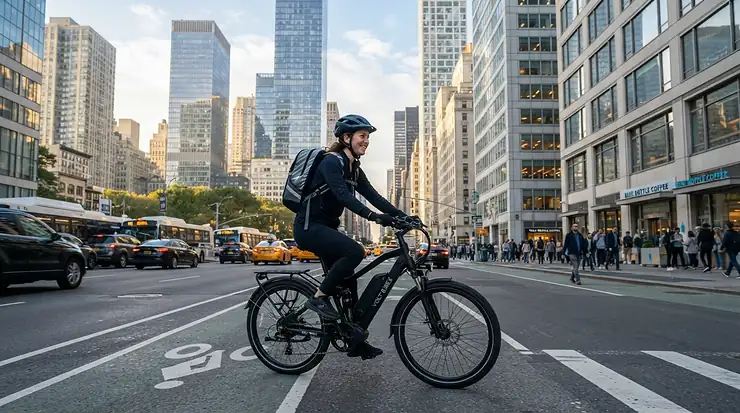
Amazon’s listing for the Lectric XPedition2 says 28 MPH, while Consumer Reports tested the same bike family as a Class 2 model capped at 20 mph until a setting was changed. That gap between the headline number and the out-of-the-box behavior runs through nearly every one of the class 3 electric bikes sold online in 2027, and it decides whether a bike feels legal, fast, or frustrating.
This guide compares five bikes you can order on Amazon, plus a handful of benchmarks that testers rely on. You also get the throttle question answered with real rules, a top-speed reality check, and a practical look at hauling several bikes behind an SUV. One note on method: Specs come from the listing text that showed up in search results and from the outlets named in each entry, and no single reviewer tested all five bikes.
Prices move weekly and several listings carry multiple versions, so every spec below is meant to be matched against the exact model on the page you land on.
How these models were picked
The best class 3 electric bikes list below follows a simple rule. Every numbered pick has a live Amazon listing, plus at least one independent test or review from a named outlet. Bikes that testers love but that are not sold as complete bikes on Amazon (the Aventon Level.3, the Lectric XPeak 2.0, the Ride1Up 700 Series) appear later as yardsticks, not as links.
Three filters mattered most for class 3 electric bikes:
A real path to 28 mph. Pedal-assist has to reach 28 mph through a documented setting, and the gearing has to let you keep pedaling there.
Certified batteries. UL 2849 and UL 2271 listings count for more than a bare “safe battery” claim, given the federal proposal covered near the end of this guide.
Honest weight. Class 3 bikes are heavy. Tested weights from reviewers beat the number on a sales page.
Motors are all rated at 500W to 750W nominal. Marketing figures like “1,200W peak” or “1500W peak” describe short bursts and are not the same thing as the legal 750W ceiling.
Class 3 electric bikes compared at a glance
Model
Motor
Battery
How it reaches 28 mph
Tested or listed weight
Lectric XPedition2
750W hub, 1310W peak, 85 Nm
Two 17.5Ah packs, 1,680Wh
Ships Class 2, raised to Class 3 in settings
Not tested here; ask the seller
Heybike Alpha
500W mid-drive, 105 Nm
680Wh
Class 2/3 modes, torque sensor
70.8 lb tested
Heybike Ranger S
750W hub
691Wh
28 mph at PAS 5 in testing
About 72 lb
Heybike Ranger 3.0 Pro
750W hub, 85 Nm
720Wh
Ships Class 2, app switches to Class 3
76.7 lb tested
Velotric Discover 2
750W, 75 Nm
705.6Wh
Ships at 20 mph, handlebar toggle
Check the listing
The best class 3 electric bikes on Amazon right now
The Amazon listing for the Lectric XPedition2 Long Range Dual-Battery model reads 750W hub, 1310W peak, 85 Nm, two 17.5Ah batteries (1,680Wh) and a 170-mile claim. Treat the 170 miles as a best case: Electric Bike Report’s range test of the XPedition 2.0 on a single pack produced 38 miles at PAS 5, which is the number that tells you more about hard-working use.
Consumer Reports confirmed the class behavior: the bike is tested as Class 2 and can be moved to a 28 mph Class 3 setting. OutdoorGearLab scored the XPedition 2.0 an 83 and ranked it fourth of ten bikes it compared, which puts it among the more proven platforms here. Freshly Charged lists a 450 lb payload for the XPedition 2.0, useful if you carry cargo.
The thing to confirm before buying is which version you are looking at. Resellers such as Upway warn that single- and dual-battery variants share a name. The dual-pack bike is the one with the 1,680Wh figure.
The Heybike Alpha is the odd one out: a 500W Mivice mid-drive with 105 Nm of torque and a 680Wh battery, listed as Class 2/3 with UL 2271 and UL 2849 marks. Electric Bike Report tested it at 70.8 lb, a light figure for a fat-tire bike, and measured a 1:19 PAS 5 hill climb and a 20’2″ average stopping distance.
Speed is where the Alpha is honest. At PAS 5 it reached 25.6 mph, and getting to 28 mph took “a significantly higher level of rider output,” according to the reviewer. The display also read as high as 29 mph when the speedometer app showed 25, so a rider trusting the dash will overestimate.
Range depends heavily on assist. Testers recorded 79.2 miles at PAS 1 and 19.4 miles at PAS 5 while holding close to 20 mph, a spread wide enough that the reviewer guessed PAS 2 would land near 60 miles. Electrek adds that there is no shift-cut sensor, so shifting under load makes a loud pop and wears the drivetrain.
✅ Mid-drive power that tester Electric Bike Report called strong and smooth
✅ Gearing matched to pedaling past 20 mph
❌ Twist throttle works only after pedaling and is inconsistent
A folding e-bike that reaches 28 mph is unusual, and the Heybike Ranger S does it with a 750W hub motor and a 691Wh battery. Electric Bike Report measured about 10.8 mph in PAS 1 climbing to 28 mph in PAS 5, climbed its test hill in 1:19, and recorded a 20’2″ stopping distance with RSX hydraulic brakes.
The weak spot is the drivetrain. The 14-28T cassette causes ghost pedaling (cranks spinning without adding load) from about 18 mph in PAS 3 and above, and the reviewer recommended an 11-32T cassette instead. Tested range ran 18.2 to 42.1 miles against a 55-mile claim.
Be careful with versions. Amazon shows Ranger S listings at 750W with 28 mph and others with 1400W peak, and Electric Bike Report’s review dates to 2023. If you are buying for the class rules, read the listing’s motor and battery lines rather than the title.
The Heybike Ranger 3.0 Pro listing shows a 750W motor with a 1200W peak, 85 Nm, a 720Wh removable battery, a Shimano Altus 8-speed drivetrain, 20-by-4-inch tires and a 440 lb maximum load. The listing weight is 75 lb and Electric Bike Report weighed one at 76.7 lb.
It arrives as a Class 2 bike. In the app’s Class 3 mode, the testers recorded assist speeds of Eco 15, Tour 18, Standard 22, Sport 25 and Turbo 28 mph. That staging is a good sign: lower assist levels stay mellow, and only the top level reaches the limit.
Some Amazon variants of this bike show 1800W peak and 32 mph. If you want to remain inside the Class 3 limit, choose the 28 mph version, not the 32 mph one.
The Velotric Discover 2 listing on Amazon describes a 750W motor with 75 Nm, a 705.6Wh battery and a torque sensor with a SensorSwap feature. Wired reported that it ships at 20 mph and moves to Class 3 with a handlebar toggle, which makes the change easier than digging through a menu.
The listing showed as currently unavailable at last check, and stock for this bike changes. Treat it as a pick to track, not one to count on being in stock.
Class 3 electric bikes reviews: what testers found beyond the spec sheet
Spec sheets cannot tell you how a bike behaves at 25 mph, so the useful class 3 electric bikes reviews dig into gearing, throttle logic and software. Here are findings from named sources, with a note on how much weight each deserves.
Alpha range collapses at high assist. Electric Bike Report measured 79.2 miles in PAS 1 and 19.4 miles in PAS 5. That is a controlled test by one outlet, so it is solid for ranking assist levels and weaker for predicting your own commute.
Ranger S gearing runs out around 18 mph. The same outlet found ghost pedaling in PAS 3 and above. It is a single reviewer’s observation on a 2023 version, so check whether your version carries the same cassette.
Software can cause new problems. Reddit owners of the Aventon Level.3 reported app outages that left bikes unable to lock or release through the app (a May 2026 snapshot). Forum threads are anecdotes, not a tested sample, but the pattern fits the bike’s app-dependent class setting.
Raising the limit can raise the throttle limit too. Electric Bike Report found that on the Heybike Mars 3.0, a sibling of the Ranger 3.0 Pro, setting pedal assist to 28 mph pushed the throttle above the Class 2 limit as well.
Benchmarks worth knowing: the Aventon Level.3 weighed 67.5 lb at Electric Bike Report and delivered 44.2 miles in Turbo against 80.6 in Eco, with a 4G/GPS feature that is free for a year and then $20 per year. The Lectric XPeak 2.0 weighed 84.4 lb, restricts PAS 1 to 9 mph and PAS 2 to 15 mph, and drew complaints about noisy tires. No complete-bike listing for these three turned up on Amazon, which is why they are not numbered picks.
Class 3 e-bike with throttle control: what the rules and the bikes allow
A class 3 e-bike with throttle control sounds like a normal request, but the rules say otherwise. The three-class system defines Class 3 as pedal assist up to 28 mph with a 750W motor, and throttle-equipped bikes belong to Class 2 (20 mph on throttle). Many brands ship a throttle limited to 20 mph and still market the bike as Class 3, which is why GearJunkie describes such bikes as out of class under the model law.
California makes the line explicit. The CHP bulletin on electric bicycles defines a Class 3 motor as assisting only while the rider pedals, with assistance stopping at 28 mph and a speedometer required. It sets a minimum age of 16 under CVC §21213, requires helmets for every operator and passenger, and lets local authorities bar e-bikes from some trails by ordinance. Other states differ, and some do not use the three classes at all, so treat the California text as one example, not a national rule.
For shoppers, this plays out three ways:
Throttle off, 28 mph on. Heybike’s Mars 3.0 page describes converting to Class 3 by disabling the throttle and raising the speed limit in the display or app.
Throttle on, 20 mph limit. The bike stays Class 2 on the throttle, with pedal assist faster.
Throttle and 28 mph together. Electric Bike Report’s Mars 3.0 test showed this combination is possible on some bikes, but it breaks the class definition.
Check local rules before you ride, and match the throttle setting to what your city or state allows.
Class 3 electric bike top speed: why 28 mph takes some work
The class 3 electric bike top speed is a limit on motor assistance, not a promise that the bike will hold 28 mph. Three things stand between you and that number.
First, the assist level. On the Ranger 3.0 Pro, Eco assist tops out at 15 mph and only Turbo reaches 28. Second, gearing. Electric Bike Report notes that many bikes sold as Class 3 lack a top gear large enough to keep pedaling above 20 mph, which is the Ranger S problem described above. Third, the rider. The Alpha reached 25.6 mph at PAS 5 and needed extra effort for the last stretch.
Real-world conditions matter, too. Wind, hills, tire pressure and payload all pull the number down, and heavier bikes accelerate less eagerly. OutdoorGearLab noted that the Level.3 stays stable past 28 mph on descents, which is worth reading as a reminder that brakes and tires should match the speed you are riding, not the speed you think you are riding.
3 wheel electric bike trailer: towed by a bike or a trike?
The phrase “3 wheel electric bike trailer” covers two different products, and the answer changes with each.
If you mean a trailer pulled behind a class 3 bike, the limiting factor is the trailer’s speed rating, not the motor. Burley’s e-bike FAQ gives typically 15 mph for child trailers and 10 mph for cargo or pet trailers, and its manuals recommend about 15 mph on smooth, straight roads and 5 mph in turns or on uneven surfaces. The Burley Bee manual also states that trailers towed by e-bikes can be restricted by law. A rider who can hit 28 mph with a trailer attached is working against the trailer’s rating.
If you mean a three-wheel electric trike, that is a different vehicle from the bikes above. Trikes fall outside the two-wheel class rules most states use, and none are evaluated here.
Hauling three bikes: closed trailers for 3 electric bikes to transport bikes behind a suv
Moving three class 3 bikes is a weight problem before it is a space problem. Using the tested weights above, three bikes such as the Alpha (70.8 lb), the Ranger S (about 72 lb) and the Ranger 3.0 Pro (76.7 lb) come to roughly 220 lb. Add wheel chocks, straps and a spare battery each and you are near 250 lb.
A hitch rack pushes that weight onto the tongue. An etrailer owner Q&A put four e-bikes plus a carrier at about 375 lb and noted that a Swagman Straddler tops out at 100 lb. An emtbforums thread discussed three e-bikes plus a rack passing a 75 kg nose weight limit, and one member suggested a light utility trailer instead. Both are anecdotes, so check your own hitch’s rated tongue weight before trusting either.
A closed trailer moves the load onto its own axle, which is why closed trailers for 3 electric bikes to transport bikes behind a suv are a common answer to rack limits. Generic towing tables show a 12-foot enclosed multi-bike trailer at roughly 1,500 lb empty with a 3,500 lb gross rating and about 400 lb of tongue weight. These are generic trailer figures, not e-bike products, and no verified Amazon listing for an enclosed e-bike trailer turned up, so there are no product picks here. What to check:
Tow rating. The SUV’s rating has to exceed the loaded trailer’s weight, with margin.
Tongue weight. It counts against the SUV’s payload, along with passengers and cargo.
Battery handling. Remove packs and carry them in the cabin, not in an unventilated trailer.
Battery safety rules coming for e-bikes
The Consumer Product Safety Commission has proposed a federal rule. The Federal Register notice was published June 24, 2026, and comments were due August 24, 2026. If finalized, e-bike electrical systems would need to meet UL 2849 with CPSC additions, including a tamper-resistant battery enclosure, a post-discharge charge test, a reverse polarity test and revised labels. It is a proposal, not a final rule.
That makes certification a sensible tie-breaker today. The Alpha lists UL 2271 and UL 2849, and the Level.3 benchmark does too, while the Ranger S listing notes UL 2849 through Electrek. Ask any seller for the certificate if the listing is vague.
Questions riders ask before buying a fast e-bike
❓ Can a class 3 e-bike have a throttle?
✅ Under the three-class model, no: Class 3 is pedal assist only up to 28 mph, and throttle bikes are Class 2. Many brands ship a throttle capped at 20 mph anyway, and California's CHP bulletin describes Class 3 motors as assisting only while pedaling.
❓ What is the real class 3 electric bike top speed?
✅ The motor stops helping at 28 mph, and testers measured 25.6 mph at PAS 5 on the Heybike Alpha before extra rider effort was needed. Speedometers can also read high, so treat the display number as a rough guide.
❓ Do I need a helmet or a minimum age on a class 3 e-bike?
✅ In California, yes to both: riders must be 16 or older, and helmets are required for every Class 3 operator and passenger regardless of age, per the CHP bulletin. Other states differ, so check your state's rules before riding.
❓ Can I tow a trailer behind a class 3 e-bike?
✅ Burley's guidance sets about 15 mph for child trailers and 10 mph for cargo or pet trailers behind e-bikes, far below 28 mph, and its manual says towing can be restricted by law. Keep trailer speed to the trailer's rating.
❓ Will new CPSC battery rules affect the bike I buy now?
✅ The CPSC rule is still a proposal, published in June 2026 with comments due August 24, 2026. If finalized, e-bike electrical systems would need UL 2849 plus extra tests, so favor bikes already listing UL 2849 certification.
Which fast e-bike fits you
Pick by how you ride. For long loops and cargo, the Lectric XPedition2 has the biggest battery. For a bike that feels closest to a normal pedal bike at speed, the Heybike Alpha has the best-matched gearing, provided you accept shorter range at high assist. The Heybike Ranger S and Ranger 3.0 Pro suit riders who need a folder and will stay with the 28 mph versions, and the Velotric Discover 2 is worth tracking when stock returns. Whatever you choose among class 3 electric bikes, confirm the exact version, switch the class setting in a way your local rules allow, and wear a helmet.
Disclaimer: This post contains affiliate links. As an Amazon Associate, we earn from qualifying purchases made through these links, at no additional cost to you.
Match the bike to your local rules first, then enjoy every mile of that 28 mph assist. 🚴
NextGenEBike is an independent buying-guide site for electric bikes, motors, batteries and accessories. Our editorial team compares products using manufacturer specifications, independent tests from specialist e-bike media, owner reports and retailer listings. We do not claim to have tested the products ourselves; see How We Choose Gear for our method.