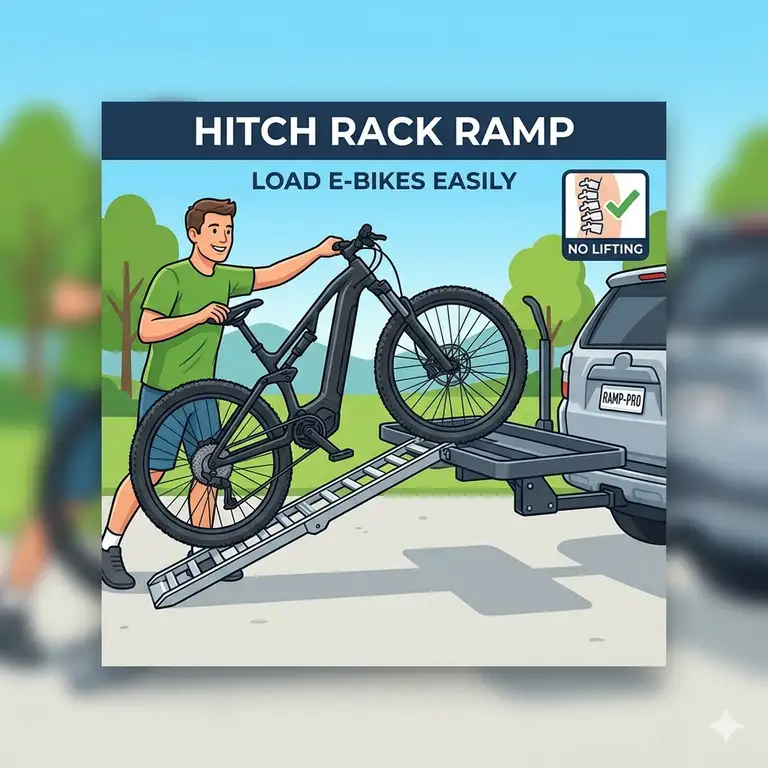
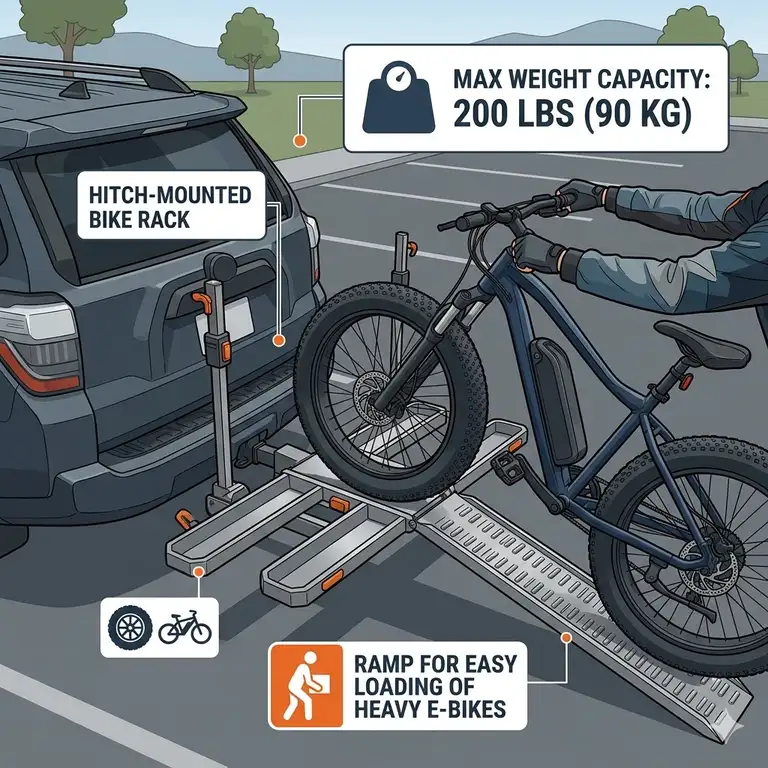
The cycling landscape in 2026 looks a lot different than it did just five years ago. If you stroll through any trailhead in the USA today, you aren’t just seeing 20-pound carbon road bikes; you are seeing 75-pound electric fat bikes, heavy-duty cargo commuters, and specialized adaptive cycles. This shift has made the hitch bike rack with ramp weight capacity the most critical piece of gear for the modern rider.
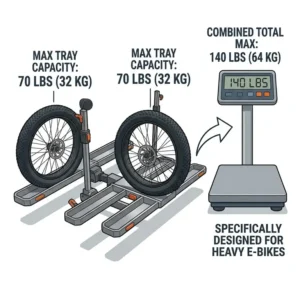
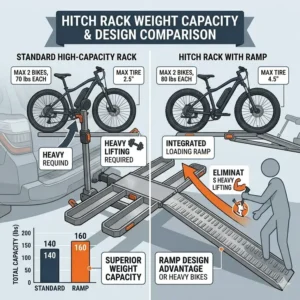
What is a hitch bike rack with ramp weight capacity? It is a vehicle-mounted transportation system designed specifically to support the extreme weight of modern electric bikes (often 60–80 lbs per tray) while providing an integrated or attachable ramp to eliminate the need for heavy lifting. These racks use the vehicle’s 1.25-inch or 2-inch receiver to provide a stable platform that can handle total loads often exceeding 130–160 lbs across two bikes.
In my years of testing gear, I’ve realized that weight capacity is the one spec you can never “fudge.” If your rack is rated for 60 lbs and your bike weighs 65 lbs with the battery, you aren’t just risking a ticket; you’re risking a catastrophic failure on the interstate. The ramp isn’t just a luxury for seniors anymore—it’s a spine-saver for anyone who prefers riding their bike to visiting the chiropractor.
Quick Comparison: High-Capacity Hitch Racks with Ramps
| Product Name | Max Weight Per Bike | Hitch Size | Best For | Price Range |
| Thule EasyFold XT 2 | 65 lbs | 1.25″ & 2″ | Portability & Storage | $850 – $950 |
| Kuat NV 2.0 + Ramp | 60 lbs | 2″ Only | Premium Aesthetics | $900 – $1,100 |
| Hollywood Racks Sport Rider | 80 lbs | 2″ Only | Heavy Cargo E-Bikes | $500 – $600 |
| Yakima OnRamp | 66 lbs | 1.25″ & 2″ | Off-Road Stability | $650 – $750 |
| Saris Door County | 60 lbs | 2″ Only | Full Electric Lift | $1,200 – $1,400 |
Analysis of the Comparison Data
When evaluating the table above, the standout for pure utility is the Hollywood Racks Sport Rider, which offers a massive 80-lb capacity per bike, making it the king for heavy-duty fat tire e-bikes. However, if you live in a condo with limited space, the Thule EasyFold XT 2 justifies its higher price point by folding into a compact suitcase shape. For those who want the absolute premium experience without lifting an inch, the Saris Door County uses the vehicle’s power to actually lower the rack to the ground, though it comes at a significant price premium compared to manual ramp systems.
💬 Just one click — help others make better buying decisions too! 😊
Top 5 Hitch Bike Racks with Ramps: Expert Analysis
1. Thule EasyFold XT 2: The Gold Standard for Convenience
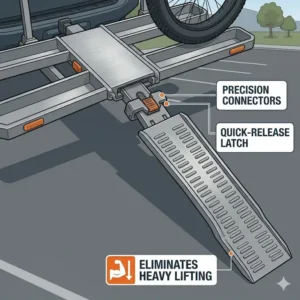
The Thule EasyFold XT 2 is a fully foldable, high-capacity rack that features a hidden, integrated ramp tucked right into the base.
Key Specifications with Real-World Meaning
-
65 lbs per bike capacity: This allows you to carry almost any standard e-bike, even with the battery installed (though I always recommend removing batteries to reduce strain).
-
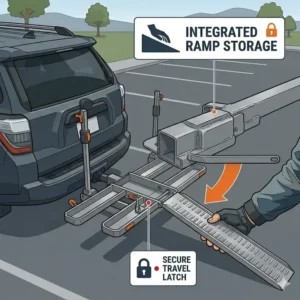
Integrated stow-away ramp: You don’t have to worry about leaving the ramp in your garage; it lives inside the rack, meaning it’s there when you finish a grueling 30-mile ride and have no arm strength left.
-
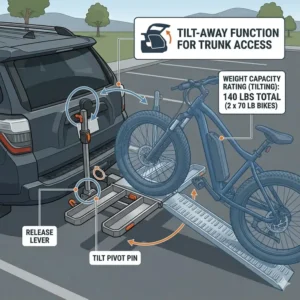
Foot-activated tilt: Even with bikes loaded, you can tilt the rack away to get into your trunk, which is essential for SUV owners.
Expert Opinion
In my experience, the EasyFold XT 2 is the best “all-rounder” for someone who values their garage space as much as their bike. Most people overlook how heavy these racks are to move when they aren’t on the car. Because this model has wheels and folds up, you can roll it like a suitcase. It’s perfect for the luxury e-bike owner who wants a sleek, refined look that doesn’t scream “industrial hardware store.”
Customer Feedback Summary
Users consistently praise the “set it and forget it” nature of the folding mechanism, though some note the included ramp is a bit short for high-clearance trucks, creating a steep angle…
-
Pros: Exceptionally portable, fits both hitch sizes, very high build quality.
-
Cons: Steep ramp angle on tall SUVs, premium price point.
-
Price Range: Around $850 – $950.
2. Hollywood Racks Sport Rider for E-Bikes: The Heavy-Duty Workhorse
The Hollywood Racks Sport Rider for E-Bikes is specifically engineered for the heaviest bikes on the market, featuring reinforced “heavy-duty” components.
Key Specifications with Real-World Meaning
-
80 lbs per bike capacity: This is the highest in the consumer class, capable of hauling “moped-style” e-bikes that other racks would buckle under.
-
5-inch wide tire trays: You won’t need to buy extra “fat tire kits”; it handles oversized rubber right out of the box.
-
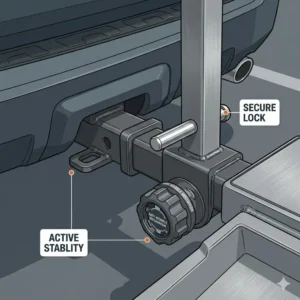
Hitch-tightening system: Uses a threaded pin to “pull” the rack into the receiver, which stops the “clunk-clunk” sound you often hear when driving over speed bumps.
Expert Opinion
What most buyers overlook about the Sport Rider is its sheer ruggedness. While it lacks the “pretty” finishes of a Kuat or Thule, it uses thick-walled steel that inspires massive confidence on long highway hauls. If you are a “full-time RVer” or someone taking heavy bikes across the country, this is your best bet. It’s the “truck” of the bike rack world—not always pretty, but it never quits.
Customer Feedback Summary
Owners rave about the stability of the bikes during transport, specifically mentioning that the bikes don’t sway even at 75 mph. Some find the rack itself quite heavy to install alone…
-
Pros: Unmatched weight capacity, fits massive fat tires, very stable.
-
Cons: Very heavy unit, utilitarian aesthetics.
-
Price Range: $500 – $600 range.
3. Yakima OnRamp: The Off-Road Ready Solution
The Yakima OnRamp was built from the ground up to address the “steep ramp” problem found on many other models.
Key Specifications with Real-World Meaning
-
66 lbs per bike capacity: Optimized for mid-weight e-bikes and mountain bikes with heavy frames.
-
Adjustable frame cradles: Unlike racks that grip the wheels, this uses padded arms to grip the frame, which is great if you have fenders that prevent wheel-strap usage.
-
Extra-long ramp: The ramp is longer than Thule’s, which significantly reduces the incline when loading onto a lifted 4×4 or a tall van.
Expert Opinion
I recommend the OnRamp specifically for the “van-life” crowd or Overlanders. If your vehicle has a 2-inch lift or high-clearance tires, a short ramp is useless. The OnRamp’s geometry is much more forgiving. The spec sheet won’t tell you this, but the way the cradles adjust makes this the best rack for carrying two different sized bikes (like a large mountain bike and a small step-through e-bike) without them banging into each other.
Customer Feedback Summary
Buyers love the versatility of the frame attachments for bikes with weird shapes, but a few have mentioned the strap system takes a bit longer to secure than “ratchet arm” style racks…
-
Pros: Best ramp angle for tall vehicles, fender-friendly, great for mixed bike types.
-
Cons: Slower loading process, frame contact requires care.
-
Price Range: Mid-$600s.
4. Kuat NV 2.0 with Access Ramp: The Stylish Performer
The Kuat NV 2.0 with Access Ramp (sold as an add-on) combines the most beautiful rack on the market with a functional loading solution.
Key Specifications with Real-World Meaning
-
60 lbs per bike capacity: Solidly mid-range, enough for most premium carbon or aluminum e-bikes.
-
Integrated Work Stand: This rack actually has a built-in “Trail Doc” repair stand so you can tune your derailleur at the trailhead.
-
Pivot lever: The foot lever is the easiest to operate in the industry, requiring almost zero force to tilt the rack down.
Expert Opinion
Kuat is the “Apple” of bike racks. The NV 2.0 is for the rider who wants their gear to look as good as their $10,000 Specialized Turbo Levo. However, the ramp is an accessory you usually buy separately. The “Original Value” here is the long-term durability of the finish. Kuat uses a high-grade powder coat that resists salt and road grime better than almost anyone else. If you live near the coast, this is the one that won’t look like a rusted heap in two years.
Customer Feedback Summary
Users love the “jewelry-like” finish and the convenience of the work stand. Some complain that for the price, the ramp should be included in the box…
-
Pros: Stunning design, built-in repair stand, best-in-class warranty.
-
Cons: Ramp is often an extra cost, lower weight limit than Hollywood.
-
Price Range: $900 – $1,100 (including ramp).
5. Saris Door County: The “No-Lift” Luxury Option
The Saris Door County is a unique electric-assist rack that uses the car’s power to raise and lower the bikes.
Key Specifications with Real-World Meaning
-
60 lbs per bike capacity: Standard e-bike rating, perfectly suited for step-through cruisers.
-
Electric Actuator: The rack literally lowers to the ground so you can just roll the bike on, then it “elevates” them into the transport position.
-
Integrated tail lights: Includes brake and turn signals that plug into your 7-way flat connector, which is a massive safety upgrade.
Expert Opinion
This is the ultimate solution for riders with limited mobility or back issues. The “ramp” is essentially the entire rack. What most buyers overlook is the safety aspect of those integrated lights. Modern e-bikes often have wide handlebars that can obscure your car’s tail lights; the Saris fixes this legal and safety headache instantly. It’s an investment in your ability to keep riding well into your 70s or 80s.
Customer Feedback Summary
“Life-changing” is a common phrase in reviews for this rack. However, customers do note that you need a 7-pin trailer wiring harness for it to work, which not all SUVs have…
-
Pros: Zero lifting required, improved visibility/safety, high-tech appeal.
-
Cons: Requires trailer wiring, very expensive, heavy to remove from car.
-
Price Range: Around $1,300.
✨ Don’t Miss These Exclusive Deals!
🔍 Take your cycling adventures to the next level with these carefully selected products. Click on any highlighted item to check current pricing and availability. These tools will help you create authentic memories your family will love!
Practical Usage Guide: Mastering the Ramp Without the Rampage
So, you’ve got your high-capacity rack. Now comes the part where most people struggle: the actual loading process. Using a hitch bike rack with ramp weight capacity seems straightforward, but there is a technique to it that prevents both bike damage and personal injury.
Step-by-Step Loading Optimization
-
Level the Ground: Always try to park on a flat surface. If the car is tilted, the ramp will be uneven, making the bike want to roll off the side.
-
Power Off (But Assist On?): Turn off your e-bike’s motor. However, some 2026 e-bikes have a “Walk Mode.” If yours does, you can actually use the motor to help “crawl” the bike up the ramp while you just guide the handlebars.
-
The “Hip Brace” Technique: Instead of standing behind the bike and pushing, stand to the side. Lean your hip slightly against the bike seat as you guide it up the ramp. This gives you a third point of contact and prevents the bike from tipping toward you.
-
Brake Management: Use your front brake as a “clutch.” As you roll up the ramp, keep a finger on the brake lever. If the bike starts to roll back, squeeze the brake. It’s much easier than trying to muscle the weight.
Maintenance for Longevity
Hitch racks live a hard life. They are sprayed with road salt, blasted by wind, and shaken by potholes.
-
Pivot Lubrication: Every three months, spray a dry PTFE lubricant into the folding joints. Avoid standard WD-40 as it attracts grit that acts like sandpaper in the joints.
-
Ramp Hinge Check: If your ramp is integrated (like the Thule), check the hinge for debris. A small pebble in the hinge can prevent the ramp from locking into place, which is a recipe for a lost ramp on the highway.
Buyer’s Decision Framework: Which Rack Fits Your Life?
Choosing a hitch bike rack with ramp weight capacity isn’t just about the bikes; it’s about your vehicle and your physical needs. Use this checklist to narrow your search.
1. The Vehicle Factor
-
Standard Sedan/Crossover: Look for the Thule EasyFold XT 2. It offers a 1.25-inch hitch option and doesn’t overwhelm a smaller car’s suspension.
-
Lifted Truck or Off-Road SUV: You need the Yakima OnRamp. The longer ramp length is non-negotiable when your hitch sits 24 inches off the ground.
-
RV or Travel Trailer: Choose the Hollywood Racks Sport Rider. RVs have much more vertical “bounce” at the rear. You need the heavy-duty steel and the “RV Rated” certification that Hollywood provides.
2. The Physical Ability Factor
-
“I just want to save my back”: The Kuat NV 2.0 with the ramp add-on is perfect. It’s easy to handle and the ramp is light.
-
“I physically cannot lift 10 lbs”: Don’t mess with manual ramps. The Saris Door County is the only logical choice. It turns a physical chore into a button-press.
3. The Bike Type Factor
-
Fat Tire E-Bikes (4″+ tires): Ensure the rack has “Fat Tire” trays. Hollywood Racks includes them; Thule and Kuat often require an extra kit.
-
Fendered Commuter Bikes: Avoid “Wheel-Hook” racks. The hook will crush your plastic fenders. Go for the Yakima OnRamp which grips the frame instead.
Understanding Tongue Weight vs. Rack Capacity: The Hidden Math
When people search for a hitch bike rack with ramp weight capacity, they often focus only on the rack’s rating. This is a dangerous mistake. You must also understand your vehicle’s Hitch Tongue Weight Capacity.
According to the National Highway Traffic Safety Administration (NHTSA), the tongue weight is the downward force exerted on the hitch ball or receiver. Typically, a Class 2 hitch (1.25″) has a tongue weight limit of 300 lbs, while a Class 3 hitch (2″) can handle 500 lbs or more.
The Calculation You Need:
Weight of the Rack + Weight of Bike A + Weight of Bike B = Total Tongue Load.
Example:
-
Hollywood Sport Rider: 58 lbs
-
E-Bike 1: 75 lbs
-
E-Bike 2: 75 lbs
-
Total: 208 lbs
If you have a small car with a Class 1 hitch (often limited to 200 lbs), you are technically exceeding the safety limit of your vehicle, even if the rack says it can handle the weight! Always check your owner’s manual before buying the heaviest rack on the market.
Common Mistakes When Buying a High-Capacity Rack
In my years of consulting for gear shops, I’ve seen the same three mistakes happen over and over. Avoid these to save your money and your shins.
1. Ignoring the “Fat Tire” Requirement
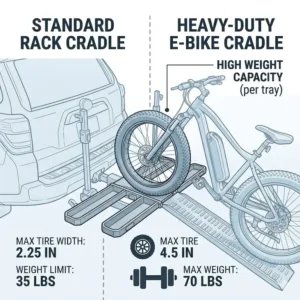
Many shoppers assume that a “heavy duty” rack automatically fits wide tires. In reality, many premium racks have trays designed for 2.5-inch mountain bike tires. If you have a 4-inch “RadPower” or “Lectric” e-bike, your tires will literally sit on top of the tray rather than inside it. This makes the bike prone to sliding off. Always verify the maximum tire width.
2. Assuming the Ramp is “Universal”
Not all ramps are created equal. Some ramps are essentially “U-channels” that the tire sits in. If your bike has very narrow road tires, they might wobble inside a wide ramp. Conversely, if your e-bike has 4.5-inch tires, it might not fit inside the ramp channel at all.
3. Forgetting the “Hitch Rise”
Some racks are “straight-shot” (coming straight out of the hitch), while others have a “rise” (curving upward). If you have a low-clearance sedan, a straight rack will scrape every time you pull into a driveway. Look for racks with a built-in “shank rise” to keep your expensive bikes from bottoming out.
Features That Actually Matter (And Those That Don’t)
Marketing teams love to sell you on “aerodynamic styling” or “anodized accents,” but when you’re 50 miles from home and a storm is rolling in, those don’t matter. Here is what does:
Does Matter: Integrated Locking Systems
Heavy e-bikes are prime targets for theft. A rack that has integrated steel cables is good, but a rack that locks the hitch pin to the car and the frame to the rack is better. In 2026, many racks now feature “Smart Locks” that alert your phone if the cable is cut.
Does Matter: Tilting with Bikes Loaded
I cannot emphasize this enough. If you have to take the bikes off just to let the dog out of the trunk, you will grow to hate your rack. Ensure the rack is rated to tilt while fully loaded.
Doesn’t Matter: Color Matching
Unless you are entering a car show, don’t pay a $100 premium for a “Metallic Grey” finish over a “Matte Black” one. These racks get scratched by pedals and road salt immediately. Focus on the quality of the powder coating, not the color.
Long-Term Cost & Maintenance Analysis
Buying a hitch bike rack with ramp weight capacity is an investment. A $900 rack seems expensive until you realize it is protecting $10,000 worth of e-bikes.
Total Cost of Ownership (TCO)
-
Initial Purchase: $500 – $1,300.
-
Installation: $0 (DIY) to $150 (if you need a hitch installed on your car).
-
Annual Maintenance: $20 (Lubricants and cleaning supplies).
-
Component Replacement: $50 – $100 (Straps and plastic cradles tend to UV-degrade after 5 years).
If you buy a high-quality brand like Thule or Kuat, the resale value is incredibly high. In the used market, these racks often sell for 60–70% of their original price even after 3 years of use. Cheap, “no-name” racks from big-box stores often have zero resale value and a higher risk of part failure.
Safety & Compliance: The Legal Side of Racks
In several US states (and increasingly in 2026), law enforcement is cracking down on “obscured license plates.” When you have two large e-bikes on a rack, they completely hide your plate.
Practical Tip:
Look for a rack that has a dedicated license plate mount (like the Saris Door County or the Thule EasyFold). If your rack doesn’t have one, you can buy a $25 bracket that attaches to the outermost bike’s pedal. Avoiding a $150 “obstructed plate” ticket makes this a wise move.
Additionally, ensure your rack does not block your “Third Brake Light” (the one in the center of your rear window). If it does, you are technically out of compliance with DOT regulations, and in the event of a rear-end collision, the insurance company could potentially argue you were partially at fault for reduced visibility.
✨ Don’t Miss These Exclusive Deals!
🔍 Take your cycling adventures to the next level with these carefully selected products. Click on any highlighted item to check current pricing and availability. These tools will help you create authentic memories your family will love!
Conclusion
Choosing the right hitch bike rack with ramp weight capacity is the final step in unlocking the freedom that modern e-bikes provide. Whether you opt for the portable elegance of the Thule EasyFold XT 2, the raw strength of the Hollywood Racks Sport Rider, or the high-tech ease of the Saris Door County, the goal remains the same: getting you on the road with less stress and more safety.
Remember to always cross-reference your vehicle’s tongue weight with the total weight of your rack and bikes. A little bit of math now prevents a lot of heartache (and car repairs) later. Invest in a quality rack, maintain it well, and enjoy the trails.
FAQs
❓ How much weight can a standard hitch bike rack with ramp hold?
✅ Most consumer models are rated for 60 to 66 lbs per bike. However, heavy-duty models like the Hollywood Racks Sport Rider can handle up to 80 lbs per bike, totaling 160 lbs across two trays…
❓ Can I use a ramp rack on a 1.25-inch hitch?
✅ Yes, but your options are more limited. The Thule EasyFold XT and Yakima OnRamp offer versions for 1.25″ hitches, but their total weight capacity is usually lower than 2″ versions due to the hitch’s structural limits…
❓ Do e-bike ramps work with fat tires?
✅ Not all of them. Many ramps are only 2.5 to 3 inches wide. If you have 4-inch fat tires, you need a specific wide-channel ramp, such as the ones provided by Hollywood Racks or the Yakima fat-tire accessory…
❓ Is it safe to leave the rack on the car year-round?
✅ While possible, it’s not recommended. Road salt and constant UV exposure can degrade straps and seize pivot points. If you do, ensure you use a “hitch lock” and regularly lubricate the moving parts…
❓ Do I need a ramp if my e-bike has a ‘Walk Mode’?
✅ ‘Walk Mode’ helps, but you still have to lift the front wheel into the tray. A ramp allows the motor to do 100% of the work while the bike stays on the ground, making the process much safer…
Recommended for You
- 5 Best hitch bike rack with ramp instructions for 2026: Expert Guide
- 5 Best Hitch Bike Rack with Ramp Storage Models for 2026 (Ultimate Guide)
- 7 Best Hitch Bike Rack with Ramp Installation Kits (2026 Review)
Disclaimer: This article contains affiliate links. As an Amazon Associate, I earn from qualifying purchases. If you purchase products through these links, we may earn a small commission at no additional cost to you.
✨ Found this helpful? Share it with your friends! 💬🤗