As an Amazon Associate I earn from qualifying purchases. Links in this article may be affiliate links. How we choose gear
Ten miles per hour is the typical top speed Burley lists for its cargo and pet trailers behind an e-bike, with fifteen for its child trailers, according to the maker’s e-bike FAQ. That one number shapes every purchase of ebike bike trailers in 2027, because a motor makes it easy to drift past it. Two Wheeling Tots, a site that tests child trailers, says riders can top 15 mph on an e-bike without noticing.
Nobody hitched any of these trailers to a bike for this article: the findings trace to Burley’s manuals and product pages, OutdoorGearLab’s cargo-trailer tests, Electric Bike Report’s towing guide, Two Wheeling Tots, etrailer’s experts and an owner forum thread, so every remark about feel belongs to a named source. Prices are ranges from those pages, and the current price on Amazon.com may differ.
What follows is a method first (speed cap, axle, motor, packing), then the repairs for what goes wrong, then four trailers tied to those steps. One section also covers the other thing people mean by the phrase: carrying the e-bike itself on the back of a travel trailer.
Choosing the best ebike bike trailers: speed, hitch, motor, load
Run these checks in order. Each one can rule out a trailer before price comes into it.
Cargo, child or dog: the load decides the speed cap
Burley’s FAQ says its trailers are tested only up to the top speed printed in the manual. In its words, “Exceeding these limits can affect handling, stability, and braking.” The manual for the Burley Encore child trailer adds two more numbers: 5 mph in turns or on uneven roads, and a rider who is at least 16 years old.
Trailer type then sets the shape of the load. Electric Bike Report’s towing guide treats single-wheelers as the choice for lighter loads and narrow paths, two-wheelers as the everyday tool, and puts most trailer ratings at about 90 pounds or less. OutdoorGearLab’s testers found two-wheeled cargo trailers better for around-town commuting and bigger loads than single-wheel designs.
Your assist level against the trailer’s speed ceiling
Burley says its trailers are not designed or tested for motorcycles, scooters or any motorized vehicle other than an e-bike, and its FAQ gives no wattage or class limit. The maker’s manuals also warn that trailers towed by electric-assist bikes can be restricted by law. E-bike rules differ by state and city, so confirm yours before towing on public roads.
Two Wheeling Tots goes further and does not recommend towing a child trailer with an e-bike at all, noting that trailers tip more easily than riders expect. For anyone who tows anyway, the site suggests 20-inch wheels on metal rims and a double trailer even for one child, because it is steadier.
The practical reading: choose an assist level that holds your cruising speed under the manual’s number, and go slower for corners and descents. Electric Bike Report gives the same advice for heavier loads, especially downhill.
Hitch fit: quick-release, nutted axle or thru-axle
Quick-release skewers are the most common e-bike axle, according to Electric Bike Report, with standard rear spacing of 130 mm on road bikes and 135 mm on mountain bikes. Solid axles turn up on hub-motor and hub-gear bikes, where some hitches slide behind the axle nut if enough thread protrudes to re-secure it. Thru-axles are usually 12 mm in several lengths, and the same guide warns against overtightening them because the thread goes straight into the frame.
Hub motors with large nutted axles may need an adapter, Burley says, and it points to the Robert Axle Project for thru-axle and nutted-axle versions. A local bike shop can measure axle diameter and thread pitch before you order. Seatpost hitches are convenient on budget trailers but, per Electric Bike Report, unsuited to very heavy loads because they can destabilize steering.
Motor and brakes: what the drivetrain has to survive
Electric Bike Report describes crank-drive motors as well suited to carrying loads, with high-torque geared hubs also able to perform, and it calls hydraulic disc brakes the current standard for load carrying. Lightweight racing-style frames are the poorer match, and wider rims, wider tires and strong spokes help.
Owner reports in an Electric Bike Review forum thread are more mixed than any spec sheet. Owners there agreed that both drive types tow on flat ground, with mid-drives smoother and quicker on hills. One mid-drive owner reported more than 2,000 miles per chain while hauling up to 400 pounds, while another said chains can snap but never had in ten builds. A third treated the wattmeter as a strain gauge: sustained output above roughly 1,000 to 1,200 watts meant shifting down or lowering assist. These are single-owner reports rather than a test, yet the habit costs nothing. The same thread advises adding the trailer’s load to the bike’s payload rating.
Packing and tongue weight: the part you can measure at home
For a two-wheeler, Electric Bike Report says cargo belongs centrally between the trailer’s axles, with heavy items low. Too far back lifts weight off the bike’s rear wheel and costs traction; too far forward degrades steering.
The Burley Encore manual puts the downward force at the tow-bar end between 2 and 20 pounds and describes the check: weigh the loaded trailer on a bathroom scale, lift the tow-bar end one foot off the ground, weigh again and subtract. That figure comes from a child-trailer manual, so your own trailer’s manual sets the number that counts.
Tires finish the checklist. OutdoorGearLab warns that under-inflation is a leading cause of trailer tire failure, and Electric Bike Report advises puncture-resistant tires, a spare tube and knowing how to pull the trailer wheel quickly.
Where an e bike trailer setup goes wrong, and the repair
Testers and owners describe a handful of repeatable e bike trailer problems, and each has a cheap fix.
Rattle when empty comes first. OutdoorGearLab’s testers found the plastic bottom and loose rails of the Aosom Wanderer annoying with nothing aboard and carried bungees to hold the rails down, which helped. The same review site calls the Schwinn Day Tripper noisy, with wheels out of true.
Hitch creep is next. The Wanderer review says its axle mount can rotate forward, and Burley’s general answer is to confirm every bike and trailer component is fastened securely before each ride.
Snaking comes from uneven packing or a floppy hitch. OutdoorGearLab reports that the Burley Coho XC wobbles when packed unevenly, and Electric Bike Report says single-sided hitches with too much flex can cause side-to-side snaking at speed. Pack on the centerline and slow down.
Curbs punish small wheels. OutdoorGearLab marks the Burley Travoy down for wheels that can be damaged on curbs and lists small wheels as a drawback of the Burley Flatbed. Take dropped curbs and driveways instead of hopping up.
Tipping is the serious one. Two Wheeling Tots says trailers tip more easily than riders expect, and one reviewer on Burley’s product page for the Burley Bee reports a single model going over. Keeping to the 5 mph limit Burley gives for turns is the fix.
Ebike bike trailers reviews: four models matched to the steps
Each pick answers a step above, so read them as tools for different jobs rather than a ranking. The cargo figures in these ebike bike trailers reviews lean on OutdoorGearLab’s cargo-trailer tests, and the child-trailer figures on Burley’s page.
| Model | Rating | Trailer weight | Wheels | Attachment |
|---|---|---|---|---|
| Burley Flatbed | 100 lb | 14.5 lb | Two, 16 in | Burley hitch with tow arm |
| Aosom Wanderer | 110 lb | 30 lb per OutdoorGearLab (other listings 22 to 26 lb) | Two, 16 in | Aosom Type B coupler on the rear hub |
| Burley Coho XC | 70 lb | 21.2 lb | One, 16 in | Dual-ball yoke for 126 to 197 mm hubs, axle sold apart |
| Burley Bee (single) | 75 lb total, 40 lb per child | 21.6 lb | Two, 20 in | Tow bar and hitch included |
By our arithmetic, the Burley Flatbed carries about 6.9 pounds per pound of its own weight, the Aosom Wanderer about 3.7 on OutdoorGearLab’s 30-pound figure, and the Burley Coho XC about 3.3. That ratio matters on climbs, where an e-bike’s motor ends up lifting the trailer too. The Burley Bee is a different animal, since its total includes the children.
1. Burley Flatbed — light two-wheel hauler for bulky loads
Odd-shaped cargo is what this deck was drawn around. Clever Cycles describes the open front, back and top as easy on items of almost any size, and Burley’s page adds that the side rails come off, the wheels pop off with push buttons and the whole trailer folds flat. Dealer listings give an interior of about 32.5 by 20.5 inches, and a flex connector keeps the trailer upright even if the bike is lying on its side.
OutdoorGearLab named the Burley Flatbed its Top Pick for heavy loads, praising the 100-pound rating at only 14.5 pounds, the big bed and the versatility. Its cons are plain: no straps or dry sack in the box, and small wheels. Budget for a cargo net and straps on top of a price that dealer pages and OutdoorGearLab put at around $300 to $320.
Pairing matters here. Burley’s 10 mph figure for cargo trailers applies to this one, so it suits a rider who keeps assist modest and hauls groceries, camping gear or lumber at an errand pace.
Check the current listing on Amazon.com.
2. Aosom Wanderer — budget price, highest tested load rating
Cost is the reason to look. Across sellers the Aosom Wanderer runs around $110 to $190, and OutdoorGearLab gave it the Best Buy award while noting it has the highest rating of the trailers it tested, 110 pounds. It arrives in five pieces with easy instructions, the front and back walls detach for long or misshapen loads, and a spring-loaded connection tracks well.
Pros:
- ✅ Highest load rating in OutdoorGearLab’s cargo test, with a sturdy build the testers trusted on heavy hauls
- ✅ Detachable walls and quick assembly
Cons:
- ❌ Rattles when empty, which bungees on the rails help with
- ❌ The axle mount can rotate forward, so recheck it before each ride
Weight is the second drawback. OutdoorGearLab lists 30 pounds and calls it one of the heaviest trailers tested, while retailer pages give 22 to 26 pounds, so sources disagree and the label on the box decides. Because the Type B coupler mounts directly on the rear hub, anyone with a nutted hub-motor axle should confirm the stack fits before hitching, and check the trailer’s own manual for its speed figure, since Burley’s 10 mph applies to Burley’s trailers.
3. Burley Coho XC — single-wheel suspension for trails
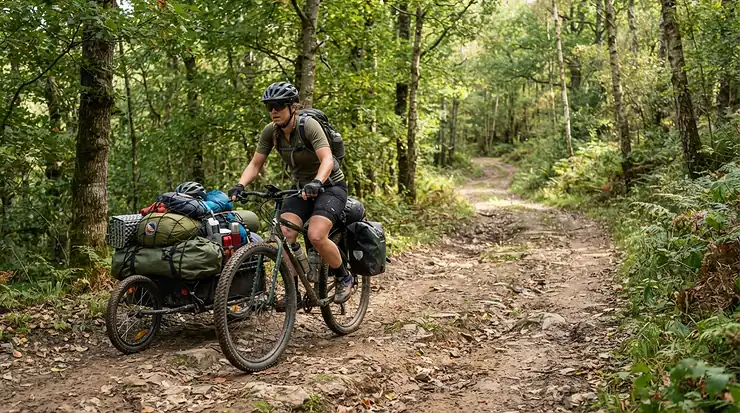
Trail riding is home turf for the Burley Coho XC, and the price shows it: around $450 to $520 for a 70-pound rating. OutdoorGearLab made it Editors’ Choice, and Burley’s page explains why: coil-spring suspension, a 70-liter bay, a height-adjustable kickstand and a one-handed dual-ball hitch, all on a 6061-T6 aluminum frame that weighs 21.2 pounds. Electric Bike Report notes single-wheelers like this suit narrow paths and lighter loads.
Pros:
- ✅ Yoke fits hub widths from 126 to 197 mm, useful on fat-tire and hub-motor wheels
- ✅ Tracks well, hitches with one hand and stands on its own
Cons:
- ❌ OutdoorGearLab found it wobbles if the load is packed unevenly
- ❌ An axle or adapter is required and sold separately (thru-axle, 5 mm skewer or nutted-axle adapter)
That last line is the hidden cost. Burley’s Axle Fit Guide shows which axle suits a given bike, and a hub-motor wheel with a big nutted axle is exactly where the adapter matters. Fold size is 31.75 by 17.5 by 13.75 inches.
Open the current listing on Amazon.com.
4. Burley Bee — child trailer with a 15 mph cap
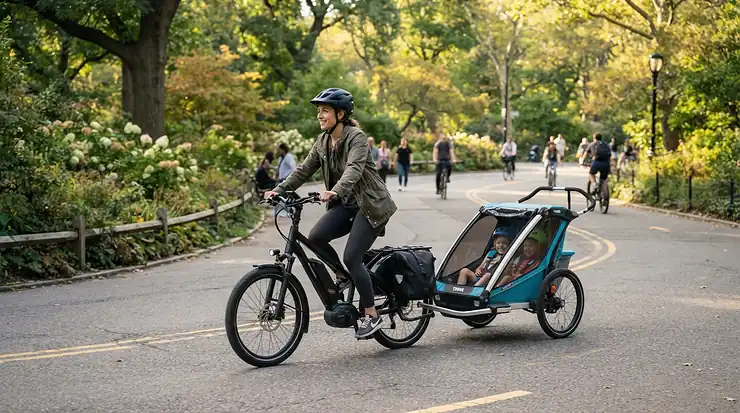
Children change the rules. The single Burley Bee carries 75 pounds in total, children plus cargo, with a limit of 40 pounds per child, a minimum age of 12 months and 20-inch wheels; the double raises the total to 100 pounds. Prices run around $380 to $400, according to Burley and Two Wheeling Tots, with a tow bar and hitch included and a 16+ wheel kit sold apart for rougher ground.
Burley says the Bee fits most e-bikes and its hitch guide lists the adapter each axle type needs. Two Wheeling Tots lists it as e-bike compatible at 15 mph maximum, praises the build quality and folding, and says hammock seats give less support than the bench seats on pricier trailers. One reviewer on Burley’s page reports the single tipping over because of its narrow wheelbase, and Two Wheeling Tots separately suggests a double even for one child when towing with an e-bike. There is no stroller conversion for the Bee.
Travel trailer bike rack or tow-behind trailer: carrying the e-bike itself
Some people searching this topic want the opposite job: hauling the bike, not cargo behind it. A travel trailer bike rack sits on the RV’s bumper or tongue, and an ebike bike rack for trailer hitch use means a 2-inch receiver rated for the weight. The ratings stack up quickly.
One etrailer expert answer shows the arithmetic for two 62-pound e-bikes on a bumper-pull travel trailer. The Swagman E-Spec Bike Rack for 2 Electric Bikes is rated at 70 pounds per bike and for travel-trailer use, and the rack itself weighs 60 pounds, so the load totals 184 pounds. The expert’s setup pairs it with Mount-n-Lock SafetyStruts, which raise a 4-inch bumper’s capacity to 400 pounds, and a Curt RV Bumper 2-inch receiver rated for 350 pounds of tongue weight. The expert’s answer works only if the bumper really measures 4 inches.
Three limits decide the build: per-bike rating, bumper capacity and receiver rating. Weight hung behind the axle also changes the trailer’s tongue weight, so the trailer maker’s figures matter alongside the rack’s.
What is the best bike frame to convert to an ebike for towing?
Steel with strong dropouts. E-bike School calls steel the best frame material, says aluminum can work but usually needs a torque arm, and says carbon fiber should never be converted. It also points out that price does not predict dropout strength, so a cheap steel bike can beat a pricey aluminum one.
Towing adds its own filter. Electric Bike Report prefers a stable, solid-feeling bike with wide rims and strong spokes over a lightweight racing frame, and hydraulic disc brakes for stopping a loaded trailer. Ebike School suggests a disc brake in front and a rim brake on the rear wheel as a compromise on a hub-motor wheel.
Check the axle against the hitch before you buy the frame. Quick-release rear ends at 130 or 135 mm are the common case Electric Bike Report describes, while a large nutted hub-motor axle may call for the adapters Burley mentions. A used steel hybrid or hardtail with disc mounts is the shape this evidence points toward.
Speed caps, axles, hubs and racks: what shoppers ask about ebike trailers
❓ Can you pull a bike trailer with an electric bike?
❓ Do mid-drive or hub motors tow better?
❓ Will a trailer hitch fit my hub-motor axle?
❓ How much weight can a bike trailer carry?
❓ Can I carry an e-bike on a travel trailer bike rack?
Choose by speed cap first, brand second
Start with the speed number in the manual, then the axle, then the load. A rider who hauls bulky errands and keeps assist modest has the clearest fit with the Burley Flatbed, while a tight budget and heavy loads point to the Aosom Wanderer once you accept its weight and rattle. Trails and wide hub spacing favor the Burley Coho XC, and a child passenger means the Burley Bee with a firm 15 mph cap and a rider at least 16.
Whichever of these ebike bike trailers you choose, weigh the tow-bar end on a bathroom scale after loading and check the hitch before every ride. Frame advice settles the rest: steel, strong dropouts, disc brakes.
Browse the current listings on Amazon.com.
Recommended for You
- 7 Best Trailer Hitch Bike Rack With Ramp Models for E-Bikes
- Travel Trailer Bike Carrier: 7 Top RV-Rated Picks 2026 for Safe & Easy Adventures
- Ebike hitch rack with ramp 2 inch receiver: 7 Best Heavy-Duty Picks!
Disclaimer: This post contains affiliate links. As an Amazon Associate, we earn from qualifying purchases made through these links, at no additional cost to you.
Towing your first load this weekend? Weigh the tow-bar end on a bathroom scale before you leave.