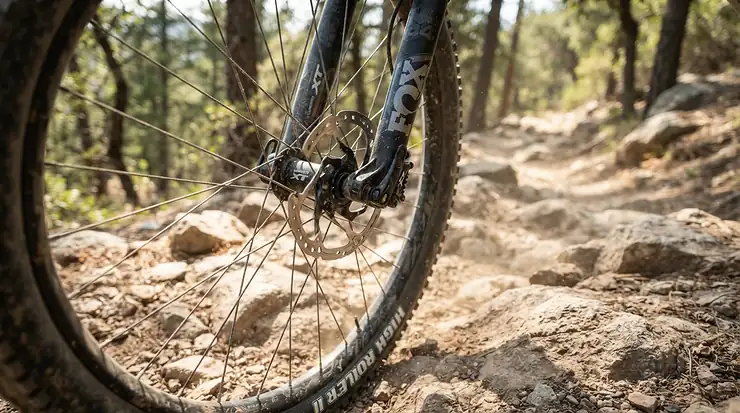
A strong motor does not decide which trailer you can tow; the rear axle does. Burley’s e-bike guide says bikes with a traditional quick-release axle and standard dropouts take its included steel hitch directly, while most hub-motor e-bikes use a nutted axle that usually needs an adapter. That puts a sharper edge on “what kind trailers work behind e-bike?” for 2027: the answer is any trailer whose hitch, speed rating and load rating all match your bike, which cuts the field to a short list of kid, dog and cargo designs.
Everything here comes from maker manuals and help pages, published tests and owner threads, not from hands-on rides. Burley is the brand whose e-bike rules could be read in full, so all four picks carry its name: the Burley Honey Bee for kids, the Burley Tail Wagon for dogs, the Burley Nomad for road errands and the Burley Coho XC for trails and hub-motor axles. If you shop another maker’s ebike trailer, ask it for the same three numbers: speed cap, load rating and hitch fit.
Three questions that rule an ebike trailer in or out
Answer these in order, because the first one can end the search before you look at a single price.
Question 1: What is bolted to your rear axle?
Electric Bike Report’s guide to cargo trailers for e-bikes calls hitch compatibility the main hurdle with any electric bike trailer: the coupler has to suit both the rear axle and the frame. Quick-release skewers are the common case, but solid threaded axles are typical on hub-motor and hub-geared bikes, and the guide tells you to confirm enough thread sticks out to refit the nut. Burley’s hitch chart sorts it three ways. Quick-release and bolt-on axles on standard dropouts use the steel hitch that ships with the trailer, hooded dropouts add an adapter, and thru-axles need a matching Burley thru-axle.
Nutted-axle adapters are named by diameter and thread pitch, such as M10 x 1.0, and Burley says to get both numbers from your bike or hub maker. It also advises against axle-mounted trailers on open horizontal dropouts, because the axle can shift under load.
Owners describe the same snag. On the Rad Owners forum, one member worried that the axle thread on a City 4 barely clears the nut, and another reports that a Robert Axle Project adapter made for Rad bikes went on easily. A poster on the Electric Bike Review forum who bought a Cannondale Topstone Neo SL 2 mainly to tow kids in a Burley calls that company’s adapter a lifesaver, and a poster in a separate thread there, who says their shop sells many trailers, recommends it so the hub stays bolted into the dropout while the hitch is torqued on its own. Those are individual reports, yet Burley’s own help center points hub-motor owners to the same company when it has no matching adapter.
Motor type matters less than axle type. The Electric Bike Report guide says large hub motors with high-torque gearing can tow well, and it recommends crank (mid-drive) motors with the highest torque ratings for very heavy loads.
Question 2: What can the bike and rider actually pull?
In the UK, writes Cycling UK’s e-bike expert Richard Peace, no legal limit governs how much a trailer can carry and makers need not state one, so the numbers come from the makers. Tern, which sells a cargo e-bike built to tow, had the hitch hardware on its GSD Gen 3 tested by the EFBE lab for up to 60 kg (132 lb) including trailer, passengers and contents, and it tells owners to stay within the bike’s maximum gross vehicle weight (rider, bike, trailer and cargo together) unless the trailer has its own brakes. Peace passes along a looser guideline from A to B magazine: trailer plus load should stay within half the combined weight of e-bike and rider, and he finds about 45 kg (roughly 99 lb) sensible for his own setup. Both are guidance, not law, and your e-bike’s manual wins any disagreement.
Here is the arithmetic for a hypothetical 160-pound rider on a 60-pound e-bike. Half of 220 pounds is 110. Add each trailer’s own weight to its maximum load and you get about 92 pounds for the Burley Coho XC, 96 for the Burley Tail Wagon, 117 for the Burley Nomad and somewhere between 125 and 129 for the Burley Honey Bee, depending on which weight listing you trust. A lighter rider will fill the last two only partway, and that is a good reason to treat a rated capacity as a ceiling, not a target.
Question 3: Who or what rides in it?
Passengers change the rules. Burley’s e-bike FAQ lists 15 mph for child trailers and 10 mph for cargo or pet trailers and says the manual for your model sets the final cap; its e-bike guide adds that pedal-assist ranges of 20 to 28 mph on many e-bikes describe the bike, not a towing limit. The guide also suggests taking turns at about 5 mph, recommends hydraulic disc brakes because a trailer lengthens stopping distance, and warns that some e-bikes have a torque delay of roughly half a second to a second, which matters when a child sits behind you.
An ebike passenger trailer therefore asks more of the whole setup than a cargo trailer does: lower assist levels, gentler throttle use, and a bike whose brakes you trust.
Four jobs, four trailers: matching an e bike trailer to the load
The table collects the listed numbers; each entry afterward ties one trailer to one situation. The Amazon listings themselves were not reviewed, so confirm that each listing matches the trailer described here before you order.
Trailer
Best job
Listed capacity
Trailer weight
Wheels
Burley speed guidance
Burley Honey Bee
One or two kids
100 lb total, 40 lb per child
About 25 to 29 lb
20″
15 mph (child trailers)
Burley Tail Wagon
A dog
75 lb
About 21 lb
16″
10 mph (pet), 15 mph per one product page
Burley Nomad
Road errands and touring
100 lb
16.7 lb
16″
10 mph (cargo)
Burley Coho XC
Trails, narrow paths, hub-motor axles
70 lb
21.5 lb
Single 16″
10 mph (cargo)
Two numbers separate these trailers more than the brand name does. The Nomad carries the most for the least weight, and the Coho XC trades 30 pounds of capacity for a 17-inch width that follows the bike through narrow gaps. Wheel size is the quiet constraint: all three cargo and pet models roll on 16-inch wheels, a point that matters for the Nomad below. Anyone searching for an e bike trailer will also meet the one-wheel versus two-wheel split; the Electric Bike Report guide calls two-wheelers the go-to for everyday use and single-wheelers better suited to narrow or off-road paths, since they put more load on the bike’s rear wheel.
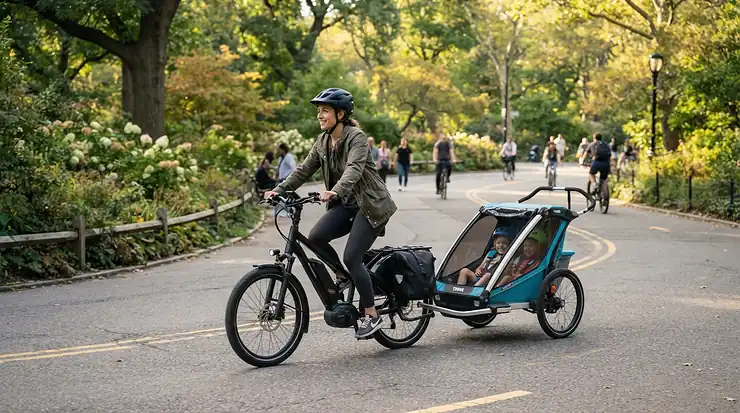
Families with one or two children under the weight limit are the reason this ebike passenger trailer exists. Burley’s Canadian product page lists 100 pounds total, no more than 40 pounds per child, a minimum age of 12 months for biking, an aluminum roll cage, a five-point harness and a parking brake. It also states the trailer was designed to meet or exceed ASTM F1975-09, an earlier edition of ASTM F1975, a standard covering nonpowered trailers pulled behind bicycles for one or two children, with tests for rollover, tipover resistance, coupling security and fatigue, plus rules for reflectors and flags. The standard governs the trailer’s build; the e-bike speed cap still comes from Burley’s own guidance.
Two Wheeling Tots, a family-focused review site, found the Honey Bee rides smoothly on paved trails and rocky paths but has no suspension, and that its child passengers complained over rough sections. The same review says the hammock seats make loading harder and two children tend to drift toward the middle, that infants need Burley’s Baby Snuggler accessory, and that it converts to a stroller without tools. Its price section is internally inconsistent, quoting $479 in a spec table and about $400 in the text, so expect somewhere between $400 and $480 and check the current price on Amazon.com.
Hitching is the usual e-bike question. Burley’s page says the Honey Bee works with quick-release axles; a hub-motor bike with a nutted axle will want the adapter route from Question 1. Compare its hitch notes against your own axle before you buy.
Pros:
Roll cage, five-point harness and parking brake, per Burley
Stroller conversion without extra kits, per Two Wheeling Tots
Large rear cargo area
Cons:
No suspension, and children noticed rough sections in one review
Hammock seats are awkward to load and crowd two kids together
Listed weights range from about 25 to nearly 29 pounds
Burley Honey BeeSee current price, sizes and reviews on Amazon.
Dog owners get the simplest of the four designs. Burley lists a 75-pound capacity, a maximum pet size of 23 inches tall and 29 inches long, 21 pounds of trailer weight and 16-inch wheels, with a price around $400 to $420 on its own page. The mesh windows are meant to keep air moving at assisted speeds, according to Burley’s e-bike guide, and the removable floor wipes clean.
Speed guidance conflicts. Burley’s help center files pet trailers under its 10 mph cargo-and-pet cap, while the Q&A on Burley’s Canadian Tail Wagon page says an e-bike can use the trailer at 15 mph on smooth surfaces and 5 mph on rough surfaces or while turning. Follow the manual that ships with your trailer, and treat the lower number as the safer default.
Burley’s page shows about 4.5 stars from 181 reviews, and the written complaints cluster around three things. A redesign dropped the waterproof top and plastic window covers. One owner’s dog tore the mesh on its first outing, and the panels cannot be replaced one at a time. Leash loops were removed in 2023 to stop tangling, so keeping a dog inside is left to the owner. On e-bikes specifically, one reviewer needed a different axle and had a local shop fit it, and another found the trailer long and hard to maneuver behind an e-bike, while a third reports riding happily with a dog. Across the three, fit and maneuvering come up more often than towing power.
Burley Tail WagonSee current price, sizes and reviews on Amazon.
Errands and light touring are where the Nomad earns its place. Burley lists 100 pounds of capacity, 105 liters of cargo space, a 6061-T6 aluminum frame and 16.7 pounds of trailer weight; Electric Bike Report priced it under $350 in 2024, though prices drift, so check the current price on Amazon.com. That reviewer towed it behind an e-bike carrying almost 60 pounds of cargo and barely noticed the load, and added that it would ride better fully packed on 20-inch tires than on the stock 16s. The Nomad ships with rear reflectors, a tail light and a safety flag, according to the same review.
The wheel-size warning has an owner behind it. A buyer on a Desertcart listing wrote that Burley advised against pairing the Nomad with their e-bike’s 20-inch wheels because the bike’s wheels sit too low for the trailer’s 16-inch wheels; they bought it anyway for city streets and report being very happy. One buyer’s experience is not a rule, and Burley’s own page leaves that question unanswered, so ask Burley about your specific bike.
Burley’s page shows about 4.6 stars from 109 reviews. The sharpest 1-star review is specific: the side panels are not secured and hit the wheels over bumps, wearing holes; the interior has no hard floor; tread wore more than halfway down in under 1,000 kilometers; and the coating peeled within two months. Other reviewers say Burley now builds the Nomad in China and call the quality a step down. These are scattered reports against a large pool of satisfied ones.
Pros:
100-pound rating at 16.7 pounds, the best ratio of the four
Hitch attaches to the axle nut and the tow arm mounts on either side, per Electric Bike Report
Folds to about 10 inches tall for storage
Cons:
16-inch wheels sit low behind some e-bikes
No hard interior floor, per one reviewer
Reports of panel rub and coating wear from individual buyers
Burley NomadSee current price, sizes and reviews on Amazon.
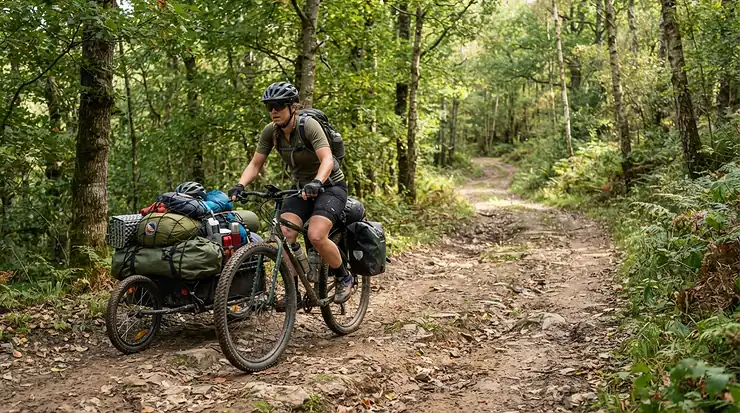
Trail riders and anyone with a hub-motor axle should look at the Coho XC first, but its limits arrive early: a 70-pound rating and a single 16-inch wheel that, Electric Bike Report says, copes with bumps less well than a 20- or 24-inch wheel would. In return it is 17 inches wide, 66.5 inches long, 21.5 pounds, and has coil-spring suspension and independent steering that the reviewer called surprisingly nimble. Cycling UK’s Peace makes the same single-wheel trade-off: good on singletrack, usually rated for less weight.
The axle story is where it differs. Electric Bike Report says the trailer ships with thru-axle, 5 mm skewer and nutted-axle adapters, so buyers need to pick the right axle kit, and it describes the trailer as working with almost every kind of e-bike. Burley’s hitch page treats the nutted-axle adapter as a separate, required part with multiple thread pitches, so the two sources disagree about what is in the box; settle it with the listing before ordering. Expect to pay around $450 to $500 based on Electric Bike Report’s 2020 and 2024 coverage, and note the three-year warranty it reports.
Burley Coho XCSee current price, sizes and reviews on Amazon.
Tow a motorcycle trailer with ebike? Where the numbers stop
The idea comes up often because motorcycle trailers are cheap and sturdy, and an e-bike seems to have the torque. The numbers say otherwise. Burley’s help center states its trailers are not designed or tested for motorcycles, scooters or motorized vehicles other than e-bikes, which tells you where bike-trailer engineering ends. Motorcycle trailers are built around a ball hitch on a tow vehicle, not an axle plate on a bicycle dropout.
Compare the weights. The Electric Bike Report guide says most bike trailers are rated about 90 pounds or less and calls the 300-pound Surly Ted far above typical e-bike capacity. Tern’s purpose-built tow hardware is tested to 132 pounds including trailer and contents. A rider in a Cyclefish motorcycle forum, meanwhile, described designing a trailer that weighed about 145 pounds empty and carried 100 to 150 pounds of cargo. That empty trailer alone exceeds every rating in the table above.
Hitch load adds a second problem for anyone still set on trying to tow a motorcycle trailer with ebike hardware. Members of motorcycle forums such as Venture Rider say tongue weight should run around 10 to 15 percent of total trailer weight. On a 250- to 300-pound loaded trailer, that is roughly 25 to 45 pounds pressing down at a coupling that, on a bicycle, sits on the rear axle. That figure is our arithmetic from forum rules of thumb, not a tested e-bike limit, but it explains why Cycling UK’s expert wants a hitch that is strong and mounted at the axle area. A trailer that needs registration or lighting on public roads also falls under state rules, which vary, so check with your state’s motor vehicle agency before hauling anything wider than a bike trailer.
Electric bike cargo trailers and electric bikes: what changes on the first loaded ride
Load placement does more than most buyers expect. Electric Bike Report advises keeping cargo centered over the trailer’s wheels and heavy items low, because weight too far back can lift the bike’s rear wheel and cost traction, and weight too far forward hurts handling. Burley’s guide gives the same low-and-centered advice.
Range drops, too. Burley’s e-bike guide says towing can cut range by roughly 20 to 50 percent depending on terrain, load, assist level and wind, so a 30-mile ride can become a 15- to 24-mile one. That is arithmetic on Burley’s range, and it is wide because the variables are wide.
Warranty is the quiet cost. Burley warns that exceeding weight limits or using an incompatible hitch can damage the bike and may affect coverage, and it tells owners to read the e-bike maker’s manual before towing. Cycling UK’s advice on carrying loads by e-bike includes a plain instruction worth following: practice somewhere quiet first, especially with a new bike or a new trailer, so the first loaded descent is not a surprise.
Hitch, speed and weight: five answers before you order
Can any bike trailer be towed behind an e-bike?
Not automatically. Burley says its trailers are compatible with many e-bikes, but safe use depends on the speed guidance in the manual, and the hitch must fit your rear axle. Check the axle type, speed cap and load rating together before ordering.
How fast can you ride with a trailer behind an e-bike?
Burley's e-bike pages list 15 mph for child trailers and 10 mph for cargo or pet trailers, with the manual setting each model's final cap. They also advise taking turns at about 5 mph. Your bike's assist ceiling is not a towing limit.
Will a trailer hitch fit a hub-motor e-bike?
Often, with an adapter. Most hub-motor e-bikes use nutted axles, and diameter and thread pitch must match. Burley suggests a bike shop measure them, and owners in forum threads report using Robert Axle Project adapters.
How much weight can an e-bike pull in a trailer?
No single number applies. Trailer ratings here run 70 to 100 pounds, and Cycling UK cites a guideline that trailer plus load should stay under half the combined weight of e-bike and rider. Your bike's maximum gross weight and manual still decide.
Can an e-bike tow a motorcycle trailer?
Treat it as a no. Tern's purpose-built tow hardware for its cargo e-bike is tested to 132 pounds including the trailer, while one rider forum's motorcycle-trailer example weighed 145 pounds empty. State registration and lighting rules also vary.
Where to start with an electric bike trailer
The cleanest answer to “what kind trailers work behind e-bike?” comes from settling three facts in order: your rear axle, the combined weight of you and the bike, and who or what rides in the trailer. A family with one or two children should read the Burley Honey Bee listing first, a dog owner the Burley Tail Wagon, an errand runner the Burley Nomad, and anyone on trails or a nutted-axle hub-motor bike the Burley Coho XC. Leave the motorcycle trailer in the garage. For 2027 purchases the decision rule is short: hitch fit, speed cap and load rating all have to pass, and one failure rules the trailer out. Compare the axle size on your bike with the hitch described on each page before you order.
Disclaimer: This post contains affiliate links. As an Amazon Associate, we earn from qualifying purchases made through these links, at no additional cost to you.
Measure your axle before you measure anything else, then let the load rating pick the trailer.
NextGenEBike is an independent buying-guide site for electric bikes, motors, batteries and accessories. Our editorial team compares products using manufacturer specifications, independent tests from specialist e-bike media, owner reports and retailer listings. We do not claim to have tested the products ourselves; see How We Choose Gear for our method.