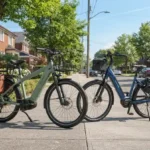
Which Ride1Up should you buy when nearly every one of the Ride1Up ebikes reviews you find is glowing? The sources agree on the broad strokes: hub motors with torque-sensing assist, Class 3 speeds and prices below most rivals. They split on the details that decide a purchase, and for 2027 those details range from a 44-pound city bike to a 97-pound moped-style cruiser.
Short version: the Ride1Up Roadster V3 suits stairs, the Ride1Up Vorsa Lite suits long commutes and hills, the Ride1Up Portola 02 suits tight storage, the Ride1Up Prodigy V2 suits riders who like to pedal, and the Ride1Up Revv 1 FS suits anyone replacing short car trips.
No bike was ridden for this article. The test figures belong to Electric Bike Report, Electric Bike Review (a different site despite the similar name), OutdoorGearLab and RiderGuide, the owner reports come from threads on the Electric Bike Review forum, and the return terms come from Ride1Up’s own support pages. Prices appear as ranges, and the current price on Amazon.com may differ.
A Ride1Up ebikes guide to weight, batteries and fit
Weight is where tested numbers drift furthest from claimed ones, so it comes first. Electric Bike Report’s scale read 44.1 pounds for the Ride1Up Roadster V3 against a 39-pound claim, and the same site weighed the Ride1Up Portola 02 at 70.9 pounds with its rack and larger battery, about 12 pounds above the claimed 59 (our arithmetic). At the far end, OutdoorGearLab measured 96.8 pounds for the Ride1Up Revv 1 FS, roughly 53 pounds more than the Ride1Up Roadster V3.
Range is the second filter. Ride1Up’s home page quotes 25 to 40 miles for the Ride1Up Roadster V3 and 35 to 50 for bikes such as the Ride1Up Portola 02 and Ride1Up Prodigy V2, and testers beat or missed those numbers depending on assist. Electric Bike Review logged about 105 miles from the Ride1Up Vorsa Lite at minimum assist and just under 50 at maximum, while OutdoorGearLab’s rider covered 37 miles on the Ride1Up Revv 1 FS over a route with 1,831 feet of climbing. Efficiency explains the spread: Electric Bike Report recorded 6.9 Wh per mile for the Ride1Up Vorsa Lite in its low-assist test against a comparison average of 10.4, and 1,040 Wh over 37 miles works out to roughly 28 Wh per mile for the Ride1Up Revv 1 FS (our arithmetic).
Class settings are mostly software. Electric Bike Report says the Ride1Up Portola 02 ships as Class 2 and can be switched to Class 1 or 3 from the display, Electric Bike Review lists the Ride1Up Vorsa Lite as switchable across all three with a 28 mph ceiling, and OutdoorGearLab notes that the off-road mode on the Ride1Up Revv 1 FS requires registering the bike and signing a waiver. Rules on classes, throttles and paths vary by state and city, so check yours before changing a setting.
Sizing and what is in the box decide the rest. Electric Bike Review gives the Ride1Up Vorsa Lite two frames covering 5’1″ to 6’4″, the Ride1Up Roadster V3 three frames from about 5’2″ to 6’4″, and the Ride1Up Prodigy V2 a narrower 5’0″ to 6’1″ spread. Only two of the five arrive with a rear rack, the Ride1Up Prodigy V2 and the standard Ride1Up Portola 02, so the other three expect you to buy one.
When reading Ride1Up ebikes reviews, compare along a row rather than down a column, because each tester used a different rider, route and assist setting. This Ride1Up ebikes guide rests on the five bikes below.
Model
Weight
Battery
Range results, low to high assist
Rack, fenders, lights
Price band
Ride1Up Roadster V3
44.1 lb tested
360 Wh
17 to 49 mi
No rack in the reviews; headlight and bell
$1,300 to $1,450
Ride1Up Vorsa Lite
62.7 lb tested
720 Wh
About 50 to 105 mi
None
$1,350 to $1,500
Ride1Up Portola 02
70.9 lb tested (66.6 lb without rack)
480 or 720 Wh
29.7 to 49.9 mi on 720 Wh
Standard model yes; lighter model no
$895 to $1,095
Ride1Up Prodigy V2
58 to 61 lb listed
504 Wh
32 to 73 mi
Rack, fenders and lights
Around $1,300 and up
Ride1Up Revv 1 FS
96.8 lb tested
1,040 Wh
37 mi on a hilly route
No rack
$2,395 to $2,495
The Ride1Up Roadster V3 is the one that gives up battery capacity to stay light. The two ends of the table sit about $1,100 apart in price, and the extra money buys roughly 53 more pounds and nearly three times the battery (our arithmetic). Price bands come from Ride1Up’s home page and the testers’ own figures, and they overlap.
Best Ride1Up ebikes, matched to five ways of riding
Each entry starts from a situation and works back to the bike.
A third-floor walk-up is the situation this bike was built around. The Ride1Up Roadster V3 weighed 44.1 pounds on Electric Bike Report’s scale, its 360 Wh battery comes out and weighs about 4.6 pounds, and a 500W MiVice hub with 50 Nm of torque sits behind a cafe-style frame. The drivetrain is either a single-speed carbon belt or a 9-speed microShift, according to Electric Bike Review.
Ride quality is where reviewers agree. OutdoorGearLab’s testers all remarked on how quiet it is and how smoothly the torque sensor meters the assist, and Electric Bike Report’s pedal-assist hill test finished about 21 seconds ahead of the city-bike average, although the throttle alone could not climb the same hill. Range is the trade-off: 17 to 49 miles at Electric Bike Report, 48 in Eco and 17 at higher assist at Electric Bike Review, and about 18 miles in boost mode for RiderGuide’s 200-pound rider on the suspension version in 50°F weather. A 250 Wh add-on battery for the Ride1Up Roadster V3 costs around $290 to $295.
Gaps are easy to list. The taillight does not work as a brake light, the flat pedals with grip tape let feet slip, and the rigid ride passes road buzz to your hands, per Electric Bike Report, while Electric Bike Review wants more mounting points on the fork and frame. Reader comments on the Electric Bike Report review mention a battery cover that did not sit flush and chipped paint, and one owner in an Electric Bike Review forum thread from September 2024 described a battery fit problem and started a return. Those are a few reports, not a pattern, but they are worth checking on delivery day. Expect to pay between $1,300 and $1,450.
Ride1Up Roadster V3See current price, sizes and reviews on Amazon.
Under $1,500 is the price tier where the Ride1Up Vorsa Lite lives, and it makes a strong value argument. Ride1Up announced it in March 2026 alongside the Ride1Up Vorsa and the fat-tire Ride1Up Vorsa FT, and Electrek reports that deleting the welded rear rack saved roughly 11 pounds. The shared powertrain is a 750W AKM hub with 95 Nm of torque and Ride1Up’s torque-and-cadence assist, paired here with a 720 Wh battery, an 8-speed Shimano Acera drivetrain and a 100 mm fork.
Electric Bike Report weighed it at 62.7 pounds and called its range and hill results standout for the price. Electric Bike Review’s test scored hill climbing 9 out of 10 and found a quirk in the brakes: the rear rotor is 203 mm and the front 180 mm, reversed from the usual arrangement, so the rear wheel tended to lock first, and the tester suggests swapping them. Tom’s Guide adds that the bike is not light and would benefit from the accessories Ride1Up removed, and one owner on the Electric Bike Review forum says they sold a standard Ride1Up Vorsa to buy the Lite and preferred the lower weight, while wishing for a rigid fork.
Pros:
About 105 miles at minimum assist and just under 50 at maximum, per Electric Bike Review
Frames for riders from 5’1″ to 6’4″, and Class 1, 2 and 3 settings
A battery that Electric Bike Review lists as UL 2271 certified
Cons:
No rear rack, front fenders or rear light
Reversed rotor sizes that make the rear brake grab
Assembly closer to 90 minutes than the 45 to 55 Ride1Up estimates, per Electric Bike Review
The price sits between $1,350 and $1,500, according to Electric Bike Review, Tom’s Guide and Ride1Up’s home page.
Ride1Up Vorsa LiteSee current price, sizes and reviews on Amazon.
Folding does not make a bike light, and the Ride1Up Portola 02 is a clear example. Electric Bike Report weighed the standard version at 70.9 pounds and the lighter model without a rack at 66.6, while RiderGuide reported 64.7, and all three sit above the claimed 59. Folded, it measures 35 by 21 by 30 inches, per Electric Bike Report, so the weight, not the footprint, is what limits carrying it up stairs.
What the weight buys is a real motor and real brakes. Electric Bike Report’s review lists a 750W AKM hub with 90 Nm of torque, a 17-foot-4-inch stop from 20 mph against a folding-bike average of about 19 feet 5 inches, and a verdict that it is a “competent climber rather than a supremely powerful one.” The same review flags some frame flex through corners, BMX-style bars with no cross bar, a slow 2A charger (about 7.5 hours for the 15 Ah pack) and unbranded brake calipers that make long-term service a question mark. The standard model adds a welded rack rated for 150 pounds, fenders and a rear light with turn signals, and the lighter model leaves all three off.
Range on the 720 Wh pack was 49.9 miles in Eco and 29.7 in Boost, against folding-bike averages of 60 and 28.9 in Electric Bike Report’s data. Sources disagree on the entry price: Notebookcheck says the 10 Ah version starts at $995, while Ride1Up’s home page advertises a starting figure of $895, so the band is $895 to $1,095. Check current availability on Amazon.com before settling on a battery size.
Ride1Up Portola 02See current price, sizes and reviews on Amazon.
A mid-drive changes how a bike behaves on a long climb, and the Ride1Up Prodigy V2 is the only one here with one. Electric Bike Review lists a Brose motor rated at 250W nominal with 90 Nm of torque, a 504 Wh battery, Class 3 pedal assist to 28 mph and a rack, fenders and lights on the bike. It logged 73 miles in Tour mode on a flat path and 32 at top assist, averaging about 19 mph. The 73-mile run works out to 6.9 Wh per mile (our arithmetic), the same frugality as the Ride1Up Vorsa Lite from a smaller pack.
Fit narrows the audience. Electric Bike Review gives the XR frame about 5’5″ to 6’1″ and the ST about 5’0″ to 6’0″, and its summary on 99Spokes lists the lack of adjustability, the missing throttle and the narrow size range as lows. OutdoorGearLab tested the CVT version in March 2024, scored it 68 and ranked it 15th of 19, saying size and limited adjustability may leave it with a narrow audience. Electric Bike Review also flagged an exposed headlight wire, no app, and a battery that may limit very long rides. A second battery costs $395 on Ride1Up’s battery page, and batteries cannot be returned.
Price swings widely by build. Ride1Up’s home page currently shows an ECO build at around $1,300, while reviewers who tested higher-spec builds quoted between $2,295 and $2,695, so check which build a review describes before comparing.
Ride1Up Prodigy V2See current price, sizes and reviews on Amazon.
Ninety-seven pounds is the number to accept first. OutdoorGearLab measured 96.8 pounds for the Ride1Up Revv 1 FS, calling it almost a 100-pound bike, and rated it 90 overall, with a 1,040 Wh removable battery, 4-piston hydraulic brakes with 200 mm rotors and a score of 9 out of 10 for hills. Its rider rating is 350 pounds at OutdoorGearLab, while eBicycles lists a 400-pound capacity for the Ride1Up Revv 1 family, so confirm the figure on the label.
The tester’s range was 37.17 miles with 1,831 feet of climbing, against Ride1Up’s claim of 30 to 60. Class 2 caps the throttle at 20 mph and Class 3 reaches 28, and OutdoorGearLab says pedaling is not realistic at this weight, which makes it a throttle-first vehicle. Ride1Up’s navigation currently highlights the Ride1Up Revv 1 DRT, around $2,100, and the semi-solid-state Ride1Up Revv 1 EVO at $2,395, with the EVO’s 1,200-cycle battery claim coming from the maker rather than a test.
Pros:
Ride quality 9.0 and range 9.1 in OutdoorGearLab’s scoring
A removable 1,040 Wh battery and a 20 mph Class 2 default
Enjoyable cruising, convenience and strong hill work listed as pros by OutdoorGearLab
Cons:
96.8 pounds on the scale, so it needs ground-floor storage
No rack or pannier mounts, per OutdoorGearLab
A 14-day return window that only covers unopened, unused bikes
Reviewers quote the Ride1Up Revv 1 FS between $2,395 and $2,495.
Ride1Up Revv 1 FSSee current price, sizes and reviews on Amazon.
Odometers, spokes and support threads: where Ride1Up gets tested
A 30-day window with a 20-mile odometer
Ride1Up’s support page allows returns on most bikes within 30 days if the odometer reads under 20 miles, the bike goes back in its original box with all contents, and Ride1Up has approved the return first. The buyer pays return shipping, a restocking fee of $250 (parcel) or $350 (freight) applies, and batteries, accessories and parts are not returnable. A ComplaintsBoard reviewer says a return was refused after 30 miles, which matches the 20-mile rule, so treat that mileage as a hard line. The Ride1Up Revv 1 line is stricter still, with 14 days and only for unopened, unused bikes.
Sale season changes the rules. Ride1Up’s return page says the 30-day policy does not apply to Black Friday specials, so read the terms on a sale bike before you ride it. The warranty runs one year against manufacturing defects, requires photo or video evidence, and singles out a three-working-day reporting window for components that arrive defective.
What owners keep reporting
Support experiences split. On an Electric Bike Review forum thread about the Ride1Up LMT’D, one owner described a week of silence beyond an acknowledgment after a spare battery stalled in shipping, while in a separate thread another owner with a battery that would not charge past 52.5 volts said Ride1Up sent a replacement after a few emails. A third owner with a step-through bike whose battery kept popping loose said support’s spacer suggestion fixed it. Each is one report, and most of these threads date from roughly 2019 to 2024.
Hardware advice is more consistent. Several posters in the long-running known-issues thread tell new owners to check spoke tension with a spoke wrench in the first miles, and one poster says they frequently read about owners receiving replacement controllers. Searches for this guide turned up no CPSC recall naming Ride1Up, though other e-bike brands have been the subject of recent notices, so check cpsc.gov by model before buying secondhand.
Old reviews of bikes that no longer exist
Many pages in the results for Ride1Up ebikes reviews describe discontinued bikes. Ride1Up lists the Ride1Up 500 Series as discontinued, and WeTried.it says the Ride1Up Core-5 and Ride1Up Cafe Cruiser it tested are gone, with the Ride1Up Turris named as the successor to the Ride1Up Core-5. Weigh a review’s date against the bikes above before trusting its price or range numbers.
Ride1Up ebikes price: what each tier costs and what comes on top
Ride1Up’s home page marks most models with a “Limited Time Discount,” and the gap between the crossed-out figure and the current one runs roughly $100 to $150 on the bikes it shows. The Ride1Up ebikes price bands below use the ranges the sources support.
Around $895 to $1,095: the Ride1Up Portola 02
Between $1,300 and $1,450: the Ride1Up Roadster V3
Between $1,350 and $1,500: the Ride1Up Vorsa Lite
Around $1,300 and up: the Ride1Up Prodigy V2, depending on build
Between $2,395 and $2,495: the Ride1Up Revv 1 FS
The sticker is not the total. A second Ride1Up Prodigy V2 battery is $395, the 250 Wh add-on for the Ride1Up Roadster V3 is around $290 to $295, a return costs $250 to $350 plus shipping, and both the rack-free Ride1Up Vorsa Lite and the Lite trim of the Ride1Up Portola 02 need a rack, fenders or a rear light bought separately. Free shipping covers the contiguous 48 states, per Ride1Up’s pages.
Cheap Ride1Up ebikes: where the floor sits
The floor on Ride1Up’s home page is the Lite trim of the Ride1Up Portola 02, advertised from around $895, though Electric Bike Report notes it has no rack, fenders or rear light. The Ride1Up Turris is listed near $1,395 on 99Spokes’ brand page, while 2023 reviews quote it closer to $1,100 to $1,300, and OutdoorGearLab called it a bargain Class 3 bike with hydraulic brakes. Shoppers hunting cheap Ride1Up ebikes should count the missing rack, fenders and lights, because a bare bike is cheaper at checkout and not always cheaper by the time you ride it.
Buy Ride1Up ebikes direct, at a local shop, or through Amazon.com
Ride1Up sells mainly through its own store, and its pages say bikes ship free to the contiguous 48 states. Its locations page lists independent owners and shops that offer assembly, tuning and sometimes test rides, with a note that service quality is not guaranteed and that any bike shop can work on the bikes. Assembly is the part to plan for: Electric Bike Review budgets about 90 minutes for the Ride1Up Vorsa Lite against Ride1Up’s 45 to 55 minute estimate, and Ebike Escape says the Ride1Up Turris needs the front fork, crank arm and front brake installed.
To buy Ride1Up ebikes through Amazon.com, look for the seller’s own return terms, because Ride1Up’s return and warranty pages are written around orders from its own store and a purchase elsewhere may follow different rules. Match the exact name on the listing, such as Lite versus standard or ECO versus a higher build, against the bike you meant to order. No sources opened for this guide showed a current Amazon.com listing, so treat availability as something to confirm.
Ride1Up ebikes 2027: what has actually been announced
Searches for a 2027 model year turn up 2026 launches and nothing newer. Ride1Up’s home page shows no 2027 labels, so Ride1Up ebikes 2027 coverage so far leans on this year’s releases. The Ride1Up Vorsa Lite and Ride1Up Vorsa FT were announced in March 2026, Electrek covered a suspension version of the Ride1Up Roadster V3 in May, the Ride1Up Revv 1 EVO was announced in May with shipping said to start in August, and the Ride1Up Portola 02 arrived in August. Treat anything labeled 2027 as unconfirmed for US buyers until Ride1Up lists the bike itself.
Range, returns and reliability: quick answers on Ride1Up
Are Ride1Up ebikes reliable?
Testers score the current lineup well, and owner threads mostly describe fixable battery, controller and spoke problems on older bikes. Support experiences split: some owners got parts quickly, others waited. Inspect any new bike in its first miles and keep photos for warranty claims.
How far can a Ride1Up go on one charge?
Claims run from 20 to 60 miles, and tests vary with assist level. Electric Bike Review logged about 105 miles at minimum assist on one 720 Wh model and just under 50 at maximum, while a 97-pound moped-style bike managed 37 hilly miles on 1,040 Wh.
Can I return a Ride1Up if I don't like it?
Most bikes have a 30-day window, but the odometer must read under 20 miles, the original box is required, and Ride1Up deducts a $250 to $350 restocking fee. The buyer pays return shipping. The moped-style model has only 14 days and must be unused.
What is the cheapest Ride1Up ebike?
Ride1Up's home page lists a folding model from around $895, and testers describe that version as lacking a rack, fenders and rear light. The next step up, a lightweight city bike, sits between roughly $1,300 and $1,450, so budget for accessories before comparing totals.
Is there a 2027 Ride1Up lineup yet?
Not yet: Ride1Up's home page carries no 2027 labels, and its newest launches are 2026 models, including a folding bike and a semi-solid-state moped-style bike. Treat any 2027 claim as unconfirmed until Ride1Up lists the bike itself.
Which Ride1Up to buy: one rule for each kind of rider
Across the Ride1Up ebikes reviews behind this page, the evidence points to one order of decisions: weight first, then range and hills, then the return window. The best Ride1Up ebikes follow from it. If stairs are part of the routine, the Ride1Up Roadster V3 is the bike you will keep lifting. For hills and long commutes, the Ride1Up Vorsa Lite has the strongest tested range, and a rack and fenders cost extra. Tight storage points to the Ride1Up Portola 02, pedaling riders of average height can look at the Ride1Up Prodigy V2, and anyone swapping out a car should check the Ride1Up Revv 1 FS.
Whichever you pick, confirm the return terms first and keep the odometer under 20 miles until you are sure the bike fits your life, because that mileage line is where Ride1Up’s 30-day promise ends. Check current availability below.
Disclaimer: This post contains affiliate links. As an Amazon Associate, we earn from qualifying purchases made through these links, at no additional cost to you.
Match the bike to your hallway and your hills first, and the Ride1Up checkout gets a lot easier.
NextGenEBike is an independent buying-guide site for electric bikes, motors, batteries and accessories. Our editorial team compares products using manufacturer specifications, independent tests from specialist e-bike media, owner reports and retailer listings. We do not claim to have tested the products ourselves; see How We Choose Gear for our method.