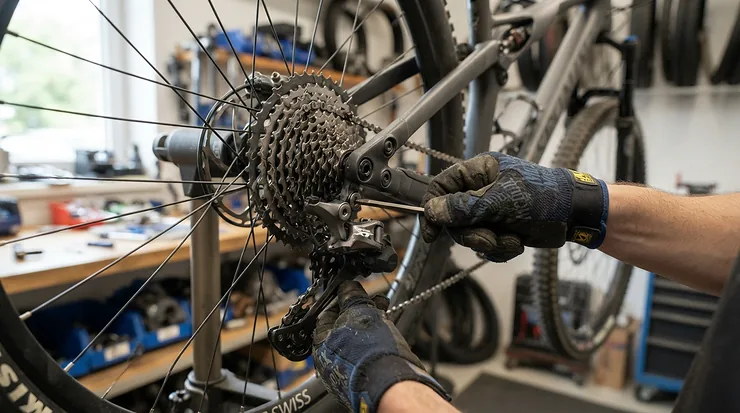
Why do ebike rear cassettes give up so much sooner than the ones on a pedal-only bike, and can a better cassette fix it? Owners on eMTB Forums mostly blame the chain, and the evidence gathered here leans their way. For 2027, this ebike rear cassettes guide sorts five real Shimano and SRAM models by motor layout, freehub body and budget, because the right cassette for a rear hub-motor kit is often the wrong one for a mid-drive.
Dealer and maker spec pages supply the numbers, Park Tool supplies the chain-wear thresholds, and owner threads supply the real-use findings. Nothing was bolted to a bike for this piece, so every remark about shifting feel is credited to the person who made it, and prices appear as dealer ranges because the current price on Amazon.com may differ.
Freehub body first, tooth count second: what separates these five
Most cassette mistakes are fit mistakes. The interface between cassette and hub decides what can be mounted at all, and bike-components’ freehub guide lays out three families that do not swap: Shimano HG, which takes 8- to 10-speed cassettes and some 11-speed MTB ones; Micro Spline, used for Shimano’s 12-speed MTB cassettes with a 10-tooth small cog; and SRAM XD, which refuses HG cassettes. A Micro Spline cassette will not seat on an HG body, and the reverse holds too.
Motor layout adds a second filter. On a rear hub-motor bike the cassette sits on the motor’s own freehub, so the motor maker decides what fits. The dealer ebikes.ca says most of its rear hub motors use the Shimano HG standard, with the eZee as the exception because it takes a threaded freewheel. A mid-drive bike uses an ordinary rear wheel, so any body works as long as the wheel carries the matching one.
Layout also changes how hard the cassette works. Leoguar Ebikes’ blog points out that a rear hub motor drives the wheel directly rather than through the chain, which would explain why the heaviest wear stories in the owner threads below mostly involve mid-drive bikes. That second part is my reading of those threads, not a measured result.
Speed count shapes upkeep. Park Tool sets the chain-replacement point at 0.75% wear for 10-speed or fewer and 0.5% for 11-speed or more, and says a cassette costs far more to replace than a chain. A 12-speed cassette therefore asks for a tighter chain-check habit than a 9- or 10-speed one.
Tooth count comes last, and the smallest cogs take the abuse. An Electric Bike Review member explains that the smallest cog wears fastest because few teeth share the load, and an eMTB Forums poster with photos ties skipping under high torque to slightly rounded 11-tooth teeth.
Model
Speeds
Range
Freehub body
Chain it expects
E-bike notes on the pages
Dealer price range
Shimano CS-HG400-9
9
11-36 (other ranges exist)
Shimano HG
HG 9-speed
No e-bike claim
Around $40 to $50
Shimano CS-HG500-10
10
11-34
Shimano HG
HG-X 10-speed or HG 10-speed
Dealers cite E-MTB durability; Shimano EU files it under GRX
Around $45 to $65
Shimano Deore CS-M4100-10
10
11-42 or 11-46
Shimano HG
HG-X 10-speed
STEPS E7000 listed at bike-components
Around $45 to $60
Shimano SLX CS-M7100-12
12
10-51 or 10-45
Micro Spline
HG 12-speed
Dealers cite E-MTB durability; STEPS E7000 listed
Around $125 to $135
SRAM EX1 XG-899
8
11-48
Shimano/SRAM 8/9/10-speed body
SRAM PC EX1
Built for the EX1 e-MTB group
Between $460 and $490
Only the Shimano SLX CS-M7100-12 needs a Micro Spline body, which a typical HG-based hub-motor kit will not have, and only the SRAM EX1 XG-899 is built around its own derailleur and chain. The three HG cassettes are the ones a hub-motor owner can usually fit without changing the wheel. Prices span roughly $40 to nearly $500, yet the hub decides more than the budget does.
Matching a cassette to the bike you actually ride
Each entry starts from a situation and works back to the part. Check current availability below once the freehub body is confirmed.
A rear hub-motor conversion with a 9-speed HG freehub is where the Shimano CS-HG400-9 makes sense. It is an Alivio-level cassette in nickel-plated steel, sold in 11-28, 11-32, 11-34, 11-36 and 12-36 ranges, and Shimano’s page pairs it with an HG 9-speed chain. The 11-36 version steps through 11-13-15-17-20-23-26-30-36 teeth, and its 11-tooth small cog avoids the 14-tooth floor that ebikes.ca says most threaded freewheels hit.
One Electric Bike Review member, replying to a question about a Bafang RM-G062 1000W rear hub, says the HG400-9 is the cassette he runs and that any Shimano-compatible 9-speed should do. That is a single owner’s word, though it agrees with ebikes.ca’s note about the HG freehub standard. A member in a different thread reports good results from a budget 11-36 cassette that cost around $22, which fits the idea of treating this tier as a replaceable part. Dealer listings sit at around $40 to $50; check the current price on Amazon.com.
Pros:
Fits HG freehub bodies, the type ebikes.ca fits to most of its rear motors
Dealer prices around $40 to $50
An 11-tooth small cog for faster pedaling speeds
Cons:
Nothing on Shimano’s page or the dealer pages calls it an e-bike part
The range ends at 36 teeth, six short of the Deore option below
Shimano CS-HG400-9See current price, sizes and reviews on Amazon.
Between $45 and $65 on dealer pages, the Shimano CS-HG500-10 costs only slightly more than the nine-speed above and adds a tenth cog. The 11-34 version runs 11-13-15-17-19-21-23-26-30-34 in nickel-plated steel and takes an HG-X 10-speed chain, and bike-components lists it for Shimano MTB freehubs.
A commuter pulling away from lights with a loaded rear carrier is the hypothetical fit. The 34-tooth low gear helps with starts, and as a 10-speed it keeps Park Tool’s more forgiving 0.75% chain threshold instead of the 0.5% that 11-speed and wider drivetrains need.
Sources disagree on what it is built for. Shimano’s EU page files it under GRX 10-speed with 11-25T, 12-28T, 11-32T and 11-34T options, while Pro Bike Supply and GearX state that it meets durability requirements for E-MTB applications and mark it as designed for ebike. Read the label and check the exact model number before ordering. At 34 teeth, its low gear sits eight teeth below the 42 on the Deore 10-speed that follows.
Shimano CS-HG500-10See current price, sizes and reviews on Amazon.
Climbing is the reason to look at the Shimano Deore CS-M4100-10. The 11-42 version steps through 11-13-15-18-21-24-28-32-37-42 teeth and an 11-46 version also exists, both in steel with an HG-X 10-speed chain such as the CN-HG95 or CN-HG54. Bike-components lists the STEPS E7000 e-bike drivetrain among its compatible systems, and US dealers put it at around $45 to $60.
This is the 10-speed answer for a hardtail with a rear hub motor. An eMTB Forums thread about fitting an 11-speed cassette to a Bafang BFSWX02 (G020.500.DC) hub went unresolved, because that hub’s freehub is the 8/9/10-speed type and nobody confirmed the chain would clear the motor body in the lowest gear. Staying at 10 speeds sidesteps the question, though that is reasoning rather than a tested fit, and the big cog still sits next to the motor, so check the gap.
The derailleur matters as much as the hub. Bike-components pairs the 11-42 with the RD-M5120-SGS, RD-M4120-SGS and RD-M6000-GS, while the 11-46 appears only with the RD-M5120-SGS in a 1×10 setup. Leoguar Ebikes adds that a larger sprocket can exceed a derailleur’s limit even when it physically fits the wheel.
Shimano Deore CS-M4100-10See current price, sizes and reviews on Amazon.
Anyone with an HG freehub can stop reading here, because the Shimano SLX CS-M7100-12 only mounts on a Micro Spline body. On a mid-drive bike with a modern Micro Spline wheel it is the most e-bike-ready Shimano entry in this list: Mike’s Bikes and Cahaba Cycles both state that it meets durability requirements for E-MTB applications, and bike-components lists STEPS E7000 under its compatible drivetrains.
It comes in 10-45 and 10-51, the latter stepping through 10-12-14-16-18-21-24-28-33-39-45-51 teeth. Bike-components lists sprockets 1 to 11 as plated steel, the 12th as anodized aluminum, a painted aluminum carrier and weights of 513 g for the 10-45 and 534 g for the 10-51. The recommended chain is the 12-speed CN-M7100, and Park Tool’s 0.5% threshold applies, so budget for a gauge.
An eMTB Forums poster reports running a stock Shimano SLX 11-speed drivetrain past 2,500 miles with the chain checker reading worn yet shifting still fine. That is the previous generation and one rider, but it shows what a steel-heavy SLX cassette can manage when the chain is checked. Dealers list the 12-speed at around $125 to $135.
Pros:
Dealers cite E-MTB durability, and STEPS E7000 is listed for it
A 10-51 range with 12 gears for steep climbs
Cons:
Micro Spline only, so most HG-based hub-motor kits are out
More than double the dealer price of the 10-speed Deore, by our arithmetic
Shimano SLX CS-M7100-12See current price, sizes and reviews on Amazon.
Only a bike built around SRAM’s EX1 group should consider the SRAM EX1 XG-899. It is an 8-speed, 11-48 cassette in hardened tool steel with teeth stepping 11-13-15-18-24-32-40-48, and its E-Block design gives the chain a fixed link position on each sprocket so inner and outer links engage cleanly. Rose Bikes describes a 436% range, an EX1 X-Horizon 8-speed derailleur and the PC EX1 chain as its partners.
Fit is narrower than the 8-speed count suggests. Bike-components lists it for Shimano or SRAM 9- and 10-speed freehubs, and e-bikeshop.co.uk says it goes on a standard cassette body, not an 11-speed driver body. US dealers list it at between $460 and $490, several times any Shimano entry above.
Owners split on durability. In the eMTB Forums thread on e-specific parts, one poster calls the EX1 chain his most durable at roughly half the price of alternatives, while another says the EX1 chain and cassette lasted but the derailleurs broke. Galaxus dates the cassette to 2017, and several US listings showed it out of stock or on backorder, so confirm stock before planning a build around it. Listings also disagree on weight, 559 g at bike-components and Galaxus against 320 g at Performance Bike and Northwest Bicycle.
SRAM EX1 XG-899See current price, sizes and reviews on Amazon.
Rear carriers, rear bags and a rear motor: what shares space with the cassette
The cassette lives in the same corner as the motor, the carrier legs and the bag, so each one narrows the choices of the others.
Rear motor for ebike MTB builds: freehub limits and chain clearance
A rear motor for ebike MTB builds such as the Bafang BFSWX02 can arrive with an 8/9/10-speed HG body, and that is where wider cassettes run into trouble. The eMTB Forums poster asked whether an 11-speed MTB cassette would clear the motor in the lowest gear, since the last sprocket sits closer to the spokes than on a 10-speed one, and the thread never confirmed a fit. That is one reason the 10-speed Shimano Deore CS-M4100-10 appears above rather than a 12-speed.
ebikes.ca’s freewheel and cassette page adds a second warning. Stepping a threaded freewheel up from 7 to 8 or 9 speeds can push it past the axle shoulder, so the shop sells 3 mm and 5 mm spacer washers. Leoguar Ebikes adds that a cassette is not a direct replacement for a threaded freewheel, and that swapping one can mean a different wheel. Any ebike rear cassette on a rear motor needs the freehub type checked first.
Adding an ebike’s weight to rear carriers: rack ratings and axle stress
Adding an ebike’s weight to rear carriers puts load on the same axle that holds the cassette. Marsant’s packing guide says heavy loads on hub-motor bikes put enormous force on the rear axle, which can spin and damage the dropouts, and it recommends torque arms or reinforced axles. It also gives 40 to 70 pounds as the typical rating for frame-mounted racks, and, from the author’s field experience rather than a test, a 10 to 20% range loss on flat ground and 20 to 35% on hills with more than 50 pounds on the racks.
Velotric’s buying guide warns that a high total payload rating does not lift the rack’s own limit, which can be as low as 50 or 60 pounds. One Electric Bike Review member’s rack, rated for 50 pounds, broke after about two months under a battery bag of roughly 19 pounds with the battery and tools inside; he moved to torque arms and a lower rack with nearly vertical legs. That load is well under the rating by our arithmetic, though it is one owner’s report. Punkride’s rack guide adds that axle nuts, torque washers and motor cable exits can block common attachment points on hub-motor bikes.
Choosing the best ebike rear bag without crowding the drivetrain
The best ebike rear bag starts with the rack beneath it. Marsant’s guide calls panniers high-volume and easy to pack but wide, and advises splitting weight evenly left and right; trunk bags on top of the rack, it says, raise the center of gravity more than panniers do. Punkride’s guide adds that a battery mounted over the rear wheel can leave no room for a rack platform or support arm.
Reasoning from the layout rather than a test, the derailleur and the largest cog sit on the drive side, so the pannier on that side is the one to check first for heel and derailleur clearance. The rule that fits both the cassette and the bag is the same: match each part to the bike’s own hardware and stated ratings before buying.
Ebike rear cassettes tips: when to swap the chain, the cogs, or both
The cheapest protection for any of these cassettes is a chain gauge. Park Tool’s chain-wear guide puts the replacement point at 0.75% for 10-speed or fewer and 0.5% for 11-speed or more, and warns that running a chain past its limit wears cogs and chainrings early.
Real-use reports show why the thresholds matter on a motor-assisted bike. In the eMTB Forums thread on e-specific parts, about three or four posters describe fast cassette and chain wear and skipping tied to worn small cogs, while two report much longer life: one with a waxed 10-speed chain over about 2,300 miles, one with a stock SLX 11-speed drivetrain beyond 2,500 miles. It is a handful of anecdotes, not a controlled comparison.
A reviewer at electricbike-blog.com, writing about high-power mid drives, says he replaces a cassette every two to three months, swaps it when a new chain skips on the worn cogs, and prefers all-steel cassettes with riveted cogs so loose cogs do not chew the aluminum freehub body. On Electric Bike Review, a Trek Allant 7 rider felt jerking at about 1,200 miles, riding roughly 75 miles a week; replacing the chain and cassette cured it. Other members advised changing chains near 0.5% and replacing the chain whenever small cogs are replaced, because a new chain and a worn cassette mesh badly.
Measure the chain with a gauge before it starts skipping, not after.
If the smallest cogs skip on a new chain, replace those cogs or the whole cassette; some cassettes sell small cogs separately, as one Electric Bike Review member points out.
Fit a new chain whenever cogs change.
On a high-power mid-drive, favor an all-steel cassette with riveted cogs.
The money argument comes from the dealer ranges above. A late chain change that forces a cassette swap costs around $45 to $65 on the 10-speed Shimano cassettes, but around $125 to $135 on the Shimano SLX CS-M7100-12, before the chain itself.
Freehub fit, wear life and rack clearance, answered
Will any 12-speed cassette fit my hub-motor ebike?
Usually not. Shimano's 12-speed MTB cassettes need a Micro Spline freehub, while most rear motors at ebikes.ca use the HG standard, which takes 8- to 10-speed cassettes and some 11-speed MTB ones. Confirm your motor's freehub type with the seller before ordering.
How long does an ebike rear cassette last?
Sources give no fixed figure. Owners in an eMTB Forums thread report anything from skipping small cogs within about 500 miles to more than 2,500 miles on one drivetrain. Posters tie that spread to chain wear and power, so measure the chain rather than counting miles.
Should I replace the chain and cassette together?
Not always. Park Tool says replace a chain at 0.75% wear on 10-speed or fewer and 0.5% on 11-speed or more, which helps protect the cassette. If a new chain skips on the old cassette, replace the worn cogs or the whole cassette.
Do ebikes need an e-bike-specific cassette?
Not required, but some are rated for it. US dealers say certain Shimano cassettes meet Shimano's E-MTB durability requirements, and SRAM built a dedicated e-bike group around a steel 8-speed cassette. Ordinary cassettes work too, though forum owners treat them as wear items.
Does a rear rack or rear bag change which cassette I can use?
Not directly. The cassette is limited by your freehub body and derailleur, but a rack must clear the axle hardware, motor cables and disc caliper. Check the rack's weight rating too; one e-bike maker notes rack limits can sit at 50 to 60 pounds.
Choosing a cassette: freehub first, then budget
For ebike rear cassettes, the freehub body makes the first cut and the budget the second. A rear hub-motor kit with an HG body points to the Shimano CS-HG400-9 for the lowest spend, the Shimano CS-HG500-10 for a loaded commuter, or the Shimano Deore CS-M4100-10 where hills call for a 42-tooth low gear. A mid-drive bike on a Micro Spline wheel is the home of the Shimano SLX CS-M7100-12, and the SRAM EX1 XG-899 only makes sense if the bike already runs the EX1 group. Whatever you buy, check the chain against Park Tool’s thresholds, since the chain is the cheap part that protects the expensive one. Check current availability below, and confirm your freehub type with the seller first.
Disclaimer: This post contains affiliate links. As an Amazon Associate, we earn from qualifying purchases made through these links, at no additional cost to you.
Confirm your freehub body, then check current availability on Amazon.com for the cassette that matches it.
NextGenEBike is an independent buying-guide site for electric bikes, motors, batteries and accessories. Our editorial team compares products using manufacturer specifications, independent tests from specialist e-bike media, owner reports and retailer listings. We do not claim to have tested the products ourselves; see How We Choose Gear for our method.