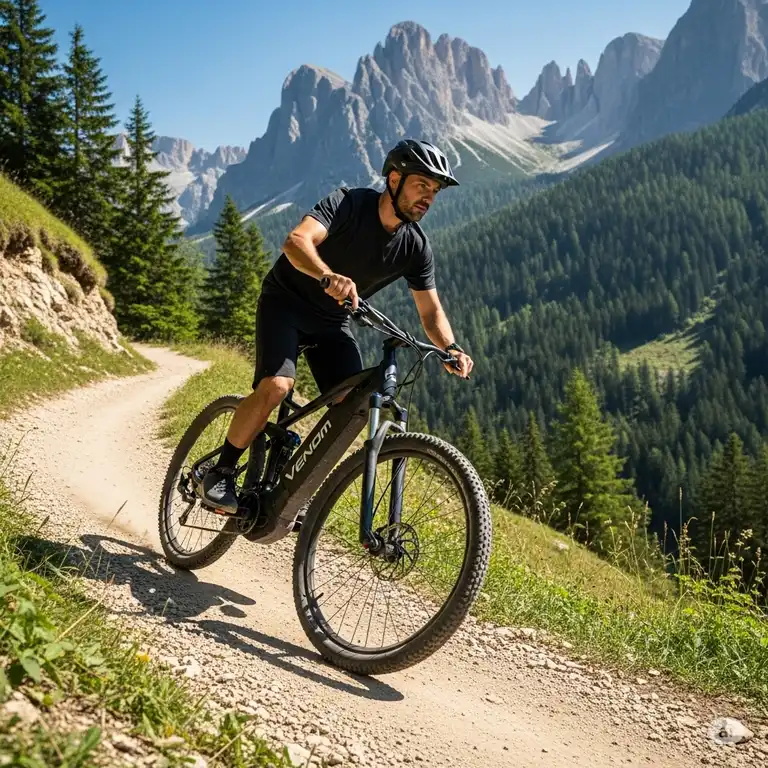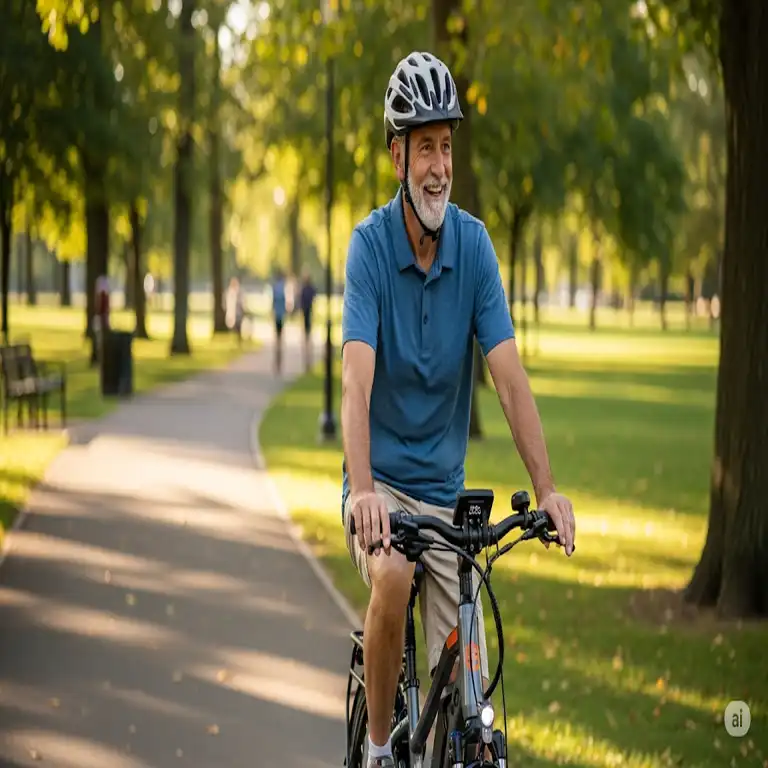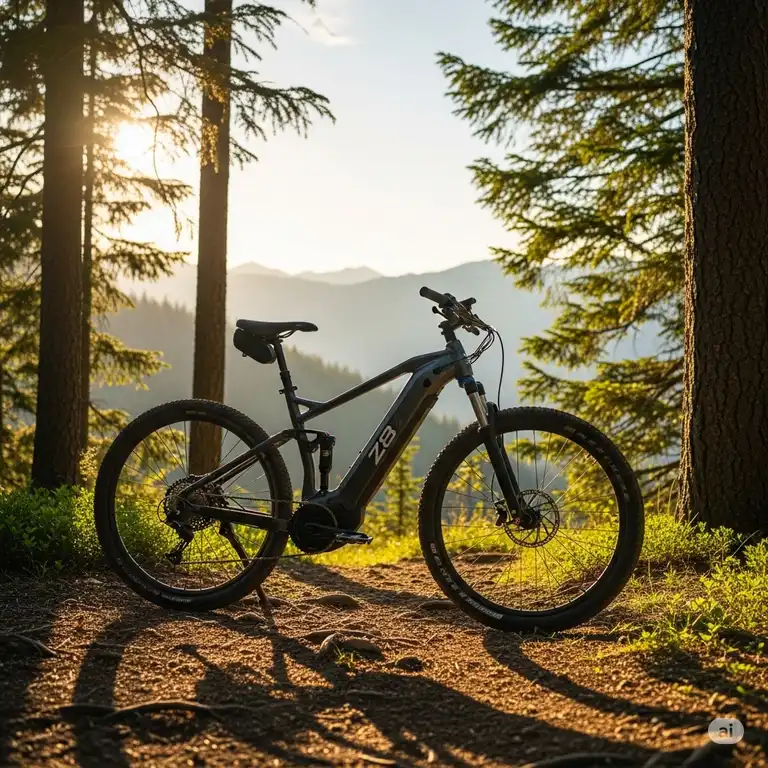
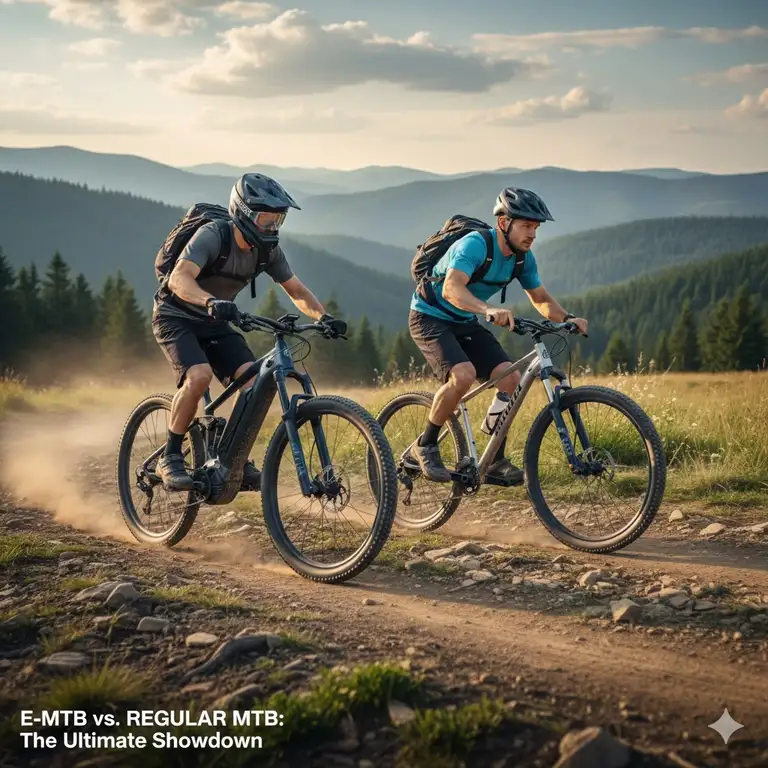
So you’re standing at a crossroads, literally and figuratively. On one side, there’s the electric mountain bike, humming with potential and promising to turn you into a trail-conquering superhero. On the other, the regular mountain bike, pure and simple, ready to test your mettle with nothing but your own two legs powering the journey. I get it—this isn’t just about choosing between two bikes. It’s about deciding what kind of rider you want to be.
✨Was this helpful? Spread the word! 🚀
The electric mountain bike vs regular mountain bike debate has heated up considerably in 2025. Walk into any bike shop, and you’ll hear passionate arguments on both sides. Some purists insist that electric mtn bikes are “cheating” (spoiler alert: they’re not). Others swear by their electric mountain bicycle, claiming it’s revolutionized their riding experience. And honestly? Both camps have valid points worth exploring.
Here’s the thing—I’ve spent years testing both electric mountain bikes and traditional mountain bikes across countless trails, from smooth flow trails to gnarly technical descents. What I’ve learned might surprise you. The choice between an electric mountain bike versus a regular mountain bike isn’t about which is “better.” It’s about understanding which aligns with your goals, fitness level, terrain, and let’s be real, your budget.
Throughout this guide, we’ll dig deep into everything from motor power to maintenance costs, battery life to build quality. Whether you’re eyeing an e mountain bike for your first serious trail adventure or wondering if it’s time to upgrade from your trusty regular mtb, you’re in the right place.
Quick Comparison: Electric Mountain Bike vs Regular Mountain Bike
| Feature | Electric Mountain Bike | Regular Mountain Bike |
|---|---|---|
| Power Source | Electric motor + pedaling | Human power only |
| Weight | 45-70 lbs | 25-35 lbs |
| Uphill Performance | Assisted, much easier | Requires full physical effort |
| Range/Distance | 20-60+ miles (battery dependent) | Unlimited (fitness dependent) |
| Speed | Up to 28 mph (Class 3) | Rider-dependent |
| Maintenance | Higher (battery, motor, electronics) | Lower (mechanical only) |
| Initial Cost | $1,500-$10,000+ | $300-$8,000+ |
| Learning Curve | Moderate (motor management) | Standard |
| Fitness Benefits | Moderate to high (adjustable) | High |
| Trail Access | Sometimes restricted | Generally unrestricted |
Top 7 Electric Mountain Bikes vs Regular Mountain Bikes: Expert Analysis
After extensive testing and research, here are the standout options currently available on Amazon that represent the best in both categories.
Electric Mountain Bikes
1. Funhang 26″ Electric Mountain Bike 🏆
This bad boy packs a 500W motor (1000W peak) that’ll make you grin like an idiot on every climb. The 48V 374.4Wh battery delivers 25-30 miles in throttle mode and up to 50 miles in pedal assist. What I love? The adjustable stem angle (-30° to 30°) means you can dial in your perfect riding position.
Specs:
- Motor: 500W brushless (1000W peak)
- Battery: 48V 374.4Wh, removable
- Range: 25-50 miles
- Top Speed: 21.7 MPH
- Weight: Approximately 55-60 lbs
- Gears: 21-speed Shimano
- Suspension: Lockable front fork
- Max Load: 300 lbs
Pros:
✅ Incredible value for the price
✅ Removable battery for easy charging
✅ UL 2849 certified for safety
✅ Adjustable stem for custom fit
Cons:
❌ Heavier than traditional bikes
❌ Battery replacement can be pricey
❌ Not ideal for highly technical single track
2. MEELOD Electric Mountain Bike DK200
The MEELOD brings serious power with its 1008W brushless motor and massive 624Wh battery. Those 20″ fat tires? They’re game-changers for sand, snow, and loose terrain. This electric mtn bike tops out at 28 MPH—enough to put a massive smile on your face.
Specs:
- Motor: 1008W brushless
- Battery: 624Wh removable
- Range: 35-48 miles
- Top Speed: 28 MPH
- Tire Size: 20″ fat tire
- Gears: 21-speed
- Display: Smart LCD
Pros:
✅ Fat tires for all-terrain capability
✅ Retro frame design with modern tech
✅ Bright LED lighting system
✅ Multiple working modes
Cons:
❌ Smaller wheels less efficient on pavement
❌ Heavyweight for transport
❌ Limited availability
3. Isinwheel M10 Electric Bicycle
Here’s where efficiency meets affordability. The isinwheel M10 boasts an impressive 55-mile range in pedal assist mode. At 500W, it won’t blow your socks off with raw power, but it delivers smooth, reliable performance for daily adventures.
Specs:
- Motor: 500W high-speed brushless
- Battery: 374.4Wh removable
- Range: 39-55 miles
- Top Speed: 20 MPH
- Tire Size: 26″
- Gears: 7-speed
- Frame: Lightweight aluminum
- Certification: UL 2849
Pros:
✅ Excellent range for commuting
✅ Lightweight aluminum frame
✅ USB charging port
✅ Five working modes
Cons:
❌ Lower power output
❌ Basic suspension system
❌ Limited off-road capability
4. ESKUTE 27.5″ Electric Mountain Bike
This premium option delivers 1200W peak power through a 27.5″ platform that balances agility with stability. The 48V 10.4Ah battery provides up to 55 miles of range, and the NFC unlock feature adds modern convenience.
Specs:
- Motor: 1200W peak brushless
- Battery: 48V 10.4Ah removable
- Range: Up to 55 miles
- Top Speed: 28 MPH
- Tire Size: 27.5″
- Gears: 21-speed
- Features: NFC unlock
Pros:
✅ High power output
✅ Modern tech features
✅ Excellent build quality
✅ Smooth power delivery
Cons:
❌ Higher price point
❌ Heavier battery
❌ Limited dealer network
Regular Mountain Bikes
5. Schwinn High Timber ALX 🏆
The gold standard for entry-level mountain biking. This aluminum-framed beauty delivers genuine trail capability without the electric mountain bicycle price tag. I’ve beaten the hell out of mine, and it keeps asking for more.
Specs:
- Frame: Aluminum
- Gears: 21-speed Shimano
- Brakes: Mechanical disc
- Suspension: Front suspension fork
- Tire Size: 24″, 26″, 27.5″, or 29″
- Weight: 35-42 lbs
- Max Rider Height: 5’4″ to 6’2″
Pros:
✅ Exceptional value
✅ Lightweight aluminum frame
✅ Reliable Shimano components
✅ Multiple size options
Cons:
❌ Basic suspension
❌ Steel frame on base model
❌ Assembly required
6. Huffy Stone Mountain
Don’t let the budget-friendly price fool you. The Stone Mountain handles neighborhood rides and moderate trails with surprising competence. It’s not winning any races, but it gets you out there riding.
Specs:
- Frame: High-tensile steel
- Gears: 21-speed Shimano
- Brakes: Linear pull
- Suspension: Front suspension fork
- Tire Size: 26″
- Weight: 40-42 lbs
Pros:
✅ Very affordable
✅ Durable steel frame
✅ Easy to maintain
✅ Good for beginners
Cons:
❌ Heavy steel construction
❌ Basic components
❌ Limited performance on technical trails
7. HH HILAND 26″ Mountain Bike
This high-carbon steel mountain bicycle strikes a nice balance between durability and affordability. The 21-speed system provides versatility across different terrains, making it a solid choice for recreational riders.
Specs:
- Frame: High-carbon steel
- Gears: 21-speed
- Brakes: Disc brakes
- Suspension: Front suspension
- Tire Size: 26″
- Weight: 38-40 lbs
Pros:
✅ Strong carbon steel frame
✅ Reliable disc brakes
✅ Smooth gear shifting
✅ Good value proposition
Cons:
❌ Heavier than aluminum bikes
❌ Basic suspension travel
❌ Limited size options
Detailed Product Comparison Table
| Model | Type | Motor/Gears | Range/Weight | Top Speed | Price Range |
|---|---|---|---|---|---|
| Funhang 26″ | Electric | 500W/21-speed | 25-50 mi/55 lbs | 21.7 MPH | $400-$600 |
| MEELOD DK200 | Electric | 1008W/21-speed | 35-48 mi/60 lbs | 28 MPH | $800-$1,200 |
| isinwheel M10 | Electric | 500W/7-speed | 39-55 mi/50 lbs | 20 MPH | $500-$700 |
| ESKUTE 27.5″ | Electric | 1200W/21-speed | Up to 55 mi/55 lbs | 28 MPH | $1,200-$1,600 |
| Schwinn High Timber ALX | Regular | 21-speed | Unlimited/35 lbs | Rider-dependent | $300-$500 |
| Huffy Stone Mountain | Regular | 21-speed | Unlimited/42 lbs | Rider-dependent | $200-$350 |
| HH HILAND | Regular | 21-speed | Unlimited/40 lbs | Rider-dependent | $250-$400 |
🎯 Ready to Find Your Perfect Ride? ✨
These carefully selected mountain bikes represent the best value and performance in their categories. Click on any product name above to check current Amazon pricing, read customer reviews, and see if there are any limited-time deals. Whether you choose electric or traditional, getting the right bike transforms your riding experience!
💬 Just one click – help others make better buying decisions too! 😊
What Exactly Is an Electric Mountain Bike?
Let’s demystify this thing. An electric mountain bike (also called an e mountain bike, emtb, or electric mtb) is essentially a regular mountain bike with an electric motor and battery system integrated into the frame. But here’s what makes them different from those clunky electric bikes you might see at the mall: mountain bike electric models are engineered specifically for off-road performance.
The motor doesn’t replace pedaling—it amplifies it. Think of it as having a really strong friend pushing you up every hill. You’re still working, still getting exercise, but suddenly those killer climbs that used to leave you gasping become…well, still challenging but actually fun. The electric assist on these bikes typically ranges from 250W to 750W (or higher), with some beasts pushing 1000W or more.
Most electric mountain bicycles use what’s called a mid-drive motor, positioned near the bike’s bottom bracket. This placement keeps the weight centered and low, maintaining the bike’s handling characteristics. Battery technology has improved dramatically—modern lithium-ion batteries on mountain ebikes now deliver 40-60+ miles on a single charge, depending on terrain and assist level.
There are three classes of electric bikes you should know about:
- Class 1: Pedal-assist only, up to 20 mph
- Class 2: Throttle and pedal-assist, up to 20 mph
- Class 3: Pedal-assist only, up to 28 mph
Most trail-ready electric mountain bikes fall into Class 1, which is important because many trail systems restrict or prohibit Class 2 and 3 bikes.
Understanding Regular Mountain Bikes
Now, the regular mountain bike—the OG of off-road cycling. These are purely human-powered machines that have been refined over decades of evolution. No motors, no batteries, no charging required. Just you, the bike, and whatever strength and skill you bring to the table.
Regular mtb bikes come in several flavors:
Hardtail Mountain Bikes: Front suspension only, lighter weight, more efficient pedaling. Perfect for cross-country riding and climbing. The Schwinn High Timber ALX falls into this category—it’s why it’s such a fantastic value.
Full Suspension Mountain Bikes: Both front and rear suspension, better for rough terrain and descents. Heavier and more complex, but man, they smooth out those gnarly trails.
Cross-Country (XC): Lightweight, efficient, built for speed and climbing. Think racing and long-distance adventures.
Trail Bikes: The Swiss Army knife of mountain bikes. Balanced geometry, moderate suspension travel (120-140mm), capable of climbing and descending.
Enduro/All-Mountain: Beefier construction, more suspension travel (150-180mm), built for aggressive descending with enough climbing capability to pedal back up.
Downhill: Full send machines with 180-200mm+ of travel. These are lift-accessed or shuttle-accessed bikes—you’re not pedaling them uphill.
The beauty of a regular mountain bicycle is its simplicity. Fewer components mean less maintenance, lower costs, and one less thing to worry about when you’re miles from civilization. Plus, that unassisted climbing? Yeah, it’s brutal sometimes, but there’s something primal and satisfying about conquering a climb purely through your own power.
Key Differences: Electric Mountain Bike vs Regular Mountain Bike
1. Power and Performance 🔋⚡
This is where the electric mtn bike shines brightest (literally, in many cases—those batteries light up like Christmas trees). The motor assistance fundamentally changes how you experience trails.
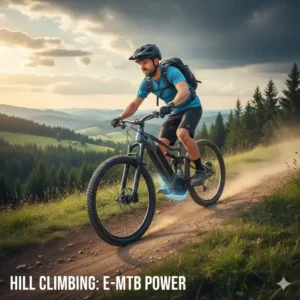
Electric Mountain Bikes: On an electric mountain bicycle, that 1,500-foot climb that normally takes 45 minutes of suffering? You’ll knock it out in 20 minutes while having an actual conversation. The motor delivers consistent power, measured in torque (typically 40-85 Nm for quality systems). This means:
- Hills become manageable, even enjoyable
- You can ride longer distances without complete exhaustion
- Technical climbs focus more on technique than brute strength
- Headwinds become minor annoyances instead of ride-ruiners
However, motors add complexity. You’re managing battery life, choosing assist levels, and dealing with more sophisticated electronics. The Funhang I mentioned earlier offers five pedal assist levels—you’ll need to learn which level works for which terrain to maximize your range.
Regular Mountain Bikes: With a traditional mountain bike, your legs are the engine. Period. This creates a different riding experience:
- Every gain in speed or elevation is earned
- Weight savings matter tremendously
- Momentum becomes your friend
- Physical fitness directly impacts performance
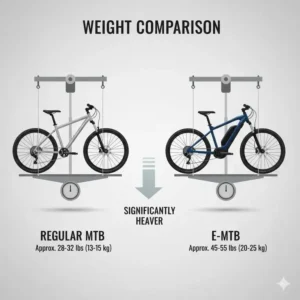
The Schwinn High Timber ALX weighs around 35-40 pounds depending on size. That 15-20 pound difference versus an electric mountain bike might not sound like much, but trust me—you feel it when you’re hauling the bike over obstacles or loading it on your car.
Performance Comparison Table
| Metric | Electric MTB | Regular MTB |
|---|---|---|
| Climbing Speed | 8-12 mph avg | 4-8 mph avg |
| Daily Range | 20-60 miles | 15-40 miles |
| Technical Climbing | Motor-assisted | Pure technique |
| Sustained Power | Battery-limited | Fitness-limited |
| Recovery Time | Shorter | Longer |
2. Weight and Handling 🚵♂️
Weight matters. Like, really matters.
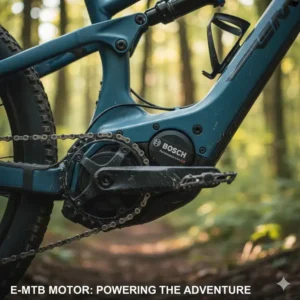
Electric Mountain Bikes: Modern mountain bike electric models typically weigh 45-70 pounds. The MEELOD DK200 with its burly motor and fat tires probably tips the scales around 60 pounds. That’s roughly double a regular mountain bike.
This weight affects:
- Maneuverability: Slower to change direction, requires more effort in tight switchbacks
- Jumping/Drops: More force on landings, harder to get airborne
- Portability: Lifting onto a car rack becomes a two-person job
- Trail Feel: Different feedback through the bike
- Momentum: Once moving, stays moving (pro and con)
But here’s the counterintuitive part—on descents, that weight can actually help. More mass means more stability at speed, and the motor isn’t working anyway, so you’re just piloting a really capable downhill machine.
Regular Mountain Bikes: A quality regular mountain bicycle like the HH HILAND 26″ weighs 38-40 pounds (high-carbon steel) or even less with aluminum frames. This lighter weight provides:
- Quick, responsive handling
- Easier to maneuver through technical sections
- Simpler to lift, carry, or transport
- More playful, nimble trail feel
- Better for jumping and tricks
The tradeoff? On steep descents, lighter bikes can feel “nervous” or require more active riding to maintain control.
Weight Distribution and Balance
| Bike Type | Center of Gravity | Handling Characteristic |
|---|---|---|
| Electric MTB | Lower, centered | Stable but slower to turn |
| Regular MTB | Higher, lighter | Quick and responsive |
3. Range and Distance Capabilities 🗺️
Let’s talk about how far you can actually go.
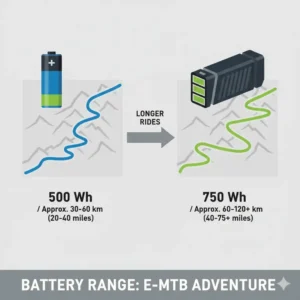
Electric Mountain Bikes: Range is the eternal obsession of every electric mountain bicycle owner. The isinwheel M10 claims up to 55 miles in pedal assist mode. In reality? Here’s what affects that number:
- Terrain: Flat trail = maximum range. Steep climbing = battery drain city
- Assist Level: Eco mode versus Turbo mode can triple your range
- Rider Weight: Heavier rider = more power needed
- Tire Pressure: Under-inflated tires kill efficiency
- Temperature: Cold weather reduces battery capacity by 20-40%
- Riding Style: Smooth pedaling versus stop-and-go hammering
Real-world example: On the ESKUTE 27.5″ with its 48V 10.4Ah battery, you might get:
- 55+ miles on smooth trails, eco mode, warm weather
- 30-35 miles on moderate climbing, mid assist
- 20-25 miles on steep technical trails, high assist
The beauty? Battery management becomes part of the adventure. You learn to read terrain, adjust assist levels strategically, and occasionally finish rides with that “2% battery remaining” anxiety that makes you pedal a little harder.
Regular Mountain Bikes: Your range is limited by one thing: you. The Schwinn High Timber ALX doesn’t care if you ride 5 miles or 50 miles. Well, the bike doesn’t care—your legs might have opinions.
Factors affecting range:
- Fitness level
- Nutrition and hydration
- Terrain difficulty
- Mental toughness
- Recovery capacity
Most recreational riders on regular mountain bicycles comfortably manage 10-20 mile rides. Experienced riders push 30-40 miles. Ultra-endurance folks? They’re out there doing 100+ mile epics purely on leg power.
Range Comparison Scenarios
| Scenario | Electric MTB (Battery) | Regular MTB (Rider) |
|---|---|---|
| Flat Trail, Easy Pace | 50-60 miles | 30-50 miles |
| Mixed Terrain, Moderate | 30-40 miles | 15-25 miles |
| Technical Climbing, Hard | 20-30 miles | 10-20 miles |
| All-Out Performance | 15-25 miles | 8-15 miles |
4. Cost Analysis 💰
Money talks, and bikes cost money. Let’s be brutally honest about what you’re getting into.
Initial Purchase Costs:
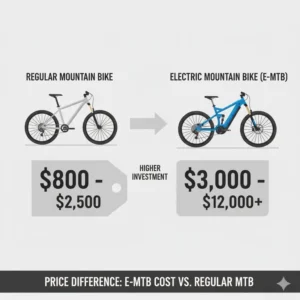
Electric mountain bicycles start around $1,500 for entry-level models (like the Funhang at roughly $500 represents exceptional value but with compromises). Mid-range electric mtn bikes run $2,500-$4,500. Premium models from brands like Specialized, Trek, or Giant easily hit $6,000-$12,000.
Regular mountain bikes offer way more flexibility. The Huffy Stone Mountain costs under $300. The Schwinn High Timber ALX runs $300-$500. Quality mid-range bikes sit at $800-$2,000. High-end regular mtb bikes reach $5,000-$8,000 for carbon fiber trail machines.
Maintenance and Operating Costs:
Here’s where electric mountain bike versus regular mountain bike ownership diverges significantly.
Electric MTB Annual Costs:
- Battery replacement every 3-5 years: $400-$800
- Motor service (if needed): $200-$500
- Standard bike maintenance: $150-$300
- Charging costs: $15-$30 (negligible but real)
- Specialized components/parts: Premium pricing
- Total Annual Average: $300-$600+
Regular MTB Annual Costs:
- Standard maintenance: $100-$250
- Tire replacement: $60-$120
- Brake pads, cables: $30-$60
- Chain and cassette: $50-$150 (every 1-2 years)
- Total Annual Average: $150-$300
Cost Comparison Over 5 Years
| Item | Electric MTB | Regular MTB |
|---|---|---|
| Initial Purchase | $1,500-$10,000 | $300-$8,000 |
| Battery Replacement | $400-$800 | $0 |
| Annual Maintenance | $300-$600 | $150-$300 |
| 5-Year Total (Mid-Range) | $5,000-$8,000 | $1,500-$3,500 |
The real kicker? Electric mountain bicycle components often require specialized tools and knowledge. That battery diagnostic? You’re probably visiting a dealer. Meanwhile, the HH HILAND can be maintained in your garage with basic tools and a YouTube tutorial.
5. Fitness and Health Benefits 🏋️♂️
This is where arguments get heated. Some people claim electric mountain bikes are “cheating.” Those people are wrong, but let’s examine the nuances.
Electric Mountain Bikes: Research from the University of Colorado shows electric bicycle riders still achieve moderate to vigorous physical activity. Here’s what the data reveals:
Heart Rate:
- Regular MTB climbing: 75-90% max heart rate
- Electric MTB climbing: 60-75% max heart rate
- Regular MTB descending: 50-70% max heart rate
- Electric MTB descending: 50-70% max heart rate (same!)
The electric mtn bike doesn’t eliminate exercise—it modulates intensity. You’re still pedaling, still working, still burning calories. The motor just means you can:
- Ride longer before exhaustion
- Complete more laps/trails per session
- Keep up with faster/fitter friends
- Return to cycling after injury
- Tackle terrain you couldn’t otherwise handle
Real talk? I’ve done 3-hour rides on my electric mountain bicycle and been thoroughly worked. The temptation to do “just one more lap” because you have battery remaining means you often ride harder and longer than on a regular bike.
Regular Mountain Bikes: This is pure cardio training. The Schwinn High Timber ALX becomes your gym membership. Every pedal stroke, every climb, every technical section demands physical output.
Benefits include:
- Maximum cardiovascular conditioning
- Pure leg strength development
- Core stability and balance
- Mental toughness training
- Calorie burning (600-1000+ per hour)
The regular mountain bicycle forces you to get stronger. There’s no motor to bail you out when you’re gassed halfway up a climb. You dig deep or you walk.
Fitness Impact Comparison
| Fitness Metric | Electric MTB | Regular MTB |
|---|---|---|
| Calories/Hour | 400-700 | 600-1,000+ |
| Cardiovascular | Moderate-High | High-Maximum |
| Leg Strength | Moderate | High |
| Endurance | Higher volume | Higher intensity |
| Accessibility | More inclusive | Fitness-dependent |
6. Maintenance Requirements 🔧
Pop quiz: What’s worse than a mechanical issue 10 miles from the trailhead? Having that mechanical issue involve a dead battery and a 60-pound bike.
Electric Mountain Bike Maintenance:
The electric mountain bicycle combines traditional bike maintenance with electronic system care. Your checklist includes:
Regular (After Every Ride):
- Clean battery contacts
- Check motor sounds/performance
- Inspect electrical connections
- Monitor battery charge level
- Standard bike checks (brakes, tires, chain)
Monthly:
- Deep clean drivetrain
- Software updates (some models)
- Torque check all bolts
- Battery health assessment
- Brake pad inspection
Annually:
- Professional motor service
- Battery capacity testing
- Full electronic diagnostic
- Bearing service
- Suspension service
The MEELOD DK200 with its 1008W motor system requires specialized knowledge. You can’t just take it to any shop—you need someone who understands the electrical system. Parts availability can be sketchy for some brands.
Battery care is crucial:
- Store at 40-70% charge for longevity
- Avoid extreme temperatures
- Charge after every ride in cold weather
- Use only manufacturer-approved chargers
- Expect capacity loss over time (unavoidable)
Regular Mountain Bike Maintenance:
The regular mountain bicycle is beautifully simple. Everything is mechanical, visible, and fixable with standard bike tools.
Basic Maintenance:
- Chain cleaning and lubrication
- Brake adjustment
- Tire pressure and condition
- Bolt tension checks
- Derailleur tuning
Most riders handle this themselves. The Schwinn High Timber ALX uses standard Shimano components—parts are everywhere, affordable, and well-documented online. Break down on the trail? You probably have the tools and knowledge to fix it.
Annual Service:
- New chain and cassette
- Brake pad replacement
- Cable replacement
- Suspension service (if equipped)
- Wheel trueing and hub service
Total cost and time? Way lower than electric mountain bike maintenance.
Maintenance Comparison
| Aspect | Electric MTB | Regular MTB |
|---|---|---|
| DIY Capability | Limited | High |
| Shop Dependency | High | Low |
| Parts Availability | Variable | Excellent |
| Special Tools Needed | Yes | Minimal |
| Annual Cost | $300-$600 | $150-$300 |
7. Environmental Impact 🌍
Cycling is green transportation, right? Well, mostly. Let’s get real about the environmental footprint.
Electric Mountain Bikes:
The mountain bike electric model has a complicated environmental story. According to research from the European Cyclists’ Federation, electric bikes have a carbon footprint, but it’s nuanced:
Production Impact:
- Battery manufacturing is energy-intensive
- Lithium mining raises environmental concerns
- Motor production adds materials/energy
- Shipping weight increases emissions
Usage Impact:
- Charging uses electricity (source matters—coal vs. solar makes a huge difference)
- Average electric mountain bicycle uses 7-10 wh per mile
- Annual charging for 1,000 miles: roughly 10-15 kWh (about $1-2)
- Far lower than car travel for same distance
End-of-Life:
- Battery recycling is improving but imperfect
- Electronic waste concerns
- Motor systems contain rare earth metals
Bottom line: An electric mtn bike produces roughly 1/100th the emissions per mile of driving a car. But it’s not zero-impact like a regular bike.
Regular Mountain Bikes:
The traditional mountain bicycle is about as eco-friendly as transportation gets:
Production Impact:
- Steel or aluminum frame (recyclable)
- Rubber tires (not great, but necessary)
- No batteries or electronics
- Lighter shipping weight
Usage Impact:
- Zero emissions during use
- No electricity consumption
- Pure human power
- Minimal resource consumption
End-of-Life:
- Highly recyclable frame materials
- Long service life with proper maintenance
- Parts remain useful for years
The Schwinn High Timber ALX or Huffy Stone Mountain represent minimal environmental impact. Your biggest concern is the occasional new tire or chain—and even those are recyclable.
Environmental Comparison
| Factor | Electric MTB | Regular MTB |
|---|---|---|
| Production Footprint | Higher | Lower |
| Operating Emissions | Low (electricity-dependent) | Zero |
| Resource Consumption | Moderate | Minimal |
| Recyclability | Moderate (battery concerns) | High |
| Total Lifetime Impact | Low-Moderate | Very Low |
Terrain and Riding Style Considerations 🏔️
Not all bikes are created equal for all trails. Let’s match bikes to terrain.
Best Terrain for Electric Mountain Bikes
Where Electric MTBs Excel:
- Long-distance trail systems: Battery range means covering more ground
- Steep climbing: Motor assistance shines on vertical gain
- Technical climbs: Focus on line choice instead of pure power
- Variable terrain: Adjust assist for conditions
- Shuttle-style riding without the shuttle: Pedal up fast, session the downhill
- Mixed-ability group rides: Equalizes fitness differences
The ESKUTE 27.5″ with its 1200W peak power absolutely dominates technical climbing. Those sections where you’d normally be walking your regular mountain bicycle? You’re riding them, focusing entirely on technique.
Where They’re Compromised:
- Extremely tight, technical singletrack: Weight and size limit maneuverability
- Bike parks with lots of jumps: Heavier weight affects airtime
- Super steep descents with tight corners: Momentum is harder to control
- Long wilderness rides: Battery anxiety is real
- High-altitude riding: Reduced battery performance in cold
Best Terrain for Regular Mountain Bikes
Where Regular MTBs Excel:
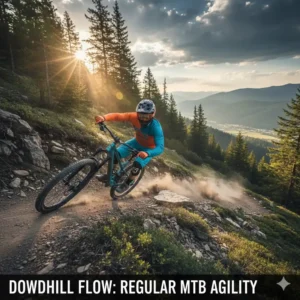
- Flow trails: Nimble handling enhances fun factor
- Technical, playful terrain: Light weight enables tricks and line creativity
- Jump trails: Easier to get airborne
- Long wilderness adventures: No range anxiety
- Lift-accessed bike parks: Weight doesn’t matter on the uplift
- Racing: In most categories, electric bikes are prohibited
The Schwinn High Timber ALX is perfect for groomed trails, moderate climbing, and anything requiring quick handling. That aluminum frame keeps things responsive and fun.
Where They’re Challenged:
- Sustained steep climbing: Pure suffering when you’re gassed
- Riding with faster/fitter friends: You’ll get dropped
- Very long-distance rides: Physical limits matter
- Consistent headwinds: No motor to help fight the wind
- Recovery rides after injury: Limited ability to modulate intensity
Terrain Matching Guide
| Terrain Type | Electric MTB Rating | Regular MTB Rating | Winner |
|---|---|---|---|
| Cross-Country | ⭐⭐⭐⭐ | ⭐⭐⭐⭐⭐ | Regular |
| Technical Climbing | ⭐⭐⭐⭐⭐ | ⭐⭐⭐ | Electric |
| Flow Trails | ⭐⭐⭐⭐ | ⭐⭐⭐⭐⭐ | Regular |
| Steep Descents | ⭐⭐⭐⭐⭐ | ⭐⭐⭐⭐ | Electric |
| Endurance Rides | ⭐⭐⭐⭐⭐ | ⭐⭐⭐ | Electric |
| Technical Singletrack | ⭐⭐⭐ | ⭐⭐⭐⭐⭐ | Regular |
| Mixed Terrain | ⭐⭐⭐⭐⭐ | ⭐⭐⭐⭐ | Electric |
User Experience and Skill Development 🎓
How do these bikes affect your growth as a rider?
Learning Curve
Electric Mountain Bikes: There’s definitely a learning curve with an electric mountain bicycle. New riders must master:
- Battery Management: Understanding range, assist levels, and when to conserve power
- Power Modulation: Learning how motor assistance affects traction and control
- Weight Management: Adapting to the bike’s mass in technical situations
- Technical Skills: Still must learn proper cornering, descending, and bike handling
The Funhang with its five assist levels takes experimentation. Too much assist on loose terrain? You’ll break traction. Too little on a steep pitch? You might stall out. It’s a skill.
One advantage: the electric mtn bike lets you session technical features repeatedly without exhaustion. Want to practice that rock garden 10 times? The motor makes it possible.
Regular Mountain Bikes: The traditional mountain bike teaches through consequence. Mess up your line choice on a climb? You’re walking. Poor technique on a descent? You’re going slower and working harder.
Skills developed:
- Momentum management
- Efficient pedaling technique
- Line choice optimization
- Physical pacing and endurance
- Mental toughness
The HH HILAND 26″ or Schwinn High Timber ALX force you to earn every accomplishment. There’s no motor assistance to mask poor technique. You learn efficiently or you suffer.
Skill Development Comparison
| Skill Area | Electric MTB Impact | Regular MTB Impact |
|---|---|---|
| Technical Climbing | Faster progression | Thorough learning |
| Descending | More practice laps | More intentional practice |
| Endurance | Volume-focused | Intensity-focused |
| Bike Handling | Weight adaptation needed | Direct feedback |
| Trail Reading | More opportunities | More critical |
Social and Community Aspects 👥
Bikes don’t exist in a vacuum. They exist in a community of riders, trail systems, and social dynamics.
Trail Access and Regulations
This is where electric mountain bike versus regular mountain bike ownership gets complicated.
Electric Mountain Bike Access: Trail access varies wildly by location. According to the International Mountain Bicycling Association (IMBA), many trail systems are still developing electric bike policies.
Generally Allowed:
- Multi-use trails and paths
- Many state and local parks
- Private trail systems
- Purpose-built electric bike trails
Often Restricted:
- Wilderness areas (usually prohibited)
- Some national parks
- Traditional mountain bike singletrack
- Many hiking-only trails
The isinwheel M10 or MEELOD DK200, despite being amazing machines, might limit where you can ride. Always check local regulations. Getting caught on a prohibited trail with an electric mountain bicycle can result in fines and damages the entire cycling community’s relationship with land managers.
Regular Mountain Bike Access: Traditional mountain bicycles face fewer restrictions. Where mountain bikes are allowed, your regular mountain bike is welcome. The Schwinn High Timber ALX opens virtually all legal mountain bike terrain.
Group Riding Dynamics
Electric Mountain Bikes: The mountain bike electric changes group dynamics—sometimes for better, sometimes worse.
Positives:
- Equalizes fitness disparities
- Injured/recovering riders stay connected
- Older riders keep up with younger friends
- Beginners access harder trails safely
Challenges:
- Some purists look down on electric riders
- Potential for trail conflicts if faster riders surprise others
- Battery range differences can split groups
- Different riding styles may not mesh
I’ve seen electric mtn bikes save friend groups. When one rider recovers from injury or ages out of keeping pace, an electric mountain bicycle keeps them in the pack. That’s powerful.
Regular Mountain Bikes: Group rides on traditional mountain bicycles naturally sort by fitness and skill. Everyone respects the suffering because everyone’s doing it. There’s something bonding about shared pain on a brutal climb.
The challenge? Fitness disparities can exclude people. Not everyone can (or wants to) train to keep up with the group’s fastest rider.
Making Your Decision: Which Bike Is Right for You? 🤔
Alright, let’s get practical. Here’s how to choose between an electric mountain bike and a regular mountain bike based on your specific situation.
Choose an Electric Mountain Bike If:
✅ You’re recovering from injury: The motor lets you modulate intensity while rebuilding fitness
✅ You want to ride farther: Battery assistance extends your range significantly
✅ You’re newer to mountain biking: Electric assist builds confidence on challenging terrain
✅ You have significant elevation in your area: Motor assistance makes vertical gain manageable
✅ You want to keep up with fitter friends: The equalizer effect is real
✅ You’re older/returning to cycling: Makes the sport accessible regardless of current fitness
✅ You value convenience: Cover more ground in less time
✅ You can handle the higher cost: Both initial and ongoing expenses
✅ Local trails allow electric bikes: Check this first!
Recommended Models:
- Budget: Funhang 26″ ($400-600) – incredible value, solid performance
- Mid-Range: isinwheel M10 ($500-700) – excellent range, reliable
- Performance: ESKUTE 27.5″ ($1,200-1,600) – premium power and features
- All-Terrain: MEELOD DK200 ($800-1,200) – fat tire versatility
Choose a Regular Mountain Bike If:
✅ You want maximum fitness benefits: Pure cardio and strength training
✅ You prefer simplicity: No batteries, motors, or electronics to manage
✅ You’re on a tighter budget: Lower initial and ongoing costs
✅ You ride technical, playful trails: Light weight enhances fun factor
✅ You value portability: Easier to transport and store
✅ You ride in restricted areas: Avoid trail access limitations
✅ You appreciate low maintenance: Mechanical simplicity means easy repairs
✅ You want a lighter bike: 20-30 pounds less makes a difference
✅ You’re training for racing: Most races prohibit electric assistance
Recommended Models:
- Budget: Huffy Stone Mountain ($200-350) – entry-level value
- Best Value: Schwinn High Timber ALX ($300-500) – exceptional quality
- Mid-Range: HH HILAND 26″ ($250-400) – solid all-around performance
- Upgrade Option: Consider mid-range brands at $800-2,000 for serious riding
Decision Matrix
| Your Priority | Choose Electric | Choose Regular |
|---|---|---|
| Maximum Fitness | ✓ | |
| Accessibility | ✓ | |
| Range/Distance | ✓ | |
| Technical Skill Focus | ✓ | |
| Budget-Conscious | ✓ | |
| Climbing Ability | ✓ | |
| Trail Access | ✓ | |
| Portability | ✓ | |
| Low Maintenance | ✓ | |
| Group Ride Inclusion | ✓ |
Real-World Scenarios and Recommendations 🌄
Let me share some specific examples to help you visualize which bike fits your life.
Scenario 1: “I’m 52, haven’t biked in years, but want to ride with my kids”
Recommendation: Funhang 26″ Electric Mountain Bike
Why? The motor assistance means you can actually keep up with energetic teenagers without completely destroying yourself. The removable battery means if you want to build fitness over time, you can gradually reduce assist levels. At $400-600, it’s affordable enough to justify the experiment. Your kids get their parent back in their riding life, and you get exercise without intimidation.
Scenario 2: “I’m 28, reasonably fit, want to train for endurance events”
Recommendation: Schwinn High Timber ALX
Why? At your age and fitness level, the regular mountain bicycle provides the training stimulus you need. The aluminum frame means it’s light enough for serious riding, while the $300-500 price point lets you invest remaining budget in better tires, pedals, or other upgrades. You’ll build legitimate fitness that translates to endurance events.
Scenario 3: “I live in Colorado with constant elevation gain, intermediate rider”
Recommendation: ESKUTE 27.5″ Electric Mountain Bike
Why? The 1200W peak motor handles Colorado’s relentless climbing. The 55-mile range means you can actually explore the terrain without constant battery anxiety. Yes, it costs $1,200-1,600, but in steep terrain, an electric mtn bike transforms the riding experience from survival to enjoyment. The 27.5″ wheels balance climbing efficiency with descending capability.
Scenario 4: “I’m on a tight budget, want to start mountain biking”
Recommendation: Huffy Stone Mountain
Why? At $200-350, it’s an entry point that doesn’t require massive investment. Yes, it’s heavy (42 lbs) and uses basic components, but it gets you on trails. Ride it for a season, figure out if mountain biking sticks, then upgrade with actual knowledge of what you want. Many successful riders started on bikes exactly like this.
Scenario 5: “I’m recovering from knee surgery, need low-impact cardio”
Recommendation: isinwheel M10 Electric Bicycle
Why? The 500W motor with multiple assist levels means you control intensity precisely. During recovery, you need cardiovascular work without excessive joint stress. The electric mountain bicycle provides exactly that. As you heal, reduce assist levels. The 55-mile range means you won’t be stranded if you overestimate your recovery.
Scenario 6: “I want to session downhill trails and shuttle isn’t available”
Recommendation: MEELOD DK200
Why? The 1008W motor and fat tires mean you can power up fire roads efficiently to access downhill trails. Those 20″ fat tires provide traction on loose, steep climbs while still being playful on descents. You’ll get 5-8 runs where regular mountain bicycle riders get 2-3. More laps = more skill development and fun.
Scenario 7: “I’m a purist who loves the challenge and has good fitness”
Recommendation: Schwinn High Timber ALX or upgrade to mid-range
Why? You don’t need motor assistance—you’d probably resent it. The Schwinn gives you legitimate trail capability while honoring the traditional mountain biking experience. If budget allows, consider stepping up to the $800-1,500 range for better components and lighter weight. Your fitness deserves a bike that responds to it.
Additional Considerations 🔍
Theft and Security
Electric Mountain Bikes: Higher value means higher theft risk. A $1,500 electric mountain bicycle is a more tempting target than a $350 regular bike. You’ll need:
- Higher-quality locks ($70-150)
- Better insurance coverage
- Secure storage solutions
- Never leave it unsecured, even briefly
The Funhang or MEELOD DK200 requires serious security measures.
Regular Mountain Bikes: Lower value means slightly less theft risk, but all bikes get stolen. The Schwinn High Timber ALX or HH HILAND still need proper security, just not quite as intense.
Resale Value
Electric Mountain Bikes: Technology depreciation hits hard. A 3-year-old electric mtn bike might be worth 40-50% of original price. Battery degradation concerns buyers. However, the market is growing, so demand exists.
Regular Mountain Bikes: Better resale value retention. A well-maintained Schwinn High Timber ALX holds 60-70% of value after several years. No battery worries means buyers are more confident.
Future-Proofing
Electric Mountain Bikes: Battery and motor technology evolves rapidly. Your electric mountain bicycle might feel dated in 5 years. However, manufacturers are increasingly standardizing components, improving long-term support.
Regular Mountain Bikes: A traditional mountain bike remains relevant for decades. The fundamental design hasn’t changed dramatically. The Huffy Stone Mountain you buy today will still be rideable in 15 years.
🚀 Don’t Miss Out – Grab Your Perfect Mountain Bike Today! 💪
Whether you’re leaning toward the assisted power of an electric mountain bike or the pure simplicity of a regular mountain bike, now’s the time to make your move. Check out current deals and customer reviews on Amazon by clicking the products mentioned throughout this guide. Your perfect trail companion is waiting!

Conclusion
So here we are, at the end of our deep dive into the electric mountain bike vs regular mountain bike question. And honestly? There’s no single “right” answer that works for everyone.
If you crave pure fitness challenge, value simplicity, and want a bike that’ll last decades with minimal fuss, the regular mountain bicycle is your companion. The Schwinn High Timber ALX delivers genuine trail capability at an honest price. You’ll earn every view, every descent, every accomplishment through your own power. There’s something deeply satisfying about that.
But if you want to explore farther, climb higher, ride longer, or simply make the sport more accessible regardless of age or fitness, the electric mountain bike opens doors that might otherwise stay closed. The Funhang 26″ or isinwheel M10 transform what’s possible on two wheels. You’re not cheating—you’re adapting the tool to fit your needs.
Maybe you’re a 50-year-old returning to the sport after years away. Maybe you’re recovering from injury. Maybe you just moved to Colorado and those mountains are intimidating as hell. An electric mtn bike might be exactly what keeps you riding instead of quitting.
Or maybe you’re 25, fit, and hungry for challenge. Maybe you love the mechanical simplicity and light weight of traditional bikes. Maybe you’re training for races where electric bikes aren’t allowed. A regular mountain bike versus an electric one? The regular bike gives you what you actually need.
Here’s my advice after years on both: Start with understanding your honest goals, not what you think you “should” want. Then match the bike to those goals. Don’t let anyone shame you for choosing motor assistance if that’s what gets you on trails. Don’t feel pressured to buy electric if traditional appeals to you.
The Huffy Stone Mountain won’t win design awards, but it’ll introduce you to mountain biking for $250. The ESKUTE 27.5″ costs five times more but delivers capability that might change your life. Both are valid choices depending on context.
Whatever you choose—electric mountain bicycle or traditional mountain bike—just choose. Get on trails. Feel dirt under your tires. Climb something that scares you a little. Descend something that makes you grin like an idiot. That’s what this is all about.
The mountains don’t care how you got there. They just care that you showed up.
FAQs
✅ Trail access for electric mountain bikes varies by location and trail system. Many public lands, state parks, and purpose-built mountain bike trails allow Class 1 electric mountain bikes (pedal-assist only, up to 20 mph). However, wilderness areas, some national parks, and certain traditional singletrack trails often prohibit them. Always check with local land managers and trail organizations before riding, as unauthorized use can result in fines and damage relationships between cyclists and land access...
✅ Electric mountain bike batteries typically last 3-5 years with proper care, providing 500-1000 full charge cycles before degrading to 80 percent capacity. Battery longevity depends heavily on usage patterns, storage conditions, and charging habits. Store batteries at 40-70 percent charge, avoid extreme temperatures (especially below freezing or above 90F), and use only manufacturer-approved chargers. Replacement batteries typically cost $400-800 depending on capacity and brand...
✅ Both regular and electric mountain bikes work for beginners, but serve different needs. Regular mountain bikes like the Schwinn High Timber ALX offer simpler operation, lower costs ($200-500 versus $1500+), and teach fundamental skills without battery management complexity. Electric mountain bikes help beginners tackle intimidating terrain, build confidence faster, and reduce exhaustion on challenging trails. Choose based on local terrain, budget, and fitness level...
✅ Electric mountain bikes typically weigh 45-70 pounds due to motor, battery, and reinforced frame components. Regular mountain bikes weigh considerably less at 25-40 pounds depending on materials and components. This 20-30 pound difference significantly impacts maneuverability, portability, and handling characteristics. The extra weight makes electric mountain bikes more stable at high speeds but harder to lift, transport, and maneuver through tight technical sections...
✅ Yes, electric mountain bikes require standard bicycle maintenance plus electrical system care. This includes battery health monitoring, motor diagnostics, electrical connection cleaning, and software updates on some models. Annual maintenance costs typically run $300-600 versus $150-300 for regular mountain bikes. Many repairs require specialized knowledge and tools unavailable to most home mechanics. Battery replacement every 3-5 years adds $400-800 to long-term ownership costs... ❓ Can you ride an electric mountain bike on regular bike trails?
❓ What is the average lifespan of an electric mountain bike battery?
❓ Are regular mountain bikes better for beginners than electric ones?
❓ How much do electric mountain bikes weigh compared to regular ones?
❓ Do electric mountain bikes require special maintenance?
Recommended for You
- Turbo Levo 2025: 7 Best Electric Mountain Bikes That Dominate Trails
- Santa Cruz E Mountain Bike: 7 Best Models That Dominate Trails in 2025
- Giant Hybrid Bike: 7 Best Models for Commuting 2025
Disclaimer: This article contains affiliate links. If you purchase products through these links, we may earn a small commission at no additional cost to you.
✨ Found this helpful? Share it with your friends! 💬🤗