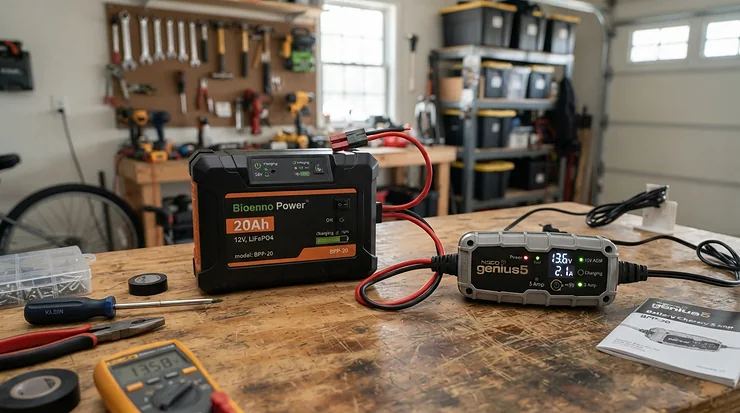
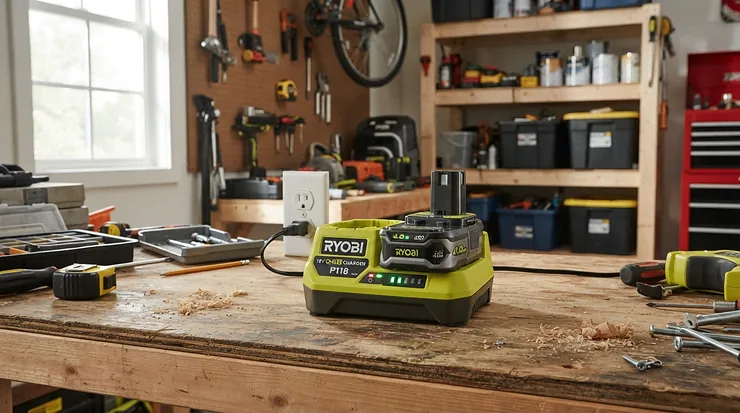
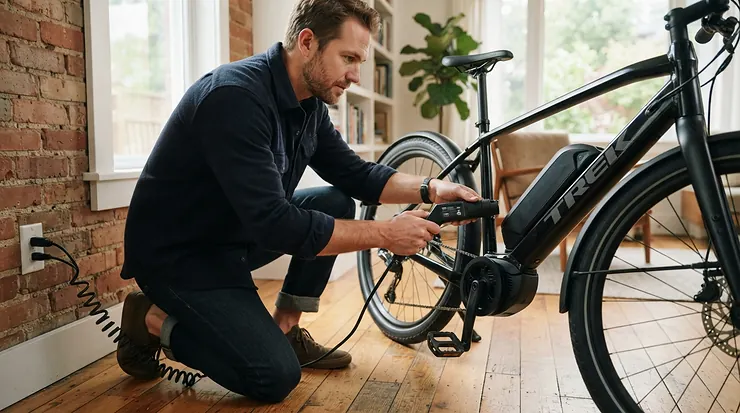
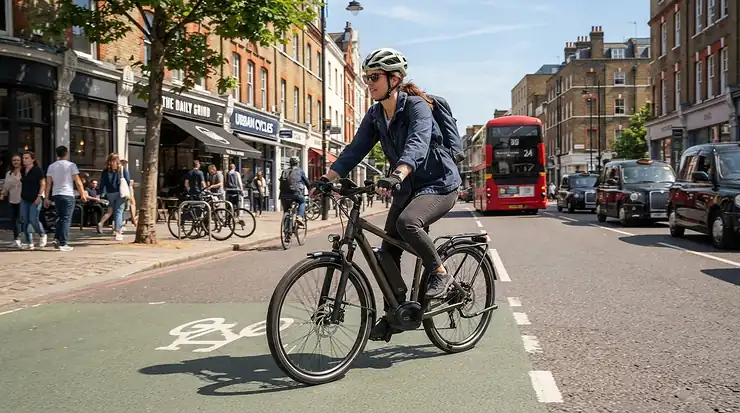
Buying the wrong ebike batteries costs more than the checkout total. A 460 mm pack will not seat in a frame built for a 390 mm one, and a pack with no lab certificate behind it can land on a federal warning list, as Unit Pack Power’s did when the CPSC told owners to stop using them. The agency’s notice says those packs sold on Amazon, eBay, Walmart and other sites for between $280 and $730.
This 2027 guide to ebike batteries pairs five Amazon products with five situations: a Dorado-style frame mount, a seat-tube bike, a conversion-kit build, a 60V lead-acid bike, and a home where the pack charges indoors. It also answers the odd questions that came with the search, such as how five batteries wire into 60 volts, how long a Dyson Bikes pack lasts, and whether battery bags are safe. The specs come from listing text that surfaced in search and are checked against CPSC, Consumer Reports, Electric Bike Report and owner forums; no pack here was bench-tested. Check the current price on Amazon.com, because packs and sellers change often.
Best ebike batteries start with voltage, connector, controller limit and certificate
Capacity gets the attention, yet four other details decide whether a pack works at all.
Voltage has to match the system the bike was built around, whether that is 36V, 48V, 52V or 60V. Watt-hours put packs of different voltages on one scale (volts times amp-hours): 624 Wh for a 48V 13Ah pack, 840 Wh for 48V 17.5Ah, 720 Wh for five 12V 12Ah blocks in series, and 1,040 Wh for 52V 20Ah.
The controller limit comes next. A battery management system (BMS) is rated for a maximum continuous current, and the controller should never ask for more than that. One Dorado listing spells it out: a 30A BMS, suited to controllers rated at 30A or less.
Mount and plugs are the physical side. Case length matters (460 mm versus 390 mm on the Dorado platform), and so do the discharge connector (2-pin, XT60, bullet) and the charge port. A seller’s fits line is a claim, so measure your old pack.
The certificate protects the house. According to the CPSC’s June 2026 proposal, UL 2271 covers user-replaceable battery packs and UL 2849 covers the electrical system of the whole e-bike. A listing that mentions UL is not the same as a certificate you can look up, and the Unit Pack Power notice turned on exactly that gap: the packs had not been certified by an accredited lab to the applicable UL standard.
Pack
Energy
Mount and plugs
BMS and discharge
Certification wording
Dorado Plus 48V 17.5Ah
840 Wh
460 mm Dorado mount, DC2.1 charge port, 2-pin discharge
30A BMS
None in the listing text
Silverfish 48V 13Ah
624 Wh
Seat-tube mount with lock, 14 to 15 in long
10A standard, 20A maximum on sibling listings
UL 2271 in the title
Joyisi 52V 20Ah
1,040 Wh
Hard shell, XT60 plugs, 14.5 in long
40A BMS
Listing says it passed UL 2271 testing
6-DZM-12 5-pack
720 Wh
Nut-and-bolt terminals, five blocks
No BMS (lead-acid)
UL Certified on one 5-pack listing
The lead-acid set holds 720 Wh at roughly 41.8 pounds (five blocks at 8.36 pounds each, per the listing), about 17 Wh per pound. The lithium packs land between roughly 69 and 86 Wh per pound on their own listed weights, with the Silverfish at 8.8 pounds, the Dorado Plus at 5.5 kg and the Joyisi 52V 20Ah at 12.13 pounds. That gap is why lead-acid bikes feel heavy, and why a chemistry swap changes the charger, the wiring and sometimes the fit.
Bikes built around the Dorado mount, including the NCM Moscow and Magnum models the listing names, are the natural home for this 840 Wh pack. The Amazon listing gives 48V and 17.5Ah, a 30A BMS, a 460 by 104 by 65 mm case, a 54.6V 3A charger, a DC2.1 charge port, a 2-pin discharge port and a USB socket, plus 65 cells the seller calls automotive A+ grade. That cell grade is the seller’s own wording.
Two details deserve a second read. The title lumps 13Ah and 17.5Ah together (the 624 Wh and 840 Wh figures), so the option you select decides what arrives. Sibling ShunTongDa listings add that the pack fits only the 460 mm platform, not the 390 mm short version, and that it suits controllers rated at 30A or less. One comparison table there shows the 17.5Ah pack with 18650 cells, while the 20Ah versions use 21700 cells in a larger case.
The closest independent evidence concerns Reention-made Dorado packs rather than this Amazon seller’s. On the Electric Bike Review forum, one member re-ran capacity tests on a 25Ah Dorado after a year and found little or no loss, and several members said 21700-cell versions beat 18650 ones on speed and range. A UK rider logged about 21 hilly miles with voltage easing from 54V to 51.5V. All of it is anecdote, mostly from 2022, and none of it proves a different seller’s build behaves the same way. The Amazon listing text shows no pack-level UL certificate, so ask the seller for one before charging indoors.
Compare the exact model number and the 460 mm length against your current pack before buying.
SDTYYP Reention Dorado Plus 48V 17.5AhSee current price, sizes and reviews on Amazon.
The number that defines this pack is 10 amps. The UL 2271 Silverfish listing specifies 48V 13Ah (624 Wh), a 10A discharge current, a safe lock, an LED indicator, USB output and a motor rating up to 700W, which points to commuter hub motors rather than hard-pulling 1,000W kits. Case length runs 14 to 15 inches across the YOSE POWER listings.
Sibling YOSE POWER listings add fit and handling details. They give a 20A maximum current, the pack ships at around half charge for transport, the 54.6V 2A charger needs about eight hours, and the seller says this style cannot replace a Heybike pack (a separate Heybike-fit listing exists). UL 2271 appears in the title as the seller’s claim, and a certificate number is easy to request.
Buyer reviews are split. On a reseller site that mirrors Amazon reviews for other YOSE POWER 13Ah listings, one reviewer reports a battery that melted and brought the fire department, another found a blown 10-amp fuse and got the pack working again after replacing it, and a third reports 2,347 miles with no loss. Three reviews prove nothing statistically, but the spread is worth knowing.
Pros:
✅ Pack-level UL 2271 claim in the title
✅ 18-month warranty on the sibling listing
✅ Familiar seat-tube footprint with a lock
Cons:
❌ 10A standard discharge limits stronger motors
❌ Mixed buyer reports, including one fire report
❌ Several YOSE POWER versions share one name
YOSE POWER UL 2271 Silverfish 48V 13AhSee current price, sizes and reviews on Amazon.
Conversion kits and big hub motors are where 1,040 Wh earns its weight. This listing describes LG cells, a 40A BMS, a hard plastic shell, XT60 plugs, a USB port, a 3A charger with a charge time of eight hours or more, and a rating for 200W to 1,600W motors. It measures 14.5 by 3.5 by 4.5 inches and weighs 12.13 pounds. The listing says it passed UL 2271 testing and supports 1,000-plus cycles, both seller statements, while Electric Bike Report’s general range for lithium packs is 500 to 1,000 cycles.
Joyisi sells many 52V 20Ah listings under similar names, and they differ in ways that matter. Another listing shows TSL cells in its 48V and 52V 20Ah table and describes a bare, PVC-wrapped pack with a note to use it inside a bag or box, and others add a rack and taillight. Pick the hard-shell version, read the cell line, and treat any compatibility line as the seller’s claim. No independent test of this pack surfaced.
The safety context matters more here than for frame-mount packs. The CPSC’s Unit Pack Power warning concerned packs sold to convert pedal bikes into e-bikes, and the proposed federal rule would also reach conversion-kit components and packs sold separately.
Pros:
✅ Highest energy of the lithium packs here
✅ 40A BMS leaves room for stronger motors
✅ Hard shell with XT60 plugs
Cons:
❌ 12.13 pounds to carry on and off the bike
❌ Cell brand and shell vary across Joyisi listings
❌ Certification claim rests on the seller’s wording
Read the cell brand and connector lines on the exact listing before ordering.
Joyisi 52V 20Ah Ebike BatterySee current price, sizes and reviews on Amazon.
Five sealed lead-acid blocks wired in series make 60 volts, which is why scooters and some budget e-bikes run sets like this one. Each block is a 6-DZM-12: 12V, 12Ah, 5.9 by 3.9 by 3.7 inches, 8.36 pounds, with nut-and-bolt terminals. Five hold 720 Wh and weigh about 41.8 pounds. One listing says only batteries and screws arrive, with no wire harness, yet a line further down mentions a 60V charger and a charging port. Compare the charger and wiring details in the listing before buying a five-pack.
Life claims conflict. A listing for a similar 5-pack claims roughly 1,000 cycles to 80 percent depth of discharge, and similar five-packs show 3-month warranties. A commenter on a forum thread about this chemistry put sealed lead-acid at about 400 cycles when well maintained. The original poster on that thread had a five-battery 60V scooter that lost range after 150 cycles, and replies pointed to uneven series charging, which can leave some blocks undercharged and sulfated, and to topping up the weak blocks individually.
Weight is the trade-off. By the listings, 720 Wh costs 41.8 pounds here, against 12.13 pounds for 1,040 Wh on the lithium Joyisi 52V 20Ah.
YC Yier 5-Pack 6-DZM-12 12V 12Ah BatterySee current price, sizes and reviews on Amazon.
Length is where bag shopping goes wrong first. The XL measures 21.2 by 5.1 by 4.7 inches, the L measures 17.3 by 5.1 by 4.7, and a 460 mm Dorado-style case is 18.1 inches long. That arithmetic puts the Dorado Plus in the XL and lets the 14.5-inch Joyisi 52V 20Ah ride in the L. The XL listing describes E-glass fiber and silicone fabric, 0.55 kg, a zipper closure and a shoulder strap.
The maker’s wording is more modest than the word fireproof on competing listings. VLITEX says the bag temporarily withstands intense fires and slows the spread of flames and smoke, urges calling the fire department, and warns that smoke may be toxic. Its storage-box listing adds that its safety bags are not a permanent solution and cannot guarantee full containment for long. The certified-by-institutes line on the bag listing names no institute.
Whether that adds up to safety is covered in the bag section below, where Consumer Reports and a German fire test show the limits. One distinction matters: the c’t test destroyed a roughly 20-euro bag from another seller, not this one. The maker’s own safety notice tells you to call the fire department first.
VLITEX E-Bike Battery Bag XLSee current price, sizes and reviews on Amazon.
Ebike batteries reviews: what to trust and what to discount
Roundups of the best ebike batteries that surfaced in search crown three different winners, a Joyisi pack in one, a Leonidas 52V 20Ah in another and the Dorado Plus in a third, and none of them shows test data. Independent evidence is thinner but checkable: CPSC incident counts, Consumer Reports on bags, forum threads where owners post capacity tests, and the buyer reviews on the listings themselves.
Weigh each by whether the claim can be re-measured. A forum member’s capacity test can be repeated, and a best-overall badge cannot. Ebike batteries reviews on a listing are the only per-seller signal, and for packs like these they are thin and split, as the YOSE POWER mirror shows. Treat any claim of 1,000 cycles as a seller’s rating, not an owner’s result.
How to put the five batteries in a 60 volt ebike and hook the wires up
The usual reading of five batteries in a 60 volt ebike is five 12-volt blocks wired in series, since 5 times 12 gives 60. Series means the positive post of one battery joins the negative post of the next, so voltages add while amp-hours stay the same. This is the layout lead-acid sets like the 6-DZM-12 5-pack use, whereas a typical lithium e-bike pack already hides its cells inside one case.
Charge and read each battery first. Victron’s wiring guide advises fully charging batteries individually before joining them, so the string does not start out imbalanced. Replace all five together, because the weakest block limits the whole string.
Power down. Switch the bike off and unplug the controller’s battery connector. Take off rings and watches and use insulated tools, since battery terminals are uninsulated, as Victron’s guide points out.
Lay the blocks in a row with alternating posts. A forum thread about this exact five-battery layout sketches it as negative and positive posts alternating down the line, so each positive post faces the next block’s negative.
Join the posts. Link battery 1 positive to battery 2 negative, 2 to 3, 3 to 4 and 4 to 5, using four jumpers of equal length. The two posts left over, negative on battery 1 and positive on battery 5, are the pack’s leads. One commenter on a lead-acid scooter thread mentioned 10-gauge wire with Anderson PowerPole connectors for a 60V pack, and another said heavier connectors might be needed, so size the cable to the controller’s current rating.
Meter it before connecting. Set a multimeter to DC volts across the two free leads. Five healthy, fully charged blocks should read about five times a single block. Confirm which lead is positive, because the same scooter thread warns that reversed connections can destroy a charger.
Connect the controller last. Cover every exposed post with caps or tape, and strap the blocks down so vibration cannot loosen a joint.
Charging is the second half of the job. A series charger built for the pack voltage handles the whole string, and one listing’s charge spec of 14.4 to 15.0 volts per block implies roughly 72 to 75 volts across five. Forum replies favored charging blocks in parallel as the kinder method but noted it requires rewiring, and one poster warned that connecting all five to a single 12V charger means opening every series link first. Four chargers run in parallel reportedly blew a pack. The simpler routine is a series charge followed by a voltage check on each block, since Victron says a noticeable difference near the end of bulk charging signals imbalance.
Unhooking runs in reverse. Switch off, pull the controller connector first, then undo the jumpers one at a time with insulated tools and tape each loose end as it comes free. Do not touch the posts at opposite ends of the string while the controller plug is still in.
Swapping to 12V LiFePO4 blocks changes the plan. A scooter-parts retailer says they are not a plug-and-play replacement for lead-acid packs and must be charged one at a time on 14.6V lithium chargers, although they can stay connected to the harness while charging.
How long do Dyson ebike batteries last? And how long does any pack?
The word Dyson in an e-bike search usually points to Dyson Bikes, an e-bike brand that a retailer page describes as founded in Australia in 2014 by David Metzke and Naomi Dyson. Its FAQ gives no cycle count or lifespan figure. It recommends charging after every ride, even when the pack is not flat, to extend its life, lists 4 to 8 hours for a full charge, and estimates 40 to 100 km of range depending on model and capacity. The FAQ cites Australian standards and dealers, so US availability is unverified. Anyone who meant a Dyson cordless-vacuum battery will find that Dyson’s support pages say vacuum battery life is not defined by a set number of years.
For a general yardstick, Electric Bike Report puts the rule of thumb at 2 to 4 years, with most lithium e-bike packs rated for roughly 500 to 1,000 full cycles. A partial discharge counts as a fraction of a cycle. Its care advice is to use the supplied charger, avoid leaving a pack on the charger for long stretches, store it cool and dry at a steady temperature, and keep it between 40 and 70 percent for off-season storage, though makers vary.
Lead-acid sets sit lower on that scale. The forum commenter’s 400 cycles and the listing’s 1,000 cannot both be right, so follow the battery label’s rating for your exact blocks.
Ebike batteries exploding: what the CPSC numbers and warnings show
On the question of ebike batteries exploding, the federal count is specific, and it is not small. In its June 2026 proposed rule, the CPSC cites 227 micromobility battery incidents from 2019 through 2023, with 39 deaths and 181 injuries. Fires account for 195 of those incidents, 86 percent, along with all 39 deaths. The figures cover e-scooters and similar devices, not only e-bikes.
The proposal would reach user-replaceable packs sold on their own, aftermarket chargers and conversion-kit components. It adds a tamper-resistant enclosure requirement, a post-discharge charging test, a reverse-polarity test and revised warning labels to the UL standards. Comments were due August 24, 2026, so check the Federal Register for whether the rule has since been finalized.
Two named warnings show the pattern. The CPSC told owners to stop using Unit Pack Power models U004 and U004-1, after 13 people reported overheating, seven of them fires with substantial property damage, and after the maker refused an acceptable recall. In November 2025 the CPSC warned about Rad Power Bikes batteries, models RP-1304 and HL-RP-S1304, citing 31 fires and saying the packs can unexpectedly ignite and explode, especially after water or debris exposure, as Electrek reported. Rad disputes that characterization and says its batteries passed UL 2271 and UL 2849 testing. One case involved uncertified packs and the other a certified brand in a dispute, so a certificate lowers a risk signal without settling it.
Habits recommended by Consumer Reports and the CPSC are consistent: charge with the supplied charger, stay nearby, never charge while you sleep, charge outside when possible, keep packs away from heat and out of your exit path, inspect a pack after a crash and replace it if it is damaged, and recycle old packs at designated drop-off sites.
Are battery bags for ebike batteries safe? What the testers found
A bag adds a layer, not a guarantee. Consumer Reports reports that most e-bike battery bags lack certification from a recognized lab such as UL Solutions, and that a spare Lectric One battery was too large for bags from Zeee and Tamfile. A University of Warwick expert it cites doubts that a reasonably sized bag could contain the gas released in thermal runaway and warns of false security. Another expert says soft-sided bags cannot withstand the heat and pressure of a real fire, though they might slow one.
The German magazine c’t tested a roughly 20-euro charging bag sold as fireproof and explosion-proof, loaded with a fully charged 375 Wh e-bike battery. The first cell exploded about five minutes in, the bag caught fire roughly ten seconds later, and only shreds remained. A battery expert there warned that a bag can concentrate heat and that escaping gases can ignite outside it. Amazon removed that model, and c’t said most bags in the same price range likely perform similarly.
Consumer Reports’ sources point to heavy-duty fire blankets as an alternative, with the caveat that UL found blankets control flaming but do not stop thermal runaway. The habits above carry more weight than any bag: a certified pack, attended charging and a clear exit path. A bag such as the VLITEX bag is a reasonable extra layer if it fits the pack, provided you do not rely on it.
Lifespan, fire risk, wiring and bags: short answers
❓ How long do ebike batteries last?
✅ Electric Bike Report gives a rule of thumb of two to four years, with most lithium packs rated for roughly 500 to 1,000 full cycles. Partial discharges count as fractions of a cycle, so a light commuter can stretch a pack further than a daily rider.
❓ How long do Dyson ebike batteries last?
✅ The Dyson Bikes FAQ gives no cycle count or lifespan figure. It only advises charging after each ride and lists 4 to 8 hours for a full charge. For an estimate, the general 500 to 1,000 cycle range for lithium packs is the fallback.
❓ Are battery bags for ebike batteries safe?
✅ They add a layer, not a guarantee. Consumer Reports found most lack recognized certification and may be too small, and a German c't test saw a cheap bag burn about ten seconds after the first cell exploded. Charging habits matter more.
❓ Why do e-bike packs explode?
✅ Reported cases are mostly fires from thermal runaway. The CPSC counted 227 micromobility battery incidents from 2019 to 2023, with fires behind 86 percent and all 39 deaths. Uncertified packs, water exposure, damage and mismatched chargers recur in its warnings and Consumer Reports advice.
❓ How do you wire five 12V batteries for a 60V ebike?
✅ Connect them in series: each battery's positive post goes to the next battery's negative post, leaving the first negative and last positive as the pack leads. Charge each first, switch the bike off, use insulated tools, and check polarity with a meter.
Which ebike battery to buy first
Start with the frame and the controller, because they rule most ebike batteries in or out before capacity enters the conversation. A Dorado mount points to the SDTYYP Reention Dorado Plus 48V 17.5Ah, a seat-tube bike to the YOSE POWER UL 2271 Silverfish 48V 13Ah, and a conversion build to the hard-shell Joyisi 52V 20Ah Ebike Battery. A 60V lead-acid bike can take the YC Yier 5-Pack 6-DZM-12 12V 12Ah Battery at a weight penalty, or move to lithium with a different charging plan.
Whatever you choose, ask for the lab certificate, charge it awake and nearby, and treat the VLITEX E-Bike Battery Bag XL as an extra layer only. Compare the certificate wording and the connector on the exact listing before you pay.
Disclaimer: This post contains affiliate links. As an Amazon Associate, we earn from qualifying purchases made through these links, at no additional cost to you.
Check the certificate first, then the connector, and only then count watt-hours. 🔋
NextGenEBike is an independent buying-guide site for electric bikes, motors, batteries and accessories. Our editorial team compares products using manufacturer specifications, independent tests from specialist e-bike media, owner reports and retailer listings. We do not claim to have tested the products ourselves; see How We Choose Gear for our method.