
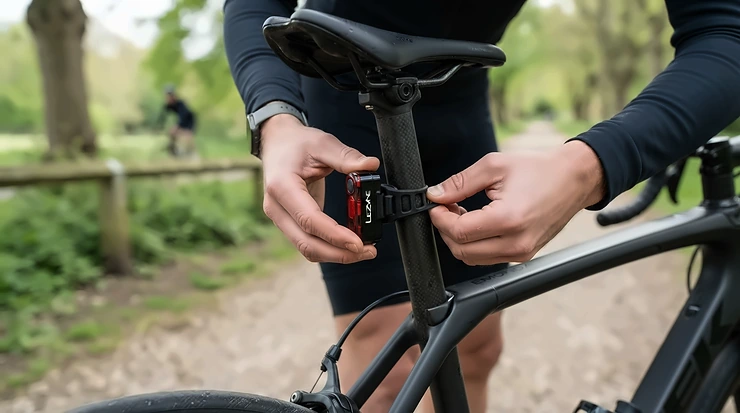
Buying the wrong brake light for electric bike use tends to cost you twice: once for the light, and again for the bracket, adapter or wiring job you discover after the box arrives. This 2027 guide sorts the options by how you ride and how much wiring you are willing to do, so the first purchase is the right one.
Everything below comes from published reviews, retailer spec pages and owner forum threads. None of it comes from my own bike, and I have not mounted any of these lights myself. Where a figure comes from a single listing or a single reviewer, the text says so.
Three questions that narrow the field before you shop
Most mistakes with a brake light for electric bike setups come from skipping one of these three questions. Answer them in order and the shortlist shrinks to one or two products.
Does the light run on its own battery or on the bike’s? A self-contained light has an accelerometer inside, charges over USB and brightens when it senses you slowing down. A wired light draws from the 36V or 48V pack and takes its cue from the brake lever’s cutoff wires. The wired route sounds tidier, but owners on the Electric Bike Review forum keep saying the outcome depends on the controller: some controllers drive a relay, some drive a light directly, and some carry no brake signal at all, so you need the schematic for your specific controller. That thread is a collection of individual owner reports, not a lab test, yet the pattern is consistent.
Where will it physically mount? Most battery-powered brake lights are built for a round or aero seatpost. E-bikes often have a rear rack, a suspension seatpost or a battery sitting where the post would be. One buyer of a different accelerometer light, on a Desertcart mirror of the listing, warned that the clamp might not fit an e-bike’s saddle frame and had to fabricate a fitting. Wahoo’s bracket is a second example: BikeRadar’s head-to-head test noted that its oversized quarter-turn connector will not fit some other mounts, saddle-rail mounts among them.
How much sensing do you actually need? Brake sensing is a motion detector, not a brake lever switch. Road.cc tested the Gaciron Loop-100 Smart Brake Tail Light and found it caught emergency stops, junction braking and traffic-light stops reliably, while a gentle slow-down from 5 mph over 30 meters slipped past it; the same slow-down from 10 and 20 mph triggered it. Many e-bikes cruise faster than 5 mph, which suggests sensors have an easier job there, though that is my reading of one test, not a measured result for e-bikes.
| Your situation | Matching pick | What decides it |
|---|---|---|
| Want to try brake sensing for the least money | ROCKBROS Smart Brake Sensing Tail Light | USB charging, small body, several variants |
| Ride mostly on rural roads at speed and want maximum brightness | Tailgator Smart Bike Rear Tail Brake Light | 300 lumens, seatpost strap |
| Commute daily and hate recharging often | Magicshine SEEMEE 300 Smart Tail Light | Large battery, metal body |
| Share lanes with fast traffic and want warning of what is behind you | Wahoo ELEMNT TRACKR RADAR | Radar plus brake light, needs a head unit |
Brightness and runtime separate these four more than sensing does, since every one of them uses an accelerometer. A rack-mounted battery bike with no usable seatpost is the case that breaks the table, and the wired options discussed further down exist for exactly that bike.
Best brake light for electric bike by situation: four picks
The four picks below are ordered from lowest cost to highest. Each is tied to a situation rather than ranked against the others.
1. ROCKBROS Smart Brake Sensing Tail Light — lowest-cost way to try brake sensing
A budget light that also senses braking is the easiest experiment on this list. ROCKBROS sells several lines under similar names (Q3, Q5, R3, R5 and BL-S2 all appear in store listings), and the specs drift between them. Store pages from ROCKBROS-US give 400mAh USB-C batteries on several of them, a 2-second brake flash on one listing and 3 seconds on the R3/R5 page, and Decathlon’s page for a Q5 lists up to 60 lumens and 20 to 50 hours of battery life. Prices on the ROCKBROS-US store run from roughly $20 to $35 depending on the line.
The buyer reports are mixed in useful ways. On a Desertcart mirror of the Amazon listing, one Q5 buyer said the brake algorithm worked well but that auto on/off and daylight motion sensing did not behave as advertised, and that the ambient light sensor could not be switched off. A buyer of a different four-mode version said only the first two modes work with the brake function. Walmart’s page for the Q3 shows 4.8 stars from 11 ratings, some marked incentivized, which is too small a sample to lean on.
Pros:
- ✅ USB-C charging and a small, light body
- ✅ Among the cheapest of the brake-sensing lights I found
Cons:
- ❌ Specs and modes differ by variant, so read the exact line
- ❌ Seatpost-style mounting leaves rack-only bikes needing an adapter
2. Tailgator Smart Bike Rear Tail Brake Light — 300 lumens, strapped to the seatpost
Brightness is the headline here. The Newegg listing describes three LEDs at 100 lumens each, an accelerometer that detects slowing, stopping or braking, and up to 60 hours of runtime. Mike’s Bikes’ listing says the light flashes in one of four patterns while riding and jumps from 200 to 300 lumens when you slow. Installation is a strap around the seatpost, with no wires or app, per the Newegg text.
Buyer comments on a Desertcart mirror of the Amazon page include a two-year long-term review calling the brake function very responsive and the battery life excellent. Another buyer there said they hoped to improve how it behaved while stopping, which is a vague complaint from one person, not a pattern. The light is about 2.5 inches tall and 1.5 inches wide, so it is chunkier than the ROCKBROS.
Compatibility is the question to settle. A strap mount means a round seatpost with some exposed length, so a rack-mounted e-bike with a short post needs measuring first. I found no source stating a price, so check the current price on Amazon.com.
3. Magicshine SEEMEE 300 Smart Tail Light — an alloy body with very long runtime
Daily commuters who forget to charge will care about the battery. Magicshine’s own page lists a 1,600mAh cell and a maximum runtime of 200 hours in its lowest-output mode, with 300 lumens as the peak in Smart Day mode. The body is aluminum alloy, the rating is IPX6, charging is USB-C and the weight is 80 grams. A brake sensor brightens the light when you slow, but the page gives neither the brake-mode lumens nor how long the boost lasts.
Pricing at one US retailer, Bike Tires Direct, sits in the $55 to $65 range. Magicshine’s page mentions no e-bike use, and the quarter-turn mount is described as fitting standard saddles and seatposts. A reviewer on that page found the brake sensor works well, while another disliked the proprietary lock mechanism and wished for a standard Garmin-style mount. Extra mounts, including a backpack clip, are sold separately.
That 200-hour figure is the best case, and the high-output modes will drain the cell much faster.
4. Wahoo ELEMNT TRACKR RADAR — radar plus brake light, premium price
Here the brake light is a bonus on a rear radar. BikeRadar’s comparison with Garmin’s Varia RTL515 notes the Wahoo ramps its brightness as you slow, and that the RTL515 lacks any braking light. Cyclingnews confirms an accelerometer inside detects the slowing. Maximum light output is modest, with BikeRadar listing 53 lumens, so this is about awareness and braking signals, not raw brightness.
Cycling Weekly’s review adds three caveats that matter to buyers. The brake light will not fire when a rider coasts gently to a stop. It has to be switched on in the Wahoo app, not on the head unit. When the Wahoo is paired with a Garmin computer, the brake light is lost because lighting must be controlled manually. BikeRadar’s review gave it 3.5 out of 5, citing blind spots in the radar and a chunky bracket that can be a problem on small frames.
Prices ran between $200 and $250 across the pages I read. It needs a compatible bike computer or phone for the radar alerts, so the total cost can rise if you do not already own one. Rack-mounted e-bikes will want to check the bracket and seatpost length before ordering.
What a cheap brake light for electric bike really buys
Price tiers come down to three things: runtime, brightness and how well the mount survives vibration. A cheap brake light for electric bike use around $20 to $35, such as the ROCKBROS lines, usually buys USB charging and a brake flash of two or three seconds. Spend closer to $60 and the Magicshine adds metal construction and a far larger battery. Past $200 the Wahoo is paying for radar, not for a better brake lamp.
Mounts are where cheap lights earn their reputation. Road.cc found the Gaciron’s rubber seatpost band flimsy and doubted it would last, while buyers of other budget lights describe straps that stretch. On an e-bike that sees more speed and more road buzz than a casual cruiser, the mount is worth treating as part of the cost.
Timing matters for 2027 shoppers too. Bicycle Retailer reported in October 2026 that Lezyne announced the Lezyne Radar Pro 300, a tail light that raises its output when you slow, with a 300-lumen Day Flash mode and up to 24 hours of runtime. The article states no ship date, so treat it as announced, not yet reviewed.
Where a brake light for electric bike setups can fall short
Sensing lights miss gentle slowing, as the road.cc and Cycling Weekly tests both showed. Neither tester described a false trigger on bumps, but both used road bikes, not e-bikes carrying a rack load, so a heavily loaded cargo bike may behave differently. No source I opened tested these lights on an e-bike.
The wired route has its own failure modes. Letrigo’s wiring guide warns against powering the light straight from the brake signal wire, because a controller can only handle milliamps, and recommends a relay that the signal energizes. It also tells riders to identify wires with a multimeter, since colors are not standardized. A buyer of a 24V to 48V headlight-and-taillight kit, on a Desertcart mirror, reported that the brake wire already carried 24 volts from the light itself, so the brake function never worked. On Endless Sphere, one owner said an older brake blinker of his expected 48 volts on the brake line.
Those reports explain why many riders choose a self-contained light first. A wired kit can still be the better long-term answer, but plan on a multimeter and an hour with the controller diagram. Rear-lighting rules differ by state, so check your own before relying on any single light as your only rear signal.
Brake lights on e-bikes: five questions answered
❓ Can I add a brake light to an e-bike without any wiring?
❓ Why does my wired e-bike brake light never turn on?
❓ How long does a rechargeable brake light last between charges?
❓ Is a brake-sensing light allowed everywhere?
❓ Where can I mount one if my e-bike has a rack and a short seatpost?
Choosing a brake light for electric bike riding in 2027
If you want the least risk, start with a self-contained light. A lower-priced pick like the ROCKBROS Smart Brake Sensing Tail Light lets you test whether brake sensing suits your riding, and the Magicshine SEEMEE 300 Smart Tail Light is the one to move up to if you want fewer charges and a metal body. Choose the Tailgator Smart Bike Rear Tail Brake Light for brightness on faster roads, and the Wahoo ELEMNT TRACKR RADAR only if radar alerts are the real goal.
The deciding factor is almost always the mount and the controller, not the lumens. Measure your seatpost, decide whether you can live with a multimeter and a relay, and set a budget. Compare the exact model number before buying, because several of these brands sell near-identical lights with different batteries, modes and brake timing.
Recommended for You
- Brake Light for Electric Bike: 7 Smart Safety Picks 2025
- Custom E Bike Headlight: 7 Top Picks Transform Night Rides
- eBikes Austin: 7 Best Electric Bikes That Transform Your Ride 2025
Disclaimer: This post contains affiliate links. As an Amazon Associate, I earn from qualifying purchases made through these links, at no additional cost to you.
Measure the seatpost first, then let the brake sensor do the talking. 🚲