Bolt a swing-away adapter onto your hitch and, according to etrailer’s experts, you cut that hitch’s rated capacity by about half. That single fact decides whether an ebike rack swing away setup turns out to be a clean solution or an expensive mistake, and it is the first number to check in 2027 before you compare a single rack.
The typical problem looks like this: two ebikes at around 65 pounds each, a 60-pound rack, and a van whose rear doors you need to open every morning for coffee and clothes. Everything below comes from spec sheets, long-term reviews, forum threads and retailer Q&A, not from hands-on testing.
The plan is simple. First a short answer, then a five-step method for sizing the setup, then the mistakes that send people back to the return counter, then four real products that solve different versions of the problem.
The short answer: pick a route, then check one number
There are two routes to a swingaway bike system. The first is an all-in-one swing-out tray rack, where the pivot is built into the rack. The second is a swing-away hitch adapter that turns any compatible 2-inch rack into a swing-out bike carrier.
Among the products that could be verified, RockyMounts BackStage is the all-in-one route. A long-term reviewer at Bikepacking.com calls it one of the only platform-style swing-away racks that needs no adapter. The adapter route covers Yakima BackSwing, Kuat Pivot XD and Swagman Swivel Hitch Extender, each paired with a rack you choose.
The number that governs both routes of any ebike rack swing away purchase is your hitch’s tongue weight rating. Etrailer’s experts say adapters reduce that capacity by about 50%, so the rack, the bikes and the adapter itself all have to fit inside half of what the hitch is stamped for.
How to size an ebike rack swing out hitch mount for van, step by step
Five checks, in this order. Skipping the first two is how people end up with a rack that bolts on fine and then sits there overloaded.
Weigh the bikes together with the rack
Per-bike ratings on ebike-capable racks cluster in a narrow band. Etrailer lists the RockyMounts BackStage at 60 pounds per bike, the Swagman E-Spec at 70 pounds per bike, and the Hollywood Racks RV Rider and Hollywood Racks Sport Rider SE at 80 pounds per bike. A 74-pound ebike, as one etrailer expert pointed out to a buyer, only fits the 80-pound class.
Add the rack itself. The Swagman E-Spec rack weighs about 60 pounds according to etrailer, and the same expert suggested pulling the batteries before driving to shed weight. Wheel and tire limits matter too: the RockyMounts BackStage listing on etrailer caps tires at 5 inches wide, wheelbases at 50 inches, and wheel sizes at 20 to 29 inches.
Find the hitch number that really limits you
Look up the tongue weight rating of your receiver, not the towing rating. Then halve it for any swing-away adapter.
Here is a worked example using sourced figures. A Winnebago Travato owner on etrailer quoted a factory hitch with a 350-pound tongue weight rating, which becomes roughly 175 pounds behind an adapter. Two ebikes at 65 pounds each, the weight an etrailer buyer gave for a pair of Pedego Elements, add up to 130 pounds. Put them on a 60-pound rack and the load is 190 pounds, already over that 175-pound limit before the adapter’s own weight is counted. Treat the numbers as a hypothetical, but the arithmetic is why hitch class matters.
Treeline Review’s tester ran into the same wall from the other direction. The reviewer calculated that a 2021 Subaru Outback with a 270-pound limit would have only 115 pounds left after a swing base, a two-bike rack and two bikes. The same system ran fine on a 1999 GMC Savana with a 500-pound tongue rating, topping out around 290 pounds including an ebike.
Leverage counts as well. Etrailer’s expert said the Kuat Pivot v3 is rated 250 pounds up to 28 inches from the hitch pin and 150 pounds between 28 and 40 inches, so a long setup loses capacity quickly.
Measure the gap behind the doors
A rear-mounted spare changes everything. One etrailer buyer with a Sprinter said the spare required about 17 inches between the bike and the rear door, and the expert pointed to the Thule EasyFold XT paired with a swing-away adapter to clear it.
Rack height matters too. A Transit owner on a Ford Transit forum reported that a Yakima swing-away hitch carrier worked well on an F-150 but sat too high to open the van’s back doors. And the Bikepacking.com reviewer needed the optional hitch extender to get a full swing and both Transit rear doors open with or without bikes on the RockyMounts BackStage.
Pick the swing angle and the side
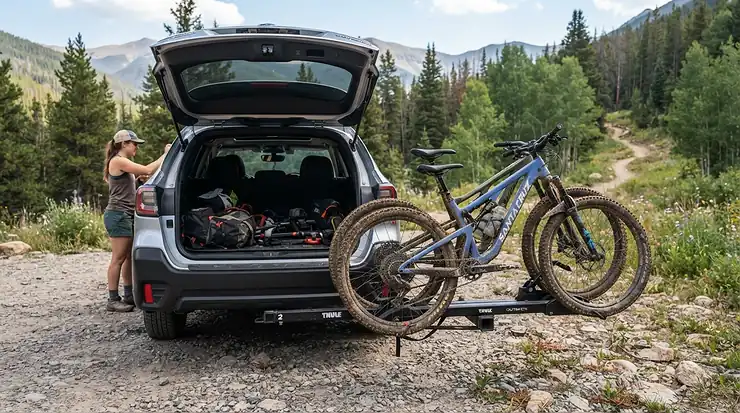
Swing angle varies by product, so check how far the bike carrier swing arm actually opens. The Yakima BackSwing rotates 90 degrees, the Kuat Pivot XD opens to 120 degrees with locking positions at 90 and 120, and, as Bikepacking.com notes, RockyMounts claims the RockyMounts BackStage swings a full 180 degrees. The Swagman Swivel Hitch Extender can be configured to swing toward either the driver or passenger side, per etrailer’s expert, while Treeline says the Yakima EXO SwingBase swings to the passenger side only.
Match the side to where you want to stand when loading, and confirm the arm clears whatever else lives behind the van, such as a storage box or tire carrier.
Decide how rough your roads will be
Etrailer’s experts say most reports of swing-arm damage come from very rough or off-road use, and they call the Kuat Pivot XD a worthwhile upgrade for rough surfaces. Treeline’s tester put more than 1,000 miles on a swing base, much of it on dirt roads, and found no corrosion, obvious wear or rattling.
Not every owner is a fan of the approach. A member of the Expedition Portal forum wrote that swing-out units are heavy, expensive and hurt departure angle, and that most are not rated for four bikes. That is one forum voice, but it points at the same lever-arm issue the Kuat Pivot v3 rating shows.
Four ways a campervan swing away bike carrier goes wrong
Most failures in the sources come from a mismatch, not from a defective part. A well-built ebike rack swing away combination can still fail if one piece was chosen without the others in mind.
Treating a campervan like a coach-built RV
Etrailer’s listing says the RockyMounts BackStage requires a 2-inch receiver and a vehicle under 10,000 pounds GVWR, and is not approved for motorhomes, towable campers or flat-towed vehicles. Nomadic Supply says its Kuat Pivot V2 is not recommended for RVs and is only for camper vans on a Class III receiver. Check the maker’s vehicle list for your exact rig, because the same conversion can land on either side of that line.
Assuming every rack pairs with every arm
Etrailer’s own answers conflict here. One expert said the Hollywood Racks Destination E works with the Kuat Pivot v3 for a pair of 50-pound ebikes, another recommended the Hollywood Racks RV Rider with the Yakima BackSwing for a 74-pound ebike, and a third reply on the Hollywood Racks Sport Rider SE page said it is not compatible with swing-away devices. When sources disagree, the rack maker’s compatibility statement settles it.
Hanging a vertical rack on the arm
The Nomadic Supply listing warns against attaching a vertical or hanging-style rack to a swing-away accessory, and Bikerumor’s notes on the Kuat Pivot XD say the same. A platform or tray rack suits the leverage better.
Ignoring care and handling
A six-year RockyMounts BackStage owner reported on Bikepacking.com that the swing action got less smooth over time, so the reviewer lubricates the pivots about every six months and has replaced the T-handle twice. Buyers on etrailer keep describing the same rack as heavy to install and remove, with unclear instructions and flimsy locks. Also check your state’s rules on license plate and light visibility, since a loaded rack can block both.
When a bumper swing-out replaces a hitch swing out bike carrier
Expedition-vehicle owners often skip the hitch and use swing-outs welded or bolted to a rear bumper. One builder on the Expedition Portal forum says the dual-shear spindle has to be the burliest you can get and the latch matters just as much, because a heavy bike hanging off a hinge puts a lot of strain on it.
Van upfitters sell their own version. Owl Vans lists rear-door swing-out carriers for Sprinter and Transit vans that mount to the doors instead of the hitch. If you already have a 2-inch receiver, the hitch-based options below are the ones that reuse it.
The tools: four swing-away options for ebikes
These four cover the realistic situations: one all-in-one tray rack and three adapters. Racks for the adapter route are named in the method section above. Prices below are ranges drawn from retailer pages.
Option
Type
Rated load
Swing
RockyMounts BackStage
Tray rack with built-in pivot
60 lb per bike, 2 bikes
Swing arm, 180 degrees claimed by the maker
Yakima BackSwing
Adapter
250 lb, rack plus bikes
90 degrees
Kuat Pivot XD
Heavy-duty adapter
350 lb
120 degrees, locks at 90 and 120
Swagman Swivel Hitch Extender
Adapter
300 lb
Driver or passenger side
The RockyMounts BackStage is the only one that carries bikes by itself, and its limit is per bike. The adapters are the opposite: their ratings cover everything hung behind the hitch, so the rack’s own weight comes out of the budget first.
If you would rather buy one product than two, this is the straightforward answer. Etrailer’s listing describes a hinged arm that extends 67 inches from the hitch and a rack that tilts down 30 degrees. It takes tires up to 5 inches wide and handles fat-tire ebikes up to 60 pounds each.
Owners on etrailer rate it 4.7 out of 5 across 152 reviews, praising swing-away access to the cargo area, secure wheel hold-downs and a sturdy build. The complaints are consistent: the rack is heavy, instructions are unclear, the included locks feel cheap, and bikes have to be lifted high because there is no ramp. Listings ranged from about $720 to $900.
Long-term evidence exists for this one. Bikepacking.com’s reviewer reports six years of use on a Ford Transit with the rack holding up, minimal side-to-side wobble and replacement parts still available, though the front-wheel hook rubbed the fork and nearly wore through a brake cable. Sources disagree on weight: Bikepacking.com says 44 pounds, etrailer says 60, and Bikerumor lists 62.4. They also disagree on tire width, with Bikepacking.com citing 3 inches and etrailer 5.
Pros:
Swings out without a separate adapter
Holds bikes by the wheels, so frame shape matters less
Folds upright against the vehicle for storage
Cons:
Heavy to install and remove
60-pound per-bike limit rules out the heaviest ebikes
Etrailer notes it may interfere with bikes that have front fenders
Check the current listing on Amazon.com.
RockyMounts BackStageSee current price, sizes and reviews on Amazon.
The trade this adapter makes is range: it swings 90 degrees, not 180. In return it converts a rack you already own into a swing-away rack. Etrailer describes it as fitting 2-inch hitches and racks up to four bikes, with a lock included, and as doubling as a hitch extender for vehicles with a rear-mounted spare.
Etrailer’s experts confirmed the 250-pound rating covers the rack and the loaded bikes together. That makes it comfortable for a pair of ebikes on a 60-pound rack but tight for anything heavier. One etrailer buyer paired it with a Thule rolling rack and said it swings clear of the van’s two rear doors. Etrailer’s expert also said a standard adapter like this should be fine unless the weight limit is exceeded, since damage stories mostly come from rough or off-road use.
Pairing matters more than the adapter itself. A 74-pound ebike, for instance, calls for a rack in the 80-pound class per one etrailer expert. Check the current price on Amazon.com.
Yakima BackSwingSee current price, sizes and reviews on Amazon.
Expect to pay around $800, roughly twice what Bikepacking.com’s reviewer cites for a Saris adapter. For that, Bikerumor’s rundown lists a 350-pound payload, heavy-duty steel construction, a pressed ball-bearing pivot, a forged latch with an oversized handle, and a 120-degree swing with locks at 90 and 120.
The restrictions are specific. It needs a Class III, 2-inch hitch at minimum, adds about 15 inches between the rack and the vehicle (so it suits two-bike racks), and Kuat does not recommend it for RV use, towing, or upright and hanging racks. It also weighs 68 pounds by itself, which eats into a hitch budget that is already halved.
Etrailer’s expert calls it a sturdier upgrade for full-time travel. A passenger-side version is listed on the retailer’s site, though Bikerumor’s first-look article described it as coming soon at the time.
Check the current price on Amazon.com.
Kuat Pivot XDSee current price, sizes and reviews on Amazon.
Pick your side: etrailer’s expert says it can be configured to swing toward the driver or passenger side on a 2-inch hitch, with a 300-pound capacity. The same expert paired it with the Swagman E-Spec Pro Bike Rack, described as a solid option for heavier bikes.
Owner comments on etrailer are encouraging. A buyer who added it to a Scope van on a Ram ProMaster 1500, alongside a spare tire mount and storage box, said it cleared everything and made rear access effortless with an ebike rack and two ebikes. A Travato owner called it rock solid with two ebikes on a platform or tray rack, but moved one tray bracket forward to reduce the leverage moment. One of them noted the extender has weight limits that need checking against the hitch.
It is a good fit when the side you swing to matters, for example when a storage box or ladder limits one direction. Price varies, so check the current price on Amazon.com.
Swagman Swivel Hitch ExtenderSee current price, sizes and reviews on Amazon.
The Saris Swing Away Hitch Extender is rated 250 pounds and costs around $400 per Bikepacking.com, which adds that it swings less than the RockyMounts BackStage. The 1UP RakAttach Hitch Swing-Out runs around $650 before you add a rack. The Thule Access Swing-Out Rack Carrier is rated 250 pounds, weighs 57 pounds and opens to 90 degrees, according to Quadratec. The Yakima EXO SwingBase costs around $700 and, per Treeline, needs a tongue weight above 300 pounds, so Class II hitches are a poor match. Etrailer lists the two-bike EXO rack at 40 pounds per bike, so confirm the ebike rating before pairing anything with it.
Five swing-away questions worth settling before you order
Can a swing-away adapter carry two ebikes?
Often, when the math works. Popular adapters are rated for 250 to 350 pounds including rack and bikes, according to etrailer's experts. Your hitch is the weaker link, since an adapter cuts its capacity by about half, so add rack, bikes and adapter before ordering.
Will a swing-away rack let me open both van doors?
Usually, if the arm clears the door swing. One long-term reviewer needed the optional extender to open both Transit doors with a swing-out tray rack, while a Transit owner on a forum found a different hitch carrier sat too high. Test-fit before committing.
Is a swing-away rack safe on a motorhome or Class B?
Not automatically. One popular swing-out rack excludes motorhomes, towable campers and flat-towed vehicles from its approved uses, and one adapter maker advises against RV use. A campervan on a van chassis may be treated differently from a coach-built RV, so read the maker's vehicle list.
Should I take the battery off before driving?
Etrailer's experts suggested pulling the batteries on at least one heavy-ebike pairing, which trims weight from a rack already working against a halved hitch rating. Check your bike's manual and the rack's per-bike limit, because the battery is only part of the weight.
How much do swing-away options cost?
Adapter-only routes in the reviews and listings run from around $400 to $800, and the one all-in-one swing-out tray rack ran about $720 to $900. Racks for the adapters cost extra. Check current prices on Amazon.com.
Which swing-away setup to buy for your van
Start with the hitch rating, not the rack. If the halved number can carry two ebikes, the rack and the arm, pick by how you travel: the RockyMounts BackStage for a single heavy but capable product, the Yakima BackSwing for a modest budget and a rack you already have, the Kuat Pivot XD for rough roads and heavier loads, and the Swagman Swivel Hitch Extender when the swing side matters.
If the halved number falls short, no ebike rack swing away setup will fix it, and a stronger hitch or a rear-door carrier is the honest answer. Check bike weights, per-bike limits and your door clearance once more before you order.
Take a look at the current listings on Amazon.com.
Disclaimer: This post contains affiliate links. As an Amazon Associate, we earn from qualifying purchases made through these links, at no additional cost to you.
NextGenEBike is an independent buying-guide site for electric bikes, motors, batteries and accessories. Our editorial team compares products using manufacturer specifications, independent tests from specialist e-bike media, owner reports and retailer listings. We do not claim to have tested the products ourselves; see How We Choose Gear for our method.