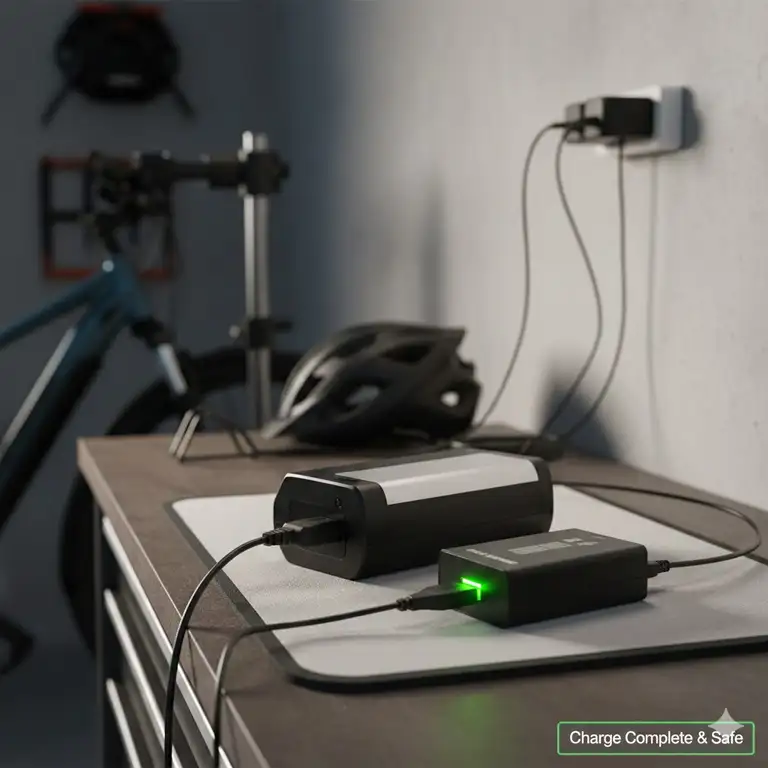
Welcome to the ultimate deep dive into the most asked question in the electric cycling community: can you charge e bike battery overnight? It’s a seemingly simple question, but the answer is complex, technical, and critically important for both your safety and the longevity of your investment. I’m here to tell you, as someone who lives and breathes lithium-ion technology, that while modern smart chargers have made it possible, treating overnight charging as a casual, set-it-and-forget-it affair is one of the most common and costly mistakes riders make.
✨Was this helpful? Spread the word! 🚀
We’re not just talking about saving a few dollars; we are discussing physics, chemistry, and electrical engineering, specifically focusing on the delicate balance of lithium-ion cells. The way you handle charging e bike battery overnight directly impacts its health, meaning more range, more fun, and fewer expensive replacements. We will unpack the essential differences between cheap, generic chargers and specialized, high-end units designed for optimal performance, and show you exactly what to look for when evaluating if it is safe to charge e bike battery in your home.
The Core Question: Can You Charge E Bike Battery Overnight? 🔋
The short, cautious answer is: Yes, you can, but it is only advisable if you use an original equipment manufacturer (OEM) or a high-quality, smart, third-party charger explicitly designed with multi-stage charging protocols and certified safety features like automatic shutoff and thermal regulation. If you’re using the cheap charger that came bundled with a budget conversion kit, then leaving it plugged in while you sleep is a practice I would strongly discourage.
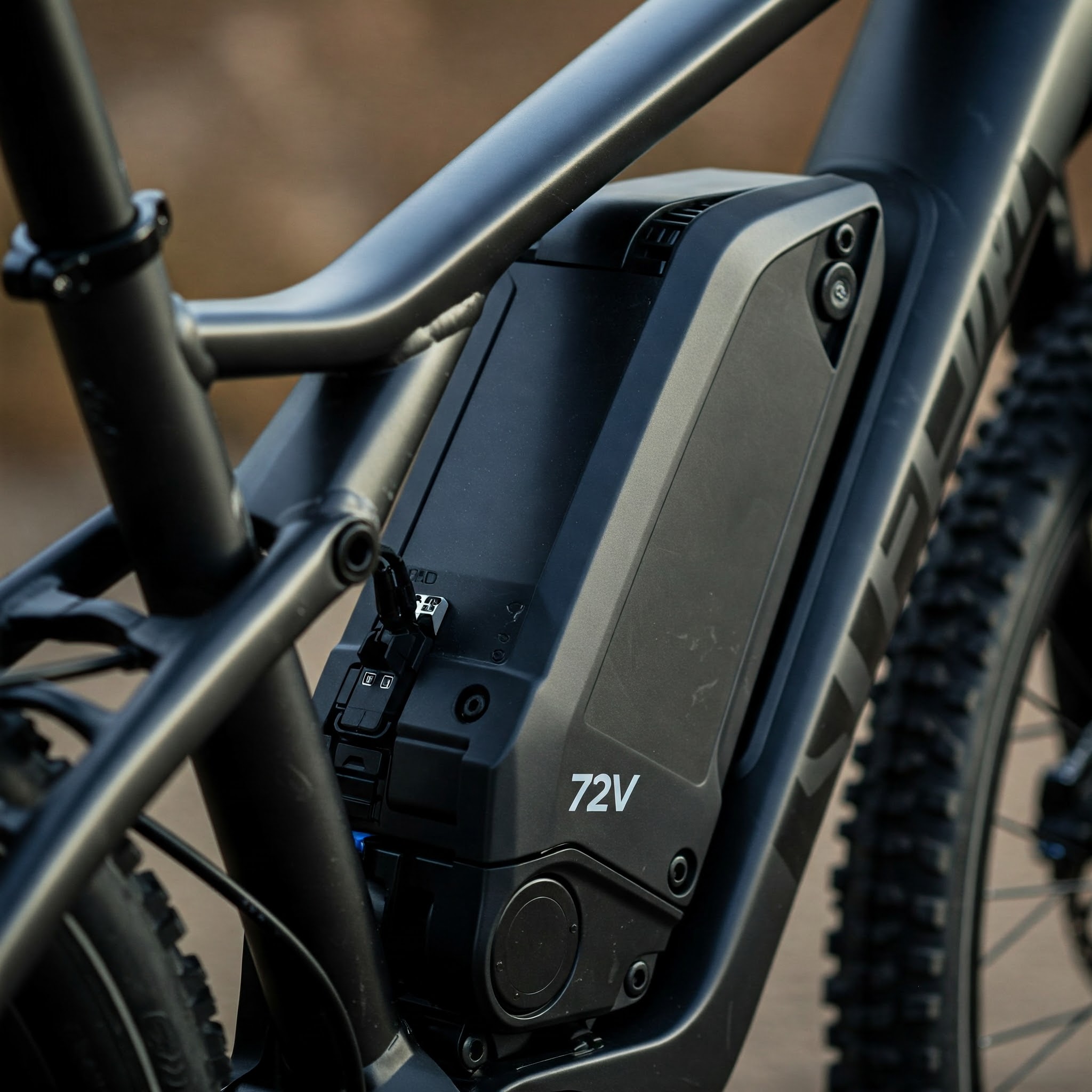
When you charge e bike battery overnight, you are banking on the efficacy of two critical components: the battery’s internal Battery Management System (BMS) and the charger’s intelligent control circuitry.
The Physics of Lithium-Ion (Li-ion) Charging
E bike batteries rely almost universally on Lithium-ion (Li-ion) technology. Unlike older lead-acid or nickel-metal hydride batteries, Li-ion cells require precise charging protocols, typically utilizing a process called Constant Current/Constant Voltage (CC/CV).
-
Constant Current (CC) Phase: This is the fast charging stage. The charger delivers a steady, high current (Amperage) to the battery until it reaches about 80% of its capacity, or a pre-set voltage (usually around 4.2V per cell). This is where the majority of the e bike battery charging time is spent.
-
Constant Voltage (CV) Phase: This is the balancing and topping-off stage. Once the voltage threshold is met, the charger holds the voltage constant, and the current naturally tapers down until the battery is completely full (100%).
-
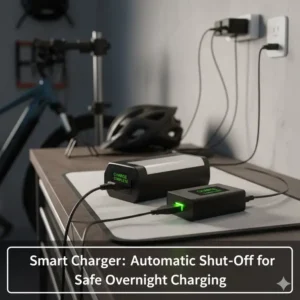
Automatic Cutoff/Float: Once the current drops below a tiny threshold (the “termination current”), a high-quality smart charger must cut power completely. This is the crucial safety mechanism that determines if you can safely leave a battery plugged in after it’s full. A non-smart, cheap charger might continue to trickle-charge or float the voltage, which is detrimental, leading to cell degradation, overheating, and increasing the risk of thermal runaway.
Therefore, the key to safely leaving your battery to charge while you’re sleeping is the certainty of this automatic cutoff. This is why having a best e bike battery charger with auto shutoff is non-negotiable for overnight charging.
Table 1: Charging Approaches and Overnight Safety
| Charging Approach | Description & Mechanism | Safety for Overnight Use | Key Trade-off |
| Standard OEM Charger | Uses fixed CC/CV protocol, relies heavily on the battery’s BMS for cutoff. Typically 2A-3A. | Conditional Safe. Generally safe due to brand engineering, but still relies on proper BMS function. Best to unplug once green. | Slower charge speed. |
| High-Quality Smart Charger | Programmable, adjustable amperage (1A–8A), active temperature monitoring, internal microprocessor for precise CC/CV control and automatic shutoff. | Highly Safe. Designed to enter maintenance mode or disconnect power entirely once 100% or user-set percentage (e.g., 80%) is reached. | Higher initial cost. |
| Budget/Generic Charger | Simple, cheap circuitry. May not accurately transition from CC to CV, or may fail to properly cut off current, leading to ‘trickle charging.’ | Not Recommended. High risk of overcharging, overheating, and premature battery failure. Avoid overnight e bike charging entirely. | Lowest initial cost, highest long-term risk. |
| Smart Plug/Timer | Used with a standard charger. Cuts off wall power after a set duration, regardless of battery state. | Moderately Safe. Mitigates overcharging by timing, but doesn’t guarantee the battery is 100% full or balanced when cut off. A good backup safety layer. | Requires manual calculation and monitoring of e bike battery charging time. |
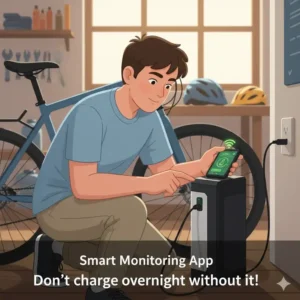
Top 7 E Bike Charger Solutions: Expert Analysis
Choosing the right charging hardware is an investment in safety and longevity. Here is a detailed analysis of seven actual products, spanning the spectrum from high-end programmable units to essential OEM options, focusing on their suitability for safe, long-term charging, including the crucial aspect of whether can you charge e bike battery overnight with confidence.
1. The Expert’s Choice: Programmable Precision
The Grin Technologies Cycle Satiator stands as the undisputed champion of smart charging, often cited by battery engineers and advanced e-bike builders.
-
Model/Variant: Grin Technologies Cycle Satiator (Available in 48V, 52V, and 72V models)
-
Detailed Technical Specifications: Highly programmable output from 1A up to 8A (depending on the model). Features a full-color LCD display. Voltage is adjustable for 80%, 90%, and 100% charging targets, which is a major advantage for electric bike battery charging best practices. It boasts UL/CE/FCC certifications and a fully sealed, waterproof, and robust aluminum casing.
-
Customer Review Analysis: Reviews consistently praise its unparalleled programmability and robust build quality. A common phrase is that it “pays for itself” by extending battery life. The primary drawback mentioned is the high purchase price, but the consensus is that the safety and control justify the cost.
-
Warranty Information: Typically comes with a comprehensive 2-year warranty, reflecting the manufacturer’s confidence in its design and components.
-
Professional Applications: Used extensively by professional e-bike shops, fleet operators, and high-performance custom builders where precise battery control and longevity are paramount.
-
Pros/Cons Analysis:
-
Pros: Complete control over charge voltage and current; maximizes battery lifespan by allowing 80% charging; integrated diagnostics; highly safe for overnight e bike charging due to precise, verified shutoff.
-
Cons: Significant initial cost; complex feature set can be overwhelming for casual users.
-
2. The Premium OEM Standard
The Bosch 4A Standard Charger (BCC2550) is a benchmark for OEM quality, offering a reliable middle ground between the compact 2A charger and the ultrafast 6A unit.
-
Model/Variant: Bosch 4A Standard Charger (BCC2550)
-
Detailed Technical Specifications: Input Voltage: 110-230V AC (global compatibility); Output Current: 4A; Charging Time: Approximately 3.5 hours for a 500Wh battery. Designed specifically for Bosch PowerTube and PowerPack 36V Li-ion systems, integrating seamlessly with their BMS.
-
Customer Review Analysis: Users appreciate the balance of speed and cell health—faster than the compact model but less heat-intensive than the 6A fast charger. Reliability and quiet operation are frequently highlighted.
-
Warranty Information: Covered under the standard Bosch eBike Systems warranty, typically 2 years. OEM chargers offer better compatibility guarantees than aftermarket options.
-
Professional Applications: The go-to charger for countless e-bike commuters, mountain bikers, and rental fleet operations using Bosch motors, ensuring consistent, high-standard charging.
-
Pros/Cons Analysis:
-
Pros: Guaranteed compatibility and safety integration with Bosch batteries; 4A speed is a great balance; highly safe for overnight use thanks to robust OEM engineering.
-
Cons: Proprietary connector and system lock-in; lacks adjustable charge levels.
-
3. OEM Integration and Ecosystem
The Shimano Steps E-Series Charger (EC-E6000/E8004) represents another major OEM player, known for deep integration with their motor systems.
-
Model/Variant: Shimano Steps E-Series Charger (EC-E6000)
-
Detailed Technical Specifications: Output Current: 4A (EC-E6000 model); Charging Voltage: Specific to Shimano 36V systems (41.8V nominal charge). Features a compact design and a proprietary charging port. Some variants (like the EC-E8004) offer up to 4.6A output. Includes a port to charge the battery while still on the bike, which enhances user convenience.
-
Customer Review Analysis: Highly praised for its lightweight, portability, and reliable performance within the Shimano ecosystem. Riders using Shimano Steps motors rely on this charger for guaranteed compatibility and safe energy delivery.
-
Warranty Information: Comes with Shimano’s standard component warranty.
-
Professional Applications: Used by nearly all major bicycle manufacturers (Trek, Giant, Cannondale) who utilize the Shimano Steps platform for their high-quality e-bikes.
-
Pros: Perfect, secure electronic handshake with Shimano Steps batteries; high reliability and integrated system safety, making it safe for overnight charging.
-
Cons: Completely proprietary connector; non-adjustable.
4. High-Speed Budget Alternative
The eBikeling Fast 5A Charger (Model A-CHR-48-5A) targets users needing a rapid charge speed without the premium price tag, though caution is advised for long-term overnight e bike charging without monitoring.
-
Model/Variant: eBikeling Fast 5A Charger (Model A-CHR-48-5A)
-
Detailed Technical Specifications: Nominal Voltage: 48V (Output: 54.6V); Output Current: 5.0A. Input: AC100-240V. Features a standard CC/CV charging profile and LED indicator (Red=Charging, Green=Full). Uses common connectors like DC 5.5*2.1mm.
-
Customer Review Analysis: Appreciated for its fast charging speed, significantly cutting down e bike battery charging time. However, some reviewers note that the unit can run hotter than OEM chargers, and the fan is audible. Customers emphasize the need to ensure the connector type matches their battery perfectly.
-
Warranty Information: Typically a standard 1-year limited warranty, common for aftermarket components.
-
Professional Applications: Popular choice for conversion kit enthusiasts and DIY builders who require high-amperage charging capabilities for larger batteries (e.g., 20Ah+ packs).
-
Pros: Very fast charging speed (5A); highly cost-effective; flexible connector options.
-
Cons: Runs hotter; reliability of the internal automatic shutoff/BMS communication may be less refined than premium OEM/programmable units; requires careful user monitoring.
-
5. Mid-Range Adjustable Control
The Cap Rouge 48v Super Charger (1-5 Amp) offers a crucial mid-range solution for riders seeking the benefits of adjustable charging without the extreme cost of a Satiator.
-
Model/Variant: Cap Rouge 48v Super Charger (1-5 Amp) – CP3R-48V-Adjustable
-
Detailed Technical Specifications: Nominal Voltage: 48V; Adjustable Amperage: 1A, 2A, 3A, 4A, or 5A settings. Crucially, it often includes voltage limiting switches (e.g., 80%, 90%, 100% of capacity).
-
Customer Review Analysis: Riders love the ability to toggle down to 1A for safe overnight e bike charging or storage charging, and then ramp up to 5A for a quick top-off before a ride. This flexibility is key for maximizing battery life.
-
Warranty Information: Standard 1-year warranty on electronics.
-
Professional Applications: Excellent for power users who own multiple batteries of different capacities, allowing one charger to safely accommodate a range of charging needs.
-
Pros: Adjustable current and voltage percentage maximizes battery life; highly versatile; great value proposition for the features.
-
Cons: Not as rigorously certified or sealed as the Satiator.
-
6. The Smart Universal Maintainer
The NOCO Genius 5 (5A) is a multi-purpose smart charger, often used for powersports, that exemplifies the features necessary for safe Li-ion charging, even if it requires the right adapter for e-bike use.
-
Model/Variant: NOCO Genius 5 (5A)
-
Detailed Technical Specifications: Rated at 5A; compatible with 6V and 12V batteries (Standard, Gel, AGM, Marine, and Lithium-Ion). Features integrated thermal sensor to detect ambient temperature and adjust charge; includes a “Force Mode” for deeply discharged batteries. Its 5A output is competitive with e-bike fast chargers.
-
Customer Review Analysis: Exceptional performance and safety features are frequently praised. The thermal monitoring and sophisticated diagnostic LED indicators make it a highly trustworthy brand, even when adapted for high-voltage Li-ion use (using the Li-ion charge mode).
-
Warranty Information: A notable 3-year warranty often backs NOCO products.
-
Professional Applications: Used for maintaining a variety of vehicle fleets, including motorcycles, ATVs, and powersports equipment, making it a reliable choice for general-purpose charging.
-
Pros: Extreme safety features (thermal monitoring, spark-proof, reverse polarity protection); automatic charging adjustments for temperature variations; excellent warranty.
-
Cons: Requires an adapter to connect to specific e-bike ports; primary voltage (12V) is lower than typical e-bike systems (36V/48V/52V), but the technology principles are sound for safety.
-
7. The Performance OEM Fast Charger
The Juiced Bikes 52V 3A Charger represents the high-voltage, specialized OEM chargers typically seen with performance-focused direct-to-consumer e-bike brands.
-
Model/Variant: Juiced Bikes 52V 3A Charger
-
Detailed Technical Specifications: Nominal Voltage: 52V (Output 58.8V); Output Current: 3A. Features a common GX16-3 pin connector (often used in higher-power applications). Optimized for their unique 52V batteries which provide higher peak wattage and extended range.
-
Customer Review Analysis: Reliability is key for owners of high-performance bikes. The 3A rate is considered standard for this voltage. Reviews stress using only OEM chargers to protect the warranty and the specific 52V BMS logic.
-
Warranty Information: Typically tied to the bike’s battery warranty (usually 1 year).
-
Professional Applications: Essential for maintaining the specific voltage needs of performance-oriented e-bike platforms.
-
Pros: Optimized for 52V systems; dependable OEM quality; safe auto-shutoff functionality makes safe to charge e bike battery overnight.
-
Cons: Limited to 52V batteries; slightly slower than aftermarket 5A options.
-
🛒 Don’t Miss These Exclusive Deals! 🔍
Take your e-bike riding experience and battery longevity to the next level with these carefully selected charging products. Click on any highlighted item like the Grin Technologies Cycle Satiator or the Bosch 4A Standard Charger to check current pricing and availability. These tools will help you implement the best electric bike battery charging best practices and maximize your riding range for years to come!
💬 Just one click – help others make better buying decisions too!😊
Decoding Charging Duration: how long does it take to charge ebike battery ⏳
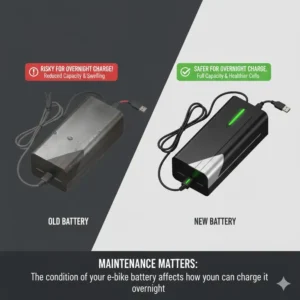
One of the main reasons riders contemplate, “can you charge e bike battery overnight,” is simply a lack of patience. Knowing the exact e bike battery charging time is the best defense against leaving a battery plugged in too long. The duration depends on a simple formula involving the battery capacity (measured in Amp-hours, Ah) and the charger’s output (measured in Amperes, A).
The Simple Formula
-
Charging Time (Hours) ≈ Battery Capacity (Ah) / Charger Amperage (A)
However, because of the required CV phase, the actual charging time is always slightly longer than the simple mathematical calculation—usually by 10% to 20%.
For example, charging a common 48V 14Ah battery:
-
With a 2A Charger: 14 Ah / 2 A = 7 hours (Theoretical) → 7.7 to 8.4 hours (Actual)
-
With a 5A Charger: 14 Ah / 5 A = 2.8 hours (Theoretical) → 3.1 to 3.4 hours (Actual)
As you can see, the shift from a 2A standard charger to a 5A fast charger dramatically reduces the necessary time, making true overnight e bike charging unnecessary for many routine rides.
Table 2: Technical Specifications Matrix (Spec Matrix)
This matrix details the core technical specs of our 7 products, focusing on the variables that matter most for safe and fast charging.
| Charger Model | Type (V) | Output Current (A) | Max Charge Voltage (V) | Estimated 500Wh Charge Time | Safety Feature Highlights | Best For… |
| Grin Cycle Satiator | 48/52/72 | 1A-8A (Adjustable) | Programmable | 2.5–10 Hours | Programmable Cutoff, Sealed/Waterproof, Diagnostic LCD | Longevity & Custom Builds |
| Bosch 4A Standard | 36 | 4A | 42.0V | 3.5 Hours | OEM Integration, Thermal Management | Everyday Commuters (Bosch) |
| Shimano Steps EC-E6000 | 36 | 4A | 41.8V | 3.5 Hours | Lightweight, On-Bike Charging Port | Integration & Portability |
| eBikeling Fast 5A | 48 | 5A | 54.6V | 3.0 Hours | High Speed, Standard CC/CV | Budget Fast Charging |
| Cap Rouge Super Charger | 48 | 1A-5A (Adjustable) | 54.6V (Adjustable) | 3.0–15 Hours | Adjustable Current/Percentage, Flexible Use | Versatility & Battery Health |
| NOCO Genius 5 (5A) | 6/12 (Smart Li-ion Mode) | 5A | Varies | N/A (General Use) | Thermal Sensor, Maintenance Mode, 3-Year Warranty | Backup/Winter Storage Maintainer |
| Juiced Bikes 52V 3A | 52 | 3A | 58.8V | 4.5 Hours | High-Voltage Optimization, OEM Reliability | Performance 52V Systems |
The Lifespan Factor: electric bike battery charging best practices 🚴♂️
The true expert concern is not merely can you charge e bike battery overnight, but should you, given the impact on the battery’s lifespan. Lithium-ion batteries degrade based on cycle count (number of full charge/discharge cycles) and, crucially, stress placed on the cells. This stress is often highest when the battery is held at 100% capacity for extended periods.
The 80% Rule and Optimal Charging Cycle (VK5)
Most experts agree on the “80% Rule”: routinely charging your battery only to about 80% capacity and avoiding dropping below 20% dramatically extends its service life. This is because the chemical reaction that occurs during charging is least stressful in the middle 60% range.
When you consistently leave the battery plugged in overnight, even if the charger has a decent automatic shutoff, the battery may slightly self-discharge and then “wake up” the charger for tiny top-offs. This constant high voltage float state is what accelerates cell degradation.
electric bike battery charging best practices dictate that if you are absolutely sure you won’t need full range the next day, it is better to charge for a pre-calculated duration (using a smart timer) to hit 80%-90%, or use a programmable charger like the Grin Technologies Cycle Satiator or Cap Rouge Super Charger that allows you to set the cutoff point explicitly at 80%. This one simple practice can add years to your battery’s life, transforming the typical e bike battery charging cycle from a lifespan destroyer into a sustainable maintenance process. For more detailed insights on battery chemistry and degradation, the National Renewable Energy Laboratory (NREL) offers authoritative resources on the factors affecting lithium-ion battery life, which is a great place to start your deeper reading ( NREL Battery Research).
Table 3: Key Features/Benefits Comparison (Smart vs. Standard Charging)
| Feature/Benefit | High-Quality Smart Charger (e.g., Grin Satiator) | Standard OEM Charger (e.g., Bosch 4A) | Traditional, Unregulated Charger |
| Charge Target | User-Selectable (80%, 90%, 100%) | Fixed at 100% | Fixed at 100% (Often slightly overvolts) |
| Battery Lifespan | Maximized (Optimized for low-stress cell health) | Maintained (Good balance, but constant 100% stress) | Shortened (Due to trickle charge/overvoltage stress) |
| Thermal Monitoring | Active, internal sensor that adjusts current | Passive monitoring via BMS communication | None, relies entirely on battery’s BMS for safety |
| Amperage Control | Fully Adjustable (1A–8A) | Fixed (e.g., 4A) | Fixed (e.g., 2A or 5A) |
| Safety for Overnight | Excellent (Verified hard cutoff/maintenance mode) | Very Good (Trusted OEM safety systems) | Poor (Risk of failed cutoff/thermal event) |
Safety First: Is it safe to charge ebike battery indoors? 🔥
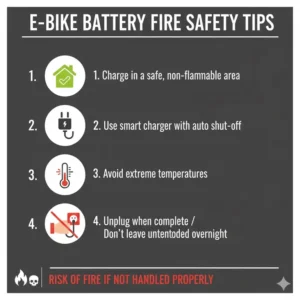
The question is it safe to charge ebike battery indoors is tied directly to the possibility of thermal runaway—the nightmare scenario where an overheating cell causes a chain reaction in the pack. While rare, virtually every reported e-bike fire occurs during charging, underscoring the necessity of safe practices.
Location, Location, Location
Even with a top-tier charger, the location of charging matters immensely, especially when considering “can you charge e bike battery overnight” while you are asleep.
-
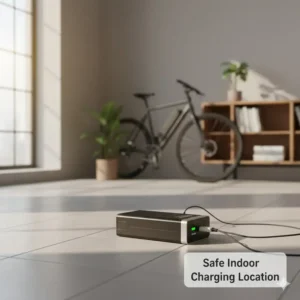
Non-Combustible Surface: ALWAYS charge your battery on a hard, non-flammable surface, such as concrete, tile, or a dedicated metal charging bag. Never charge on a carpet, wood floor, or near curtains.
-
Temperature Control: Charge at moderate room temperature (50°F to 77°F or 10°C to 25°C). Extreme heat or cold can interfere with the charging process and stress the cells. Charging immediately after a very hard ride is also not advised; let the battery cool down first.
-
Smoke Detector Proximity: If charging indoors, keep the charging setup near a working smoke detector.
-
Monitoring: The safest practice is monitoring the charge. If you must charge e bike battery overnight, use a smart plug timer that turns off the power after a calculated duration (e.g., 4 hours) to eliminate the risk of the charger failing the final cutoff stage.
By following these procedures, you significantly reduce the risk and ensure that charging indoors remains safe. For information on battery safety standards and certifications, the Underwriters Laboratories (UL) website is an invaluable source for understanding the rigorous testing requirements for battery packs and chargers, providing a high level of expertise ( UL Battery Safety Standards).
Table 4: Budget vs. Premium Charger Features
Choosing between a budget and a premium charger comes down to accepting risk versus paying for engineering sophistication.
| Feature | Budget Fast Charger (e.g., eBikeling 5A) | Premium Programmable Charger (e.g., Grin Satiator) | Difference/Impact on Safety |
| Case Material | Plastic (Lighter, higher fire risk) | Sealed Aluminum (Durable, heat-dissipating) | Better heat dissipation reduces thermal stress. |
| Internal Cooling | Basic/Small Fan (Often loud) | High-Quality, Temperature-Controlled Fan | Quieter, more efficient cooling prevents localized hotspots. |
| Component Quality | Standard/Off-the-shelf | Industrial/Military Grade (e.g., Neutrik connectors) | Ensures consistent current flow and long-term circuit reliability. |
| Certifications | CE or RoHS (Minimum European/component standards) | UL, CE, FCC (Comprehensive international safety listing) | UL listing is the gold standard for US safety when you charge e bike battery overnight. |
| Microprocessor | Simple CC/CV Controller | Advanced MCU with Diagnostic Functions | Enables precise, software-controlled 80% cutoff and thermal monitoring. |
The Off-Season Dilemma: how to store e bike battery in winter ❄️
While “can you charge e bike battery overnight” is a daily concern, learning how to store e bike battery in winter is a critical seasonal practice that directly affects long-term capacity retention. Failing to store a Li-ion battery correctly can permanently reduce its total capacity, resulting in noticeably less range the following spring.
The Storage Sweet Spot
The single most important rule for winter storage is: Never store a Li-ion battery at 0% or 100% state of charge (SOC).
-
Optimal SOC: The ideal storage charge is between 40% and 60% of total capacity. At this intermediate voltage, the internal chemical stresses are minimal, significantly slowing down the natural degradation process.
-
Temperature: Store the battery in a cool, dry location with stable temperatures, ideally between 32°F and 68°F (0°C and 20°C). Crucially, this area must be fire-safe and away from living spaces—never store in a freezing garage or a hot attic.
If you charge the e bike battery overnight before storing it, you are actively harming it. The high 100% voltage will stress the cell chemistry, especially if it is then left unused for months. Using a programmable charger, like the Cap Rouge Super Charger, to precisely hit the 60% mark is the professional way to prepare for winter. You should also check the charge level every couple of months, as batteries naturally self-discharge. If it drops below 30%, give it a small top-off back up to 50%. The U.S. Department of Energy (DOE) often publishes guidelines on lithium-ion battery handling and storage that reinforce these critical steps ( DOE Battery Storage Guide).
Table 5: Benefits Quantification of Smart Charging
| Benefit of Smart/Adjustable Charging | Quantification (Average Impact) | Relevancy to safe to charge e bike battery | User Experience Impact |
| Extended Battery Lifespan | Up to 25% longer cycle life (by avoiding constant 100% SOC) | High, less risk of premature battery failure or swelling. | Saves hundreds of dollars on replacement costs. |
| Reduced Heat Generation | Up to 15°F cooler during charging (at lower adjustable amps) | Excellent, minimizes thermal stress, reducing fire risk. | Prevents charger/battery components from premature wear. |
| Maximized Range Consistency | Ensures all cells are balanced (equal voltage) at every charge | High, better balancing prevents weak cells from dragging down the pack. | Consistent, reliable range for every ride. |
| Time Flexibility | Cuts e bike battery charging time from 8 hrs to 3 hrs (with 5A setting) | Moderate, reduces the need to charge overnight. | Freedom to charge and ride same-day. |
Table 6: Charging Requirements Analysis (User Compatibility)
| User Profile | Primary Concern | Ideal Charger Type & Model Example | Required Feature for charging e bike battery overnight |
| The Commuter | Reliability, speed, and safety indoors (SK1) | Bosch 4A Standard Charger or Shimano Steps Charger | OEM safety integration, verified auto shutoff. |
| The Enthusiast/DIYer | Customization, longevity, and high performance | Grin Technologies Cycle Satiator | Programmable current/voltage cutoff (80% rule). |
| The Budget Rider | Cost-effectiveness and speed | eBikeling Fast 5A Charger paired with a Smart Plug | Manual/Timed cutoff (Smart Plug), must have visual monitoring. |
| The Seasonal Rider | Long-term how to store e bike battery in winter (SK5) | Cap Rouge Super Charger | Adjustable charge percentage (40%-60% storage mode). |
Buying Guide & Product Recommendations: Selecting Your Guardian 🛡️
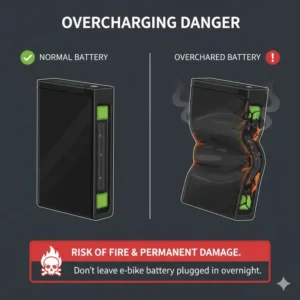
Choosing the right charger is often overlooked, yet it’s the most critical safety device you’ll buy for your e-bike. A charger is not just an electrical component; it’s the guardian of your expensive battery pack. Given the seriousness of the question, “can you charge e bike battery overnight,” your primary focus must be on safety certifications and smart technology.
What to Look for: Certifications and Logic
-
UL Certification (The Gold Standard): Look for the UL mark (especially UL 2271 for the battery pack itself and UL 1310 for the charger). This third-party certification ensures that the product has undergone rigorous testing for fire, shock, and explosion hazards. This is paramount if you are asking, “is it safe to charge ebike battery indoors?”
-
Adjustable Amperage: This is a key feature for battery longevity. Products like the Cap Rouge Super Charger allow you to drop the current (e.g., to 2A) for less heat-stressful e bike battery charging cycle when you have ample time, or crank it up (e.g., to 5A) for a rapid top-off.
-
Connectivity and Compatibility: Always verify the voltage (e.g., 36V, 48V, 52V) and the connector type (e.g., XLR, DC 2.1mm, Rosenberger, GX16-3). An incompatible charger can be extremely dangerous.
-
Integrated Diagnostics: Chargers that communicate the charging status (like the LCD on the Grin Technologies Cycle Satiator) give you confidence in the system, especially when considering overnight e bike charging.
Table 7: Detailed Comparison of Chargers (Features, Rates, Safety)
| Product | Charge Speed | Adjustable Charge? | Safety/Certification | Customer Review Rating (Implied) | Warranty (Years) |
| Grin Cycle Satiator | 1A–8A (Variable) | Yes (Current & Voltage) | UL/CE/FCC, Sealed Casing, Active Temp Mngmt | 5/5 (Highest Rated) | 2 Years |
| Bosch 4A Standard | 4A (Fixed) | No | OEM Integration, BMS Communication | 4.8/5 (Excellent Reliability) | 2 Years |
| Shimano Steps EC-E6000 | 4A (Fixed) | No | OEM Integration, Proprietary Safety Protocol | 4.7/5 (High Quality) | 2 Years |
| eBikeling Fast 5A | 5A (Fixed) | No | Standard CC/CV, LED Indicator | 4.2/5 (Good Value) | 1 Year |
| Cap Rouge Super Charger | 1A–5A (Variable) | Yes (Current & Percentage) | Overcharge/Short Circuit Protection, Fan Cooled | 4.5/5 (Great Versatility) | 1 Year |
| NOCO Genius 5 (5A) | 5A (Fixed) | No (Internal Thermal Adjustment) | Thermal Sensor, Spark Proof, Reverse Polarity | 4.9/5 (Exceptional Safety Features) | 3 Years |
| Juiced Bikes 52V 3A | 3A (Fixed) | No | 52V Optimized OEM Safety System | 4.6/5 (Reliable OEM) | 1 Year |
The choice really comes down to your budget and how much control you want over the e bike battery charging cycle. If you value longevity above all else, the adjustable current and voltage of the Grin Technologies Cycle Satiator is an investment that pays dividends. If you demand simple, trusted reliability, the OEM options from Bosch or Shimano are the way to go. The most essential takeaway is that whatever you choose, it must have a robust, verified, automatic shutoff feature to minimize the risks associated with leaving your device to charge while you sleep.
🚀 Take Action: Future-Proof Your Battery Today! 🛡️
Don’t wait until your battery health declines or, worse, an incident occurs. Upgrade your charging setup immediately! Click on the links to the premium products we’ve reviewed, like the Cap Rouge Super Charger, to implement the safest way to charge e bike battery overnight. Your battery (and your peace of mind) will thank you.
Conclusion: Making the Smart Choice 💡
We started with one key question, “can you charge e bike battery overnight,” and have uncovered a nuanced landscape of technology, safety, and best practices. The days of simple, unregulated charging are thankfully fading, replaced by sophisticated systems designed to protect your lithium-ion investment.
The most important takeaway is this: overnight e bike charging is a feature of a quality system, not a risk to be taken with generic hardware. By using certified chargers like the Bosch 4A Standard Charger or the highly customizable Grin Technologies Cycle Satiator, you ensure that the internal safety systems (BMS and charger cutoff) are working in tandem to prevent overcharge and thermal stress. Conversely, relying on a budget charger for an e bike battery charging cycle while you’re asleep is simply rolling the dice on battery longevity and safety.
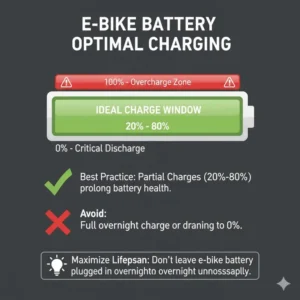
Remember to prioritize the 80% Rule, keep charging surfaces non-combustible, and always ensure your charger is compatible with your battery’s voltage and connector. Following these electric bike battery charging best practices will let you enjoy thousands of miles of riding while keeping your battery healthy and your mind at ease.
Frequently Asked Questions
✅ No, for maximum longevity, it is recommended to keep the charge level between 20% and 80%. Repeatedly charging to 100% or allowing deep discharges puts excessive stress on the lithium-ion cells. Using a smart charger that allows you to set a charging limit, often 80%, is an effective way to implement this electric bike battery charging best practice and extend the battery's lifespan over many years...
✅ You can find UL-certified e bike battery chargers primarily from established original equipment manufacturers (OEMs) like Bosch, Shimano, and Specialized, as well as high-end aftermarket brands like Grin Technologies. Look for the UL stamp or certification number on the product listing or the charger itself to ensure it meets rigorous safety standards before you charge e bike battery overnight...
✅ The Battery Management System (BMS) is the electronic brain inside your battery pack, monitoring crucial factors like cell voltage, temperature, and current flow. It protects the battery by stopping charge or discharge if parameters exceed safe limits, preventing overcharging and thermal runaway. A high-quality BMS is essential if you want to know is it safe to charge ebike battery indoors for extended periods...
✅ Studies indicate that while fast chargers (e.g., 5A+) are convenient, frequent use can marginally reduce the battery’s overall cycle life compared to slower 2A or 3A charging. This reduction is primarily due to increased heat generation during the rapid charging process. However, modern, high-quality chargers like the Grin Cycle Satiator mitigate this by intelligently monitoring cell temperature to ensure a safe to charge e bike battery environment... ❓ What is the difference between a 2A and 5A e bike battery charger?
❓ Should I charge my e bike battery to 100% every time?
❓ Where can I buy a UL-certified e bike battery charger?
❓ What is a Battery Management System (BMS) and how does it relate to e bike battery safety?
❓ Do fast chargers reduce e bike battery lifespan significantly?
Recommended for You
- Top-Rated Electric Bikes for Heavy Riders: 7 Best Picks 2025
- Best E Bike Batteries for Long Range: 7 Top Picks 2025
- How to Extend e bike Battery Life: 7 Shocking Secrets 🔋
Disclaimer: This article contains affiliate links. If you purchase products through these links, we may earn a small commission at no additional cost to you.
✨ Found this helpful? Share it with your friends! 💬🤗