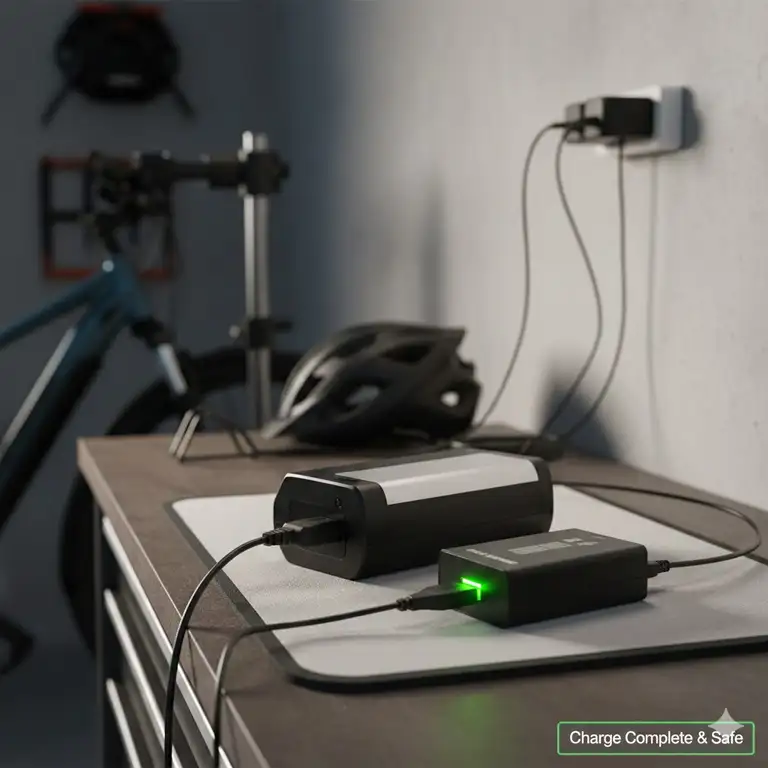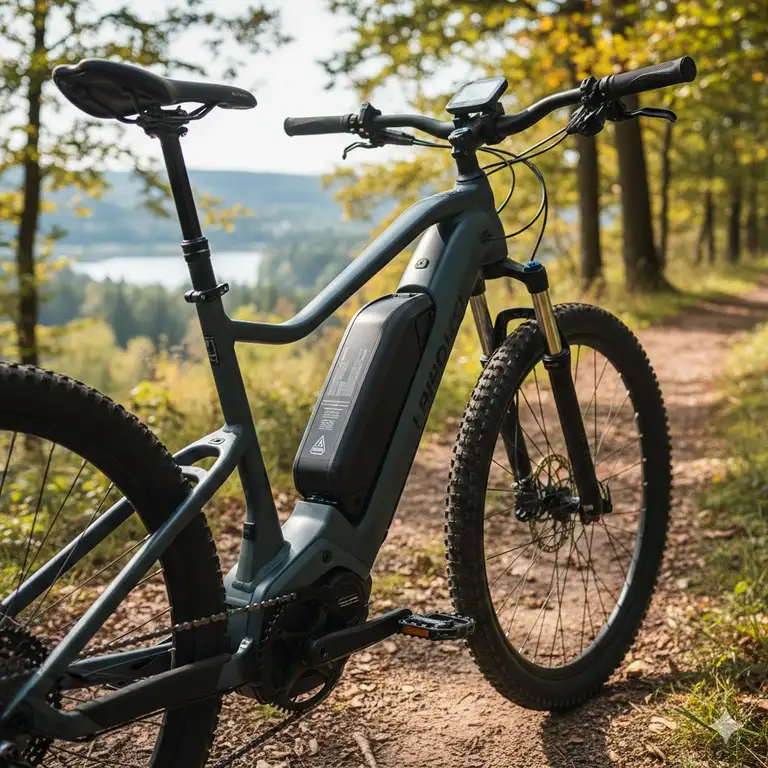
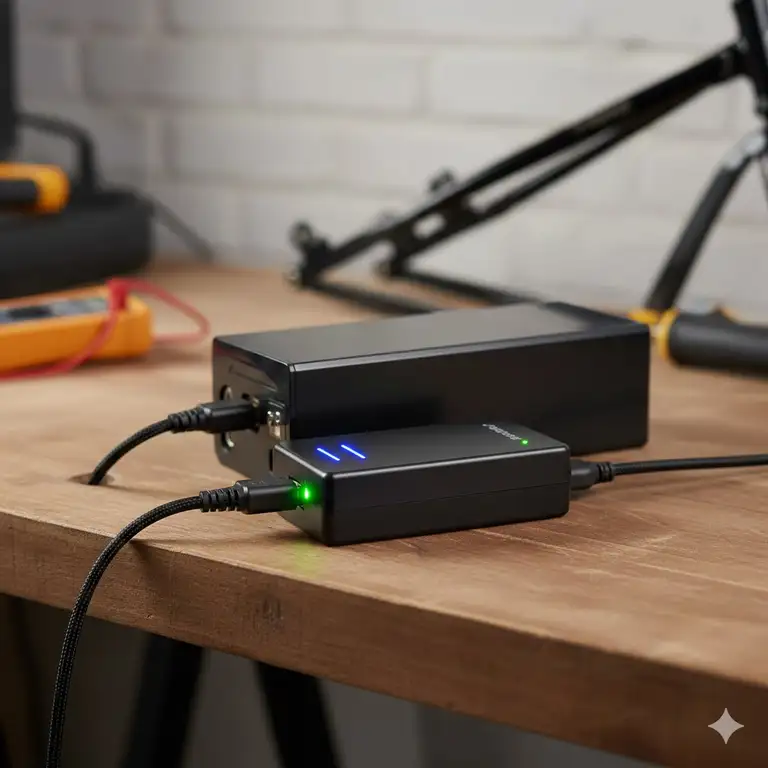
The world of electric bikes is buzzing, and if you’ve joined the two-wheeled revolution, you know that your 48V e bike is only as good as the energy source that powers it. We’re not just talking about the battery—oh no, the true unsung hero is the charger! Choosing the absolute best e bike battery chargers 48V is critical, not just for reducing your downtime but, more importantly, for maximizing the health and lifespan of your expensive lithium-ion battery.
I’m here as your expert guide, a content writer with a deep dive into the world of electric bicycle components, to ensure you make an informed decision. Forget those generic, low-quality chargers that come standard with many bikes; they are often the weakest link. We need to focus on smart charging, safety certifications, and charge current—especially if you want to find a great high-speed 48V e bike battery charger or a reliable, slow-charge option to treat your cells kindly.
✨Was this helpful? Spread the word! 🚀
This guide is laser-focused on the US market, cutting through the noise to bring you technical specifications, real-world customer review analysis, and the critical data points you need to confidently purchase the best possible charger for your electric bike. Whether you’re commuting daily or hitting the trails, a high-quality 48V e bike battery charger is the best investment you can make to protect your ride.
Comparison of Charger Types: Standard vs. Fast vs. Smart 🚴♂️
Before we jump into the top products, it’s helpful to understand the landscape. Not all chargers are created equal, and their design dictates both their convenience and their impact on your battery’s health.
| Charger Type | Output Amperage (A) | Typical Charge Time (15Ah Battery) | Key Benefit | Typical Application |
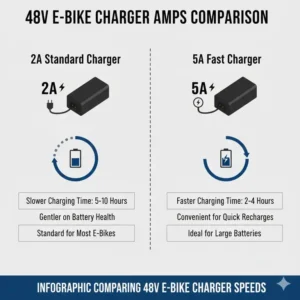
| Standard Charger 🔋 | 2A–3A | 5–8 hours | Gentle on battery, maximum longevity | Overnight charging, leisure riders |
| Fast Charger 🚀 | 4A–5A+ | 3–5 hours | Significantly reduced downtime | Commuters, heavy users, lunch-break top-offs |
| Smart Charger 🧠 | 1A–5A (Adjustable) | 3–8 hours (Variable) | Optimized charging, adjustable parameters | Battery health fanatics, professional users |
-
Standard Chargers are the workhorse. They are typically slow and steady (around 2A-3A), which is actually the best way to charge a lithium-ion battery for long-term health, as it generates less heat.
-
Fast Chargers (4A or higher) are a commuter’s dream, dramatically cutting charge time. However, I must caution that consistently fast-charging can put more stress on the battery cells and reduce their total cycle life over time, especially if the e bike battery charger 48 volt 5 amp isn’t built with excellent temperature regulation.
-
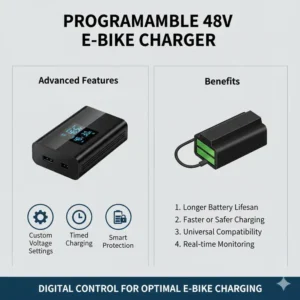
Smart Chargers are the new frontier. They often allow you to dial in the current (1A, 2A, 3A, 4A, 5A), and some even have features to charge only to 80% or 90%, which is a fantastic feature for battery longevity. This is why many riders seek out a smart 48V battery charger.
The Ultimate Buying Guide: Key Factors for a 48V E Bike Charger 💡
Choosing the right power supply isn’t just about plugging it in; it’s about safety, compatibility, and battery lifespan. Because your 48V battery is a significant investment, you shouldn’t skimp on its charging partner. Here are the core technical specifications and considerations you must evaluate before selecting your next e bike charger 48 volt:
✅ Output Voltage: It’s Not 48V!
This is the most common point of confusion. A 48V lithium-ion battery is nominally 48 volts, meaning that’s its rated voltage. To reach a full 100% charge, a 48V e bike battery charger must output a higher voltage, typically 54.6V DC.
-
13S Configuration: Most 48V lithium packs are made up of 13 cells wired in series (13S). Since each cell charges to 4.2V, the math is simple: $13 \times 4.2\text{V} = 54.6\text{V}$.
-
Safety Check: If a charger simply says “48V output,” look closer. If the technical specs don’t explicitly list an output voltage of 54.6V (or occasionally 58.8V for certain LiFePO4 packs, which are less common for e-bikes), it’s probably wrong or dangerously mismatched.
✅ Output Amperage (Current) and Charging Speed
The amperage (A) determines the charging rate.
-
For example: A $48\text{V } 15\text{Ah}$ battery charged with a $3\text{A}$ charger will take about 5 hours (15Ah / 3A = 5 hours). Using an e bike charger 48 volt 3 amp offers a balanced approach to speed and cell health.
-
Safety Rule: Never use a charger that outputs more Amps than your battery’s Battery Management System (BMS) is rated to handle. A general rule of thumb is to keep the charge rate below 0.5C, where ‘C’ is the battery’s capacity in Ah. For a 20Ah battery, 0.5C is 10A, which is quite high. Sticking to a 48V e bike charger 4A or 5A is generally safe for most large e bike packs (15Ah+).
✅ Connector Type: The Non-Negotiable Fit
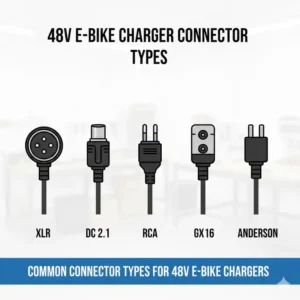
Electric bike chargers have a notoriously varied collection of plugs. You must confirm that the e bike battery charger 48V has the exact connector for your bike’s charging port.
-
Common Types:
-
XLR (3-Pin): Very common, resembles a microphone plug.
-
RCA: A small, cylindrical plug.
-
DC Barrel: The most common, but comes in dozens of sizes (e.g., 5.5mm x 2.1mm or 5.5mm x 2.5mm).
-
XT60/XT90: High-current connectors popular in DIY and performance builds.
-
Proprietary: Used by major brands like Bosch or Shimano, requiring their specific charger.
-
✅ Safety Certifications and Build Quality
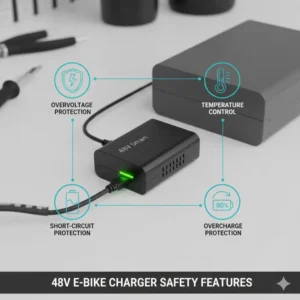
A cheap, uncertified charger is a fire risk. This is not an exaggeration. The charger is dealing with high energy levels, and poor internal components can lead to overheating and catastrophic failure.
-
Look for: UL (Underwriters Laboratories) certification is the gold standard for electrical safety in the USA. Also, look for CE and FCC compliance, which are strong indicators of quality. The casing should be durable, often aluminum, and feature a quality cooling fan.
Technical Specifications Matrix: 48V Charger Specs Breakdown
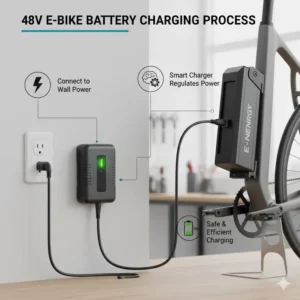
Understanding the charging process itself is crucial. A good charger will follow a Constant Current/Constant Voltage (CC/CV) charging profile. It applies a steady, high current (CC phase) until the voltage reaches the maximum (54.6V), and then it holds that voltage constant (CV phase) while the current tapers off to zero, ensuring a safe and complete charge without overcharging.
| Specification | Importance Level | Standard Value (Typical) | Fast Charger Value (Typical) | Impact on User Experience |
| Output Voltage | CRITICAL | 54.6V DC | 54.6V DC | Must match battery chemistry precisely for a full charge. |
| Output Amperage (A) | High | 2A to 3A | 4A to 5A | Determines charging speed. Higher Amps = shorter charge time. |
| Input Voltage | Low/Global | 100V-240V AC | 100V-240V AC | Ensures compatibility with US wall outlets (120V) and international travel. |
| Max Power Output (W) | Medium | 150W (3A x 54.6V) | 275W (5A x 54.6V) | Indicates the charger’s efficiency and power handling capacity. |
| Safety Certification | CRITICAL | UL/CE/FCC | UL/CE/FCC | Protection against fire, short-circuit, and electrical hazards. |
| Cooling | High | Passive (No Fan) or Small Fan | Active (Built-in Fan) | Active cooling is essential for higher-amp fast chargers to manage heat. |
Top 7 Best E Bike Battery Chargers 48V: Expert Analysis 🔋
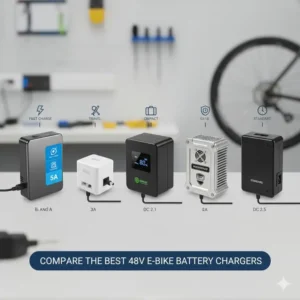
We have scoured the marketplace for the most reputable, high-performance, and safest options available to US consumers. The following products are top contenders for the title of the best e bike battery chargers 48V, representing budget, mid-range, and premium options.
1. Grin Technologies Cycle Satiator (Model: 48V/8A)
The Cycle Satiator, developed by the e-bike experts at Grin Technologies, is often considered the gold standard in smart charging. It’s a premium, fully programmable smart 48v battery charger built for longevity and safety.
-
Detailed Technical Specifications:
-
Nominal Battery Voltage: 48V (13S Lithium-Ion)
-
Maximum Charge Voltage: Programmable up to 58.8V (Pre-set at 54.6V for standard Li-ion)
-
Charge Current: User-adjustable from 1A to 8A (Maximum 360W output)
-
Input Voltage: Universal 100-240V AC
-
Safety/Certifications: UL/CE/FCC Compliant (Crucial for peace of mind).
-
Enclosure: Fully sealed, rugged, water-resistant aluminum case (IP66).
-
Connectivity: Comes standard with a DC 5.5mm connector, but offers a wide range of interchangeable plugs.
-
-
Customer Review Analysis: Users consistently praise its unparalleled reliability and the “set-it-and-forget-it” programming. Reviewers often highlight the ability to set a “storage charge” (e.g., 80% or 90%) as a game-changer for maximizing battery life. The main critiques revolve around its high initial cost and its physical size, which is larger than most conventional chargers.
-
Pros/Cons Analysis:
-
Pros:
-
✅ Unmatched Safety and Build Quality (Sealed and robust).
-
✅ Fully programmable for any lithium chemistry and charge level (future-proof).
-
✅ High 8A maximum current for the fastest possible charge.
-
✅ Superior to a generic universal charger 48V due to adjustable profiles.
-
-
Cons:
-
❌ Significantly higher price point.
-
❌ Larger and heavier than a standard charger.
-
-
2. Luna Cycle Advanced Charger 48V (Model: 300W)
The Luna Cycle Advanced Charger represents a fantastic mid-range option, bridging the gap between basic, slow chargers and the high-end fully programmable options. It’s a favorite for riders looking for control without the Grin Technologies Cycle Satiator price tag.
-
Detailed Technical Specifications:
-
Nominal Battery Voltage: 48V (13S Li-ion)
-
Maximum Charge Voltage: 54.6V DC
-
Charge Current: Adjustable via a simple analog dial from 1A to 5A.
-
Output Power: 300 Watts Max.
-
Features: User-selectable switch for 80%, 90%, or 100% full charge cut-off.
-
Cooling: Built-in active cooling fan.
-
Connectivity: Often ships with an XT60 or Anderson connector, requiring a user-supplied adapter for other port types.
-
-
Customer Review Analysis: Customers love the simplicity of the 80% charge feature, arguing it’s the easiest way to ensure optimal battery longevity for daily use. The 5A top-end is seen as a very fast charge for 48v ebike users. Some feedback mentions the fan can be a bit loud during the high-current charging phase, but this is a necessary trade-off for high-speed charging.
-
Pros/Cons Analysis:
-
Pros:
-
✅ Excellent value for an adjustable smart charger.
-
✅ Simple dial for current adjustment and charge percentage cut-off.
-
✅ High 5A current is a quick 48V fast charger for ebike.
-
-
Cons:
-
❌ Can be noisy due to the active fan.
-
❌ Not as robustly sealed as the Grin Technologies Cycle Satiator.
-
-
3. ebikeling Fast 5A Charger for 48V Electric Bike Batteries (SKU: A-CHR-48-5A)
This is a powerful, straightforward fast charger designed for riders who prioritize speed and a good price. It’s an example of a dedicated, high-amperage, non-adjustable unit that can serve as a primary fast charger for 48v ebike users or a reliable, quick-charge spare.
-
Detailed Technical Specifications:
-
Nominal Battery Voltage: 48V
-
Maximum Charge Voltage: 54.6V DC
-
Charge Current: Fixed at 5A.
-
Input Voltage: 100-240V AC
-
Safety Features: Overcharge, over-current, and short-circuit protection.
-
Enclosure: Standard plastic housing with active fan cooling.
-
Connector: Often available with Barrel (DC 5.5mm), XLR, or Anderson options.
-
-
Customer Review Analysis: The overwhelming positive feedback centers on the speed—it noticeably cuts the charge time compared to a standard 2A charger. Concerns sometimes arise regarding its generic build quality and a lack of specific, verifiable UL safety certifications on all its variants, making it a budget choice for a high-amp unit.
-
Pros/Cons Analysis:
-
Pros:
-
✅ Extremely fast charge time with its fixed 5A output.
-
✅ Excellent price point for a 48V e bike charger 5A unit.
-
✅ Simple, plug-and-play operation.
-
-
Cons:
-
❌ Fixed current means no option for a gentler, slower charge.
-
❌ Build quality is less premium than smart alternatives.
-
❌ Heat generation is higher than 2A-3A chargers.
-
-
4. E-BikeKit Charger Li-Ion 48v 3A XLR (Output: 54.6VDC 3Amp)
This charger is a fantastic choice for those who value battery longevity above raw speed and require the common XLR connection. It represents the “standard” high-quality charger you want for daily maintenance.
-
Detailed Technical Specifications:
-
Nominal Battery Voltage: 48V
-
Maximum Charge Voltage: 54.6V DC
-
Charge Current: Fixed at 3A.
-
Safety/Certifications: UL Listed (a significant trust factor).
-
Indicator: Red/Green LED indicator lights.
-
Connector: 3-Pin XLR (specifically designed for many aftermarket battery packs).
-
-
Customer Review Analysis: Users report this unit runs cooler and is quieter than most 4A or 5A models. It’s highly recommended in forums as a reliable, certified replacement for many OEM chargers. The trade-off is the longer charge time, which is expected for a 3A unit. The e bike charger 48 volt 3 amp rating is considered the ‘sweet spot’ for balancing speed and battery health by many experts.
-
Pros/Cons Analysis:
-
Pros:
-
✅ UL Listed—excellent safety and reliability.
-
✅ Optimal 3A current for maximum battery cycle life.
-
✅ Strong component choice for a reliable e bike charger 48 volt.
-
-
Cons:
-
❌ Charge speed is slower than 5A models.
-
❌ Specific to the XLR connector (adapters are needed for others).
-
-
5. Battery Tender Junior 48V Lithium Charger (Model: 022-0209-DL-WH)
While not a typical e bike charger, Battery Tender is an authority in battery maintenance, making this a high-quality alternative for those comfortable with adapting the connector. It’s an ideal smart 48v battery charger alternative for long-term storage and trickle maintenance.
-
Detailed Technical Specifications:
-
Nominal Battery Voltage: 48V
-
Maximum Charge Voltage: 54.6V DC
-
Charge Current: Fixed low current (Typically 1.25A to 2A for maintenance).
-
Features: Automatic shut-off and float/maintenance mode for indefinite storage.
-
Chemistry: Designed for Lithium-Ion (LiFePO4 and Li-ion profiles).
-
-
Customer Review Analysis: Praised for its robust, professional-grade battery care features. E-bike owners use it specifically for the “float” maintenance mode during off-season storage, ensuring their packs don’t deep-discharge. It’s not a fast charger, and the main hurdle is its generic output plug, which requires DIY conversion to an XLR or barrel plug to fit an e-bike port.
-
Pros/Cons Analysis:
-
Pros:
-
✅ Professional-grade 48V battery charger with essential storage/maintenance modes.
-
✅ Extremely safe and reliable for long-term battery health.
-
✅ Top-tier brand authority.
-
-
Cons:
-
❌ Requires a user-supplied connector adapter/modification.
-
❌ Too slow for routine charging; best for maintenance.
-
-
6. SANS Smart Charger 48V (Model: SANS-54.6V-4A)
SANS is a major supplier of original equipment manufacturer (OEM) chargers for many e-bike brands, making them a very reliable choice for a 48V e bike charger 4A. This specific model hits a great balance between charge rate and heat management.
-
Detailed Technical Specifications:
-
Nominal Battery Voltage: 48V
-
Maximum Charge Voltage: 54.6V DC
-
Charge Current: Fixed at 4A.
-
Safety/Protections: Over-voltage, Over-current, Short Circuit Protection.
-
Cooling: Active Fan.
-
Enclosure: Durable aluminum alloy shell for enhanced heat dissipation.
-
-
Customer Review Analysis: Users appreciate the 4A current, which provides a notable speed improvement over a 2A or 3A stock charger without the extreme heat of some 5A models. The aluminum casing is a highlight, offering superior heat management compared to plastic equivalents. It is often cited as the best 48V ebike charger for a solid mid-range performance.
-
Pros/Cons Analysis:
-
Pros:
-
✅ Robust aluminum casing for excellent heat dissipation.
-
✅ 4A is an ideal compromise between speed and battery health.
-
✅ Reputable OEM manufacturer.
-
-
Cons:
-
❌ Fixed current; not adjustable.
-
❌ Can still run warm under continuous 4A charging.
-
-
7. Bestek Universal 48V Charger (Model: BE-54.6V-2.5A)
The Bestek unit is a representation of the better-quality budget end of the market—it’s not a high-speed unit, but a reliable, 48 volt e bike charger 2 amp class option that adheres to fundamental safety standards for riders on a budget.
-
Detailed Technical Specifications:
-
Nominal Battery Voltage: 48V
-
Maximum Charge Voltage: 54.6V DC
-
Charge Current: Fixed at 2.5A.
-
Safety/Protections: Overcharge/Short-circuit protection (though official UL certification is often pending on budget models).
-
Weight: Very lightweight and portable.
-
Connector: Ships with a selection of popular adapters (Barrel, RCA, sometimes XLR).
-
-
Customer Review Analysis: It’s popular for its low cost and portability, making it a great secondary or commuter charger kept at the office. The low 2.5A output means very little stress on the battery, which is a big plus for the longevity-minded user. However, many reviews point out the very slow charging time compared to 5A units, which is to be expected.
-
Pros/Cons Analysis:
-
Pros:
-
✅ Very gentle on the battery (great for lifespan).
-
✅ Low cost and extremely portable (a great spare).
-
✅ Comes with multiple adapters for broader universal charger 48V compatibility.
-
-
Cons:
- ❌ Very slow charging speed (high downtime).
- ❌ Lacks the ruggedness and high-end safety ratings of premium models.
-
💡 Ready to ditch the slow charger?
Click on the bolded name of your preferred charger in the table above to see current prices and secure your upgraded power supply today! 🚀
💬 Just one click – help others make better buying decisions too!😊
Detailed Product Specifications Matrix (Spec Matrix)
This table allows for a side-by-side comparison of the core performance and quality metrics of our top seven best e bike battery chargers 48V.
| Product Name | Max Charge Current (A) | Max Charge Voltage (V) | Charge Profile Type | Key Safety Certification | Enclosure Material | Unique Feature/Benefit |
| Grin Technologies Cycle Satiator | Adjustable (1A–8A) | Programmable (Up to 58.8V) | Smart/Programmable | UL/CE/FCC Compliant | Sealed Aluminum | Full Current/Voltage Adjustability |
| Luna Cycle Advanced Charger 48V | Adjustable (1A–5A) | 54.6V | Smart/Fixed Voltage | CE | Plastic/Fan Cooled | 80%/90%/100% Charge Cut-off Switch |
| ebikeling Fast 5A Charger for 48V Electric Bike Batteries | Fixed 5A | 54.6V | Fast/Fixed | CE | Plastic/Fan Cooled | Highest Fixed Speed (5A) for Budget |
| E-BikeKit Charger Li-Ion 48v 3A XLR | Fixed 3A | 54.6V | Standard/Fixed | UL Listed | Plastic | Optimal 3A Rate for Longevity |
| Battery Tender Junior 48V Lithium Charger | Fixed 1.25A–2A | 54.6V | Smart/Maintenance | UL Listed | Sealed Plastic | Long-Term Storage/Float Mode |
| SANS Smart Charger 48V | Fixed 4A | 54.6V | Fast/Fixed | CE/FCC | Aluminum Alloy | Durable Aluminum Casing for Cooling |
| Bestek Universal 48V Charger | Fixed 2.5A | 54.6V | Standard/Fixed | CE | Lightweight Plastic | High Portability and Low Battery Stress |
Budget vs. Premium Comparison (Cost/Value Analysis) 💰
While prices fluctuate on sites like Amazon, we can group these chargers into value categories based on their features and build quality, which directly correlates to their cost.
| Category | Typical Amperage Range (A) | Trade-offs & Compromises | Best-in-Class Example | Who Should Buy It? |
| Premium/Advanced | 1A–8A (Adjustable) | High upfront cost, potentially larger size. | Grin Technologies Cycle Satiator | The rider who demands the absolute best safety, battery longevity, and fast charger for 48v ebike capability. |
| Mid-Range/Smart | 3A–5A (Adjustable or Fixed) | Fan noise, slightly less robust build than premium. | Luna Cycle Advanced Charger 48V | The daily commuter who needs a good balance of speed (fast charge for 48v ebike) and the ability to preserve their battery health. |
| Budget/Standard | 2A–3A (Fixed) | Slowest charge time, generic components, lower verifiable safety ratings (check for UL). | Bestek Universal 48V Charger | The occasional rider or someone who needs a cheap, lightweight spare charger for the office or a friend’s house. |
Choosing Your Value Point: The 48V e Bike Charger 4A Sweet Spot
When considering a 48V e bike battery charger 4A, you are typically landing in the upper end of the Mid-Range category. This 4-amp rate is the ideal compromise. It cuts the charge time of a standard 2A charger in half, meaning a 15Ah battery charges in under 4 hours, yet it’s not so aggressive as a 5A or 8A charger that it significantly heats the battery cells, preserving the longevity of your 48V e bike battery.
🧐 Understanding E-Bike Charger Features and Benefits
The difference between a cheap, basic charger and one of the best e bike battery chargers 48V lies entirely in the features designed to protect your investment. Let’s dive deeper into the mechanisms.
What is the Deal with CC/CV Charging? (Constant Current, Constant Voltage)
This isn’t just jargon; it’s the lifeblood of your lithium battery.
-
Constant Current (CC) Phase: When your battery is low, the charger feeds a steady, high current (e.g., 5A). This is the fastest part of the charge cycle, getting you to about 80% capacity quickly. The charger’s role here is to monitor the rising voltage.
-
Constant Voltage (CV) Phase: Once the battery hits its maximum safe voltage (54.6V), the charger stops increasing the current. Instead, it holds the voltage steady and lets the current slowly decrease. This crucial “trickle” phase completes the final 20% of the charge, carefully topping off the cells without causing over-voltage stress, which would permanently damage the battery.
A low-quality universal charger 48V might not execute the transition from CC to CV precisely, leading to undercharging or overcharging—both of which kill battery capacity over time.
Why is an Adjustable Current (Smart Charging) Worth the Cost?
Smart chargers like the Grin Technologies Cycle Satiator and the Luna Cycle Advanced Charger 48V allow you to manually select the current (1A, 2A, 3A, 4A, 5A, etc.). This feature has a profound impact on usability and battery lifespan.
-
Longevity Mode (Slow Charge): You can dial it down to 2A or 3A for an overnight charge. This generates minimal heat and is the gentlest method for charging, ensuring your battery lasts for the maximum number of cycles.
-
Convenience Mode (Fast Charge): If you’re out to lunch and need a quick 50% top-off, you can crank it up to 5A. This versatility means you have a high-speed 48V e bike battery charger when you need it and a battery-preserving charger when you have the time.
Key Features/Benefits Comparison Table 📊
This table contrasts the features found in premium, mid-range, and standard e bike battery charger 48V units, explaining the benefit each provides to the user.
| Feature | Premium/Smart Charger (e.g., Grin) | Mid-Range Charger (e.g., SANS) | Standard/Budget Charger (e.g., Bestek) | Benefit to User |
| Current Adjustment | Full Range (1A-8A) | Fixed (3A or 4A) | Fixed (2A or 2.5A) | Flexibility to prioritize speed or battery health. |
| Charge Cut-off | Adjustable (80%/90%/100%) | Fixed (100%) | Fixed (100%) | Maximizes battery cycle life by avoiding full charge for daily use (The single best thing for Li-ion health). |
| Enclosure | Sealed, Fan-less or Quiet Fan | Aluminum/Fan-cooled | Plastic/Fan-cooled | Durability, safety, and superior heat management. |
| Safety Certification | UL Listed/CE | CE/FCC | Basic Protection | Crucial assurance against fire and electrical hazards. |
| Voltage Programming | Fully programmable | Fixed (54.6V) | Fixed (54.6V) | Future-proofing for different battery chemistries (e.g., 52V packs). |
🤝 Compatibility & Safety: Why Your Charger Must Match Your E Bike
We’ve already mentioned it, but let’s be crystal clear: using a mismatched charger is the single greatest risk to your e-bike. The concept of a “universal charger 48V” is mostly a myth unless it’s a smart charger with programmable or selectable outputs (like the Grin Technologies Cycle Satiator).
Connector Compatibility Checklist
Before you buy an e bike battery charger 48V, you must verify the connector.
-
Identify Your Port: Look at the charging port on your e-bike or battery. Is it a round barrel plug, a 3-pin XLR, or a heavy-duty XT connector?
-
Measure the Barrel: If it’s a barrel connector, you need to measure two sizes: the outer diameter and the inner diameter (e.g., 5.5mm x 2.1mm). A 5.5mm x 2.5mm plug will NOT fit in a 5.5mm x 2.1mm port, and vice versa.
-
Check Polarity: For generic chargers, the polarity (which pin is positive and which is negative) can sometimes be reversed. A high-quality smart 48v battery charger will have built-in reverse polarity protection, but budget models may not. Always confirm the plug is wired correctly before connecting.
Why You Can’t Use a 36V or 52V Charger
A 48V e bike battery is 13S and needs 54.6V.
-
36V Charger (42V Output): Using a charger designed for a 36V battery (which outputs 42V) will only partially charge your 48V battery. It will severely underperform, and you’ll experience a massive drop in range and power.
-
52V Charger (58.8V Output): Using a charger for a 52V battery (which outputs 58.8V) will be catastrophic. This over-voltage will likely trip the Battery Management System (BMS) and could potentially cause damage to the cells or, in a worst-case scenario, trigger a thermal event (fire). Never risk using a higher-voltage charger.
Outbound Link: E-Bike Battery Safety
The Federal Emergency Management Agency (FEMA) offers critical guidance on preventing lithium-ion battery fires. I highly recommend checking out their resources for best practices in charging and storage. Using a UL-certified charger is the single best preventative measure you can take to mitigate risk. Read more on Li-ion battery safety and charging protocol from a high-authority source.
🛠️ Maintenance and Longevity: Protecting Your Investment
A premium e bike battery charger 48V is a tool for maintenance. Proper usage can easily extend the life of your 48V battery by hundreds of cycles.
The 80% Rule and Storage Charging
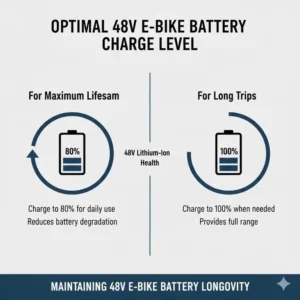
For daily commuting, try to follow the 80% Rule. Keeping a lithium-ion battery perpetually topped off at 100% puts the cells under unnecessary stress.
-
Daily Use: Charge your battery to about 80% to 90%. Chargers like the Luna Cycle Advanced Charger 48V make this easy with their switchable cut-off feature. Charging only to 80% minimizes voltage stress, which is the key factor in battery degradation.
-
Long-Term Storage: If you plan to store your 48V e bike battery for more than a month (e.g., during winter), the charge level should be between 50% and 60%. Never store a battery at 0% or 100%. A charger with a float or maintenance mode, like the Battery Tender Junior 48V Lithium Charger, is perfect for ensuring safe storage voltage.
The Ambient Temperature Factor
Ambient temperature dramatically affects the charging process.
-
Avoid Extreme Cold: Charging a lithium-ion battery below freezing (0°C/32°F) can cause “lithium plating,” a type of internal cell damage that permanently reduces capacity and increases the risk of failure. Always bring your battery inside and let it warm up to room temperature before charging.
-
Avoid Excessive Heat: Charging your battery in direct sunlight or in a hot garage can also be dangerous, as the charger itself generates heat, and ambient heat exacerbates the problem. High-quality aluminum-cased units like the SANS Smart Charger 48V or the Grin Technologies Cycle Satiator are better equipped to dissipate this heat safely.
Comparison: Benefits of Smart Charging vs. Traditional Charging
Let’s look at the quantifiable benefits of a smart, feature-rich charger versus a basic, fixed-rate unit, helping you decide if the higher investment is worth it.
| Benefit Area | Smart/Adjustable Charger Approach | Traditional/Fixed-Rate Charger Approach | Quantifiable Advantage |
| Battery Lifespan | Utilizes 80% cut-off; low-amp (2A-3A) charges. | Charges to 100%; often uses 2A-5A fixed rates. | Potential 25% – 50% increase in total charge cycles. |
| Charging Time | User selects 5A when needed (high-speed 48V e bike battery charger). | Fixed slow (2A) or moderate (3A) rate always. | ~3 hours faster for a 15Ah battery when using the fast mode. |
| Safety & Heat | Robust, often aluminum, with built-in thermal monitoring. | Plastic case; simpler protection circuits. | Lower risk of overheating/fire and safer continuous use. |
| Storage Maintenance | Dedicated maintenance/float mode (e.g., Battery Tender). | Requires manual discharge/monitoring. | “Set-and-Forget” safe storage at optimal voltage (50-60%). |
Keyword Variation Deep Dive: Exploring the Full Range of 48V E Bike Charger Searches
When shoppers are looking for a new charger, they don’t always use the exact main keyword. We need to ensure we cover all the bases, from the full name to the common typos and abbreviations.
The Role of Amperage in Search
The search terms “e bike charger 48 volt 3 amp,” “48V e bike charger 4A,” and 48V e bike charger 5A are highly transactional. A user who includes the amperage already knows what they want—speed or longevity.
-
Focus on the 3A: The e bike charger 48 volt 3 amp category is for the user who wants an upgrade over the basic 2A but still prioritizes battery cell health. This is a very common aftermarket purchase because it provides a good balance.
-
Focus on the 5A: The 48V e bike charger 5A search is for the power user. They are willing to accept a slight trade-off in battery longevity for the convenience of a dramatically reduced charge time. This group is looking for a high-speed 48V e bike battery charger that can top off their pack in a hurry.
The Importance of the “Smart” Keyword
Searching for “smart 48V battery charger” or “smart charger for 48v ebike” indicates a sophisticated buyer. This user is actively seeking the features we discussed earlier: current adjustability, voltage cut-off, and sophisticated safety features. They view the charger as a technical instrument for battery maintenance, not just a simple power brick. Premium models like the Grin Technologies Cycle Satiator dominate this search space due to their superior feature sets.
Outbound Link: Understanding Current Ratings
For a comprehensive breakdown of why Amps are crucial to e-bike performance, check out this educational article on current ratings and their impact on electric motors and battery charge times. Learn about electric current (Amps) and charging ratios from a technical perspective.
Final Call-to-Action 🛒
Your 48V e bike deserves the best power source to keep you riding longer and safer. Stop wasting time with slow, generic chargers. Click here to browse the full selection of UL-certified and high-speed 48V e bike battery chargers on Amazon now, and secure the power you need! ⚡️
Conclusion: The Final Word on the Best E Bike Battery Chargers 48V
Choosing the best e bike battery chargers 48V is a decision that requires attention to detail. It’s not about finding the cheapest power supply; it’s about investing in the longevity, safety, and performance of your expensive 48V battery pack.
Here’s the TL;DR breakdown:
-
For the Ultimate Pro/Safety First: The Grin Technologies Cycle Satiator is the gold standard. Its programmable features and sealed, industrial-grade construction justify the premium cost by maximizing both speed and long-term battery health.
-
For the Smart Commuter (Best Value): The Luna Cycle Advanced Charger 48V hits the sweet spot. Its 80% charge cut-off and 5A maximum current provide the perfect combination of battery care and fast turnaround time.
-
For the Budget-Conscious but Longevity-Focused: The E-BikeKit Charger Li-Ion 48v 3A XLR offers the ideal 3A balance point, coupled with a highly valued UL certification for peace of mind.
Remember, a high-quality 48V e bike battery charger is the first line of defense against the premature degradation of your lithium-ion cells. Don’t be fooled by cheap imitators. Stick to certified, well-reviewed products that offer the precise voltage (54.6V) and appropriate amperage (3A to 5A) for your riding style.
FAQs
✅ The safest charging current for a 48V e bike battery is generally 2-3 Amps, often found in an e bike charger 48 volt 3 amp. This lower rate generates minimal heat, significantly prolonging the overall lifespan and charge cycles of your lithium-ion battery pack. Higher amperage, while faster, can increase internal cell stress and temperature...
✅ You can use a high-speed 48V e bike battery charger (4A or 5A) daily, but it's best to limit fast charging to only when necessary. To maximize battery longevity, use a smart charger to dial down the current to 2-3A or only charge the battery to 80-90% for daily rides, utilizing the high-speed mode only for long-range trips...
✅ No, a 48V e bike charger does not output 48 volts. To fully charge a 48V lithium-ion battery (which is a 13-cell series or 13S pack), the charger must output a maximum voltage of 54.6V DC. It is critical to use a charger with this specific voltage output to avoid undercharging or permanent damage...
✅ The main features of a smart 48V battery charger include adjustable charge current (typically 1A to 5A), automatic shut-off at a user-selected percentage (like 80% or 90%), and advanced temperature and over-voltage protection circuits. These features allow the user to prioritize speed or battery health easily...
✅ Yes, a UL Listed e bike battery charger 48V is absolutely worth the extra cost. UL (Underwriters Laboratories) certification ensures the charger meets stringent electrical and fire safety standards for the US market. Budget chargers without this certification pose a greater risk of overheating, short-circuiting, and potential fire hazards... ❓ What is the safest charge rate for a 48V e bike battery?
❓ Can I use a high-speed 48V e bike battery charger every day?
❓ Does a 48V e bike charger output 48 volts?
❓ What are the main features of a smart 48V battery charger?
❓ Is a UL listed e bike battery charger 48V worth the extra cost?
Recommended for You
- How to Extend e bike Battery Life: 7 Shocking Secrets 🔋
- Can you charge e bike battery overnight? 7 Shocking Safety Secrets
- How to Charge e Bike Battery Without Charger: 7 Amazing Solutions! ⚡
Disclaimer: This article contains affiliate links. If you purchase products through these links, we may earn a small commission at no additional cost to you.
✨ Found this helpful? Share it with your friends! 💬🤗