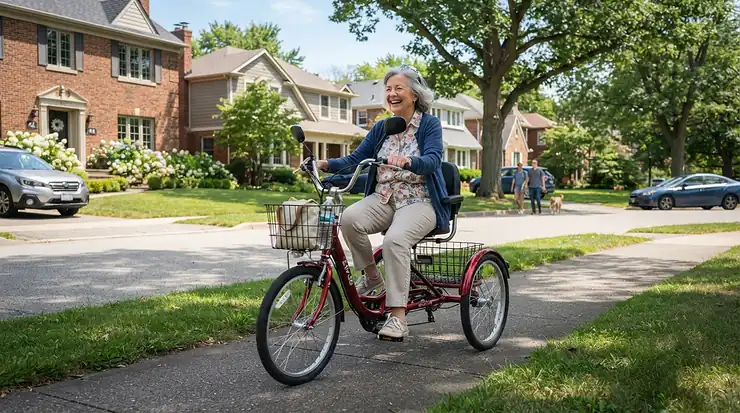
A throttle on the handlebar does not turn ebike pedals into decoration. Federal law defines a low-speed electric bicycle as a two- or three-wheeled vehicle with fully operable pedals, so the cranks, chain and pedals on your bike are part of what separates an ebike from a small moped. This 2027 guide covers what pedals still have to do on a throttle bike, which style fits which kind of riding, and three specific pairs worth a look. The conclusions rest on the text of the federal statute, maker and dealer spec pages, an Electrek commentary on pedal-free vehicles and a few owner forum threads; no pair was fitted or ridden for this guide, so any comment on feel belongs to a named reviewer.
Pedals also get less attention than the motor, even though they are the part your feet touch for every minute of every ride.
Ebike without pedal: where the legal line sits
The federal definition in Public Law 107-319 opens with a two- or three-wheeled vehicle with fully operable pedals, then adds a motor under 750 watts and a motor-only top speed under 20 mph. A model definition quoted in an Electric Bike Review forum thread, which many state three-class laws follow, describes the same bicycle with fully operable pedals and a seat. Class 2 is the class where the motor may propel the bike on its own. That is how ebikes you dont have to pedal can be sold as bicycles: they still carry pedals, they just do not demand pedaling.
State rules then add their own twists. A Morrison Foerster summary of California’s SB 1271, which took effect January 1, 2025, says Class 2 is the only class where a throttle can drive the bike above 3.7 mph, while Class 1 and Class 3 throttles are limited to that crawl speed. Aventon’s licensing explainer flags New Jersey as a state where throttle capability can trigger a different legal classification. Rules vary by state and city, so confirm yours before riding.
What about an ebike non pedal design, one with foot pegs and no cranks at all? Retailer Biktrix says that on public roads in the United States such a vehicle is generally not legal as an ebike. Electrek’s Micah Toll takes a softer view in a July 2026 column: many places do not explicitly ban pedal-less micromobility, but those vehicles lack the clear status Class 2 e-bikes enjoy, and he cites the JackRabbit, which uses pegs, as an example. The two views agree on one point. Without pedals, you are outside the settled ebike category, and your local moped or e-scooter rules may apply instead.
Ebike vs pedal assist: pick the riding mode before the pedal
The ebike vs pedal assist question comes down to what the motor needs from your legs. On Class 1 and Class 3 bikes the motor works only while you pedal, per Upway’s class summary. On a Class 2 bike a throttle can move the bike without any pedaling, up to 20 mph.
That split changes what you should want from a pedal. A pedal-assist rider is turning the cranks for the whole ride, so platform size, grip and crank clearance matter all the time. A throttle cruiser spends long stretches resting feet on stationary pedals, which favors a wide, flat platform with pins that hold a sole without effort. Mixed riders need both.
Weight and torque matter too. Leoguar, an ebike retailer, argues that a motor kicking in from a standing start or on a steep hill puts far more peak load on the spindle and body than a human leg alone, and it recommends machined aluminum for heavier riders. That is a retailer’s reasoning, not a lab result, but it matches the intuition that cheap plastic bodies are the first to complain.
Six steps to the right pair of ebike pedals
Name your riding mode. Pure pedal assist, throttle cruising or a mix. This sets how much platform and grip you need, and whether a folding pair is worth its trade-offs.
Confirm the crank thread. The pairs in this guide, along with Jetson’s replacement pedals and Leoguar’s Flippo pedals, all use the common 9/16-inch thread. Check your crank arms before ordering, because some small-wheeled and kids’ bikes differ.
Choose the body type. Flat pedals work with any shoe, hybrids pair one flat side with one clip-in side, and folding pedals trade some platform for storage width. Upway’s commuting guide calls hybrids its top recommendation for riders who want both shoe options.
Match the platform to your shoe. A 101 by 110 mm platform suits a larger sole better than a 3.5 by 3 inch platform. Reading the dimensions against your own shoe size beats trusting a “large” label.
Decide on reflectors. Leoguar’s commuter advice treats built-in reflectors as an essential safety feature, while Shimano sells its reflector for the PD-EH500 separately, according to a European dealer listing.
Install and recheck. Pedals thread on the opposite way on the left crank, so a pair swapped to the wrong side will not seat. Tighten firmly and check them again after the first ride.
Ebike pedals that turn into pegs: what exists, what owners report
Collapsible crank arms are the closest thing to a pedal that becomes a peg. A forum thread on ebikesforum.com describes a product called Pegals, which flips into footpegs for throttle riding and flips back into an “operable pedal mode.” Members in that thread call it expensive, say the arms are short at about 160 mm, thick and heavy, and report that using them as cranks widens the Q-factor noticeably. They also disagree on legality. Some read the rule as requiring functional pedals rather than pedaling, while others doubt that folded pegs count and joke that flipping them out at a traffic stop would only irritate the officer. Treat it as a split of owner opinion, not a legal ruling.
The cleaner way to get a footrest is bolt-on pegs beside real pedals. Retrospec’s Rev foot pegs mount on the chainstay, cost around $30 according to the maker’s page, and fit only a handful of its own models. The company’s FAQ says pegs are not an alternative to pedals, that most US ebikes need pedals to operate, and that each peg is rated for 30 pounds, so standing on them is off the table.
Folding pedals solve a different problem. They do not turn into pegs, but they tuck against the crank for storage. Owners on an Electric Bike Review thread about Lectric XP 3.0 stock folding pedals describe them as heavy with a weak grip, and one swapped them for roughly $30 quick-release pedals and was very happy with the change. The thread has only three replies, so it is a signal, not a verdict.
Where pedal swaps go wrong
Mistakes tend to cluster around missing information. A listing for the Leoguar Flippo Foldable Pedals, around $16, says they are designed for Flippo e-bike models and fold flat against the crank. It also leaves material and load rating blank and shows a single buyer review, which is thin evidence for a part that carries your weight on every stroke.
Grip is the second problem. OutdoorGearLab’s review of the Race Face Chester notes only eight pins per side and warns about slipperiness in wet weather, so even a respected pedal can disappoint with smooth-soled shoes.
Third, riders treat pegs like stand-up platforms. Retrospec states plainly that its pegs are for resting feet and are not built for standing or carrying a passenger. Finally, mixing up thread size or left-right orientation wastes an afternoon and can damage a crank, so check both before tightening anything.
The best ebike pedals for three kinds of riders
The right pair depends on your shoes and riding mode, so these three come from different corners: a flat platform for throttle and mixed riding, a hybrid for commuters who want both shoe options, and a folding pair for tight storage.
Model
Type
Weight per pair
Platform
Retail range
Race Face Chester Pedals
Flat, pinned
358 g
101 x 110 mm
Around $60
Shimano PD-EH500 Pedals
Hybrid SPD and flat
383 g
About 3.5 x 3 in
$80 to $85
MKS FD-7 Folding Pedals
Folding flat
402 to 487 g, by listing
100 x 69 mm
$55 to $85
The weights sit close together, so the choice is not about carrying less. It is about platform size, the shoes you wear and how much space the bike needs when parked. Prices come from OutdoorGearLab, REI, Trisports, Rogue Fitness, Nonstop Ciclismo and Northwest Bicycle; check the current price on Amazon.com.
Throttle cruisers and everyday mixed riders are the audience this pedal serves best. OutdoorGearLab lists the Race Face Chester Pedals at 358 grams a pair with a 101 by 110 mm platform, a 14 mm profile and sloped leading edges meant to reduce pedal strikes. It earned the testers’ “Best Pedal for your Buck” label with an overall score of 74, and the review calls it tough and durable. Upway also names the Chester as a durable, reasonably priced choice for commuters.
The same review lists the limits: eight pins per side, no pins along the axle, and a mid-size platform that may feel small under large feet. Servicing scored 7 out of 10, with the testers calling it straightforward. Dealers put the pedal around $60.
Race Face Chester PedalsSee current price, sizes and reviews on Amazon.
Compromise is the point of this pair, and the compromise shows in the flat side. A reviewer on the Mantel retailer page says the flat side grips well but less than a full platform because its surface area is smaller. The same page shows a 4.7 out of 5 average across 192 reviews. Upway’s commuter guide ranks hybrid pedals as its top pick for riders who want both shoe options.
Shimano lists the Shimano PD-EH500 Pedals with an aluminum body, a sealed cartridge axle, a light-action SPD side and SM-SH56 cleats in the box. Its spec sheet gives 383 grams a pair, while one UK dealer lists 330 grams; trust the maker’s figure. Retailers sell it between $80 and $85. Riders who clip in on a long commute get the efficiency benefit, and anyone running errands in sneakers can ignore the clip entirely.
Shimano PD-EH500 PedalsSee current price, sizes and reviews on Amazon.
Apartment hallways, car racks and shared bike rooms are where a folding pedal earns its price. The MKS FD-7 Folding Pedals use a push-pin fold, a double-sided aluminum body and cage, a chromoly spindle and a 9/16-inch thread. One retailer reports a folded width of 43 mm. Weights are inconsistent across listings, from about 402 to 487 grams a pair, so compare the weight you care about before you buy.
The platform measures about 100 by 69 mm per Tree Fort Bikes, smaller than the Chester. A buyer on a desertcart page praises the quality and bearings but notes the pedals do not fold as flat as many rivals, which is one reviewer’s view. Nashbar’s spec lists cup-and-cone bearings, which can be adjusted and serviced. Dealers price them from $55 to $85.
MKS FD-7 Folding PedalsSee current price, sizes and reviews on Amazon.
What a swap costs and how long it takes to settle in
Pedals are one of the cheaper upgrades on an ebike. Going by the dealer figures above, a single pair runs from around $55 for the low end of the MKS FD-7 Folding Pedals to $85 for the top of the Shimano PD-EH500 Pedals range, with the Race Face Chester Pedals in between at around $60. A 15mm pedal wrench is the main tool, and Jetson’s own replacement-pedal page names that size for its 9/16-inch thread.
Upkeep differs by design. OutdoorGearLab’s testers describe the Chester as straightforward to service and found replacing a worn pin easy. Shimano specifies a sealed cartridge axle on the PD-EH500, which means less routine attention, while the cup-and-cone bearings on the MKS pair reward an occasional adjustment. None of this needs a shop. Folding hinges on any brand collect grit, though, and A-Spadz, an ebike maker, advises cleaning the hinge area so dirt does not stop the pedal from locking open.
Give a new pair a few rides before judging them. Grip on pins and platform size often feels different once you stop thinking about it, and a hybrid’s flat side is easiest to judge after a wet commute.
Quick answers on pedals, pegs and throttle-only riding
Do you have to pedal an ebike?
Not on a Class 2 bike, where the throttle drives the motor up to 20 mph. Class 1 and Class 3 bikes assist only while you pedal. Even Class 2 bikes must carry working pedals to meet the federal definition.
Are ebikes without pedals legal?
Generally not as ebikes. The federal definition requires fully operable pedals, and retailer Biktrix says pedal-free vehicles are usually illegal on US roads. Electrek calls the status murky and inconsistent, so check state moped and e-scooter rules.
Are there ebike pedals that turn into pegs?
Collapsible crank arms called Pegals fold into footpegs, though forum members describe them as short, heavy and expensive, and they dispute whether folded pegs satisfy pedal rules. Bolt-on pegs beside normal pedals are a safer way to rest your feet.
What are the best ebike pedals for commuting?
It depends on your shoes. Pinned flat pedals suit any sole, hybrids add a clip-in side for longer rides, and folding pedals help in tight storage. Upway ranks hybrids first for commuters who want both shoe options.
Can I put regular bike pedals on an electric bike?
Usually yes, if the pedal thread matches your crank. Many adult cranks take 9/16-inch pedals, and Leoguar says its pedals fit most standard cranks. Check the thread, remember the left side threads the opposite way, and choose a sturdy body.
Which ebike pedals to order
Start with how you ride. If you throttle-cruise or mix modes in everyday shoes, the Race Face Chester Pedals are the safest starting point because of their large flat platform and low price. If you commute longer distances and own cycling shoes, the Shimano PD-EH500 Pedals let you clip in or not. If the bike lives in a hallway or on a rack, the MKS FD-7 Folding Pedals save width.
Whatever you pick, keep real pedals on the bike. Bolt-on pegs are fine for resting feet, but the legal ebike definition rests on pedals that work, and a bike without them can leave you arguing over classification. Choose the best ebike pedals for your shoes and storage first, then worry about looks. Compare the thread and platform size against your crank before you order.
Disclaimer: This post contains affiliate links. As an Amazon Associate, we earn from qualifying purchases made through these links, at no additional cost to you.
Compare the exact model number and thread size against your crank before buying.
NextGenEBike is an independent buying-guide site for electric bikes, motors, batteries and accessories. Our editorial team compares products using manufacturer specifications, independent tests from specialist e-bike media, owner reports and retailer listings. We do not claim to have tested the products ourselves; see How We Choose Gear for our method.