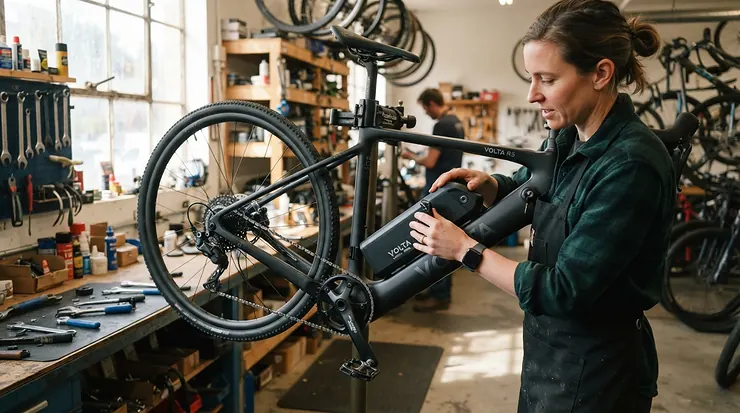
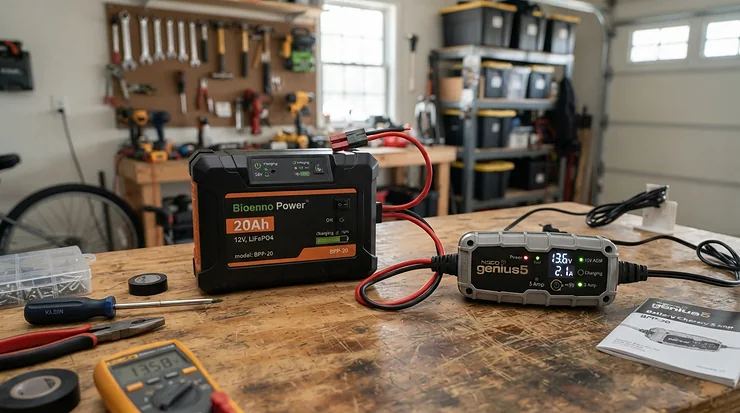
A rider working two shifts on a 14Ah pack runs into simple arithmetic. Electric Bike Review’s RadRover write-up puts the stock 2A charger at about six hours from empty, so a lunch break refills very little. That gap is why shoppers in 2027 look for ebike battery chargers fast enough to double or triple the current, and it is also where most of the risk sits.
No charger was plugged in for this guide. The findings rest on maker pages, a Samsung cell datasheet, safety notices from Consumer Reports and the CPSC, forum threads and Amazon buyer reviews as mirrored by third-party sites. Four chargers made the cut, each tied to a different routine: a multi-bike household, a 72V rig, a 48V commuter and a 52V owner who wants 4A.
Voltage, plug, amps and a safety mark: what the label has to say
Voltage comes first, because a mismatch is the one error that extra speed cannot excuse. Letrigo’s reference table pairs 36V packs with 42.0V chargers, 48V packs with 54.6V, 52V packs with 58.8V and 60V packs with 67.2V, and it warns that 54.6V and 58.8V are not interchangeable. The arithmetic is simple: a 48V pack stacks 13 cells at a 4.2V charge limit, which is 54.6V, while a 52V pack stacks 14, which is 58.8V.
Plug type comes second. EM3ev’s charger guide lists DC barrel, GX16, Anderson, XT60 and XLR connectors across common packs, and as the forum evidence below shows, the jack itself can be the limiting part of a fast charge.
Amps come third, and the useful way to read them is as a fraction of the pack’s capacity. Battery University says charging above 1C reduces service life and recommends 0.8C for longevity, so divide the charger’s amps by the pack’s amp-hours. The table does that for three common pack sizes, with the hours the constant-current stage alone would take.
Pack size
2A (stock)
4A
5A
8A
10Ah
0.20C, 5.0 h
0.40C, 2.5 h
0.50C, 2.0 h
0.80C, 1.3 h
14Ah
0.14C, 7.0 h
0.29C, 3.5 h
0.36C, 2.8 h
0.57C, 1.8 h
20Ah
0.10C, 10 h
0.20C, 5.0 h
0.25C, 4.0 h
0.40C, 2.5 h
The 14Ah row is the one to study: 5A is only about 0.36C there, so the speedup is large and the stress modest. On a 10Ah pack the same 5A is 0.5C, and an 8A charger reaches 0.8C, right at Battery University’s recommended ceiling. The hours are our arithmetic; one forum member notes that the battery’s BMS tapers current near the end of a charge to balance cells, so a full charge runs longer than the table shows.
The safety mark weighs most. Consumer Reports’ September 2024 release says the CPSC linked 156 fire and thermal incidents to “universal” mobility chargers between January 2023 and May 2024, and that two such units sold on Amazon and eBay were tied to 47 reported fires. CR’s advice is to use only a UL-certified charger designed for your device and to ask the maker for a replacement. That points to a fair first move: if your bike maker sells a faster charger for your pack, buy that. Bosch’s US charger page, for example, lists a 12A unit alongside its 4A and 2A chargers for the Smart System. The picks below are for packs where no such option exists, or where the stock charger stops at 2A.
Samsung chargers fast charging: phone adapters versus Samsung cells
Two different things hide behind that search phrase. The first is the wall adapter. Samsung’s 45W Super Fast Charger 2.0 page lists USB-C output at 9V, 15V and 20V in fixed steps, and 5.0V to 20.0V in programmable mode. A 48V ebike pack needs 54.6V to fill, so no Samsung phone adapter can charge an ebike battery, however quickly it refills a phone.
The second is the cells inside the pack. A spec comparison page lists the Rad Power Bikes RadRover 5 as a 48V, 14Ah pack with Samsung 35E cells, and Samsung SDI’s INR18650-35E sheet, as hosted by parts distributors, gives three charge currents per cell: 1.02A in its cycle-life test, 1.7A as the standard charge, and 2A as the maximum, marked as not for cycle life. The sheet also puts 1C at 3.4A and shows 97% relative capacity at that rate against 100% at 0.5C.
Scale that up with an assumption: if the pack holds four 3.5Ah cells in parallel (14Ah divided by 3.5Ah), then 4A at the pack is about 1A per cell, close to the cycle-life test. A 5A charger means 1.25A per cell, 7A means 1.75A, near the standard charge, and 8A means 2A, the datasheet’s ceiling. For a pack built this way, a 4A to 6A charger looks like the comfortable zone, while the Satiator’s 8A setting is a deliberate choice. Parallel-cell counts are rarely printed on a battery label, so ask the maker or check the spec sheet before leaning on this arithmetic.
Best ebike battery chargers fast, matched to four riding routines
Each pick below answers a different situation, and the table shows how little they overlap on voltage and plug.
Model
Pack voltage
Max current
Plug
Cooling
Safety marks on the page
Grin Cycle Satiator Standard Model
36V, 48V, 52V (full charge 63V or less)
8A (7A on 48V packs, per Grin)
3-pin XLR, adapters sold apart
Sealed, fan-free
None listed
Grin Cycle Satiator High Voltage Model
36V to 84V nominal
5A
3-pin XLR, adapters sold apart
Sealed, fan-free
None listed
QKDIM 54.6V 5A Charger
48V (13S)
5A
6-in-1 DC plug set
Fan
None shown
YZPOWER 58.8V 4A Lithium Battery Charger
52V (14S)
4A
Not listed on the page
Not listed; a reviewer mentions noise
CE, FCC
Voltage coverage is the clearest split. The Grin Cycle Satiator Standard Model reaches 52V packs and the Grin Cycle Satiator High Voltage Model reaches 72V, while the QKDIM 54.6V 5A Charger and the YZPOWER 58.8V 4A Lithium Battery Charger each serve exactly one pack voltage. The pages opened for the other three list no certification mark at all, and the YZPOWER page names CE and FCC, which are not UL. A missing mark is not proof of a problem, but it is a reason to charge any of them only while you are in the room.
Households with two bikes and two kinds of pack are the situation this unit was designed around. Grin Technologies says the Grin Cycle Satiator Standard Model stores up to 20 custom charge profiles and tops up lead, nickel or lithium packs with a full-charge voltage of 63V or less, which takes in 36V, 48V and 52V lithium. It delivers 360 watts from a sealed, fan-free case and, per Grin, charges up to twice as fast as a typical 4A charger: up to 8A on 24V and 36V packs and 7A on 48V packs.
The adjustable stop point is what makes it the most flexible of the four. Grin’s figures, repeated in an Ebike School review, say stopping at 90% can stretch cycle life about 1.5 times and stopping at 80% can double it, at the cost of range. Treat that as the maker’s claim rather than a lab result, though it lines up with Battery University’s point that stress builds in the second half of a charge.
The same review, an undated page with comments from 2016 and 2017, adds the learning curve. The two-button menu is confusing at first, the free Satiator Suite software makes profiles easier, and the case runs warm, so it should not be covered at high current. Two warnings come with it. Some battery management systems cut off at low voltage and stop the charger from starting, which the reviewer solved by holding the lower button, and a reader comment notes that the charger has no per-cell monitoring, so a wrong profile can overcharge a pack that lacks its own protection. Amazon buyers, as quoted on a mirror site, add two notes: one needed a 3-pin to 2.1 mm adapter for their battery, and another reported a screen that went blank after the third use.
Grin’s own store lists the Satiator family between about $325 and $385 depending on model and bundle, and Grin says the Standard Model is also sold on Amazon for US customers. The XLR-to-Anderson adapter and the USB programming cable cost extra.
Grin Cycle Satiator Standard ModelSee current price, sizes and reviews on Amazon.
A 72V pack changes the shopping list, because the other chargers in this guide stop at 54.6V or 58.8V. The Grin Cycle Satiator High Voltage Model is rated for packs from 36V to 84V nominal, with presets of 42.0V, 54.6V, 58.8V and 84.0V maximum, and Grin says it can be programmed for full-charge voltages up to 103V. Current tops out at 5A within the same 360 watts. The Ebike School reviewer, writing about the original Satiator, noted that the first version stopped at 60V and that a later one reached 103V, the same ceiling Grin lists for this model.
Five amps sounds modest, yet on a 20Ah pack it works out to 0.25C by our arithmetic, a gentle rate well under Battery University’s 0.8C. The price is time: roughly four hours of constant current before the end-of-charge taper.
Pros:
✅ Covers 36V through 84V nominal packs with one unit
✅ Sealed, fan-free case, according to Grin
✅ Programmable charge profiles, like the Standard Model
Cons:
❌ The 5A ceiling means a 20Ah pack needs four hours or more
❌ Adapters and the USB programming cable are sold separately
❌ Grin’s store prices it between about $330 and $385 depending on bundle
Grin lists it as available on Amazon for US customers, with a 3-pin XLR output cable and a North American power cord in the box.
Grin Cycle Satiator High Voltage ModelSee current price, sizes and reviews on Amazon.
Connector fit decides whether the QKDIM 54.6V 5A Charger is a bargain or a drawer item. The listing gives 54.6V DC at 5A from a 110V to 240V input, a cooling fan, a 6-in-1 plug set, dimensions of about 6 by 3.5 by 1.5 inches and a one-year warranty, and it limits use to 13S 48V lithium packs, not lead-acid. Check the current price on Amazon.com.
Buyer reports are positive and thin. Amazon reviews reproduced by a retail aggregator describe a 48V 17.5Ah battery that charges fast, a delivery rider who says the jump from a 2A charger fixed a bike that kept dying mid-shift, and another owner who went from about 10 hours on a 2A charger to a much shorter wait. These are single anecdotes, not a pattern. On a 17.5Ah pack, 5A is about 0.29C by our arithmetic.
The plug is the open question. In a 2019 to 2020 Electric Bike Review thread about faster chargers for Rad packs with DC2.1 jacks, members split. One advised staying at or under 4A because the jack handles power poorly and mentioned a 5A input fuse inside the battery, another called the jack “Not a good connector for charging over 2A,” and a third argued that even cheap 5.5 mm plugs handle 5A. A common compromise in that thread was 3A to 4A. If your battery has that kind of barrel jack, run this charger only where you can watch it, or pick a lower-current unit.
A one-year warranty is the only protection the listing text spells out.
QKDIM 54.6V 5A ChargerSee current price, sizes and reviews on Amazon.
58.8V is the number to read before anything else on the YZPOWER 58.8V 4A Lithium Battery Charger, because that is the full-charge voltage of a 14S pack, nominally 52V. The page lists a 120V AC input, 58.8V DC output at 4A, CE and FCC marks, dimensions of 6.1 by 2.9 by 2.1 inches, a weight of 0.5 kg and a four-hour charge time. Only a mirrored copy of its Amazon reviews was available, showing eight.
Those reviews lean favorable. One owner keeps a slow charger for routine use and this one for occasional fast charging, another calls the plastic housing solid and light and finds one-hour top-ups useful, and a third says it is a little noisy but small enough to carry on a scooter. One reviewer says it worked once, then stopped detecting the battery and calls it junk. One failure among eight shown is an anecdote, but it is worth knowing about.
A sibling YZPOWER 58.8V listing advertises compatibility with 48V, 51.8V and 52V packs, and that wording is the trap. A 13S 48V pack tops out at 54.6V, so a 58.8V charger is wrong for it. One buyer on that listing also reports that it did not work with a Rad City bike and came without an adapter, which fits: Rad’s 48V packs use the lower voltage.
Pros:
✅ 58.8V at 4A matches 14S, 52V-class packs; on a 20Ah pack that is 0.2C by our arithmetic
✅ 120V US input and 0.5 kg make it easy to carry
✅ CE and FCC are named on the page
Cons:
❌ A reviewer mentions fan noise
❌ The connector is not listed on the page that was opened
❌ One buyer reports failure after first use
The pack’s label should read 58.8V at full charge, or a 13S bike is not a match.
Spotted a match for your pack? Take a closer look at the listing on Amazon.com, and compare its plug photo with your battery’s port.
YZPOWER 58.8V 4A Lithium Battery ChargerSee current price, sizes and reviews on Amazon.
What ebike battery chargers fast reviews keep flagging: noise, jacks and mismatched volts
Three complaints recur in the reviews that could be found, and each changes what to buy.
Noise comes first. Super73’s own store page for its 5A charger shows 4.25 out of 5 from four reviews, yet one reviewer rated it 2 of 5, describing an unsettling noise while charging and saying it barely beat the 3A version. The same page warns that a fast charger will reduce a battery’s capacity faster than the standard 3A unit and should not be the main charger. That branded 5A charger is a useful reminder that a maker-approved unit usually costs well above what generic ones do. A buyer of a different generic 54.6V “4A” adapter, quoted on a mirror site, says the label read 3A and the fan was audible, while the original 2A charger had been silent.
Jacks come second, as the Rad thread above shows: the debate there was about the connector, not the charger or the cells. Mismatched voltage comes third, and the YZPOWER sibling listing is the clearest example of marketing copy that contradicts the voltage table.
None of this makes fast charging a bad idea. It makes the label, the plug and the fan noise the three things worth reading before the checkout button.
A routine that keeps the speed and trims the heat
Use the stock or slower charger on days when time is free, and keep the fast one for top-ups. Super73’s page says as much, and Battery University’s guidance to reduce current as a pack passes roughly 70% charge points the same way. When the charger allows it, stop at 80% or 90%, as the Satiator can; that is the setting Grin credits with extending cycle life.
Stay in the room. The CPSC’s e-bike battery notice advises charging only with the charger supplied by the e-bike maker, always being present while charging, and never charging micromobility batteries while sleeping. Charge at moderate temperatures too, since Battery University notes that heat accelerates aging and cold promotes lithium plating.
Fast-charging doubts, answered: heat, amps, plugs and Samsung
❓ Is a fast charger bad for an ebike battery?
✅ It adds heat and stress, so daily fast charging can shorten life. Battery University says charging above 1C reduces service life, and a 5A charger on a 14Ah pack runs near 0.36C. Use it for top-ups and keep slower charging for days when time is free.
❓ How many amps counts as a fast ebike charger?
✅ Many stock chargers, including Rad Power Bikes' bundled unit, are 2A, while the fast ones in this guide run 4A, 5A or up to 8A. Divide the amps by your pack's amp-hours to get the C-rate; 5A on 14Ah is about 0.36C.
❓ Can I use a Samsung phone fast charger on an ebike battery?
✅ No. Samsung's 45W Super Fast Charger 2.0 tops out around 20 volts on its USB-C output, while a 48V ebike pack needs 54.6V to fill. Phone adapters and ebike chargers are different tools, so use only a charger built for your pack's voltage and plug.
❓ What happens if I use a 52V charger on a 48V battery?
✅ A 58.8V charger pushes a 13S pack past its 54.6V full-charge limit, since 13 cells at 4.2V each equal 54.6V. Whether the pack's protection catches it depends on the pack, so never rely on it. Match output voltage to the label.
❓ Are universal ebike chargers safe?
✅ Consumer Reports and the CPSC urge using only a UL-certified charger designed for your device, and the CPSC linked 156 fire and thermal incidents to universal chargers between January 2023 and May 2024. Ask your bike maker first, then check the label and plug.
Which fast charger to buy for your ebike battery
Start with the maker: if your bike’s brand sells a faster charger rated for your pack, that beats any aftermarket option. When it does not, let the label decide. The Grin Cycle Satiator Standard Model suits multi-bike households and anyone who wants an 80% stop. The Grin Cycle Satiator High Voltage Model is the one for 72V builds. The QKDIM 54.6V 5A Charger fits a 48V pack only if its jack tolerates 5A. The YZPOWER 58.8V 4A Lithium Battery Charger is for 14S, 52V-class packs and nothing else.
For ebike battery chargers fast enough to matter, read voltage first, plug second and amps third, then charge only while you are watching. Read the voltage and plug printed on your current charger before ordering. Found your pack’s voltage on the list? Take a closer look on Amazon.com and confirm the connector.
Disclaimer: This post contains affiliate links. As an Amazon Associate, we earn from qualifying purchases made through these links, at no additional cost to you.
Read the voltage on your battery label twice, then let the right charger do the waiting. ⚡
NextGenEBike is an independent buying-guide site for electric bikes, motors, batteries and accessories. Our editorial team compares products using manufacturer specifications, independent tests from specialist e-bike media, owner reports and retailer listings. We do not claim to have tested the products ourselves; see How We Choose Gear for our method.