A rack and a drop bar suggest a bike that can carry a child seat, yet for most electric gravel bikes the paperwork says no. Specialized’s riding-with-kids addendum tells owners not to attach a child carrier to a carbon or composite part, and carbon is the frame material on three of the five bikes in this 2027 shortlist. That makes the frame, not the motor, the first filter when you shop.
Maker spec pages, road tests from BikeRadar and Cyclingnews, and owner threads on the Electric Bike Review forum supply the figures below; a number that shows up on only one page is labeled that way.
The order follows the decision itself: what separates these bikes, which e-gravel bikes are good with a child seat, five models matched to a situation, a Giant-versus-Trek comparison, and where testers agree.
Frame, payload, battery and tire room: what separates these bikes
Price sorts the field last. Four physical facts sort it first.
Frame material sets the accessory rules
Carbon saves weight and limits what you may bolt on. Trek’s Checkpoint+ SL uses 500 Series OCLV carbon with a rear IsoSpeed decoupler, according to Electrek’s launch report, and Trek’s own FAQ calls it a full carbon frame designed specifically for the TQ mid-motor. Aluminum costs weight: the aluminum bike tested by BikeRadar came in at 18.17 kg, roughly 40 pounds, which the reviewer called not lightweight. Leoguar goes further and says never to mount a child seat on a carbon frame.
Payload is a total, not a rack rating
Specialized lists a 125 kg (275 lb) limit for rider plus cargo on its Turbo Creo 2, according to Bikerumor. Electric Bike Review lists 225 lb total payload for the Ride1Up CF Racer1. The two numbers describe different bikes with very different tolerances, so read the one printed for the exact model.
Battery size and real range rarely match
The packs here run from 252 Wh to 500 Wh, and most makers offer a range extender or a second battery. Upway’s gravel guide says rough surfaces, climbing, wind, soft tires and extra gear all cut range, so a figure measured on smooth pavement overstates what gravel delivers.
Tire room and class decide where you can ride
Upway suggests 45 to 50 mm of clearance for rougher gravel, noting that 38 to 42 mm can work on smooth dirt roads. Class matters too: Trek’s Checkpoint+ SL is pedal-assist only with no throttle and runs to 28 mph as a Class 3 bike in the US, per Electrek. Where a Class 3 bike may ride depends on the state and the land manager.
Which e-gravel bikes are good with a child seat? Read the frame first
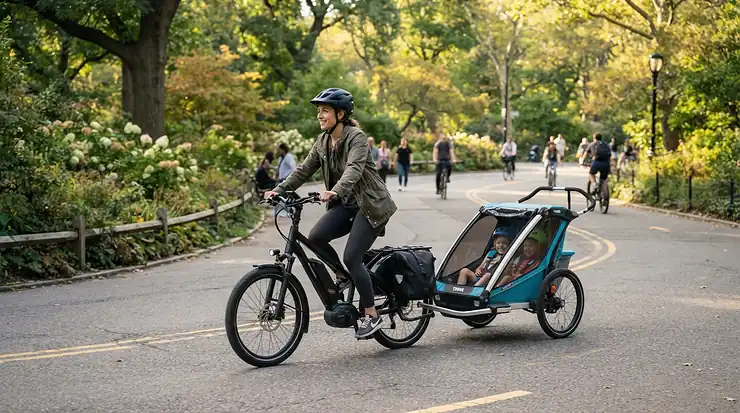
Start with what a rear-mounted seat needs. Leoguar, an e-bike maker, says the rack must bolt to the frame rather than clamp to the seatpost, and that its weight rating, often stamped on the rack, is a hard limit. Retrospec’s listing for the Thule Yepp 2 Maxi adds that the seat wants an ISO 11243-compliant rack, with a 40 lb child maximum and a 7.7 lb seat.
Then check what the bike maker permits. Specialized’s addendum says its bikes are designed and tested for one person and bars child carriers on carbon or composite parts. In one forum thread on the Cannondale Topstone, the original poster quoted the carbon Topstone Neo Carbon Lefty 3 manual as not allowing child seats, trailers or racks, while other posters said the rear end relies on frame flex, which is why racks and seats are a bad fit. A Bicycle Habitat listing for Trek’s CheckOUT SL rear rack says it is not intended for child carriers and caps the load at 22 lb; the listing does not say which bikes it fits, so treat it as a sign of Trek’s caution rather than a verdict on one model. A Giant-group manual, seen in its Liv-branded edition, tells owners to follow the seat maker’s instructions, never modify original parts, and stay inside both the carrier’s capacity and the bike’s total permissible load.
None of the maker pages for the Checkpoint+ SL, Turbo Creo 2 or Topstone Neo 5 lists a child seat as approved. That leaves two aluminum bikes with rack mounts, the Giant Revolt E+ and the Topstone Neo 5, as the only ones worth a dealer question.
A hypothetical worked example shows why payload alone does not settle it. A 170-pound adult, a 7.7-pound seat and a 40-pound child total about 218 pounds, close to the CF Racer1‘s 225 lb limit before a single pannier goes on. Local rules vary as well, and Specialized’s addendum says they are especially likely to apply to electric and pedal-assist bikes. This is background, not legal advice. The electric gravel bike best suited to a family is simply the one whose maker approves the seat in writing.
Best electric gravel bikes, matched to the way you ride
Model
Frame
Motor and battery
Rear rack mounts
Giant Revolt E+
ALUXX SL aluminum
Shimano EP8, 85 Nm, 500 Wh (Giant’s release); some 2026 trims list Yamaha-built SyncDrive Sport2
Integrated, per Giant
Cannondale Topstone Neo 5
SmartForm C1 alloy
Bosch Performance Line CX, 85 Nm, 500 Wh
Rack and fender mounts, per Cannondale
Trek Checkpoint+ SL
OCLV 500 carbon
TQ HPR60, 60 Nm, 360 Wh
Many mounts, including triple rack mounts on the fork
Specialized Turbo Creo 2
FACT 11r carbon
SL 1.2, about 50 Nm and 320 Wh per Upway, 160 Wh extender
Rack, fender and fork mounts
Ride1Up CF Racer1
Carbon
250 W hub, 42 Nm, 252 Wh
Mounting points for Ride1Up’s Connect+ rack
The two aluminum bikes carry the biggest batteries and the heaviest frames, while the three carbon bikes trade capacity for lightness. Motors differ more in character than in raw numbers: a mid-drive adds torque where you need it, and the hub motor on the CF Racer1 keeps cost and weight down.
A child seat narrows the field to aluminum, and the Giant is the clearest candidate. Its launch release, as published by eBikes International, describes a reengineered ALUXX SL aluminum frameset with integrated rack mounts for fenders, racks and other accessories, a Shimano EP8 motor with 85 Nm, and a 500 Wh EnergyPak that accepts a range extender.
BikeRadar’s test put real numbers on it. The bike weighed 18.17 kg, and a 90 kg rider carrying a bottle and bar bag covered 73.7 miles with 2,035 m of climbing, mostly off-road on warm spring days. He rarely went above assist level three, shifting to the 42-tooth cog and level five for steep climbs. Tires clear up to 53 mm, and the bike ships with 40 mm tubeless Maxxis. The review’s cons are weight and price.
Specs drift by year and market, so read the label. Retailers list a 2026 Revolt E+ 1 with a SyncDrive Sport2 motor, and they disagree on the pack: one lists 400 Wh, another 625 Wh. A forum poster on Electric Bike Review says a friend’s aluminum Revolt E+ takes a rack and fenders, and no post in that thread describes mounting a child seat. No page opened for this article gives a rack load rating, which is the number to ask a Giant dealer for in writing. Check the current price on Amazon.com.
Tire clearance is where this one is murky. Cannondale’s page lists a stock 700x36c tire, then gives a 40 mm maximum in one place and 42 mm in another, though it says 650 wheels with 48 mm tires fit. Upway’s reviewer thinks 45 mm is the minimum for long gravel days and calls the alloy model’s 42 mm potentially harsh on rough, long rides.
The rest is practical. The SmartForm C1 alloy frame carries a removable downtube battery, rack and fender mounts and a 12×142 thru-axle, with a Bosch Performance Line CX, 85 Nm and a 500 Wh PowerTube claimed at up to 70 miles. Upway says US versions are Class 3 with assist to 28 mph, and a Ride Review listing puts the bike near 40 pounds.
Owner evidence comes from a forum, where one member reports bolting on a Racktime rack with integrated lights wired into the Bosch system, plus SKS Chromoplastic fenders that clear 700×36 and 650B 1.9-inch tires. The same poster saw no Cannondale-specific racks for the model. The carbon Neo bikes are a different story, as the child-seat section above showed, so confirm that Cannondale will approve a child seat on the aluminum frame before buying one. Upway calls the family pricey when bought new and notes that refurbished examples can offer better value, which is a seller’s view. Check the current price on Amazon.com.
Expect to spend roughly $6,000 to $8,000, according to Cyclingnews and BikeRadar launch coverage of the three trims. The SL 5 has a Shimano GRX mechanical drivetrain and a rigid fork, the SL 6 AXS adds SRAM GX AXS, and the SL 7 AXS brings a 40 mm RockShox Rudy fork and carbon wheels.
All three share a TQ HPR60 motor with 60 Nm and 350 W peak, a 360 Wh internal battery and a claimed 50 miles in Eco, according to Electrek and BikeRadar. A 160 Wh bottle-cage extender adds up to 44% more range. Tire clearance is 50 mm, and the frame has mounts for racks, fenders and bags, though no in-frame storage because the battery fills the down tube.
Real-use evidence leans cautious. BikeRide’s roundup of reviews says motor drag and system weight make riding without assistance impractical, and it treats the 50-mile claim as reasonable while saying an extender is likely needed to get the most from the bike. Upway’s write-up adds that the bike is not built for remote backcountry trips. Gran Fondo’s group test weighed the SL 7 AXS at 14.16 kg in size M and noted that the small battery is a deliberate trade for a natural ride feel. Two separate outlets, then, describe the same compromise: a light feel bought with a modest pack.
Pros:
✅ A quiet, compact mid-drive on a carbon frame with rear IsoSpeed
✅ Clearance for 50 mm tires and plenty of bike-bag mounts
Cons:
❌ Small 360 Wh pack, so heavy assist on climbs shortens a day quickly
❌ No source states that Trek approves a child seat on this carbon frame
Weight is the argument for this bike. Launch-build listings on 99spokes run from 28.6 to 31.9 pounds across three builds, and Specialized’s own page lists 14.47 kg for a size 56 build with the SL 1.2 system. The maker’s S-Works page claims up to 120 miles, and Bikerumor says the 160 Wh range extender adds roughly 50% more.
Expect between roughly $6,500 and $14,000 across the three launch builds, per 99spokes. Bikerumor lists rack, fender and fork cargo mounts and a 125 kg (275 lb) limit for rider plus cargo.
Reviewers largely agree. BikeRide’s roundup scores the bike 91 out of 100 across five rated expert reviews, with testers disappointed mainly by the relatively high weight for a premium e-road build. One owner on Specialized’s own page reports adding a Tubus rack and seeing range in line with the advertised figure after about 200 miles, a single account rather than a trend. The rack mounts are real, yet Specialized’s addendum still bars child carriers on carbon or composite parts, so the mounts serve panniers, not seats.
Budget is the whole case here. Electric Bike Review puts a full carbon bike at around $2,300 and about 28.6 pounds, with a 250 W Bafang rear hub motor making 42 Nm, a hidden 252 Wh battery and assist to 28 mph. It ships with Continental 700x40c tires, and the page lists frame clearance up to 50c; the reviewer notes some owners have fitted 50c and advises checking with Ride1Up first.
The pack is small, so range swings with assist. Electric Bike Report measured 47.6 miles on the lowest assist level and 15.3 on the highest, a difference of more than thirty miles on one bike. Rear mounting points take Ride1Up’s Connect+ rack and pannier bags.
Pros:
✅ About 28.6 pounds, matching the lightest Turbo Creo 2 build, at a far lower price
✅ Clean hidden battery, smooth linear assist and name-brand parts
Cons:
❌ A one-piece handlebar and headset limit fit changes, and the wheels are not tubeless-ready
❌ The rear wheel uses a bolt rather than a thru-axle, and the 225 lb payload excludes many buyers
A carbon frame and that 225 lb limit take this bike out of the child-seat conversation entirely.
Giant vs Trek gravel bikes: how the electric versions compare
Compare Trek vs Giant gravel bikes by frame first. Giant’s Revolt E+ is aluminum with a Shimano-based system in its launch spec, while Trek’s Checkpoint+ SL is carbon with a TQ mid-drive. The Giant carries 500 Wh in BikeRadar’s test and up to 625 Wh on some retailer-listed trims; the Trek holds 360 Wh plus an optional 160 Wh extender.
Weight follows the frame. BikeRadar weighed the Giant at 18.17 kg, while a Trek retailer listing gives 13.76 kg for the SL 6 AXS in size ML and Gran Fondo measured the SL 7 AXS at 14.16 kg. That gap of roughly four kilograms reflects the Giant’s aluminum frame and larger pack.
Upway’s brand comparison says both makers sell through large dealer networks and that the local shop often matters more than the badge. It describes Giant as competing on value because it builds many of its own parts, and Trek as often priced slightly higher. In the US, Electrek and BikeRadar report the Checkpoint+ SL as Class 3 up to 28 mph, while Upway says Giant’s class varies by model and region.
One piece of reasoning, not a sourced finding: forum posters explain the Cannondale rack warning by pointing at frames engineered to flex at the rear. Trek’s IsoSpeed decoupler is also designed to flex, so any rear accessory on the Checkpoint+ SL is a question for Trek, not an assumption.
Choose by use. Racks, fenders, bigger battery and a possible child seat point to the Giant. Lower weight, 50 mm tires and a quiet motor point to the Trek.
Electric gravel bikes reviews: where testers agree and where claims slip
Weight is the repeated complaint. BikeRadar calls the Revolt E+ not lightweight, BikeRide reports testers disappointed by the Turbo Creo 2‘s relatively high weight, and the same site’s summary flags motor drag with assist off on the Checkpoint+ SL.
Range claims slip next. Trek claims 50 miles in Eco, BikeRide calls that reasonable while suggesting an extender, and Electric Bike Report’s 47.6-versus-15.3-mile test of the CF Racer1 shows how far assist level moves the number. BikeRadar’s 73.7 miles came on a larger 500 Wh pack, a 90 kg rider and warm spring weather. Count the assist you will use, not the figure on the box.
Price draws the third complaint. BikeRadar calls the Revolt E+ expensive, and Upway, which sells certified pre-owned bikes, says new examples from brands like these run high and advertises savings of up to 60% off retail. Treat that as a seller’s claim and compare condition and warranty before buying used.
Three ways an e-gravel purchase goes wrong
Buying carbon, then planning a child seat. The manual language above is blunt, and Specialized says to stop riding and have a retailer inspect the bike if a carrier was already attached to a carbon part.
Trusting range from a different kind of ride. A claim that holds on pavement stops holding once climbs, wind and soft tires enter the route. Choose the pack for your hills and plan on an extender if the bike supports one.
Skipping the support question. The CF Racer1‘s bolt-on rear wheel needs a 15 mm wrench, a detail that matters on a trailside flat. Dealer-supported brands such as Trek and Giant bring a shop that can service the motor, which Upway says often matters more than the badge. Battery rules are also moving: the Consumer Product Safety Commission published a proposed rule that would require e-bike electrical systems to meet UL 2849 and separately sold packs to meet UL 2271, with added tamper-resistance and charging tests. Comments closed August 24, 2026, and the portion of the notice retrieved states no compliance date, so it is a proposal to watch rather than a rule in force.
Child seats, class limits, weight and range: short answers
❓ Can you put a child seat on an electric gravel bike?
✅ Only if the maker approves it for that exact bike. Specialized's addendum bars child carriers on carbon parts, and a forum-quoted Cannondale carbon-model manual prohibits them. Start with aluminum frames that have rack mounts, then ask the dealer for the rack's load rating.
❓ Are electric gravel bikes Class 3 in the US?
✅ Many are. Trek's carbon e-gravel bike ships as Class 3 in the US with assist to 28 mph, and Upway says Cannondale's US e-gravel line is Class 3 as well. Giant's class varies by model and region, so read the label and check local trail rules.
❓ How far can an electric gravel bike go on one charge?
✅ Makers claim from 50 miles on a compact 360 Wh pack in Eco to 120 miles on a Specialized page, but tests spread wider. Electric Bike Report logged 47.6 miles on one budget model's lowest assist and 15.3 on its highest. Gravel, climbing and wind cut range.
❓ How heavy are electric gravel bikes?
✅ Listings and tests run from about 28.6 pounds for a budget carbon model, through roughly 29 to 32 pounds for premium carbon builds, to around 40 pounds for the aluminum Giant BikeRadar tested at 18.17 kg. Weight matters most when assist is off.
❓ Is Giant or Trek better for a first electric gravel bike?
✅ Giant's aluminum e-gravel bike suits buyers who want racks, fenders and a larger battery; Trek's carbon one suits riders chasing lower weight and a compact TQ motor. Upway's brand comparison says the local shop often matters more than the badge, so weigh service nearby.
Choosing among electric gravel bikes: a decision rule
Pick the frame before the motor. If a child seat is in your plans, start with the aluminum Giant Revolt E+ or Topstone Neo 5, and get the rack’s load rating and the maker’s child-seat position in writing. For solo riding with dealer support, the Checkpoint+ SL offers 50 mm tires and a quiet motor, while the Turbo Creo 2 suits riders who want a light premium build and accept the cost. A light rider on a tight budget can look at the CF Racer1, mindful of its 225 lb payload.
For electric gravel bikes in 2027, the sensible order is frame material, payload, battery and then price. Compare the exact model number before buying, since trims and motors shifted from year to year on the Giant and Cannondale lines.
Disclaimer: This post contains affiliate links. As an Amazon Associate, I earn from qualifying purchases made through these links, at no additional cost to you.
Get the rack rating and the child-seat answer in writing before the seat ever touches the frame.
At NextGenEBike, we are passionate about the future of mobility. Our team of experts provides in-depth reviews, comparisons, and buying guides on the latest electric bikes, ensuring you stay ahead in the world of eco-friendly transportation.