The best bike rain gear is a chain of small decisions that starts at your wheels and ends at your hood, and a jacket alone covers only the last link. For 2027, this guide follows a wet commute in order: how much waterproofing the rain demands, which fenders keep spray off your legs, how men’s jackets and pants fit, how to shield a rear box on an e-bike, and why belt drives and hub gears suit soggy roads. Four products close the guide, each tied to one step.
The findings lean on published tests from Cyclingnews, BikeRadar and Bikepacking.com, maker pages, shop listings and owner threads on Bike Forums. Nothing was worn or ridden for this piece, so every remark about comfort or wear belongs to a named tester, and prices appear as ranges because the current figure on Amazon.com may differ.
From wheels to hood: the order that keeps a wet commute dry
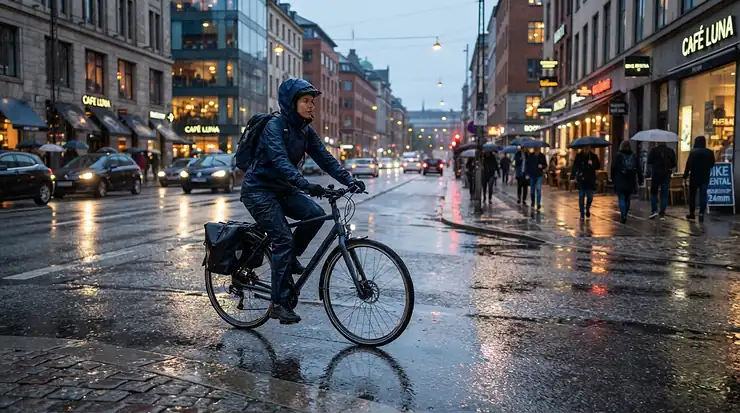
Rain reaches a rider from three directions: from above, from the front wheel’s spray, and from the rear wheel’s spray onto whatever rides on the rack. Each step below blocks one of them.
Read the fabric numbers, then the seams and cuffs
Start with the number on the tag, then stop trusting it. BikeRadar’s jacket tests explain that a millimeter rating measures only the fabric, while seams, zips, collars and cuffs decide how dry you stay. Bikepacking.com offers a workable scale in its rain-pant testing that carries over to jackets: under 10,000 mm suits light rain, 10,000 to 15,000 mm suits moderate rain, and above 15,000 mm suits heavy rain.
Breathability is the price of sealing everything. BikeRadar notes that taping seams improves waterproofing but lowers breathability, and its tester found the untaped Velobici Alfred breathed better for exactly that reason, at the cost of being less impermeable.
The labels can mislead in both directions. The Altura Icon Pocket Rocket carries a 10,000 mm rating and wetted out slightly in extreme rain without letting water through, while the Van Rysel Racer Ultralight handled medium showers but was overwhelmed in heavy rain. Each is a single tester’s finding, yet both point to the same rule: judge a shell by the longest, hardest rain you ride in.
One maintenance fact belongs here too. The water-repellent finish, known as DWR, wears off over time, and BikeRadar says it can be refreshed at home by following the maker’s care instructions. The same review reported that the Gore Torrent showed no wetting out even after repeated washes with tech-wash, so washing a shell is routine care, not a risk.
Fenders come before jackets
A full-wrap fender covers roughly 60% of the wheel and adds a mudflap, according to bike-size.com’s 2026 fender guide, while clip-on models cover 25 to 40% and saddle-only guards protect little beyond the seat. The same guide advises choosing a fender at least 8 to 10 mm wider than the tire.
Bolt-on fenders need eyelets on the frame and fork. Where those are missing, strap-on sets are the workaround: Electric Bike Journal found the SKS Speedrocker quick to fit and easy to move between bikes, with a limit of 42 mm tires on 700c or 650b wheels (52 mm for the XL version) and compatibility with disc brakes only. For an e-bike on wide tires, that width ceiling is the first number to check.
Longevity reports come from commuters. In a Bike Forums fender thread, one poster describes running Planet Bike Cascadia fenders on two bikes for 13 to 15 years, and several others say SKS and Planet Bike’s top plastic fenders perform about the same. A different poster found SKS fenders unpleasant to install, a theme that returns in the SKS entry below.
Bike rain gear for men: cut, sizing and cuffs
Men’s cuts vary enough between brands that the same size can fit differently. BikeRadar’s testers found the Gore Torrent slim and short, so riders with larger chests may need to size up, and Cyclingnews called the Endura Pro SL tight through the shoulders for broader riders.
Pants add their own sizing problem. Bikepacking.com’s tester found the slim PEdALED Odyssey Waterproof Pants stretched noticeably after hours in the rain and suggests sizing down when between sizes. The site’s general advice is to aim for a middle fit, since overly slim pants limit layering and baggy ones interfere with pedaling, and it praises ankle zips because they let you pull pants over shoes.
Cuffs are where bike rain gear for men meets the drivetrain. Windrider’s commuter guide recommends full rain pants with a snug ankle cuff or reflective strap to cinch the fabric away from the chain. Oil matters as well: Bikepacking.com’s rain pants roundup warns that chain lube can contaminate the membrane of Gore-Tex ePE pants, which is why those need regular washing.
An e-bike back box rain guard has two weak points
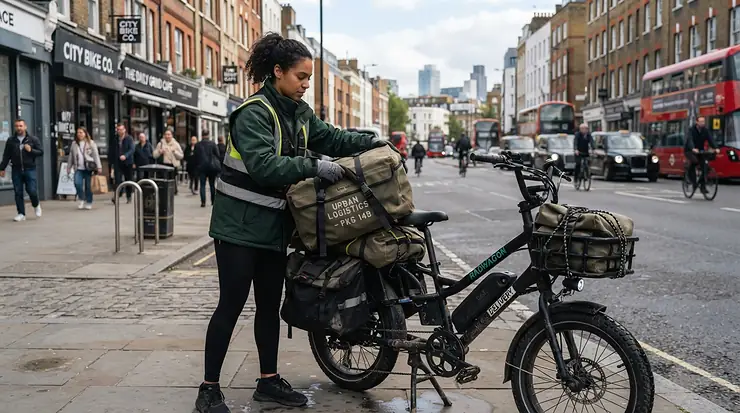
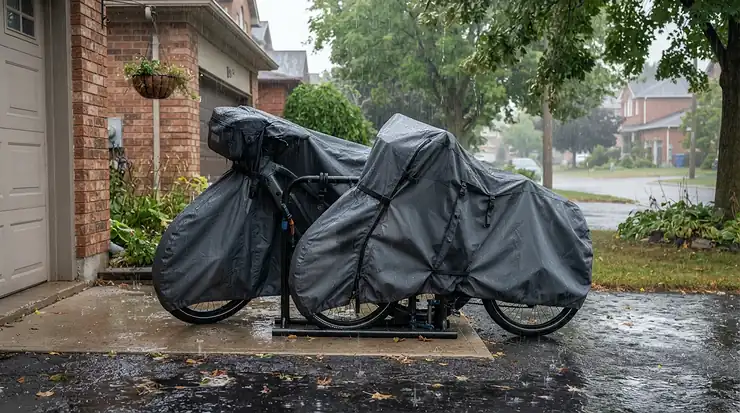
A rear trunk bag rides above the rear wheel, so it gets wet from the sky and from the road. Some bags ship with their own covers, such as the ROCKBROS Large Capacity Bike Carrier Bag, whose listing at E-Bike Super Shop mentions a green rain cover and reflective straps. Others sell the cover separately, as Topeak does for its MTX trunk bags.
A buyer on a desertcart listing for the Topeak cover reasoned that the weak points sit where the bag meets the rack at the front and where road spray flies up from the rear wheel beneath the rack. Another buyer found the cover fitted poorly near the seat, while a third said it slips on in seconds and folds into a tiny packet. Those reports conflict, which is why the entry below pins the fit to specific bag models.
Belts and hub gears in the rain, and the lightest belt drive internal gear hub bike
Water and road grit are hard on chains. Tern says the Gates belt on its bikes needs no grease or lubrication, stays clean and dry, and will not rust, which it presents as an advantage on wet or icy salted roads. Tern’s belt drive page adds that the belt and both sprockets weigh less than the chain they replace, and that the belt does not stretch and lasts twice as long. Cycling About observes that gearbox cogs sit sealed away from the elements, which is the other half of the rainy-day argument.
Weight is the cost. Cycling About’s drivetrain weight comparison puts the Shimano Alfine 11 belt drivetrain at 3,058 g, against 2,247 to 2,581 g for SRAM 1x derailleur groups, and the Rohloff 14-speed at 3,125 g with a belt versus 3,194 g with a chain. Its author counts a 70 g saving for the belt over a chain and estimates roughly 10,000 km from a chain against 25,000 km from a belt.
So the hunt for the lightest belt drive internal gear hub bike is really a hunt for the lightest hub, because the belt trims grams and the hub adds them. Two data points show the range. Bike Magazin lists the KTM Macina Superbelt SX 10 Di2, a 2027 model-year e-bike, at 22 kg according to the maker with mudguards, lights, a rack and a kickstand fitted, pairing a Shimano Alfine Di2 eight-speed hub with a Gates CDC belt; the review does not test the drivetrain in rain. At the other end, a Weight Weenies builder put together a drop-bar belt-and-hub winter bike at 12.0 kg to avoid cleaning and lubing a chain on salty roads, while admitting that belt durability was still unknown, and one reply pointed out that the hub alone weighs 1,665 g.
Matching the best bike belt carbon rear gear to your hub
A carbon belt needs a matching rear cog, and the best bike belt carbon rear gear is simply the Gates CDX CenterTrack cog made for your hub. Modern Bike’s listings show it sold for Enviolo, Shimano Alfine and Nexus (3-lobe SureFit), Di2 (6-lobe), Rohloff-splined and Hyperglide hubs, in tooth counts from 19 to 28, at roughly $95 to $130. The shop describes the CDX:EXP version as offering 25% more wear surface.
Two compatibility rules prevent expensive mistakes. A CDX belt works only with Gates CDX CenterTrack cogs and sprockets, and BikeParts.com lists the frame requirement: a split or opening in the rear triangle so the belt can loop through. Rose Bikes adds a handling rule: remove the rear wheel when changing a belt, and never roll the belt sideways onto the cog or pry it on with a lever.
Where bike rain gear reviews agree, split and mislead
Read side by side, bike rain gear reviews agree on three points. Seams, zips and cuffs matter as much as the fabric rating. Waterproofing and breathability pull against each other. And commuting punishes a shell harder than other riding, in the view of Cyclingnews’ long-term POC tester, who also considers a plain jacket without tabs, toggles and extra zips an advantage for that reason.
They split on storage. BikeRadar lists several premium shells with no pockets at all, including the Bontrager Velocis Stormshell, the Maap Atmos and the Rapha Core Rain II, a drawback for anyone carrying a phone and keys.
Most of the mistakes that follow are predictable:
Buying on the millimeter rating alone, then finding a leaking zip or soggy cuffs. Check the seams, collar and cuffs before the number.
Choosing slim rain pants and finding they stretch after hours of rain. Size by the tester’s advice, and prefer a middle fit.
Fitting fenders without tire clearance. SKS recommends at least 1.5 cm between tire and fender.
Letting chain oil reach Gore-Tex ePE pants. Wash them regularly, as Bikepacking.com advises.
Buying a rack-bag cover that was cut for another bag. Match the cover to the bag’s model name.
The best bike rain gear for each step: four tools to buy
Each product below maps to one step above. Prices are ranges from shop listings and reviews, so confirm the current price on Amazon.com.
Commuting is rough on a shell: backpack straps, locks, rack bags and daily folding. Cyclingnews’ long-term tester used the POC Motion Rain Jacket for well over a year and named it the best commuter jacket, praising a design with no tabs, toggles or extra velcro. Road.cc describes a three-layer nylon build rated at 20,000 mm with a fluorocarbon-free DWR and a hood sized for use under a helmet, and calls the breathability a step below the waterproofing. US dealers list the men’s version between $270 and $300, and a French test site says the men’s range runs from S to XXL.
Pros:
Thick face fabric that Cyclingnews says handles daily commuting wear
Helmet-compatible hood and ventilation zones under the arms
A casual cut that passes for ordinary outerwear off the bike
Cons:
The main zip is not waterproof, so an internal storm flap does that job
Arms can run short for long-armed riders because the cut leans toward mountain biking
It runs warm on hard efforts and costs more than most commuter jackets Cyclingnews tested
Cyclingnews adds that it is not the jacket for a road bike with an aggressive fit. Check current availability on Amazon.com for men’s sizes.
POC Motion Rain JacketSee current price, sizes and reviews on Amazon.
These cost a lot, and the sources disagree about how they cope with rain. The Patagonia Dirt Roamer Storm Pants weigh 295 g and use a three-layer H2No shell. Bikepacking.com lists the waterproof rating at 10,000 to 20,000 mm, named them its most durable pick, and reports one tester wearing them for nearly two years. BikePerfect’s reviewer found the DWR still beading after several washes and the fit excellent, while noting the price takes a sizeable bite, at around $300.
Against that, one of two ratings on Backcountry’s listing, dated 2021, reports a soaked seat after a mile of steady rain. Both ratings on that page are a single star, so the sample is tiny, but it contradicts the praise, and the care label deserves attention: Patagonia’s page gives machine wash warm and tumble dry low.
Zippered leg openings let you pull them over shoes, two waterproof zippered thigh pockets carry a phone, and the fit leaves room for a light layer underneath. They are heavier and bulkier in a saddlebag than the lightest pants Bikepacking.com tested. Pair them with an ankle strap if the cuffs sit near your chain.
Patagonia Dirt Roamer Storm PantsSee current price, sizes and reviews on Amazon.
Between $75 and $85 buys full-wrap coverage, and The Sweet Cyclists’ review prices the plain and Style versions in that range. The SKS Bluemels Style Fender Set reviewed there came in a 700 x 28-37 size for tires from 28 to 37 mm, so e-bike riders on fatter rubber should look for the wider variants; bike-size.com says the 53 mm Bluemels fits tires from 28 to 47 mm. Coverage runs 960 mm at the front and 1,300 mm at the back, with extended mudflaps and a flexible rear spoiler on the Style version, though riders behind you may still catch some spray.
Installation is the sticking point. The reviewer needed about 30 minutes before fine-tuning, the struts may need cutting, and the Style version lacks the cutout that eases rear mounting. SKS recommends at least 1.5 cm of tire clearance.
Pros:
Aluminum core under a plastic coating, light but rigid in wet weather
Adjustable for many frame geometries, with break-away safety struts
Extended mudflaps on both fenders
Cons:
Slow, fiddly bolt-on setup that needs frame and fork eyelets
The Style set weighs about 843 g, against 566 g for the standard set
The reviewer scored it 8.7 out of 10. Check current availability on Amazon.com for the width that matches your tires.
SKS Bluemels Style Fender SetSee current price, sizes and reviews on Amazon.
Compatibility comes first, because the cover is cut for particular bags. Topeak’s page lists item TRC006 for the MTX TrunkBag DXP and EXP, the MTS TrunkBag DXP and the MTM TrunkBag DXP, made of 190T nylon, and retailers say it folds into its own storage pouch. Compare the exact model number of your bag before buying.
Buyer comments on the desertcart listing split. One calls it a glove-like fit with both side panels out or in, another says it fits poorly near the seat, and a third finds it slips on in seconds. As a back box rain guard for e-bike racks, it covers the bag itself but not the splash that reaches the rack joint from below, which the reviewer quoted earlier flagged as a weak spot, so a rear fender with a mudflap is a sensible companion. One retailer lists the package at 0.08 kg, so it adds almost nothing to a pannier. For the current price, check Amazon.com.
Topeak Rain Cover for MTX TrunkBag EXP & DXPSee current price, sizes and reviews on Amazon.
Wet-weather riding: quick answers on pants, fenders and belts
Do I need rain pants for a short bike commute?
Not always. Windrider's commuter guide calls full rain pants with snug ankle cuffs the most coverage for keeping work clothes dry, while Bikepacking.com says ratings under 10,000 mm suit light rain. For a short ride in showers, fenders plus a jacket may be enough.
Are full fenders better than clip-on ones?
Coverage favors full-wrap fenders, which cover roughly 60% of the wheel against 25 to 40% for clip-on sets, according to bike-size.com. Clip-ons install in minutes and suit bikes without eyelets, but expect more spray. Match fender width to tire width either way.
Does a belt drive work well in the rain?
Tern says its Gates belt needs no lubrication, stays clean and dry, and will not rust, which it presents as a plus on wet or salted roads. The frame must be belt-compatible, with a split in the rear triangle, so check before buying.
Will a rain cover protect an e-bike back box?
Only if it matches the bag. Topeak's cover fits the MTX TrunkBag EXP and DXP, among a few other models, and buyers disagree on fit near the seat. One reviewer also noted that spray from the rear wheel can still reach the joint where the bag meets the rack.
How do I keep a cycling rain jacket waterproof?
Wash it as the maker directs. BikeRadar says the DWR finish wears off over time and can be refreshed at home, and Bikepacking.com warns that chain lube can contaminate Gore-Tex ePE membranes. Keep oily cuffs and chains away from the fabric.
Start at the wheels, finish at the hood
For a wet commute, spend in this order: fenders sized to your tire width, a shell whose seams and cuffs suit the longest rain you ride in, pants with ankle zips and a strap that keeps fabric clear of the chain, and a cover that matches your rack bag. Bike rain gear that skips any one of those leaves a gap the others cannot fill. Riders weighing a belt drive should confirm the frame split and the Gates CDX cog for their hub before anything else, since those two details decide whether the swap works at all. The four products above map to the steps one for one, and each carries a trade-off named in its entry. Check current availability on Amazon.com for sizes and models before the forecast turns.
Disclaimer: This post contains affiliate links. As an Amazon Associate, we earn from qualifying purchases made through these links, at no additional cost to you.
Pack the cover before the clouds roll in, and ride dry.
NextGenEBike is an independent buying-guide site for electric bikes, motors, batteries and accessories. Our editorial team compares products using manufacturer specifications, independent tests from specialist e-bike media, owner reports and retailer listings. We do not claim to have tested the products ourselves; see How We Choose Gear for our method.