As an Amazon Associate I earn from qualifying purchases. Links in this article may be affiliate links. How we choose gear
The right ebike chains match your cassette’s speed count and carry an e-bike rating: the KMC e11 EPT suits 11-speed mid-drives, the KMC e10 EPT and Shimano CN-E6090-10 cover 10-speed bikes, and the KMC e12 EPT handles 12-speed eMTB setups. Hub-gear and single-speed bikes need a single-speed chain in the right width, which is where the KMC e1 EPT comes in. Two lubes round out the list, because a worn chain left running eventually costs you a cassette, and Park Tool notes that the cassette is the far pricier part.
Heading into the 2027 riding season, this guide also tackles the questions that gather around the purchase: whether Lucas lube belongs on an ebike, how often to lube, and whether a belt drive or a bike with no chain is the smarter route. Maker spec pages, Amazon listings, Park Tool’s wear guidance and two long Electric Bike Review threads carry the evidence, and none of these chains was bench-tested for this article.
What the shortlist had to clear
Four filters decided who made the list. The chain had to be sold by its maker for e-bike use, its speed count and pin width had to be stated plainly, its closure (quick link or pressed pin) had to be known, and a live amazon.com listing had to exist.
Speed count matters more than brand. KMC’s own guidance says to match the chain to your drivetrain speed and adds that standard chains may wear faster under motor torque. Pin length falls as speeds rise in KMC’s e-series: 5.88 mm on the 10-speed, 5.65 mm on the 11-speed and 5.2 mm on the 12-speed.
Coatings and closures split the rest. KMC rates its EPT coating at over 650 hours of salt spray, while Shimano’s Sil-Tec treatment targets friction and wear. Most KMC picks ship with a single-use MissingLink, whereas Shimano’s chain needs a pin pressed in with a chain tool.
Speeds, pin sizes and closures across the shortlist
| Pick | Fits | Pin length | Closure | Price tier |
|---|---|---|---|---|
| KMC e11 EPT | 11-speed derailleur | 5.65 mm | Single-use MissingLink | Around $45 to $65 |
| KMC e12 EPT | 12-speed (not SRAM flat-top) | 5.2 mm | Single-use MissingLink | Around $85 to $115 |
| KMC e10 EPT | 10-speed derailleur | 5.88 mm | Single-use MissingLink | Around $45 to $60 |
| Shimano CN-E6090-10 | 10-speed, single chainring | Not listed | Pressed pin | Around $45 to $70 |
| KMC e1 EPT | Single-speed and hub gear, 3/32″ | 6.7 mm | Single-use MissingLink | Around $40 to $70 |
The 12-speed chain sits at roughly twice the shelf cost of the 11-speed one (our arithmetic from the ranges above), and that gap is the biggest price step on the list. Shimano’s chain is the only pressed-pin design here. The KMC e1 EPT is the only pick that fits a hub-gear bike, and its 3/32-inch width does not interchange with the 1/8-inch KMC e101 EPT covered in its entry.
Spotted your speed count in the table? Check current availability below, since several of these ship in more than one link count.
Best ebike chains for each kind of drivetrain
1. KMC e11 EPT — the default for 11-speed mid-drives
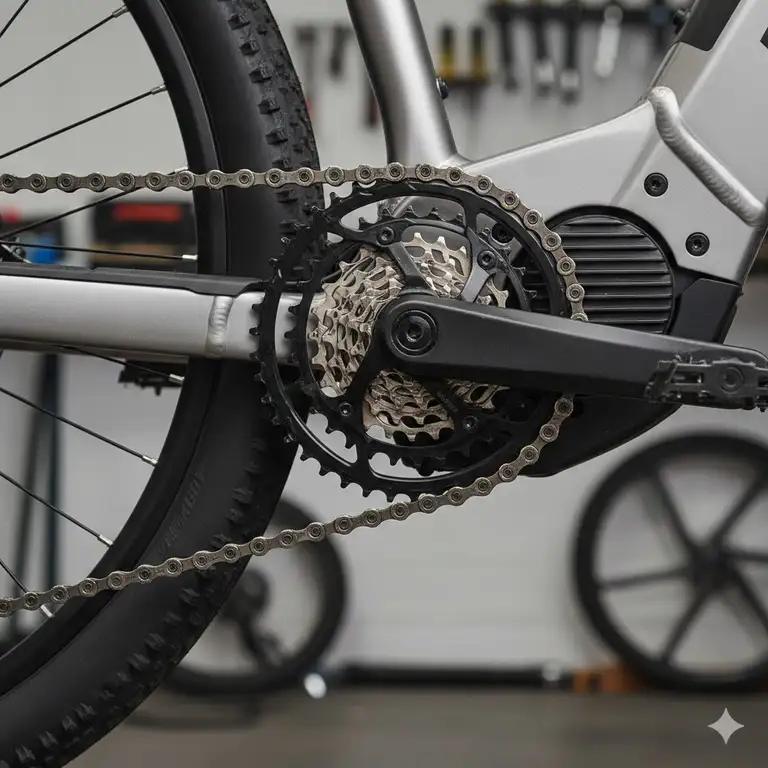
If your cassette has eleven cogs and a Bosch, Brose or Yamaha motor turns the cranks, the KMC e11 EPT is the chain KMC itself points to. KMC’s US page calls it the best choice for 11-speed e-bikes, citing Double X-Bridge plates for precise shifting and a build meant to withstand e-bike torque, with the EcoProTeQ coating added for rust resistance. The spec sheet reads 1/2″ x 11/128″ with a 5.65 mm pin.
Length is the practical detail. The 136-link version is cut for long chainstays, while Amazon also carries 118-, 122- and 126-link versions of the same chain, so a shorter frame means trimming or buying the shorter one. Weights are another loose end: one German retailer prints 247 g from the manufacturer and 308 g on its own scale, so treat gram figures as approximate. Expect roughly $45 to $65 depending on link count and seller.
Pros:
- KMC lists compatibility with Shimano and SRAM 11-speed systems
- Non-directional, so there is no wrong way to install it
- EPT coating suits wet-weather commuting
Cons:
- The MissingLink is single-use, so reopening the chain later means a fresh link
- The 136-link version needs trimming on shorter frames
2. KMC e12 EPT — twelve speeds for hard-working eMTB motors
At around $85 to $115, the KMC e12 EPT is the most expensive chain here, and the money buys a narrower 5.2 mm pin for 12-speed cassettes. KMC describes it as one of the best 12-speed e-bike chains for mountain bikes with powerful motors. Trek’s product page for the e12 Turbo EPT adds that its tensile strength exceeds the international standard by over 30% and repeats KMC’s lifespan estimate of 7,500 km (4,660 miles), which is a maker projection rather than a test result.
Compatibility has one exclusion. Amazon’s listing says the chain fits all 12-speed derailleur systems except SRAM systems that use flat-top chains. Listings also use e12, e12 EPT and e12 Turbo for what appears to be one family, with 130- and 136-link counts, so match the model code and link count to your cassette before ordering. Amazon pages list weights from 239 g for the gold version to 282 g for the dark silver EPT one.
3. KMC e10 EPT — a long 136-link chain for 10-speed
Listings disagree about what the KMC e10 EPT weighs: Merlin Cycles prints 321 g for 136 links, while Nashbar lists 273 g. The pin matters more. At 5.88 mm it is the longest in KMC’s e-series here, sized for 10-speed Shimano, SRAM and Campagnolo drivetrains, and bike24 says it was optimized for strong mid-motors such as Bosch, Panasonic and AEG.
Ten speeds also carry a gentler wear rule. Park Tool puts replacement for 10-speed and fewer at 0.75% stretch, against 0.5% for 11-speed and up, so a 10-speed chain can stay on a little longer before it threatens the cassette. Amazon sells it in at least 122- and 136-link lengths, around $45 to $60.
4. Shimano CN-E6090-10 — Sil-Tec plating for Shimano STEPS bikes
Built around Shimano’s STEPS drive units, the Shimano CN-E6090-10 is a 10-speed HG-X chain with Sil-Tec treatment on the pins and both plate types. Shimano’s comparison against ordinary zinc-nickel plating, repeated in Halfords’ listing, claims 60% less sliding friction, 2.7 dB less drive noise, 30% better mud shedding and 20% better wear resistance. Those are maker numbers, not an independent test.
One poster on the Electric Bike Review forum compared a Shimano e-bike 10-speed chain with a regular one and reported about 3,000 miles against about 2,500, then judged the extra cost not worth it while allowing that another motor might give different results. That is a single report, but it is a useful brake on assuming that every premium chain pays for itself.
Pros:
- Sil-Tec treatment on pins, inner plates and outer plates
- HG-X shaping aimed at Shimano shifting
Cons:
- Directional, and bike-components says it works only with a single chainring
- Closes with a pressed pin, which Mantel calls harder than a quick link; expect about $45 to $70
5. KMC e1 EPT — a narrow single-speed chain for hub gears
Two widths hide behind the KMC e1 name, and ordering the wrong one is the main risk on single-speed and hub-gear bikes. The KMC e1 EPT is the narrow 1/2″ x 3/32″ chain with a 6.7 mm pin in 110- or 130-link lengths, while the KMC e101 EPT is the wider 1/8″ version with an 8 mm pin and 112 links. Your cog and chainring decide which one fits, not the motor. KMC lists the e1 for hub gears from Shimano, SRAM, NuVinci and Rohloff and for powerful mid-drive city, touring and mountain bikes.
Longevity claims differ by page. KMC’s Amazon copy for the waxed e1 cites 3,500 km or more when paired with a matching KMC narrow sprocket and chainring, while bike24’s page for the e101 quotes up to 10,000 km with KMC’s e-bike cog. Park Tool sets single-speed replacement at 1.0% wear, the most relaxed threshold of any drivetrain. Amazon and US shops run about $40 to $70 for the narrow e1 and about $50 to $75 for the wide e101.
What owners report: 1,000 to 3,500 miles, and why the spread is so wide
One long Electric Bike Review thread on e-bike-specific versus regular chains gives the clearest picture, and it is mixed. The original poster, riding an 85-pound Bafang mid-drive, says a regular chain was nearly finished at about 1,000 miles per their shop, then got around 2,000 miles over two years from a KMC e9 Sport with one or two chain drops and no snapped links. They ride gently and never shift under power.
Another poster measured about 2,500 miles from a regular 10-speed chain against 3,000 from an e-bike one, and on a Trek about 2,000 against 3,500, with cassettes lasting around 8,000 miles (14,000 on a Bosch bike). A third rider on a hardtail got only about 800 km from a KMC e9 before the gears slipped, then about 2,200 km from a SRAM GX with no problems.
Three things follow from those reports. The e-rated premium bought between 20% and 75% more miles in the thread’s own comparisons (our arithmetic: 3,000 against 2,500, and 3,500 against 2,000), so the benefit is real but uneven. Shifting habits matter alongside the chain, since several riders ease off the pedals mid-shift. And wear is measured inconsistently: one poster challenged the shop’s “80% used” estimate because stretch, with 0.75% as the usual replacement point, is the standard yardstick. All figures are self-reported on different bikes and motors.
Park Tool’s replacement guide supplies that yardstick: 1.0% for single-speed, 0.75% for 10-speed or fewer and 0.5% for 11-speed or more, with each drivetrain maker free to set its own limit. The Park Tool CC-3.2 chain checker, which sits around $13, reads the 0.5% and 0.75% marks directly. Park Tool’s point is simple arithmetic: a worn chain chews the cogs, and a cassette costs far more than a chain.
Best chain lubes for ebikes, once the new chain is on
Lube type should follow conditions. WD-40’s e-bike guidance maps a general lube to everyday riding, wet lube to rain, mud and winter roads, and dry lube to dusty or sandy trails. Two brands also sell lubes made for the added load of an electric drivetrain, both with extreme-pressure additives.
6. Muc-Off eBike All-Weather Lube — synthetic oil with extreme-pressure additives
Muc-Off pitches the Muc-Off eBike All-Weather Lube as a synthetic, water-repellent, non-fling oil with extreme-pressure additives and boron nitride, which the brand says forms a stable protective film under high torque. Application is plain: degrease and dry the chain, shake the can, coat every link and keep it off the brakes.
The brand’s FAQ asks e-bike riders to clean and re-lube as often as they can, after each ride if possible, and gives no mileage figure despite the “unrivalled intervals” copy. Amazon’s listing title mentions dry weather conditions while the maker’s page says all conditions, so read the label on the can you receive.
Pros:
- Formulated for e-bike torque, with extreme-pressure additives
- Non-fling formula
Cons:
- No mileage interval from the maker
- Needs a fully degreased, dry chain before application; expect about $13 to $17 for the 250 ml can
7. Finish Line E-Bike Chain Lube — a semi-dry drip for dusty commutes
Dusty towpaths and fair-weather commutes are where the Finish Line E-Bike Chain Lube earns its place. Competitive Cyclist describes a semi-dry formulation with a blend of high-pressure and corrosion-inhibiting additives, and retailers list it as a wax-based, non-petroleum drip lube. Amazon’s Finish Line storefront also shows a newer “Evolve” e-bike lube alongside this one, and prices across shops run about $12 to $18. Retailers list the bottle at 4 ounces, about 118 mL.
Lucas chain lubricant for ebike use: what the label and riders say
Lucas makes the Lucas Chain Lube Aerosol (item 10393), an 11-ounce semi-synthetic spray that Lucas says is designed for high-performance motorcycle chains and sprockets. The maker’s page lists water resistance, rust protection and a protective film, calls it suitable for all chains including O-ring types, and never mentions bicycles. A can runs around $9 to $13 at retailers.
Riders who have tried motorcycle lubes on bikes are split. In an Electric Bike Review thread, a poster who says they work in a bike shop reports sticky buildup that is hard to clean and clogs the pulleys. Another poster uses DuPont Chain Saver on bikes and a motorcycle and reports no measurable stretch after about 1,500 miles on an 11-speed chain, though that is a different product from Lucas. A third argues that motorcycle lubes are made for sealed O-ring chains, while a bicycle chain has open rollers that need oil to work in.
That leaves Lucas as a product nobody has shown to be right for this job. A bike-specific lube costs about the same, and the aerosol format raises the odds of overspray, which matters because WD-40’s e-bike advice says to lube only the chain and never the brake rotors. If a can of Lucas is already in your garage, use it on the motorcycle.
Ebike chain lube intervals? Three signals beat a fixed number
Makers do not agree on a number, so use three signals together.
First, mileage. WD-40’s e-bike guidance gives every 100 to 150 miles as the baseline. Second, conditions: the same page says to lube after wet, dusty or salty rides, and Muc-Off goes further, recommending e-bike owners clean and re-lube as often as possible, after each ride if possible. Third, wear: KMC advises lubricating frequently, checking stretch with a wear tool and doing both more often than on a standard bike because of the higher load.
Preparation counts as much as frequency. Muc-Off says to degrease and dry the chain before applying, and WD-40 says to wipe off the excess because leftover lube attracts dirt. Neither source gives a single interval that fits every chain, and nothing here sets a mileage rule for wax-based lubes specifically, so lean on the 100-to-150-mile baseline and adjust to what the chain looks and sounds like.
Ebike chain vs belt drive: when dropping the chain pays off
A carbon belt trades maintenance for flexibility. BikeRadar’s guide lists belts as lighter (one maker cites 87 g against 300 g for a metal chain), free of rust and stretch, and free of lubricant. Electrek relays Gates’s claim that its Carbon Drive systems can last up to 50,000 miles, which is a best-case figure rather than a typical one.
The costs are structural. Most continuous belts need a frame with a split rear triangle, so you cannot retrofit one to a chain-drive frame, and a damaged belt cannot be repaired roadside. BikeRadar adds that multi-speed belts usually depend on heavier hub gears or a Pinion gearbox, that tension must be set correctly, that belts are less efficient than a well-kept chain at high power, and that not every system handles e-bike output (Gates and Veer offer rated options). BikeRadar’s belt-drive guide concludes that belts suit commuters and city riders while chains remain the better choice for performance and high-torque eMTB use.
Electrek’s pros-and-cons piece says the same from the commuter side: belts stay clean and quiet, but most systems are proprietary, full-suspension bikes are harder to build around them and prices run higher. My reading: choose a chain if you want a derailleur’s gear range, a full-suspension frame or standard replacement parts, and a belt with an internal hub if you ride a flat commute and would rather never touch a lube bottle. The frame decides this at purchase, because you cannot swap later.
Ebike without chain: what shafts and hub gears change
Few bikes truly drop the drive loop. Belt drives keep a loop but remove the lubricant, and the only fully chainless pedal drive is the shaft. Cycling About’s shaft-drive guide estimates about 92% efficiency for a shaft against about 99% for a single-speed chain and 98.6% for a belt, adds roughly 1 to 2 kg of weight, and notes that shafts cannot work with derailleurs. They also rely on proprietary frames and parts, so a failed shaft cannot be swapped for a chain.
The newest attempt is the Orbit Drive from Driven Technologies, shown as a prototype at Eurobike 2023, which hides a drive shaft inside the frame. InsideEVs reports the company’s claim of over 10,000 miles without maintenance and the article’s own caution that repairs would be less straightforward and would likely need a specialist.
For almost every buyer, then, the real choice is a chain or a belt. If a dealer pushes a chainless model, ask who services it and where the parts come from before you ask about the range.
Chain swaps, wear limits and lube habits: straight answers
Can I put a regular chain on an ebike?
How many miles should an ebike chain last?
When is an ebike chain worn out?
Is wax or oil better for an ebike chain?
Will a KMC ebike chain work with Shimano or SRAM parts?
Start with the speed count, then let wear readings set the schedule
Count the cogs on your cassette, then buy the e-bike-rated chain that matches: the KMC e11 EPT for 11 speeds, the KMC e10 EPT (or the Shimano CN-E6090-10 on a STEPS bike) for 10, the KMC e12 EPT for 12 and the KMC e1 EPT or KMC e101 EPT for hub gears, matched by width. Owner reports suggest that ebike chains rated for torque last between 20% and 75% longer than ordinary ones, a gain worth paying for given what a cassette costs.
Lube every 100 to 150 miles with a bike-formulated product such as the Muc-Off eBike All-Weather Lube or the Finish Line E-Bike Chain Lube, measure stretch with a gauge, and leave the Lucas Chain Lube Aerosol for motorcycles. Consider a belt only when you are choosing a new bike, since the frame decides it. Compare your speed count against the listings, then take a look at what is in stock on Amazon.com today.
Recommended for You
- Specialized eBikes 2027: 7 Best Purpose-Built Picks, Ranked
- 7 Best Ways to Lube eBike Chain for Maximum Performance in 2026
- Dual Motor Electric Bicycle: 7 Powerful Picks for 2026
Disclaimer: This post contains affiliate links. As an Amazon Associate, we earn from qualifying purchases made through these links, at no additional cost to you.
Know your cassette’s speed count before you shop, then see which of these chains Amazon.com has in stock right now.