Among mid drive electric bikes in 2027, the Tenways AGO X is the one I’d try first. Electric Bike Report weighed it at 61 pounds and got 49.9 miles from its 504 Wh battery on the gentlest assist level, while the other four bikes in this guide weigh roughly 64 to 75 pounds. Heavier doesn’t mean worse, though: the Aventon Aventure M logged 110 Eco miles and the Himiway A7 Pro brings full suspension, so the right pick depends on the road you ride, not on a ranking.
This guide leans on independent range, hill and weight tests from Electric Bike Report, T3 and Outdoor Gear Lab, plus owner threads on specialist forums. Amazon blocks automated page reads, so price and stock on Amazon.com are the one thing to confirm yourself before ordering. Two of the five bikes, from Velowave and ENGWE, rest mostly on maker figures, and the entries say where.
You also get the side questions people ask next: how a mid drive compares with a hub motor, whether a belt makes sense, what a conversion kit really involves, and how light a mid-drive road bike can get.
What got a bike onto the list: verified torque, weight and tested miles
Three filters decided it. Each bike needed a true mid-mounted motor with a torque sensor, a weight someone had put on a scale (or a maker figure clearly labeled as one), and, ideally, range numbers from a reviewer. Three bikes meet all three; the Velowave Forest SM and ENGWE L20 3.0 Pro made the list on maker figures because they cover ground the others don’t, an M600 full-suspension bike near $3,000 and a folding compact. Electric Bike Report’s guide to mid-drive e-bikes frames the split as automatic versus manual: a hub motor lets you stay passive, while a mid-drive keeps you involved, and that framing shaped the picks below.
Bike
Mid-drive motor
Battery
Weight
Tested miles, gentle / strong assist
Wh per mile, gentle / strong
Tenways AGO X
Bafang M410, 250 W, 80 Nm
504 Wh
61 lb tested
49.9 / 31.5
10.1 / 16.0
Himiway A7 Pro
Ananda M100, 500 W
720 Wh
74.3 lb tested
85.1 / 36.5
8.5 / 19.7
Aventon Aventure M
Aventon A100, 250 W, 100 Nm
733 Wh
74.6 lb tested
110 / 37
6.7 / 19.8
Velowave Forest SM
Bafang M600, 500 W
about 720 Wh
64 lb (maker)
No independent figure
n/a
ENGWE L20 3.0 Pro
Mivice X700, 250 W, 100 Nm
720 Wh
about 72 lb (maker, 32.8 kg)
No independent figure
n/a
Watt-hours per mile is simply battery capacity divided by the miles Electric Bike Report recorded (my arithmetic), and it shows how hard each bike drinks at its strongest setting. The Aventon Aventure M is the thriftiest at gentle assist yet nearly triples its consumption in Turbo. The Tenways AGO X changes least between settings, about 1.6 times, partly because it is a Class 1 bike capped at 20 mph.
Best mid drive electric bikes for each kind of ride
The order follows the kind of rider, not a score. Each entry starts from what the testers measured.
Sixty-one pounds is what Electric Bike Report put on the scale, three under the maker’s 64, and that number explains most of what reviewers like. T3 measured 62.3 pounds on a large frame and called the bike one that flattens hills well around town. The motor is a Bafang M410 rated at 250 W and 80 Nm, working through a Shimano Deore 10-speed with Tektro hydraulic brakes, 29-inch CST tires and 770 mm bars.
Range falls short of the 62 miles Tenways claims. Electric Bike Report recorded 49.9 miles in PAS 1 and 31.5 in PAS 5, and T3 measured 41.3 miles. On the hill test in PAS 5 with no throttle, the bike took 1 minute 49 seconds at an average of 10 mph. Electric Bike Report liked the stable handling and natural power, and its complaints were small: tires with minimal tread that limit off-road use, and a taillight without brake-light function.
It is a Class 1 bike with no throttle and a 20 mph motor cutoff, and the rear rack tops out at 55 pounds. T3 lists it at around $2,500.
Potholed streets are where the Himiway A7 Pro earns its weight. A 120 mm Suntour fork and a rear air shock sit on a step-over frame, with 27.5 x 2.4 Schwalbe tires, Shimano MT200 hydraulic brakes and a 9-speed drivetrain. The 500 W Ananda M100 mid-drive pairs with a 48V, 15Ah (720 Wh) battery.
Electric Bike Report measured 74.3 pounds against a claimed 77, and recorded 85.1 miles in PAS 1 but only 36.5 in PAS 5, against Himiway’s advertised 30 to 50. Web Bike World observed about 35 miles in its own use. On the hill test the A7 Pro finished about 9 to 10 seconds faster than similar bikes with mid-drives. It ships as Class 2 at 20 mph; a Class 3 setting up to 28 mph needs a passcode from Himiway, and the reviewers measured about 28.5 mph with it enabled. The throttle works only after you start pedaling, which Electric Bike Report called dated.
Sources disagree on torque: Electric Bike Report and eRideHero list 100 Nm, while Web Bike World, Upway and the maker’s retailers cite 130 Nm, so look at the label. Himiway also sells a hub-drive A7 on the same frame, and Mountain Weekly describes a newer A7 Pro with a rear hub, so confirm the listing says Ananda M100 mid-drive before you buy. UL certification was “coming soon” in Electric Bike Report’s May 2024 spec list, while Rider Guide lists UL 2849. Expect between $2,400 and $2,600.
Around $2,900 puts the Aventon Aventure M about $900 above Aventon’s own hub-drive Aventure, according to Rider Guide. The extra money buys the A100 mid-drive (250 W nominal, 750 W peak, 100 Nm), SRAM DB4 four-piston brakes and electronic shifting on a 733 Wh pack.
Electric Bike Report recorded 110 miles in Eco and 37 in Turbo, and ranked the Eco figure fifth-best among minimum-power results in a database of more than 300 e-bikes. The hill test covered a grade averaging 8 percent with over 200 feet of climbing in 1 minute 56 seconds, at 15.6 mph. Outdoor Gear Lab liked the intuitive torque-sensing assist and found the step-over frame stiffer than earlier Aventure models, yet said the bike won’t justify its cost for everyone.
Pros:
✅ 110 Eco miles and 37 Turbo miles on 733 Wh in Electric Bike Report’s test
✅ 100 Nm motor with four-piston brakes and electronic shifting
✅ Fat tires and a mid-drive that Electric Bike Report says allow off-road riding
Cons:
❌ 74.6 pounds with the battery, 66 without
❌ The shifter sometimes ignores two or three quick clicks
❌ No factory throttle; BikeRide says Aventon sells one for about $11
The 4G security module is free for the first year, then about $2 a month, per Electric Bike Report.
Bafang’s M600 is the motor in the Velowave Forest SM, and its torque rating depends on who you ask. Bafang’s own OEM data lists 120 Nm, the Velowave blog caption says 140 Nm, and Upway notes that M600 figures run from about 95 to 140 Nm depending on the model year. The bike pairs it with a torque sensor, 500 W continuous and 760 W peak output, a throttle, a 48V, 15Ah pack (about 720 Wh), a 140 mm air fork and a Deore 10-speed with a shift sensor that cuts motor power during gear changes.
The maker states 64 pounds, a 385-pound maximum load and a UL 2271 battery. It quotes 30 to 40 miles on throttle alone and up to 70 on Eco assist. Ebike Escape’s review, which Velowave hosts on its own site, says the motor whines more than Shimano or Bosch units and that the brakes and fork suit moderate trails, not hard descents. BikeRide’s summary of reviews adds that the fork is terrain-limited and the bike has no dropper post, and concludes the bike is not capable of true mountain biking.
Pros:
✅ Strong M600 climbing, with a Boost mode that handles steep grades
✅ Shift sensor that reduces drivetrain wear
✅ Throttle for starts and breaks
Cons:
❌ Motor whine, noted by Ebike Escape and by a tester in BikeRide’s summary
❌ Fork and brakes aimed at moderate trails
❌ Torque and range figures come mostly from the maker
Twenty-inch wheels are the oddity here. The ENGWE L20 3.0 Pro puts a Mivice X700 mid-drive (250 W, 100 Nm, torque sensor) on a folding step-through frame with 20 x 3.0 tires, a hydraulic fork with lockout and 30 mm of rear travel. The battery is 48V, 15Ah (720 Wh) with Samsung cells. ENGWE lists a 330-pound maximum load, riders from 5’1″ to 6’3″ and about 32.8 kg, roughly 72 pounds.
Every range figure comes from the maker: a lab-tested 160 km in PAS 1 with a 75 kg rider at 25°C, and real-world figures of 140 km in PAS 1, 110 km in PAS 3 and 96 km in PAS 5. That is about 60 to 87 miles, or 8 to 12 Wh per mile by my arithmetic, which sits inside the range reviewers measured on the other bikes. The maker’s page lists CE (EN 15194) certification, not UL, so ask the seller what a US buyer receives. Check the current price on Amazon.com.
Check current availability on Amazon.com for the size and color you want.
Mid drive electric bike vs hub: what changes when the road tilts up
A mid-drive pushes the crank, so the motor uses your gears. BikeTips explains that a hub motor bypasses them and cannot multiply its torque on steep climbs, which is why it argues a well-tuned 250 W mid-drive can beat a crude 750 W hub on hills. Road.cc adds a caution about the spec sheet: hub torque is measured at the motor shaft and mid-drive torque at the crankshaft, so the two numbers don’t compare directly.
The cost of that gearing advantage is attention. Zeus eBikes, a Canadian retailer, tells buyers that anyone unwilling to shift gears should not buy a mid-drive, and the Himiway A7 Pro‘s throttle-after-pedal design ties even the throttle to your cranks. Pedego, which sells both types, says the differences matter less than the debate suggests. Hub bikes cost less and ask less of the drivetrain, though they run slightly heavier.
One pair from this guide makes the trade concrete. Rider Guide says the hub-drive Aventure costs about $900 less and has a factory throttle, while the Aventon Aventure M adds mid-drive feel, electronic shifting and four-piston brakes. If you ride flat paths and never shift, the cheaper bike wins. If you climb, the mid-drive earns its premium.
Mid drive electric bikes reviews: what testers and owners keep reporting
Five findings recur across the tests and threads behind this guide.
Range depends heavily on the assist level. Electric Bike Report and T3 both fell short of Tenways’ 62-mile claim for the Tenways AGO X, at 49.9 and 41.3 miles. For the Himiway A7 Pro, Electric Bike Report got 85.1 miles in PAS 1 but 36.5 in PAS 5, and Web Bike World observed about 35 against a claimed 50. The Aventon Aventure M beat its claim in Eco, since Rider Guide cites Aventon’s figure as up to 85 miles. Two independent testers agree on the AGO X; the A7 Pro results fit a single pattern.
Chain and cassette life varies widely. A member of eMTB Forums reports an original drivetrain lasting just under 2,000 miles. A member of the Electric Bike Review forum reports a chain at 4,000 miles just reaching the replacement mark, with the cassette at about 8,800 miles. Another owner there says a Yamaha mid-drive without a shift sensor broke a chain within two weeks, while other members describe easing off the pedals at every shift. These are individual reports on different motors, so treat them as a range, not a rule. The Himiway A7 Pro and Velowave Forest SM both list shift sensors.
Weight is the common complaint. Web Bike World calls the Himiway A7 Pro‘s 77 pounds its only real downside, and road.cc describes 35 kg as eye-watering. Electric Bike Report notes that the Aventon Aventure M weighs 74.6 pounds with its battery.
Motor noise and control quirks are real but small. Ebike Escape and a tester quoted by BikeRide both mention the Velowave Forest SM‘s whine. Electric Bike Report saw the Aventon Aventure M‘s shifter miss rapid clicks, in a single review.
Retailer experience is positive but interested. Zeus eBikes reports one warranty call in two years with its Himiway A7 Pro, naming fine mud as the weak spot. The shop sells the bike, so weigh that accordingly.
Belt drive electric bike: why belts rarely meet mid-drive motors
Road.cc’s pros and cons of belt drive e-bikes lists the upside plainly: no lubrication, a cleaner drivetrain, and claimed lifespans of 10,000 to 20,000 miles against about 2,500 for a chain. The downsides matter more with a mid-drive. Belts cannot run derailleurs, so gears must come from an internally geared hub, a gearbox or a multi-speed bottom bracket, and road.cc warns that some hub gearing may limit torque. Repairs usually need a bike shop.
The retailer EVELO claims a mid-drive wears a chain out in 1,000 to 2,000 miles while a belt lasts past 10,000. The owner reports above run higher for chains, from about 2,000 to 4,000 miles, so the saving depends on how you shift.
None of the five bikes here uses a belt; all run derailleur chains. One well-known belt bike, the Tenways CGO600 Pro, is hub-driven and single-speed, and GearJunkie’s reviewer, after four months of riding it, said the lack of gearing made some steep hills unrideable. Road.cc points to a Shimano EP801 mid-drive with an Enviolo hub on the Orbea Diem 10 as the premium route. Low maintenance favors a belt with a hub motor; steep terrain favors a chain with a mid-drive.
An e bike mid drive conversion kit: what you keep and what you give up
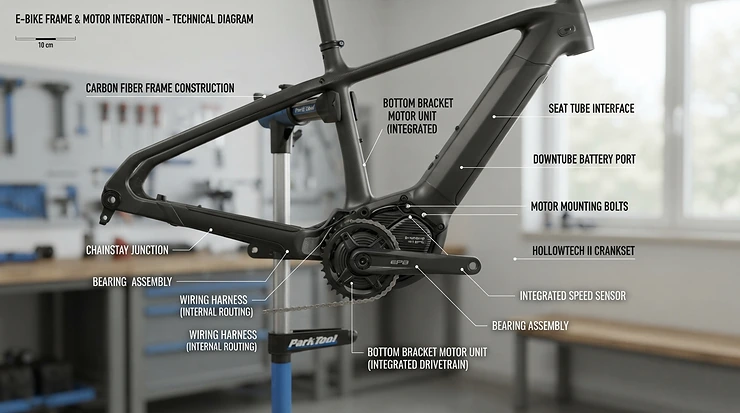
Electric Bike Review’s page on the Bafang BBS02, a review dated 2014 whose pricing is out of date, still explains what an e bike mid drive conversion kit changes. It fits 68 to 73 mm bottom brackets, not 100 mm fat-bike shells, and replaces the bottom bracket, cranks and chainring while the wheels, cassette and derailleur stay. A single front ring turns a 21-speed setup into a 7-speed. The reviewer called installation “not that difficult” with a crank puller and spanner wrench.
Cons from the same page: the kit cannot sense gear shifts, so it may grind gears and wear the chain and cassette faster, and it is louder than most hub motors. The battery is sold separately. A reseller’s spec sheet lists torque from 100 Nm up to 160 Nm across the kit line, from the 500 W model to the 1,000 W BBSHD. Bafang no longer sells the older UART-based BBS02 and BBSHD, a forum member reports, though controller boards remain available.
Rules on motor power and class vary by state, so check yours before choosing between 750 W and 1,000 W. A kit suits a rider with a good frame and a mechanical streak. The complete bikes above arrive with a maker standing behind the whole system, which a home build does not.
The lightest mid drive endurance electric road bikes, and what the weight costs
Cyclingnews’ roundup of lightweight e-bikes shows how far weight falls when torque and battery shrink. The Specialized Turbo Creo 2 weighs 12.28 kg in size L (about 27 pounds) with a 50 Nm motor and 320 Wh battery. The Trek Domane+ SLR 9 uses a TQ HPR50 mid-drive, weighs 11.8 kg (about 26 pounds) and carries 360 Wh, with a 28 mph limit in the US; the reviewer notes its battery is non-removable and its top specs expensive. The Canyon Endurace:ONfly SUB-10 starts from 9.6 kg with a 40 Nm TQ motor and 290 Wh.
Lightness does not guarantee a mid-drive. Cyclingnews lists the Van Rysel E-EDR and the Ribble CGR E as rear-hub bikes at 14 and 13.7 kg. Set against the Tenways AGO X, the mid-drive road bikes shed about 35 pounds but carry 40 to 50 Nm instead of 80 and 290 to 360 Wh instead of 504. They suit riders who want a road bike first and an e-bike second, which is a different buyer from the five above.
A battery label worth checking on any of these
The U.S. Consumer Product Safety Commission proposed a lithium-ion battery safety rule in the Federal Register. It would require e-bike electrical systems to meet UL 2849 with modifications and user-replaceable packs to meet UL 2271, adding tamper-resistant enclosures and a reverse polarity test. It is a proposal, not a final rule, and written comments closed August 24, 2026.
Certification data in the sources is uneven: Electric Bike Report’s spec fields for the Aventon Aventure M and Tenways AGO X were blank, Velowave states a UL 2271 battery, and ENGWE lists CE instead. Look for both UL marks on the listing, and ask the seller when they are missing.
Mid drive e-bike answers on hills, chains, range and conversions
❓ Are mid drive electric bikes better than hub motors for hills?
✅ Usually on long, steep climbs, because the motor works through your gears and keeps torque high at low speed. Hub bikes cost less and need less drivetrain care, and Pedego says the gap matters less than marketing suggests for most riders.
❓ How long does a chain last on a mid drive e-bike?
✅ Owner reports vary widely. One eMTB Forums member cites just under 2,000 miles from an original drivetrain, while an Electric Bike Review forum member reports about 4,000 miles on one chain. Easing off the pedals while shifting helps, and a shift sensor is useful.
❓ Can I add a mid drive conversion kit to my own bike?
✅ Often, if the bottom bracket matches. Electric Bike Review lists 68 to 73 mm for the BBS02, and the kit replaces the cranks and chainring. The battery is sold separately, and local rules on motor power vary by state.
❓ Do belt drive e-bikes work with mid drive motors?
✅ They can, but a belt-ready frame and an internally geared hub or gearbox are required because belts cannot run derailleurs. Road.cc warns some hub gearing may limit torque, so these bikes are usually premium, specialist builds.
❓ How far can a mid drive e-bike go on one charge?
✅ Tested figures here run from 31.5 to 110 miles on batteries of 504 to 733 Wh. Gentle assist stretched range between 1.6 and 3 times beyond the strongest setting. Treat maker claims as best-case numbers.
Matching the motor to the ride you actually take
Mid drive electric bikes reward riders who shift gears and climb, and they cost more in weight and drivetrain upkeep than a hub bike. For pavement and light gravel at the lowest weight, the Tenways AGO X is the safest start. The Himiway A7 Pro suits rough city streets where full suspension matters, the Aventon Aventure M fits riders who want fat tires and the longest Eco range, and the Velowave Forest SM gives M600 power and a throttle near $3,000 if you accept the whine. The ENGWE L20 3.0 Pro is the compact folding option, with certification worth confirming first.
Choose by weight and terrain before torque, then confirm stock and price on Amazon.com.
Disclaimer: This post contains affiliate links. As an Amazon Associate, I earn from qualifying purchases made through these links, at no additional cost to you.
At NextGenEBike, we are passionate about the future of mobility. Our team of experts provides in-depth reviews, comparisons, and buying guides on the latest electric bikes, ensuring you stay ahead in the world of eco-friendly transportation.
Home » Mid drive electric bikes: Which One Fits Your Ride? Among mid drive electric bikes in 2027, the Tenways AGO X is the one I’d try first. Electric Bike
Home » Mid drive electric bikes: Which One Fits Your Ride? Among mid drive electric bikes in 2027, the Tenways AGO X is the one I’d try first. Electric Bike
Home » Mid drive electric bikes: Which One Fits Your Ride? Among mid drive electric bikes in 2027, the Tenways AGO X is the one I’d try first. Electric Bike