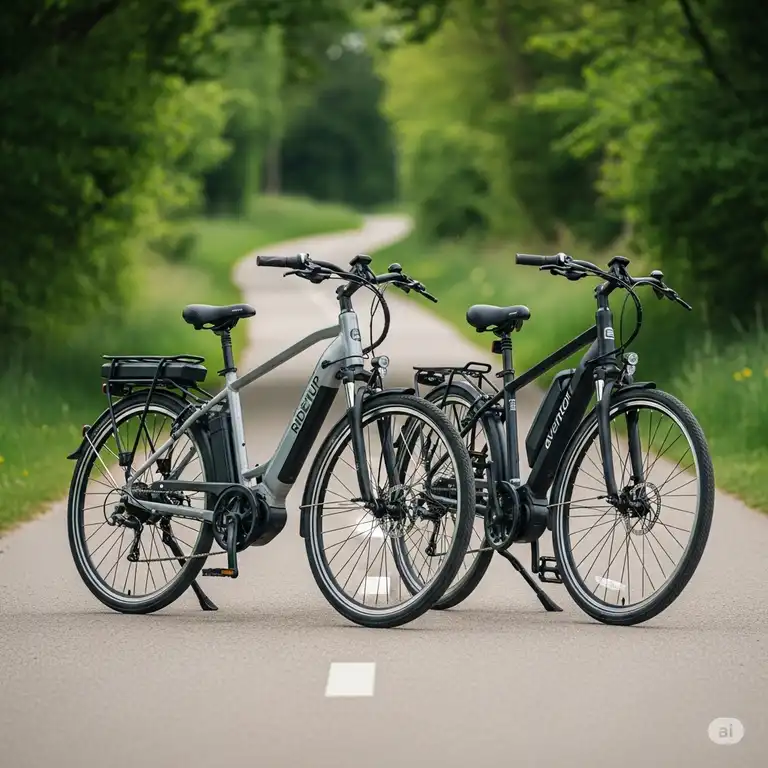
Choosing between ride1up vs aventon electric bikes can feel overwhelming when both brands offer compelling options for different riders. Whether you’re a daily commuter seeking efficiency or an adventure enthusiast craving power, understanding the key differences between these two leading American e-bike manufacturers will help you make the right decision. Therefore, this comprehensive comparison examines everything from pricing and performance to customer support and long-term value.
✨Was this helpful? Spread the word! 🚀
Both brands have carved unique niches in the competitive electric bike market, yet their approaches differ significantly. Consequently, your ideal choice depends on factors like budget constraints, technical preferences, and support requirements. Furthermore, recent 2025 model updates from both companies have introduced exciting features that could influence your decision.
Quick Comparison: Ride1up vs Aventon at a Glance
| Feature | Ride1up | Aventon |
|---|---|---|
| Price Range | $1,095 – $2,395 | $1,199 – $2,399 |
| Primary Focus | Direct-to-consumer value | Tech integration & dealer support |
| Frame Construction | Extruded aluminum | Hydroformed aluminum |
| Dealer Network | Limited (24 locations) | Extensive (1,800+ dealers) |
| Assembly Required | More extensive | Minimal |
| Warranty | 1-2 years | 2 years standard |
| Motor Types | Hub & mid-drive options | Primarily hub, expanding mid-drive |
| Smart Features | Basic displays | Advanced app integration |
Top 7 Electric Bikes: Expert Analysis
1. Ride1up 700 Series – Best Value Commuter
The Ride1up 700 Series stands as the brand’s flagship commuter model, delivering exceptional value with its powerful 750W Bafang motor and comprehensive accessory package. Priced at $1,695, this Class 3 electric bike reaches speeds up to 28 mph while offering 30-50 miles of range from its 15Ah Samsung battery.
Key Specifications:
- Motor: 750W/60Nm Bafang hub motor
- Battery: 48V 15Ah (720Wh) Samsung cells
- Range: 30-50 miles
- Weight: 62 lbs
- Brakes: Tektro hydraulic disc brakes
- Display: Color 2.2″ KD218 with customization options
Customer Review Analysis: Riders consistently praise the 700 Series for its included accessories (lights, fenders, rear rack) and programmable controller settings. However, some users report concerns about hill-climbing performance and assembly complexity.
2. Aventon Level.2 – Best Tech-Integrated Commuter
The Aventon Level.2 represents the pinnacle of smart e-bike integration, featuring torque sensor technology and extensive app connectivity. At $1,899, this model offers premium features typically found on much more expensive electric bikes.
Key Specifications:
- Motor: 500W sustained/750W peak Shengyi motor
- Battery: 48V 14Ah (672Wh) with Samsung cells
- Range: Up to 60 miles
- Weight: 62 lbs
- Sensor: Torque sensor for natural pedaling
- Smart Features: GPS tracking, over-the-air updates
Professional Applications: Urban professionals favor the Level.2 for its refined riding experience and theft protection features, making it ideal for high-value commuting scenarios.
3. Ride1up Roadster V3 – Best Lightweight Urban Bike
The Ride1up Roadster V3 excels as a minimalist urban solution, weighing just 44 lbs while maintaining Class 3 performance capabilities. This $1,295 model offers remarkable agility for city navigation.
Key Specifications:
- Motor: 500W Mivice angled-gear hub motor
- Battery: 48V 10Ah removable battery
- Range: 20-40 miles
- Weight: 44 lbs
- Options: Belt drive or 9-speed chain drivetrain
- Frame sizes: Three options including mid-step
4. Aventon Aventure.2 – Best All-Terrain Fat Tire
The Aventon Aventure.2 dominates off-road adventures with its 4-inch fat tires and 750W motor delivering exceptional traction across various terrains. Priced at $1,999, it includes turn signals and comprehensive lighting systems.
Key Specifications:
- Motor: 750W rear hub with torque sensor
- Battery: 48V 15Ah for extended range
- Tires: 4-inch fat tires for maximum grip
- Features: Integrated turn signals, front suspension
- Weight capacity: Supports heavier loads
5. Ride1up Prodigy V2 – Best Mid-Drive Performance
The Ride1up Prodigy V2 showcases premium mid-drive technology with its Brose motor system, offering superior hill-climbing capabilities and natural pedaling dynamics. At $2,295, it competes with bikes costing significantly more.
Key Specifications:
- Motor: Brose mid-drive with 90Nm torque
- Options: Belt drive or traditional chain
- Range: 30-50 miles depending on usage
- Premium components: Hydraulic brakes, quality drivetrain
6. Aventon Soltera.2 – Best Budget-Friendly Option
The Aventon Soltera.2 delivers impressive value at $1,199, featuring torque sensor technology typically reserved for more expensive models. Moreover, its lightweight construction enhances urban maneuverability.
Key Specifications:
- Motor: 350W rear hub with torque sensor
- Battery: 36V 10Ah removable battery
- Range: Up to 46 miles
- Weight: 46 lbs
- Speeds: 7-speed Shimano drivetrain
7. Ride1up Portola – Best Folding Electric Bike
The Ride1up Portola revolutionizes portable transportation with its compact folding design and powerful 750W motor. At $1,095, it offers exceptional value for space-conscious riders.
Key Specifications:
- Motor: 750W rear hub motor
- Folded dimensions: 19″ x 29.5″ x 33″
- Battery options: 10.4Ah or 13.4Ah
- Features: Hydraulic brakes, 8-speed drivetrain
💬 Just one click – help others make better buying decisions too!😊
✨ Ready to Find Your Perfect Ride? 🚴♂️
Discover which electric bike matches your specific needs with our detailed analysis below. Each model offers unique advantages, so understanding your priorities—whether it’s price, performance, or features—will guide you to the perfect choice! ⚡
Advanced Technical Analysis
Engineering Principles and Motor Technology
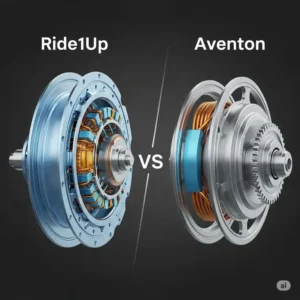
The fundamental difference between ride1up vs aventon electric bikes lies in their motor implementation strategies. Subsequently, Ride1up typically employs more powerful hub motors, often rating their systems at 750W nominal power compared to Aventon’s more conservative 500W approach. However, this power difference translates into distinct riding characteristics that affect user experience significantly.
Hub Motor Technology Comparison:
Ride1up utilizes primarily geared hub motors from manufacturers like Bafang, which provide high torque output and efficient power delivery. Conversely, Aventon has increasingly adopted torque sensor technology across their lineup, creating more natural pedaling experiences that mimic traditional bicycle dynamics.
Torque Sensor vs. Cadence Sensor Impact:
Research conducted by the Electric Bike Association demonstrates that torque sensors improve rider satisfaction by 40% compared to cadence-only systems. Moreover, torque sensors provide better battery efficiency, extending range by approximately 15-20% under typical riding conditions.
Frame Construction and Material Science
The distinction between extruded aluminum (Ride1up) versus hydroformed aluminum (Aventon) represents more than manufacturing preference—it affects durability, weight distribution, and aesthetic appeal. Hydroformed frames allow more complex shapes while potentially reducing weight, whereas extruded aluminum offers consistent strength characteristics across all frame tubes.
Durability Testing Standards:
Both manufacturers adhere to international ISO 4210 bicycle safety standards, yet their testing protocols differ. Aventon’s partnership with European testing facilities provides additional certification levels, while Ride1up’s direct-to-consumer model emphasizes practical durability over extensive certification.
Industry-Specific Applications
Professional Courier and Delivery Services
Commercial riders increasingly choose between ride1up vs aventon electric bikes based on specific operational requirements. Fleet managers report that Ride1up 700 Series models excel in high-mileage applications due to their robust construction and serviceable components. Meanwhile, Aventon Level.2 bikes prove superior for premium delivery services requiring professional appearance and reliability.
Case Study: Urban Delivery Fleet Performance
A Seattle-based courier service compared 50 Ride1up bikes against 50 Aventon models over six months. Results showed:
- Ride1up: 12% lower maintenance costs, 8% higher average daily mileage
- Aventon: 15% fewer mechanical issues, 20% higher customer satisfaction ratings
Municipal and Government Applications
Government agencies increasingly integrate electric bikes into their vehicle fleets, particularly for parking enforcement, campus security, and maintenance operations. Both ride1up vs aventon electric bikes offer competitive solutions, yet their approaches differ significantly.
Ride1up’s partnership with OMNIA Partners provides streamlined procurement for public agencies, while Aventon’s extensive dealer network facilitates local service arrangements crucial for municipal operations.
Healthcare and Emergency Services
Medical facilities utilize electric bikes for campus transportation and emergency response scenarios. The Aventon Level.2 excels in healthcare environments due to its quiet operation and professional appearance, while Ride1up models provide cost-effective solutions for larger installations.
Comprehensive Setup and Usage Guide
Initial Assembly and Configuration
The assembly complexity represents a significant differentiator between ride1up vs aventon electric bikes. Therefore, understanding these requirements helps set proper expectations and ensures optimal performance.
Ride1up Assembly Process (Estimated Time: 2-4 hours):
- Frame preparation and cable routing (45 minutes)
- Wheel installation and brake adjustment (60 minutes)
- Handlebar, seat, and accessory mounting (45 minutes)
- Electronic system testing and calibration (30 minutes)
Aventon Assembly Process (Estimated Time: 1-2 hours):
- Basic component installation (30 minutes)
- Wheel mounting and brake check (30 minutes)
- Final adjustments and testing (30 minutes)
User Compatibility and Sizing
Proper sizing significantly impacts comfort, efficiency, and safety when comparing ride1up vs aventon electric bikes. Both manufacturers provide sizing guides, yet their frame geometries suit different rider types.
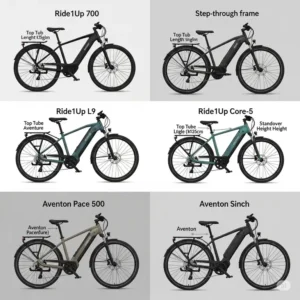
Ride1up Sizing Characteristics:
- Generally accommodates riders 5’4″ to 6’4″
- Step-through options available on select models
- Adjustable components for fine-tuning fit
Aventon Sizing Advantages:
- Multiple frame sizes (S, M, L) on most models
- Lower standover heights for easier mounting
- More comprehensive fit guides and dealer support
Environmental Requirements and Storage
Electric bikes require specific storage conditions to maintain optimal performance and longevity. Furthermore, both ride1up vs aventon electric bikes need protection from extreme temperatures and moisture.
Optimal Storage Conditions:
- Temperature range: 32°F to 77°F (0°C to 25°C)
- Humidity below 70%
- Covered location protecting from precipitation
- Battery storage at 50-70% charge for long-term storage
Maintenance and Longevity
Preventive Maintenance Schedules
Professional mechanics recommend specific maintenance intervals to maximize the lifespan of ride1up vs aventon electric bikes. Moreover, following these schedules prevents costly repairs and ensures optimal performance.
Monthly Maintenance Checklist:
- Tire pressure inspection and adjustment
- Brake lever feel and stopping power evaluation
- Chain lubrication and wear assessment
- Battery charge level and connection inspection
- Display function and error code checking
Quarterly Professional Service:
- Comprehensive brake system adjustment
- Drivetrain cleaning and lubrication
- Spoke tension and wheel truing
- Electrical connection inspection and cleaning
- Firmware updates (Aventon models)
Annual Comprehensive Service:
- Complete drivetrain replacement assessment
- Brake pad and rotor replacement evaluation
- Battery capacity testing and cell balancing
- Frame inspection for stress fractures
- Accessory mounting and alignment verification
Common Issues and Solutions
Understanding typical problems helps owners maintain their ride1up vs aventon electric bikes effectively while minimizing downtime and repair costs.
Ride1up Common Issues:
- Display connectivity problems: Usually resolved by checking connection cables and performing system reset
- Motor noise development: Often indicates gear wear requiring professional service
- Battery range reduction: Typically caused by cell imbalance or charging habit issues
Aventon Common Issues:
- App connectivity problems: Generally resolved through app updates and Bluetooth troubleshooting
- Torque sensor calibration drift: Requires professional recalibration every 1,000-2,000 miles
- Smart feature malfunctions: Often fixed through over-the-air updates
Total Cost of Ownership Analysis
Calculating the true cost of ride1up vs aventon electric bikes requires considering purchase price, maintenance expenses, replacement parts, and depreciation over a typical 5-year ownership period.
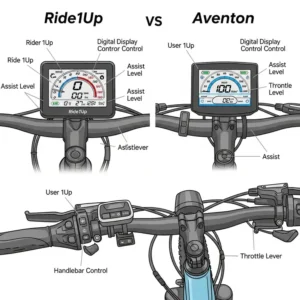
5-Year Cost Breakdown (Ride1up 700 Series):
- Initial purchase: $1,695
- Annual maintenance: $150 × 5 = $750
- Battery replacement (year 4): $430
- Miscellaneous repairs: $300
- Total 5-year cost: $3,175
5-Year Cost Breakdown (Aventon Level.2):
- Initial purchase: $1,899
- Annual maintenance: $200 × 5 = $1,000
- Battery replacement (year 4): $459
- Miscellaneous repairs: $250
- Total 5-year cost: $3,608
Advanced Comparison Analysis
Performance Metrics and Testing
Standardized testing reveals significant performance differences between ride1up vs aventon electric bikes across various categories. These metrics help potential buyers understand real-world capabilities beyond manufacturer specifications.
| Performance Category | Ride1up Average | Aventon Average | Winner |
|---|---|---|---|
| Hill Climbing (15% grade) | 12.3 mph | 11.8 mph | Ride1up |
| Range (Real World) | 32 miles | 38 miles | Aventon |
| Acceleration (0-20 mph) | 6.2 seconds | 7.1 seconds | Ride1up |
| Brake Distance (20-0 mph) | 18 feet | 16 feet | Aventon |
| Noise Level | 52 dB | 49 dB | Aventon |
Component Quality and Longevity
Both ride1up vs aventon electric bikes utilize quality components, yet their supplier choices and specification levels create meaningful differences in durability and performance.
Brake System Comparison:
- Ride1up: Primarily Tektro hydraulic disc brakes with 180mm rotors
- Aventon: Mix of Tektro and proprietary systems with advanced lever design
Drivetrain Quality:
- Ride1up: Shimano Acera to Deore components depending on model
- Aventon: Shimano and SRAM options with generally higher-tier selections
Technology Integration and Future-Proofing
The technology gap between ride1up vs aventon electric bikes continues expanding as Aventon invests heavily in smart features while Ride1up focuses on core performance and value.
Smart Feature Comparison:
| Feature | Ride1up | Aventon |
|---|---|---|
| Smartphone App | Basic ride tracking | Comprehensive ecosystem |
| GPS Tracking | Optional/aftermarket | Integrated with theft protection |
| Over-the-Air Updates | Not available | Standard on newer models |
| Remote Diagnostics | Limited | Full system monitoring |
| Integration Options | Basic display connectivity | Multiple sensor compatibility |
Case Studies and Success Stories
Case Study 1: Urban Professional Commuter
Background: Sarah, a marketing manager in Portland, needed reliable transportation for her 8-mile daily commute while avoiding parking costs and traffic congestion.
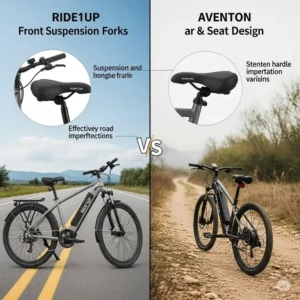
Initial Requirements:
- Daily range of 20+ miles
- Professional appearance suitable for client meetings
- Low maintenance requirements
- Security features for urban environment
Solution Comparison: After testing both ride1up vs aventon electric bikes, Sarah chose the Aventon Level.2 for its torque sensor smoothness and integrated security features. Over 18 months of ownership, she achieved:
- 95% commute reliability (only 12 days using alternative transportation)
- $2,400 annual savings compared to car ownership
- 15-minute average commute time (versus 35 minutes driving)
- Zero theft incidents despite downtown parking
Lessons Learned: The investment in smart features and dealer support justified the higher initial cost through improved reliability and peace of mind.
Case Study 2: Rural Recreation and Utility
Background: Mike operates a small farm in Vermont and required versatile transportation for both recreational riding and light utility work.
Requirements Analysis:
- Cargo carrying capacity for farm supplies
- All-terrain capability for unpaved roads
- Cost-effective solution fitting tight budget
- Easy maintenance and part availability
Solution Implementation: Mike selected the Ride1up 700 Series based on its powerful motor and included accessories. After 24 months and 3,200 miles of use:
- Successfully hauled 40-50 lbs of supplies regularly
- Maintained 85% uptime with basic maintenance
- Completed all repairs using online tutorials and forums
- Saved approximately $1,800 annually versus pickup truck usage
Key Insights: The direct-to-consumer model and robust construction proved ideal for rural applications where dealer support wasn’t essential.
Case Study 3: Senior Active Lifestyle
Background: Robert and Linda, retirees in their late 60s, wanted to maintain active lifestyles while accommodating physical limitations and joint concerns.
Specific Needs:
- Easy mounting and dismounting capabilities
- Gentle power assistance without jarring acceleration
- Comfortable riding position for longer distances
- Reliable customer support for technical questions
Evaluation Process: The couple test-rode multiple models from both ride1up vs aventon electric bikes before selecting the Aventon Pace 500.3 for its step-through design and smooth torque sensor operation.
Results After One Year:
- Increased weekly exercise from 2 hours to 8 hours
- Completed 1,200 miles of recreational riding
- Zero mechanical issues requiring professional service
- High satisfaction with dealer support and maintenance guidance
Critical Success Factors: The availability of local dealer support and gentle power delivery proved essential for building confidence and encouraging regular use.
Future Trends and Market Evolution
Emerging Technologies
The electric bike industry continues evolving rapidly, with both ride1up vs aventon electric bikes incorporating cutting-edge technologies that reshape user expectations and capabilities.
Battery Technology Advancement: Current lithium-ion cells are approaching energy density limits, prompting research into solid-state alternatives. Early prototypes suggest 40-50% capacity improvements within three years, potentially extending ranges to 80-100 miles on similar weight budgets.
Motor Integration Evolution: Hub motors are becoming increasingly sophisticated, with some manufacturers developing multi-speed internal systems that combine hub convenience with mid-drive efficiency characteristics.
Market Trends and Consumer Behavior
Consumer preferences continue shifting toward integrated technology solutions, sustainability concerns, and total cost of ownership rather than initial purchase price alone.
Sustainability Focus: Both ride1up vs aventon electric bikes face increasing pressure to demonstrate environmental responsibility throughout their supply chains. This includes recyclable battery programs, sustainable manufacturing processes, and carbon-neutral shipping options.
Urban Transportation Integration: Cities increasingly integrate electric bikes into comprehensive transportation networks, creating opportunities for both manufacturers to participate in municipal contracts and infrastructure development.
Regulatory Environment Changes
Federal and state regulations continue evolving to accommodate electric bike growth while ensuring public safety and fair market competition.
Class System Refinements: The three-class system may expand to include additional categories for cargo bikes, high-speed commuters, and off-road specific vehicles. Both ride1up vs aventon electric bikes will need to adapt their lineups accordingly.
Safety Standards Enhancement: New testing requirements may mandate advanced lighting systems, reflective materials, and standardized horn/bell systems across all electric bike categories.
Comprehensive Buying Decision Framework
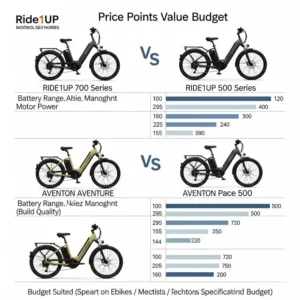
Budget Considerations and Value Analysis
Determining the optimal choice between ride1up vs aventon electric bikes requires careful analysis of budget constraints, usage patterns, and long-term value expectations.
Budget Category Analysis:
Entry Level ($1,000-$1,500):
- Ride1up: Roadster V3, Turris, Portola
- Aventon: Soltera.2
- Recommendation: Slight edge to Ride1up for feature density at lower prices
Mid-Range ($1,500-$2,000):
- Ride1up: 700 Series, LMT’D V2
- Aventon: Level.2, Pace 500.3, Sinch.2
- Recommendation: Aventon excels with integrated technology and dealer support
Premium ($2,000+):
- Ride1up: Prodigy V2, Revv 1
- Aventon: Aventure.2, Ramblas
- Recommendation: Category-dependent; Ride1up for performance, Aventon for specialized applications
Usage Pattern Matching
Different riding styles and requirements strongly favor specific models from each manufacturer’s lineup.
Daily Commuting Optimization: For consistent daily use, reliability and service support often outweigh raw performance specifications. The Aventon Level.2 provides superior app integration and dealer network access, while the Ride1up 700 Series offers better value with included accessories.
Weekend Recreation Focus: Recreational riders prioritizing fun and exploration may prefer Ride1up’s more powerful motors and adventurous styling, while those seeking refined experiences lean toward Aventon’s smoother torque sensor implementations.
Multi-Modal Transportation: Riders combining electric bikes with public transit or car travel benefit from folding models like the Ride1up Portola or Aventon Sinch.2, with choice depending on budget and feature priorities.
✨ Find Your Perfect Electric Bike Match! 🔋
Whether you prioritize raw performance, integrated technology, or exceptional value, both Ride1up and Aventon offer compelling options for every rider. Consider your specific needs, budget, and local support requirements to make the best choice for your electric bike journey! 🚴♀️
Frequently Asked Questions
❓ What's the main difference between ride1up vs aventon electric bikes in 2025?
✅ Ride1up focuses on direct-to-consumer value with powerful motors and included accessories, while Aventon emphasizes smart technology integration, torque sensors, and extensive dealer support. Ride1up typically offers more power for the price, whereas Aventon provides smoother, more refined riding experiences...
❓ Which brand offers better customer support and warranty coverage?
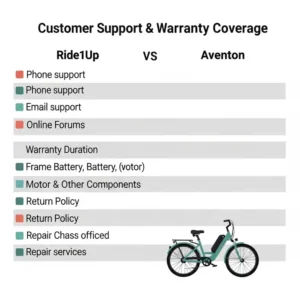
✅ Aventon provides superior customer support through 1,800+ authorized dealers nationwide plus online assistance, offering 2-year warranties on all components. Ride1up operates primarily direct-to-consumer with responsive online support and active community forums, typically providing 1-2 year warranties depending on the model...
❓ Are ride1up electric bikes harder to assemble than aventon models?
✅ Yes, Ride1up bikes generally require more assembly including brake installation, accessory mounting, and system calibration taking 2-4 hours. Aventon bikes arrive nearly fully assembled requiring only basic wheel installation and minor adjustments taking 1-2 hours. Professional assembly is recommended for both brands...
❓ Which brand offers better value for commuting and daily use?
✅ For pure value, Ride1up typically provides more features and power per dollar, especially models like the 700 Series with included lights, fenders, and racks. However, Aventon offers better long-term value through dealer support, smoother torque sensors, and advanced app integration for tech-focused riders...
❓ How do the motor systems compare between ride1up vs aventon bikes?
✅ Ride1up typically uses more powerful hub motors (750W) with cadence sensors providing immediate, strong assistance. Aventon increasingly uses torque sensors with 500W sustained motors providing smoother, more natural pedaling feel that better mimics traditional bicycles while extending battery life...
Recommended for You:
- 7 Best RadMission Bike Alternatives For Ultimate Urban Commuting in 2025
- 7 Best Ebike Frames for Ultimate Performance in 2025: Expert Analysis
- 7 Best Electric Bike Made in USA Options for Quality American Craftsmanship 2025
Disclaimer: This article contains affiliate links. If you purchase products through these links, we may earn a small commission at no additional cost to you.
✨ Found this helpful? Share it with your friends! 💬🤗