As an Amazon Associate I earn from qualifying purchases. Links in this article may be affiliate links. How we choose gear
A pair of cycling glasses earns its place when three things line up: a lens suited to the light you ride in, arms that stay put under a helmet, and enough wrap to keep wind and grit out. This 2027 guide takes those decisions in the order that avoids returns, then checks four real pairs against them: the Tifosi Sledge Lite, the 100% S2, the Oakley Radar EV Path and the Tifosi Tyrant 2.0 Fototec.
The findings rest on tester pages from OutdoorGearLab, Cyclingnews, Cycling Weekly and Road Bike Rider, retailer review sections and one long forum thread. No pair was worn for this guide, so every comment on feel belongs to a named reviewer. Prices appear as ranges, and the current price on Amazon.com may differ.
For a short answer, the best cycling glasses for you are the ones that suit your face width first, your usual light second and your budget third. OutdoorGearLab’s cycling sunglasses tests back that order: its scoring gives coverage, fit and lens quality 20 percent each, with field performance at 25 percent and frame quality at 15.
The method: lens, fit, helmet and fog, then price
Work through these in order, because each one narrows the next.
- Decide whether a dedicated pair is worth it. The cycling glasses vs sunglasses gap is about coverage, retention and impact marking, not only tint.
- Match the lens to your light: fixed tint, photochromic, mirror or clear.
- Size by head width, then test cycling glasses under or over straps with your own helmet buckled.
- Check the daily-use problems reviewers keep raising: fog, dust, scratches and lens swaps.
- Set the budget last. Cyclingnews says cheap pairs can do the basics well, and that premium ones mainly add adjustability, field of view, build quality and optical clarity.
Each step has its own section below, and the four pairs at the end show how the trade-offs land in real products.
Cycling glasses vs sunglasses: what the standards and the testers say
Two US standards sit behind most labels. ANSI’s eyewear standards post explains that ANSI Z80.3 covers non-prescription sunglasses and fashion eyewear, including optical clarity, UV protection, light transmittance, traffic-signal recognition and the durability of lenses and frames. ANSI/ISEA Z87.1 is the occupational and educational protective-eyewear standard, which tests impact resistance, coverage and optical quality. Products that meet it carry a Z87 or Z87+ mark, and the plus signals high-impact compliance.
So a sunglasses label tells you about UV and basic durability, while a Z87+ mark tells you about impact. They are separate claims, and a pair can make one without the other. None of the listings and reviews opened for the four pairs below mentions a Z87+ mark; they describe polycarbonate lenses and UV protection, and Oakley’s retailer text refers to high-mass and high-velocity testing without naming a standard. If a certified impact rating matters to you, ask the maker.
Testers care about more than certification. OutdoorGearLab describes cycling shades as built for airflow, debris protection, glare reduction and sweat management, and it weights coverage and fit as heavily as lens quality. Everyday sunglasses can handle UV on an easy spin. The case for a dedicated pair grows with speed, distance and dust, since those are the conditions a flat fashion frame was not shaped for (our reading of the scoring criteria, not a test result).
Tint, photochromic or polarized: matching the lens to your light
Cyclingnews’ how-to-choose section sorts lenses into tinted, photochromic and clear. Red and orange base tints add contrast in low light, a reflective outer coating helps in bright sun, and clear is the only sensible choice at night. UV blocking is a separate matter: the guide says sunglasses must block UVA and UVB by law and that a darker lens does not mean more UV protection, so the maker’s spec sheet is where to check.
Photochromic lenses split the testers. The Cyclingnews author is not convinced; they suit overcast spring and autumn rides, commuting and winter, but cannot react fast enough for dramatic changes in light. OutdoorGearLab leans the other way. It recommends photochromic for rides that run from dawn to dusk and a fixed tint for steady conditions, and its three highest-scoring pairs (the Smith Wildcat, Roka SR-1X and Smith Pursuit) all use photochromic lenses.
Polarized lenses get the firmest warning. Cyclingnews does not recommend them for riding, because they can reduce your ability to notice surface water, and a puddle at speed is an avoidable surprise.
A workable rule from the two sources: choose a fixed tint if your rides happen at one time of day, photochromic if they span changing light, and keep a clear lens for dusk and night.
Cycling glasses with mirror lenses: bright-sun help, fingerprint cost
A mirror is a reflective coating on the outside of the lens. Cyclingnews says it helps in bright sun and names HiPER Silver Mirror as one example. Sigma Sports lists the 100% S2 with that lens at 14 percent visible light transmission, a bright-sun figure. The Soft Gold Mirror lens OutdoorGearLab tested worked in bright to medium light, though 100% publishes no transmission number for it.
Upkeep is the cost. OutdoorGearLab notes that mirror finishes show smudges and fingerprints on the Smith Wildcat and Julbo Edge, and Cycling Weekly’s tester said the S2’s lens got mucky quickly despite its water-and-oil coating. That review dates from December 2018, so current lens coatings may differ.
A bright-sun mirror is also too dark for dim conditions, which is why Cycling Weekly mentions the clear lens in the box for dark morning rides. Check that a spare clear lens comes with any mirrored pair you consider.
Cycling glasses for men and larger faces: size by head width, not by label
Shopping for cycling glasses for men mostly comes down to head width, and the tester notes opened for this guide sort fit by face and head size rather than by a men’s or women’s label. OutdoorGearLab says larger heads tend to sit better in the 100% S2, the 100% Glendale and the Shimano Technium Ridescape OR, while smaller faces may prefer the Roka SR-1X or Julbo Edge. Road Bike Rider’s tester had the opposite problem with the Tifosi Sledge Lite. Its frame is designed for large to XL faces, and on her small, narrow face it fit but looked oversized.
Sources disagree on the S2. OutdoorGearLab groups it with pairs for bigger heads, while a RoadBikeReview tester found it fits narrower faces and may be tight on larger ones, and Cycling Weekly’s slim-faced tester found it comfortable. With a split like that, return terms matter more than any single review.
Cyclingnews adds two fit points. Frameless glasses are less rigid, so they grip the temples less securely, which matters most on small heads, and half-frames add rigidity with little bulk. Helmet clash is the other variable.
Cycling glasses under or over straps: what riders and testers report
Road convention puts the arms over the helmet straps. Brujula Bike’s explainer gives the reasons: the arms slide on faster from outside while you ride, and on most helmets the straps sit close to the face, which the author considers safer. The same article admits that no scientific study settles the question, so the habit rests on rider experience.
A Bike Forums thread, likely from 2021, shows the habit meeting a real helmet. The original poster, who had always worn Oakley Radar Path frames over the straps, found that on a new Specialized Prevail II MIPS in size large the front straps sat about 1.5 cm from the head. The arms pressed the straps inward and the straps pushed back whenever the jaw dropped.
Replies split. Some riders say over-strap arms can whistle in the wind and stop the straps from being cinched properly. Others, especially prescription wearers, prefer under so the glasses stay put when the helmet comes off. Several blame strap anchor placement, and one asks for evidence that either position affects safety. All of it is anecdote, not testing.
OutdoorGearLab adds hardware-specific notes: the earpieces of the Tifosi Moab can interfere with some helmet retention systems, and the stiff arms of the Shimano Technium Ridescape OR may not sit well on every helmet. Cyclingnews says arms can clash with some helmet cradles, naming the 100% S3 as one example, though its flat profile makes it less of a problem.
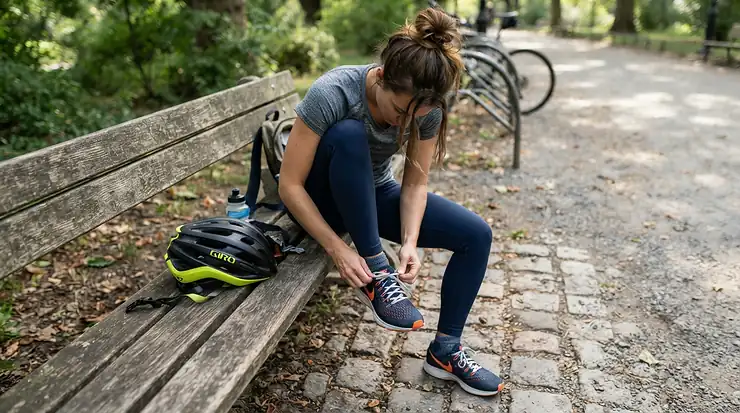
A fair method: buckle and adjust the helmet first, since helmet fit comes before eyewear, then try the arms both ways. Keep the position that leaves the straps untouched, puts no pressure on the temples and stays quiet at speed.
Fog, scratches and lens swaps: the daily-use problems
Ventilation decides fog, and it trades against dust. OutdoorGearLab rates the 100% S2 best for fog, crediting an off-face fit and air scoops along the bottom of the lens. It also credits the vents on the Oakley Radar EV Path and the small lens vents on the Shimano Technium Ridescape OR, and it flags the original Tifosi Sledge and the Tifosi Rail as weaker, with fogging when you stop. The cost of that airflow is dust, which the testers raise for the S2 in off-road group riding. Cyclingnews makes a related point: a lens that sits further from the face resists fogging, as on the POC Elicit and Smith Wildcat.
Lens swaps are the second complaint. OutdoorGearLab calls swaps difficult on the original Tifosi Sledge, the Oakley Radar EV Path and the Oakley Encoder, while Cyclingnews calls the Radar swap pretty easy. A reader comment on Road Bike Rider says one owner could not change the lenses on a Sledge Lite even after watching the maker’s video. That is a single report, but it matches the pattern. If you plan to carry several tints, ask about return terms or try a swap in a shop.
Scratches come third. All About Vision calls polycarbonate the preferred lens material for safety eyewear because it weighs less than half as much as glass and resists impact better, yet it scratches more easily even with a coating. Road Bike Rider readers show both sides: one says he replaces his Tifosi lenses yearly, another reports 10 to 12 years of use without problems. Impact rating and scratch resistance are separate properties, so a tough lens can still need a soft pouch.
How a pair ends up in the returns box
Buying by label is the first route. A frame built for large to XL faces will fit a small head loosely, and a narrow one will pinch a wide head, so measure before you trust a size name.
Next comes one dark lens for every ride. A bright-sun mirror or a heavy tint is the wrong tool at dawn, and the fix is a clear spare or a photochromic lens, depending on your rides.
Prescription needs get forgotten until after the order. The 100% S2 listing at Bikebug mentions a 100% RX insert in a large size, Oakley retailer pages mention Oakley Authentic Prescription Lenses for the Oakley Radar EV Path, and a Leisure Lakes listing for the Tifosi Tyrant 2.0 Fototec says direct-fit Rx compatibility. Your optician can say which of these suits your prescription.
Last is paying for features you will not use. Premium pairs buy better adjustability and optics, per Cyclingnews, but a budget pair with three lenses can cover a lot. When you read cycling glasses reviews, start with the middling ratings, since fit and swap complaints tend to cluster there.
Best cycling glasses for each problem: four pairs against the method
Across the cycling glasses reviews opened here, optics draw praise while fit, fog and lens swaps draw the disagreement, so each entry below spends its words on those points.
| Model | Lens setup | Weight reported | Fit per testers and listings | Retailer price range |
|---|---|---|---|---|
| Tifosi Sledge Lite | Three polycarbonate lenses, including clear and AC Red | 35.5 g | Large to XL faces | About $70 to $80 |
| 100% S2 | One mirror or HiPER lens plus a clear spare | About 32 g with lens | Disputed: narrow faces per two testers, larger heads per OutdoorGearLab | Roughly $130 to $230 |
| Oakley Radar EV Path | One Prizm or other lens; extra lenses sold separately | 28 to 29 g | Heavy wrap, shallow lens | Roughly $190 to $300 |
| Tifosi Tyrant 2.0 Fototec | One photochromic lens | About 24 g | Medium and small | Around $80 where listed |
Weight barely separates these, since all four sit between roughly 24 and 36 grams. The real splits are lens strategy (three swappable lenses against one that adapts) and face size, which is why the two Tifosi pairs sit at opposite ends of the fit range. Prices overlap less: the Tifosi Sledge Lite and Tifosi Tyrant 2.0 Fototec cost a fraction of the other two.
1. Tifosi Sledge Lite — three lenses for large faces
Large faces and small budgets meet here. Road Bike Rider reports that Tifosi added this semi-rimless version of the Sledge in spring 2021, selling for $69.95 with three lenses and $79.95 with the hydrophobic Clarion lens set. Its tester scored it four stars, liked the wide shield, four browline vents, adjustable nose pads and earpieces, and noted a 35.5 g weight. She also said it suits large to XL faces rather than small or medium ones, and that a rear-view mirror does not fit its arm.
The fog and lens-swap evidence comes mostly from the original Tifosi Sledge, not the Lite. OutdoorGearLab found three good lenses and good dust protection on that model, but difficult swaps and fogging when stopped, and Road Bike Rider’s reader comments include one owner who could not swap the Lite’s lenses at all. Reader reports are individual, so treat them as a prompt to check return terms.
Retailer pages show it between about $70 and $80, with the Clarion-lens version at the top of that range.
2. 100% S2 — mirror lens and strong fog control
Lack of fit adjustment is one complaint testers raise about the 100% S2, and it is worth knowing before you read the praise. OutdoorGearLab scored it 78 and named it best for fog, crediting its off-face fit and bottom air scoops, but noted dust can enter through that airflow. The retailer listing at Bikebug describes a polycarbonate lens with UV400 protection, a 5.5-base cylindrical shield, a clear spare lens and an alternative nose pad in the box.
Cycling Weekly’s 2018 review adds that its tester found the fit good on a slim face, saw fog only while stationary, and recommended the HiPER lens version, though the lens got mucky quickly. RoadBikeReview’s tester also liked it on narrower faces and said it may be tight on larger ones, which contradicts OutdoorGearLab’s view that bigger heads fit it well. These cycling glasses with mirror lenses cost roughly $130 to $230 at retailers, depending on lens and sale timing.
Pros:
- Best fog record in OutdoorGearLab’s test, thanks to bottom air scoops
- Clear spare lens and alternative nose pad come in the box, per the Bikebug listing
Cons:
- No fit adjustment, per OutdoorGearLab
- Airflow lets dust in during off-road group rides
3. Oakley Radar EV Path — Prizm optics and a grippy wrap
Testers disagree on two things about the Oakley Radar EV Path: fog and lens swaps. Cyclingnews gave it 84 percent, said the swap is pretty easy and warned that the brow sits close to the face, which can trap perspiration and fog the lens. OutdoorGearLab scored it 78, praised vents that resist fogging and strong hinges, and called swaps difficult. Neither side is wrong so much as differently tested, and you should expect some variation by lens and face shape.
Fit earns the better notes. Cyclingnews says the rubberized arms grip helmet vents and never interfered with a helmet cradle, and it describes the shallow, heavily wrapped lens as giving less field of view than big monolens glasses, scoring that area 6 out of 10. Its author owned a pair for years and eventually replaced the arm grippers. Road.cc’s tester recorded a weight of 28 g, and a retailer listing for a Trail Torch version says 29 g.
Retailer prices on Cyclingnews’ page span roughly $190 to $300, and Cyclingnews notes that replacement lenses run under £100 each, so a second tint adds noticeably to the total.
4. Tifosi Tyrant 2.0 Fototec — photochromic lens for smaller faces
Changing light is the problem this pair addresses, with a single photochromic lens in place of a swap set. Retailer pages describe a half frame in Grilamid TR90 nylon, about 24 g, in medium and small fit, with adjustable nose and ear pads and a bag and case. One listing gives light transmission of 28 to 76 percent for the Light Night version, and Trisports lists 100 percent UVA and UVB protection. Bike Tires Direct shows about $80, though that page and a European retailer list it as out of stock, so confirm availability on Amazon.com.
Reviews skew positive. Bike Tires Direct shows 17 reviews, 13 of them five-star, and one buyer there says they keep coming back to the pair across several purchases. Trisports reviewers praise not having to swap lenses mid-ride and one found the darkening fine on a moderately sunny day. Cyclingnews cautions that photochromic lenses react too slowly for sharp changes in light.
Pros:
- One lens for dawn-to-dusk rides, so no swapping
- About 24 g, with a small and medium fit
Cons:
- A single lens with no clear spare in the listings opened
- Photochromic reaction can lag in sudden light changes, per Cyclingnews
Check current availability on Amazon.com before you decide.
Mirrors, polarizing, straps and fog: quick answers
Are cycling glasses really better than regular sunglasses?
Do cycling glasses go over or under helmet straps?
Are polarized lenses a good idea for cycling?
Do mirror lenses help in bright sun?
How do I stop cycling glasses from fogging?
Which cycling glasses to start with
Start with face width. Large-to-XL faces and tight budgets point to the Tifosi Sledge Lite. Smaller faces that want one lens for changing light point to the Tifosi Tyrant 2.0 Fototec. Riders after a mirror lens and the best fog record in OutdoorGearLab’s tests can try the 100% S2 while checking return terms, and the Oakley Radar EV Path suits those who value Prizm optics and a grippy wrap and accept the mixed reports on fog and lens swaps.
Whichever you choose, buckle your helmet and test the arms both over and under the straps, and keep a clear lens for dusk. Cycling glasses are cheap to get right once you size them by head, light and helmet, and costly to return when you choose by label. Check current availability on Amazon.com and compare the exact lens version before ordering.
Recommended for You
- Ebike battery bag: A Practical Guide (2027)
- E bike brake pads: A Practical Guide (2027)
- Ebike storage racks: A Practical Garage Guide (2027)
Disclaimer: This post contains affiliate links. As an Amazon Associate, we earn from qualifying purchases made through these links, at no additional cost to you.
Measure your face width, test the straps with your helmet, then let your usual light choose the lens.